
Greater Cleveland
Chimney Leak Repair & Waterproofing in Cleveland, OH
Finding where the water actually gets in — crown, cap, flashing, masonry or condensation — and fixing that, not caulking symptoms.
A leaking chimney is a symptom with at least five different causes, and fixing the wrong one is why so many chimney leaks come back. Water can enter through a cracked crown, a missing or undersized cap, failed flashing where the chimney meets the roof, saturated porous masonry, or condensation forming inside an oversized flue. Each of those has a different repair, and none of them is solved by sealant on whatever surface was easiest to reach. Our leak work starts with diagnosis at roof level and inside the house, so the fix targets the actual entry point.
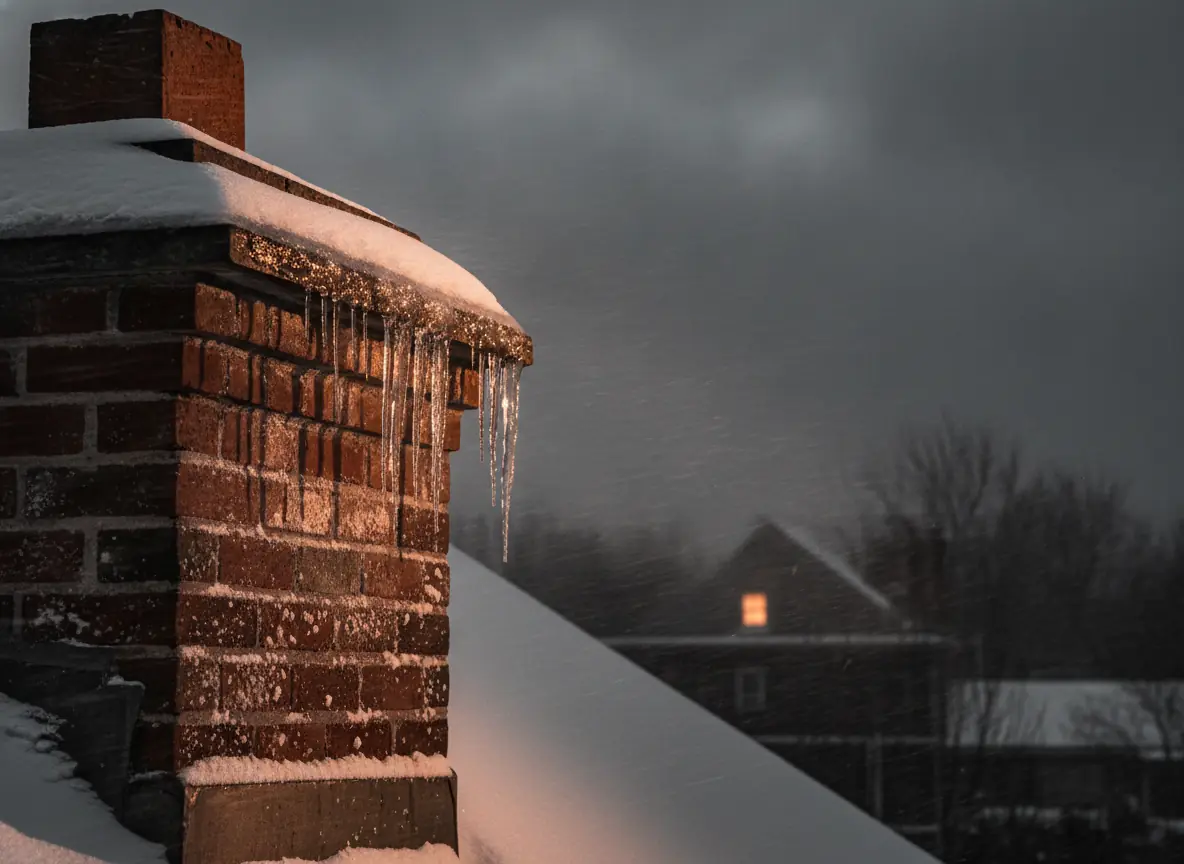
In Greater Cleveland, water is also what kills chimneys over the long run, because every trapped drop becomes a wedge the next time the temperature drops. That makes leak repair double as prevention. A sound crown, a proper cap, tight flashing and, where the masonry is genuinely porous, a vapor-permeable repellent are the difference between a chimney that needs pointing every couple of decades and one that quietly comes apart. Ceiling stains near the chimney, damp patches after a driven rain, and a musty fireplace smell in July are all the same message.
The five ways water gets into a chimney
Every chimney leak comes down to one or more of these. The diagnosis is figuring out which, and the honest ones are often a combination.
The crown
The slab that seals the top of the stack around the flue tiles. Most crowns on older Cleveland chimneys were struck flat out of leftover mortar on the day the chimney was finished, with no overhang and no expansion gap around the tile. Mortar is not a weatherproofing material and it cracks, usually radially from the flue outward, and once it does the crown is delivering water directly into the top of the brickwork. This is the single most common source of a chimney leak in this market.
The cap, or its absence
An uncapped flue is an open pipe pointed at the sky. Every rain puts water straight down inside it, onto the smoke shelf, into the firebox, and onto whatever masonry it touches on the way. A surprising number of chimneys in Greater Cleveland have never had a cap. Undersized or poorly fitted caps and rusted-through caps produce the same result more slowly.
Flashing
Where the chimney passes through the roof plane, the seal is made by step flashing woven into the shingle courses and counterflashing let into the mortar joints above it. Both parts have to be right. What we find instead, constantly, is a bead of roofing cement smeared over the joint by someone in a hurry, which lasts a couple of seasons and then cracks. Flashing is the classic leak nobody owns, because it is the exact point where the roofing trade and the masonry trade meet.
Porous or open masonry
Brick and mortar absorb water by design. When the joints have opened up or the brick faces have spalled, the absorption stops being harmless. On a wind-driven rain, water can be pushed into the wall of a stack faster than it can dry, travel through the masonry, and appear inside the house. This is the leak that only shows up in certain weather, which is what makes it confusing.
Condensation, which is not a leak at all
Sometimes the water inside the chimney was never rain. An oversized flue serving a modern appliance runs below its exhaust dew point and condenses moisture on its own walls, which runs down and appears as dampness at the base. The give-away is that it correlates with cold weather and appliance run time rather than with rain. Sealing the outside of that chimney does nothing, which is why condensation is one of the more commonly mis-diagnosed conditions in the trade.
How we find which one it is
The diagnosis is systematic, because guessing is what produces repeat leaks. We start with what you can tell us: where the stain is, whether it appears in every rain or only in wind-driven rain, whether it correlates with snow melt, whether it started after a roof was done. That pattern narrows the list before anyone gets on a ladder. Sustained rain of any direction points at flashing or crown. Only wind-driven rain from one direction points at masonry on the weather face. Cold weather with no rain points at condensation. Snow melt at the roofline points at ice damming interacting with the flashing.
Then it is roof level: crown photographed and examined for cracks and for whether it has any overhang at all, cap condition and fit, flue tile terminations, flashing and counterflashing inspected at the joint rather than from six feet away, and the masonry faces looked over for open joints and spalling with attention to the side the weather comes from. Inside, the firebox, smoke chamber and damper get checked for water staining, rust and damp, and the ceiling or wall stain gets traced back to where it plausibly originates rather than where it appears.
You get the photographs, and the diagnosis explains itself. That matters more here than on almost any other chimney job, because leak repair is the area of this trade where guesswork is most often sold as expertise.
The fixes, matched to the cause
- Cracked but structurally sound crown: a flexible elastomeric crown coating bridges the crazing and seals it for years.
- Failed or never-adequate crown: a full recast in reinforced concrete, with a drip edge overhanging the brick and an expansion joint around the flue tile so thermal movement does not crack it again.
- No cap or a failed cap: a stainless cap sized and anchored to the flue, with screen. This one repair often ends the leak entirely.
- Failed flashing: proper step flashing and counterflashing reset into a cut reglet in the mortar joint, not sealant over the old work. Where the roof is at the end of its life, this gets coordinated with the roofing rather than done twice.
- Open joints and spalled brick on the weather face: repointing and unit replacement, because a repellent over open joints is a waste of a product.
- Genuinely porous but sound masonry: a vapor-permeable siloxane-type water repellent that sheds driven rain while letting the wall dry outward.
- Condensation in an oversized flue: correctly sized liner, which is a relining job rather than a waterproofing one.
- A wide chimney with no cricket on the up-slope side: a cricket, the small saddle roof that diverts water and snow around the stack instead of letting it pool against it.
Why sealing the whole chimney is usually a mistake
The instinct when a masonry chimney leaks is to coat it, and the products that come to hand at a hardware store are mostly film-forming: acrylic sealers, masonry paint, silicone. In a freeze-thaw climate these do real damage. Brick and mortar have to be able to release moisture outward. A film-forming coating stops that while doing nothing about the water arriving from the crown or the flashing, so the moisture that gets in stays in — and every freeze then works on masonry that cannot dry. Painted and sealed chimneys spall spectacularly, and the damage shows up across the whole face rather than at one entry point.
Where a repellent is genuinely appropriate, the product class matters: silane and siloxane repellents penetrate and repel liquid water while remaining vapor permeable, so the wall still breathes. And it is applied after the joints are sound, never as a substitute for pointing them. A repellent is a raincoat, not a roof, and it will never fix a crown or a piece of flashing.
Lake Erie weather and what it does to the weather face
Wind-driven rain is the local variable that catches people out. Rain falling straight down mostly runs off a vertical brick face. Rain driven at a wall by thirty miles an hour of wind off the lake is pushed into it, and a masonry wall's ability to resist that is a function of its joints. This is why so many chimney leaks in Rocky River, Westlake, Lakewood and the lakefront stretch of Euclid appear only in storms from one particular direction, and why the weather-facing side of a stack is frequently in visibly worse condition than the sheltered side of the same chimney.
The second local factor is duration. Lake-effect conditions keep masonry wet for days rather than hours, so there is far less drying time between wetting events than the same chimney would get in a drier climate. Water that never fully leaves the wall is water available to freeze. That is the whole reason water management on a chimney matters more here than the average national advice suggests.
What drives the cost of leak work
- The diagnosis versus the repair. Finding the entry point is a defined piece of work; the fix depends entirely on what the finding is, which is why an honest quote for 'a chimney leak' cannot be given over the phone.
- Which component failed. A cap is a small job. A full crown recast is a bigger one. A complete re-flash with the roofing coordinated is bigger again.
- Roof access, pitch and material, as with all chimney work.
- Whether more than one entry point is active — which is common, because the conditions that kill a crown also kill flashing of the same age.
- How much interior damage there is. We do the chimney; drywall, plaster and framing repair inside is separate work and we will say so plainly rather than quietly including it.
- Whether the masonry needs pointing before any repellent is worth applying.
What water does if the leak is left
The stain on the ceiling is the least of it. Once water has an established route into a chimney, three things happen in parallel. The masonry deteriorates faster, because every wet freeze widens the path the water is already using. The framing around the chimney takes moisture it was never designed to take, and rot in a concealed chase around a chimney is both slow and expensive to find. And inside the flue, water attacks mortar joints between the flue tiles, so a water problem at the top becomes a liner problem in the middle.
There is a fourth, less obvious one: a chimney with water in it smells. The musty odour that shows up in a fireplace in warm weather is damp deposits, and it is a reliable early sign of a water path that has not yet produced a visible stain. Leak repairs sit near the top of the fix-this-season list, not because a small stain is an emergency, but because the path is established and Cleveland winters are very good at widening established paths.
How we handle a leaking chimney
- Roof-level diagnosis: crown, cap, flashing, masonry and shoulder — photographed
- Interior check: firebox, smoke chamber and damper for staining, rust and damp
- Flashing repair or a full re-flash where the roofline seal has failed
- Crown repair or full recast with a drip edge and an expansion joint at the flue
- Vapor-permeable masonry repellent on porous brick — never paint or film-forming sealers
- An honest call on whether the 'leak' is actually flue condensation
- The fix in writing, matched to the diagnosed entry point
Our work
Chimney Leak Repair & Waterproofing, photographed on the job
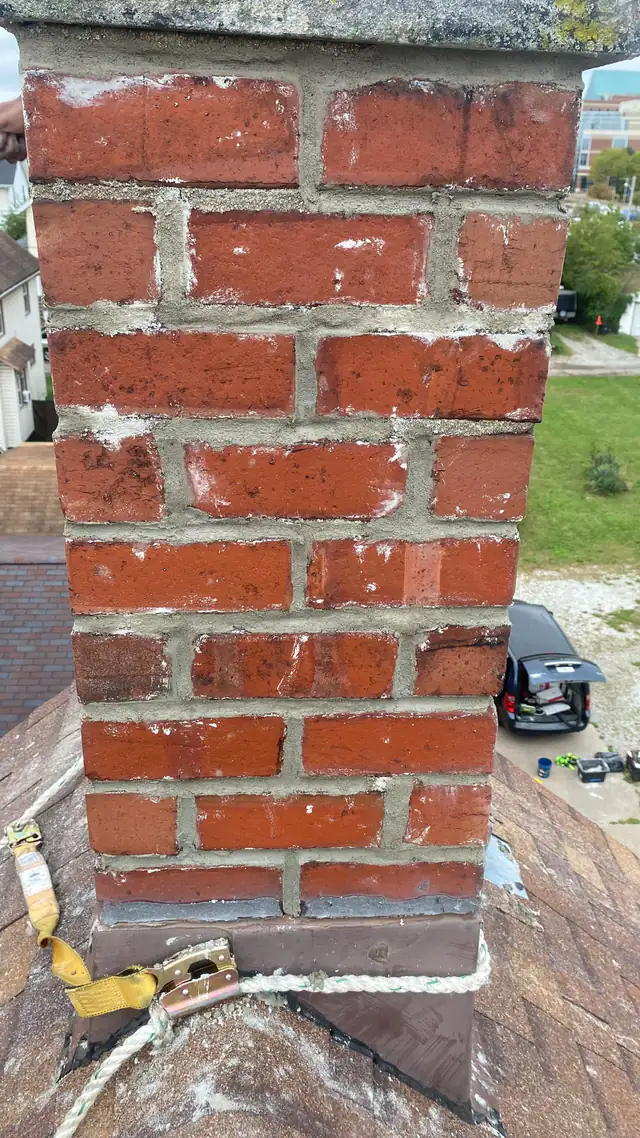
Roped in on a steep roof — repointed, flashing sealed 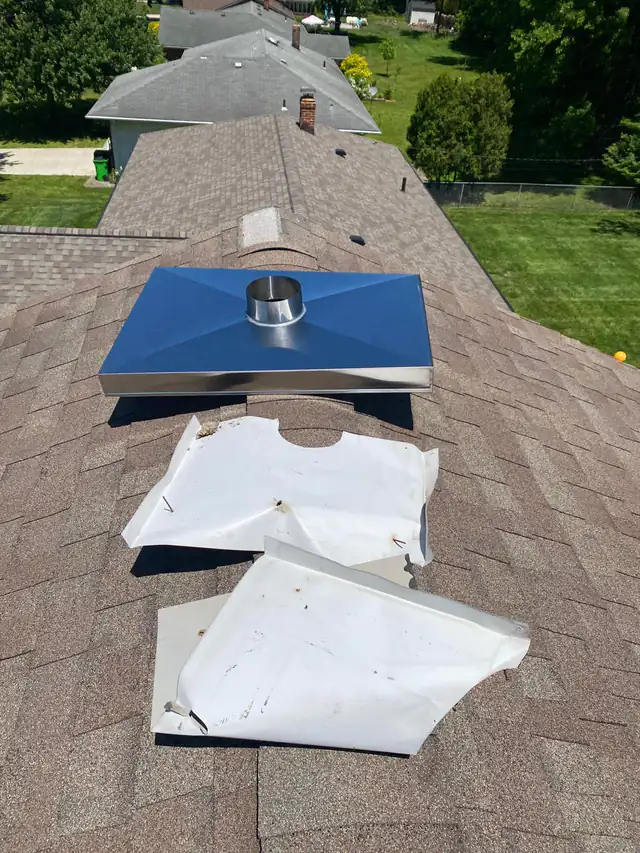
Replacement chase cover beside the removed cover sections on the roof 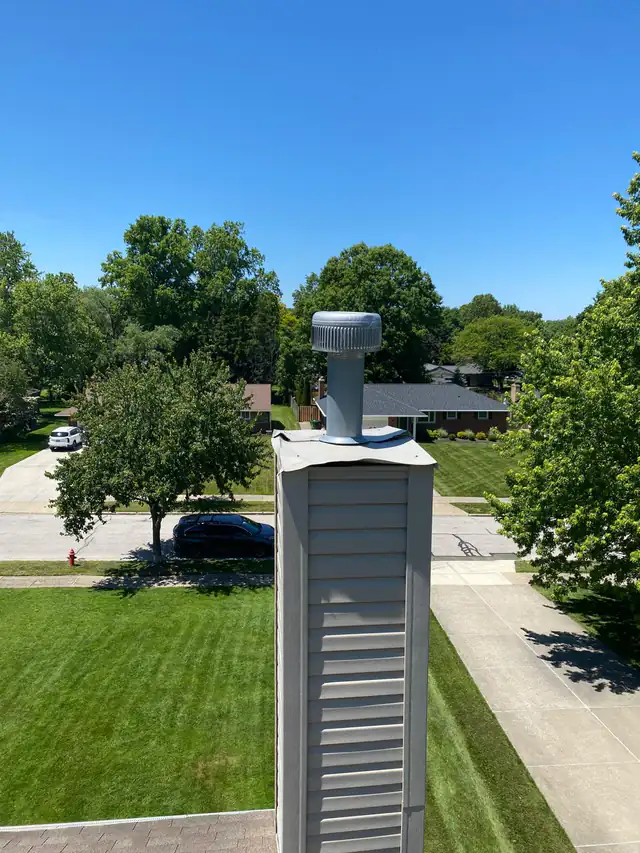
Before — the old chase cover, with bent and raised edges around the vent 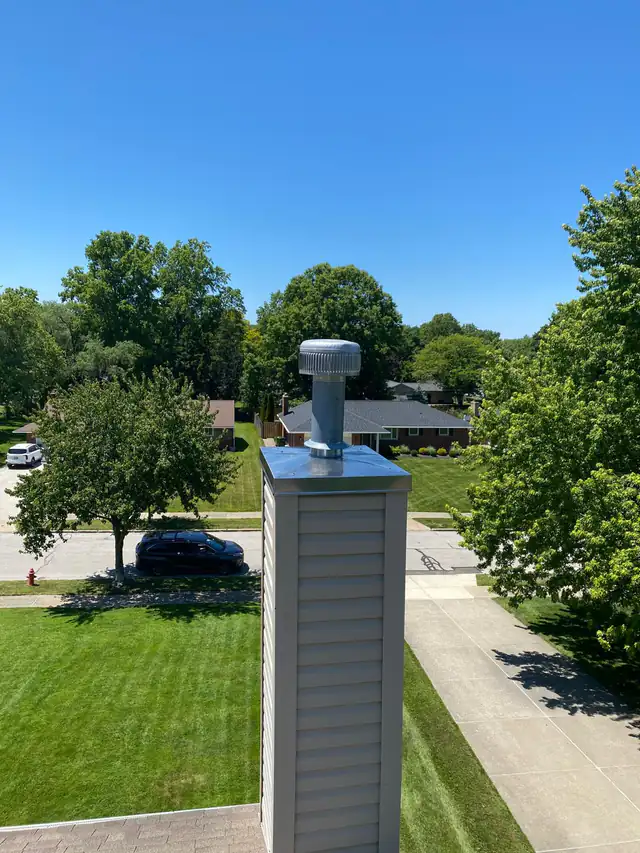
After — replacement chase cover fitted around the vent 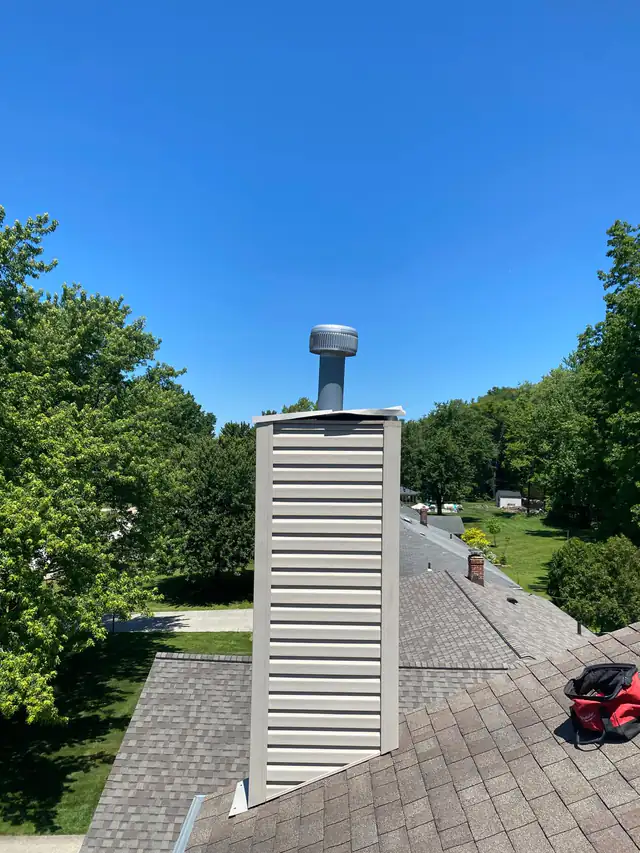
Before — the old cover from the roof side, with a raised edge 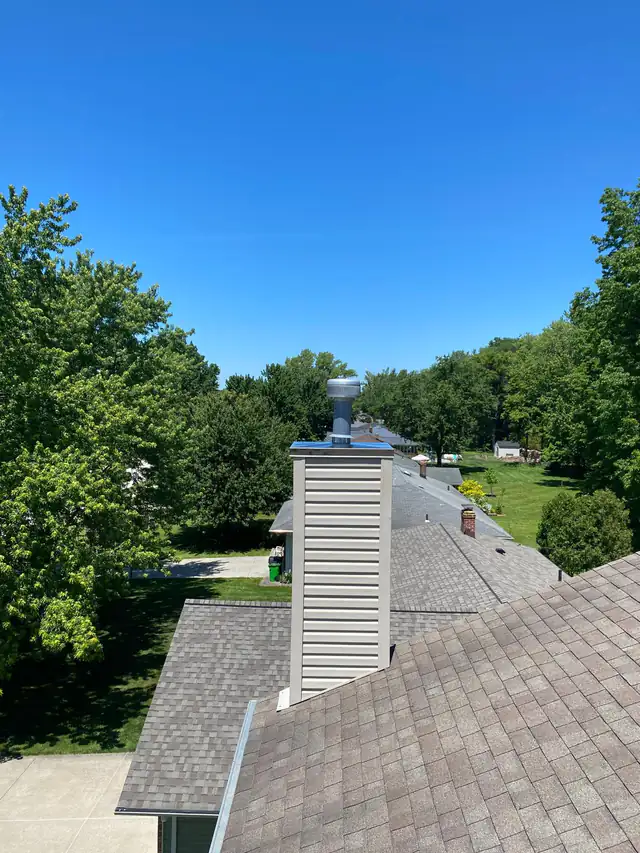
After — the replacement cover and chase, viewed from the roof
Meet the team
The people behind the work
Manny, Zack and Myke — meet the people behind Chimney Expert Solutions.
Our team and story →
Manny
Owner
Zack
Manager

Myke
Technician
FAQ
Chimney Leak Repair & Waterproofing: questions we hear
My roofer says it's the chimney and the chimney guy says it's the roof. Who's right?
That standoff almost always means flashing, the one joint where the two trades meet and neither owns it. We diagnose the whole intersection together — flashing, counterflashing, crown, cap and masonry — and give you one answer with photographs behind it. If the finding genuinely is the roof, we will tell you that too.
It leaked once and hasn't since. Do I still need it looked at?
Yes, and the intermittency is a clue rather than a reassurance. A leak that only appears under specific conditions usually means a directional entry point, most often driven rain on one face or ice damming at the roofline. The path is still there between events, and it is still admitting the water that does the freeze-thaw damage.
Can you fix a chimney leak in winter?
Some of it. Caps, some flashing work and temporary measures can be done in cold weather. Anything involving mortar or a concrete crown recast needs sustained temperatures above roughly 40°F to cure, so a winter diagnosis often means a temporary fix now and the permanent one in spring. We will tell you which category yours is in rather than laying masonry that will not set.
Should the chimney be waterproofed as routine maintenance?
Not as routine, no. A repellent is worth doing on masonry that is genuinely absorbing water and is otherwise sound, and it is pointless or harmful anywhere else. On a chimney with open joints, the joints get pointed first. On a chimney with a cracked crown, the crown is the actual hole. Selling a spray-on treatment to a chimney that needs masonry work is one of the more common bad practices in this trade.
How long does a chimney repellent last?
Vapor-permeable siloxane repellents on sound masonry are generally reapplied on a multi-year cycle rather than annually, and the exposure of the wall changes that a lot — a west-facing stack near the lake weathers faster than a sheltered interior one. Reapplication is straightforward when the masonry underneath has been kept sound, which is rather the point of doing the pointing first.
Where we do this work
Chimney Leak Repair & Waterproofing across Greater Cleveland
Housing era changes this job more than anything else does, so the towns below have their own pages on it. The rest of our Greater Cleveland service area is on the areas page.
- Chimney Leak Repair & Waterproofing in Cleveland
- Chimney Leak Repair & Waterproofing in Lakewood
- Chimney Leak Repair & Waterproofing in Cleveland Heights
- Chimney Leak Repair & Waterproofing in Shaker Heights
- Chimney Leak Repair & Waterproofing in Parma
- Chimney Leak Repair & Waterproofing in Rocky River
- Chimney Leak Repair & Waterproofing in Westlake
- Chimney Leak Repair & Waterproofing in Strongsville
- Chimney Leak Repair & Waterproofing in Euclid
- Chimney Leak Repair & Waterproofing in South Euclid
- Chimney Leak Repair & Waterproofing in University Heights
- Chimney Leak Repair & Waterproofing in Beachwood
- Chimney Leak Repair & Waterproofing in Bedford
- Chimney Leak Repair & Waterproofing in Garfield Heights
- Chimney Leak Repair & Waterproofing in North Olmsted
- Chimney Leak Repair & Waterproofing in Mentor
- Chimney Leak Repair & Waterproofing in Willoughby
- Chimney Leak Repair & Waterproofing in Painesville
- Chimney Leak Repair & Waterproofing in Chardon
- Chimney Leak Repair & Waterproofing in Elyria
- Chimney Leak Repair & Waterproofing in Lorain
- Chimney Leak Repair & Waterproofing in Avon Lake
- Chimney Leak Repair & Waterproofing in Medina
- Chimney Leak Repair & Waterproofing in Brunswick
- Chimney Leak Repair & Waterproofing in Akron
- Chimney Leak Repair & Waterproofing in Cuyahoga Falls
- Chimney Leak Repair & Waterproofing in Hudson
- Chimney Leak Repair & Waterproofing in Kent
- Canton
- Wooster
- Warren
- Youngstown
- Boardman
- Sandusky
- Mansfield
- Ashland
Free estimate
Get this looked at properly
Describe what you're seeing and we'll call or text back to schedule. Photos of what we find, honest triage, and a written scope before any work starts — that method is the whole of how we work.
Call and tell us what the chimney's doing — if we're up on a roof, we'll call you back. All the ways to reach us are on the contact page.
Call216-647-1882