
Greater Cleveland
Chimney Repair & Rebuilds in Cleveland, OH
Masonry repair from spot fixes to full stack rebuilds — spalled brick, failed joints, and chimneys the freeze-thaw cycle has taken apart.
Northeast Ohio is close to a worst case for exterior masonry. A Cleveland chimney runs through dozens of freeze-thaw cycles every winter: water finds a hairline crack or an open joint, freezes, expands by about nine percent, and levers the masonry apart a little more each time. Repeat that across eighty winters on the most weather-exposed brickwork the house owns, and you get the local pattern. Brick faces shed, mortar goes soft and sandy, top courses shift, and eventually a stack that was fine at the last home sale needs rebuilding.
The honest repair conversation is about how far it has gone, and that answer is visible in photographs rather than adjectives. Open joints and a handful of spalled bricks are repairable: cut out the failure, repoint properly, replace units, and stop the water at the crown. Once the top courses have moved or the brick has spalled through its face, a partial rebuild from the roofline up is the fix that actually lasts, and it costs a fraction of the full rebuild you will need if the deterioration keeps working downward.
How freeze-thaw takes a chimney apart
Brick and mortar are porous. They take on water in a rain and give it back in dry weather, and in a normal climate that is fine. The problem is what happens when the water is still in there and the temperature crosses freezing. Ice occupies more space than the water it came from, so every wet freeze pushes outward from inside the pore structure. One cycle does nothing measurable. A few thousand cycles reduce the face of a brick to something that flakes off in sheets.
Greater Cleveland is unusually good at generating those cycles. Lake-effect weather keeps masonry wet for long stretches, and our winters swing across the freeze line repeatedly rather than settling below it. That combination — wet masonry and frequent crossings — is worse for brick than a colder, drier winter would be.
The chimney gets the worst of it for structural reasons. It is exposed on all four sides instead of one, it has no roof over it except its own crown, it sits at the highest and windiest point of the house, and it is the one masonry element that also has hot gas running through the middle of it. Chimneys fail first, and they fail from the top down.
Reading the damage: what your chimney is telling you
Spalling
Brick faces flaking, popping or crumbling away, leaving the softer core exposed. This is water damage that has already progressed — the face is what protects the brick, and once it is gone the unit absorbs water faster and deteriorates at an accelerating rate. Chips of brick on the roof or in the flower bed under the chimney mean it is happening now, not five years ago.
Open and eroded joints
Mortar recessed back from the face of the brick, or soft enough to rake out with a key. Mortar is meant to be the sacrificial material, so this is the system working as designed, right up until the joints open enough to let water into the middle of the wall. That is the moment repointing changes from maintenance to urgency.
Efflorescence
The white, chalky bloom on the brick face. It is salt carried out of the masonry by water moving through it and deposited when the water evaporates. Efflorescence is not itself damage. It is proof that water is actively traveling through the chimney, which is the more useful information.
Shifted, leaning or stepped top courses
When the joints in the top few courses have failed completely, the bricks stop acting as a wall and start acting as a stack of loose objects. Wind and ice do the rest. A visibly leaning stack or a top course that has slid out of plane is past repointing, and it is a genuine safety issue rather than a maintenance item.
A cracked or missing crown
Almost every serious masonry failure on an older Cleveland chimney can be traced back to the crown. It is the concrete or mortar cap that seals the top of the stack around the flue tiles, and when it cracks it feeds water straight down into the brickwork. If the crown is gone, everything below it is on a countdown.
Repair, partial rebuild, or full rebuild
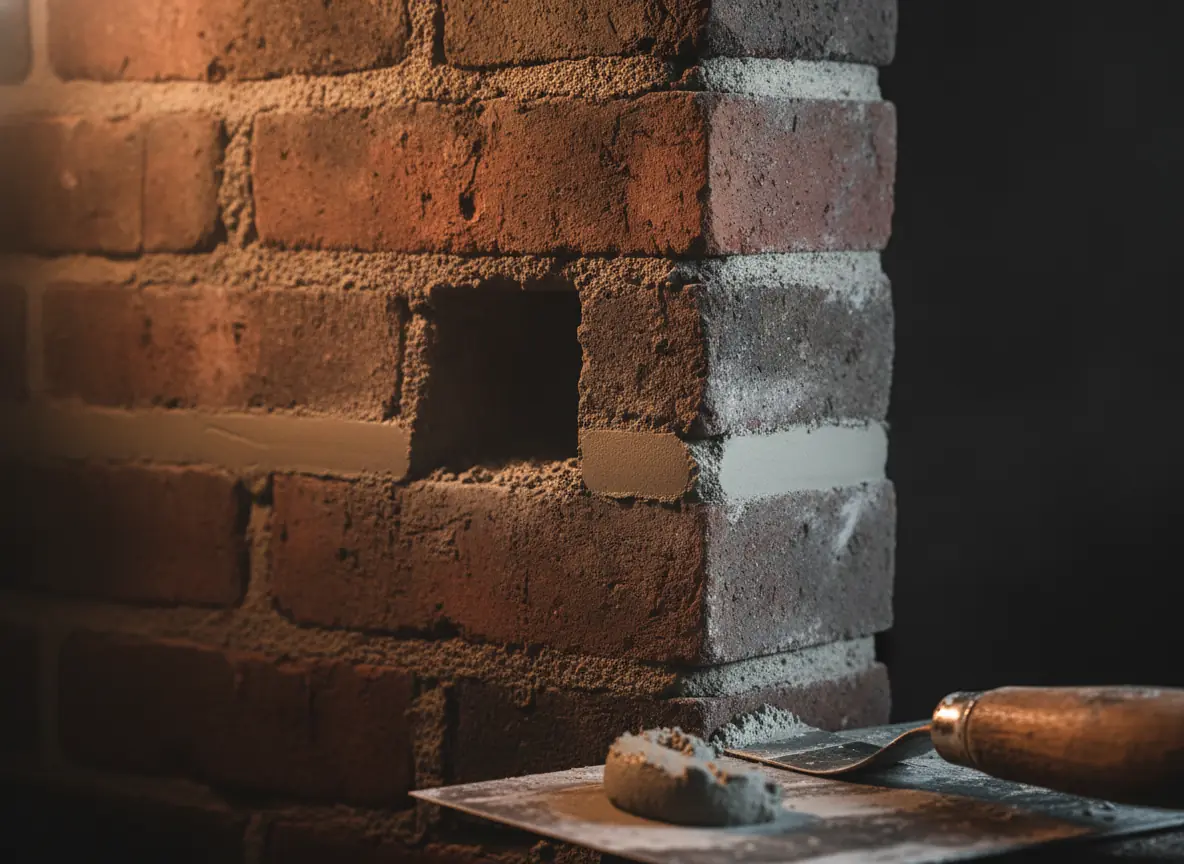
Depth of damage decides it, and there is a defensible line between the three that we will show you on your own chimney before quoting anything.
Repair and repointing hold well when the brick units themselves are sound and the failure is in the joints, with a limited number of spalled bricks to swap out. This is the cheapest outcome and the right one more often than a homeowner braced for bad news expects.
A partial rebuild — taking the stack down to sound masonry, usually at the roofline or the shoulder, and rebuilding from there — is the correct call when the damage is concentrated above the roof, which is the norm here. The masonry inside the heated envelope of the house is usually in far better shape, because it never sees the freeze-thaw exposure. Rebuilding only what has failed is not a compromise, it is the accurate scope.
A full rebuild from the foundation or the firebox up is for stacks that have deteriorated below the roofline, that have structural cracking through the body, or where the flue itself has to be reconstructed. It is a substantial job and we do not recommend it lightly. What we also will not do is repoint a chimney into another two winters when the evidence says it needs rebuilding, because that is the same money spent twice.
What a rebuild actually involves
Protecting the house first
Roof protection under the work area, the flue capped or sealed so debris does not fall down into the firebox and through the house, and a plan for getting brick and rubble down that does not involve the roof surface. On a slate or tile roof this part is most of the planning.
Down to sound masonry
The stack comes down course by course to a level where the brick and joints are genuinely sound, not to a level that was decided from the ground. Existing brick is salvaged where it is worth salvaging, and the flue tiles get evaluated as they are exposed — a rebuild is the one moment when replacing damaged tile is straightforward, and skipping that step because it was not in the original quote is a mistake you live with.
Rebuilding
New masonry laid with mortar matched to the original in strength and appearance, joints tooled to the same profile, and any original detailing reproduced. Flue tiles set with proper joints. Where the design calls for it, corbelling and decorative courses get rebuilt rather than simplified away.
The parts that make it last
A rebuild finishes with a proper cast crown with a drip edge and an expansion joint at the flue, a stainless cap on every flue, and flashing sorted at the roofline. A rebuild under a bad crown or with old failed flashing is money spent on a chimney that will start deteriorating again immediately. We treat those three as part of the scope, not as upsells at the end.
Matching brick and mortar on older Cleveland houses
On the pre-war housing stock in Cleveland, Lakewood, Cleveland Heights and Shaker Heights, matching is not a cosmetic nicety. A chimney is one of the most visible elements on the front elevation of a Tudor or a foursquare, and a rebuild in the wrong brick blend is something you look at for the next thirty years. Much of the brick used across this housing stock has close modern equivalents, and salvaged brick is available for the rest. Mortar can be tinted and struck to match the original joint color and profile.
The technical half of matching matters more than the visual half. Mortar must always be softer than the brick around it. Pre-war Cleveland brick was fired softer and more porous than modern brick, and it was laid in lime-rich mortar that could move and breathe with it. Point that wall with hard modern Portland-heavy mortar and the joints become stronger than the units. Seasonal movement and trapped moisture then have to escape through the brick instead of the joint, and the brick faces spall off. A great deal of the spalling on inner-ring suburb chimneys was caused by a repointing job that was supposed to help.
What drives the cost of masonry work
- Scope. Repointing, a partial rebuild above the roofline, and a full rebuild are different orders of work, and honest quoting means establishing which one you actually need first.
- Height and access. A chimney on a single-story ranch with a walkable roof, versus a three-story stack on slate that needs staging, is the largest single swing in this trade.
- Roof material. Slate, clay tile and standing-seam metal cannot be walked on, which changes how the work is staged and protected.
- Brick match. Sourcing or salvaging a close match for a visible 1920s chimney takes time that a plain utility stack does not.
- Detailing. Corbelled courses, stone banding, clay pots and decorative caps all have to be rebuilt rather than approximated.
- What is found on the way down. Flue tile condition and hidden deterioration are genuinely not fully knowable until the stack is opened, which is why we photograph as we go and talk before we deviate from the scope.
- Season. Work scheduled into the shoulder of the masonry season sometimes needs protection and heat, which is real cost.
The masonry season in Northeast Ohio
Mortar cures through a chemical reaction that needs sustained temperatures above roughly 40°F. Below that it does not simply cure slowly; it can be damaged permanently, and freshly laid mortar that freezes before it has set never reaches the strength it was supposed to. That gives Greater Cleveland a working masonry season of roughly April through November, with the ends of it dependent on the actual weather rather than the calendar.
The practical consequence is a scheduling one. If your chimney needs structural work, the queue and the season run out at the same time in the fall. A chimney assessed in spring gets fixed that year. The same chimney assessed in late October frequently waits until spring, taking one more winter of freeze-thaw with an open path for water.
What happens if the masonry is left
The failure curve is not linear. A chimney with a few open joints deteriorates slowly, because the water is only reaching a small volume of masonry. Once the joints are open across a face, water enters the middle of the wall, and the number of surfaces available to freeze multiplies. That is when a stack goes from needing repointing to needing rebuilding in a handful of seasons.
There are three costs to waiting and only one of them is the masonry. The second is water inside the house: a chimney taking on water at the top delivers it to the ceiling, the framing and the drywall around the chase, and rot in the framing next to a chimney is both expensive and hard to see. The third is safety. Loose brickwork forty feet up over a driveway or a walkway is a different category of problem from a maintenance item, and a stack that has started to lean should not be left through a winter of ice loading.
Repair and rebuild work we take on
- Spalled and cracked brick replacement, matched to the existing brick
- Partial rebuilds from the roofline or shoulder up
- Full chimney rebuilds where the stack is beyond saving
- Crown replacement as part of any rebuild — a rebuild under a bad crown is wasted money
- Flue tile replacement while the stack is open, where it is warranted
- Firebox masonry and refractory panel repair
- Written scope with photos before, during and after the work
Our work
Chimney Repair & Rebuilds, photographed on the job
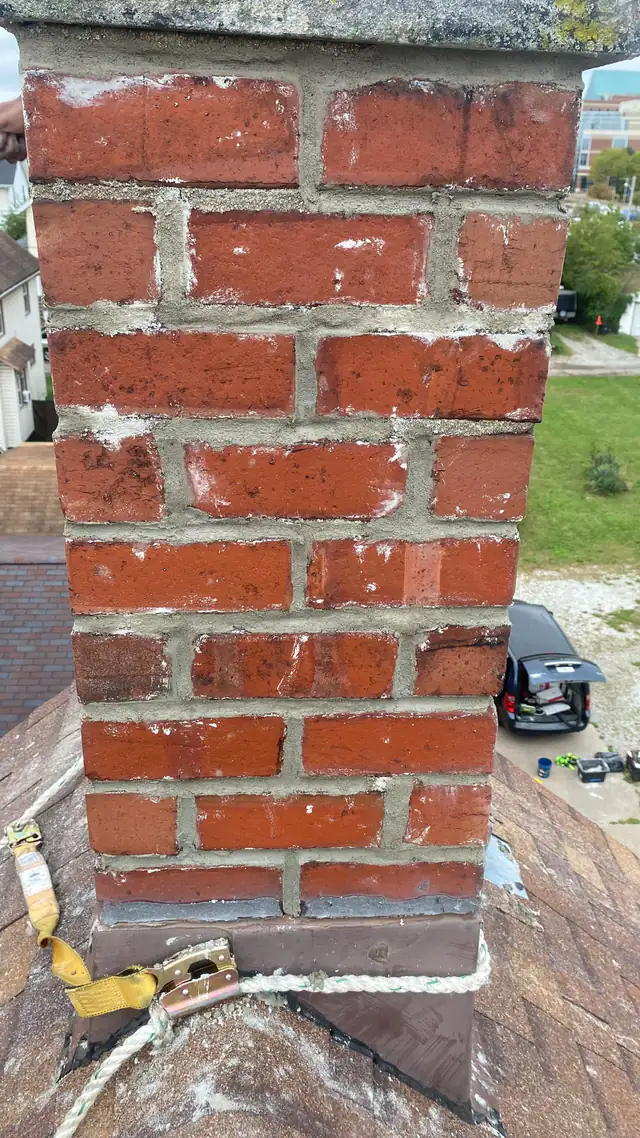
Roped in on a steep roof — repointed, flashing sealed 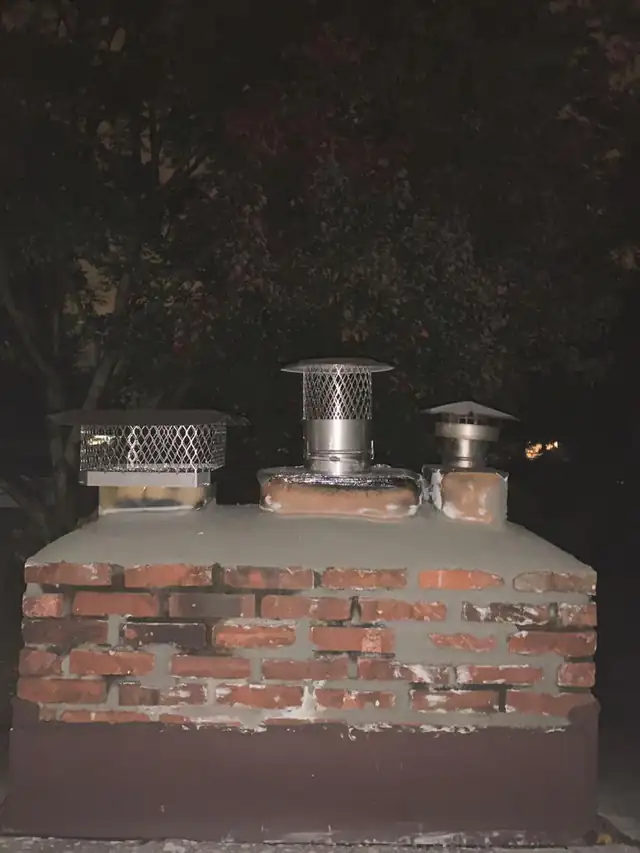
Three flues, three caps, one new crown 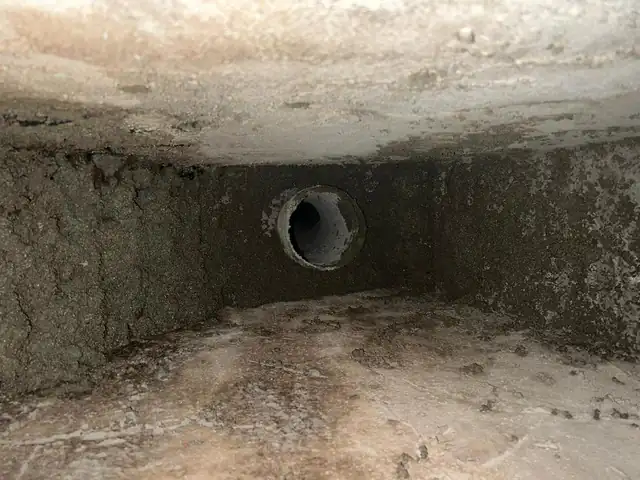
Inside the smoke chamber — the flue opening above the firebox 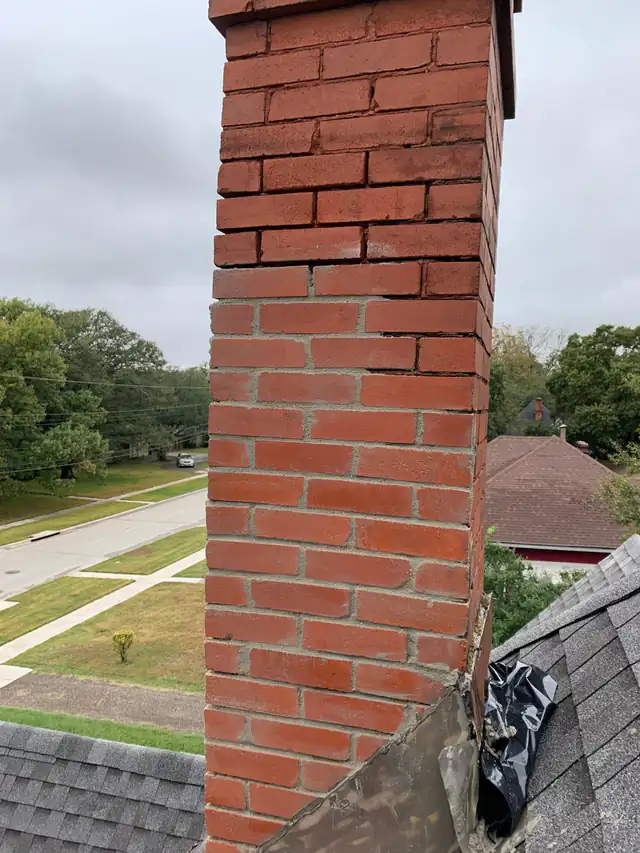
Mid-job — fresh joints below, the old eroded joints still waiting above 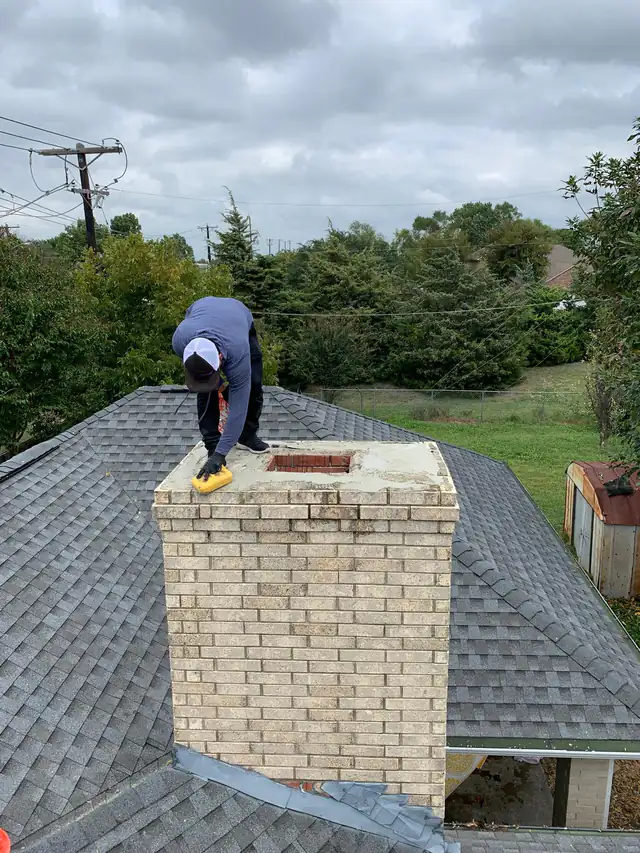
Finishing a fresh crown around the flue 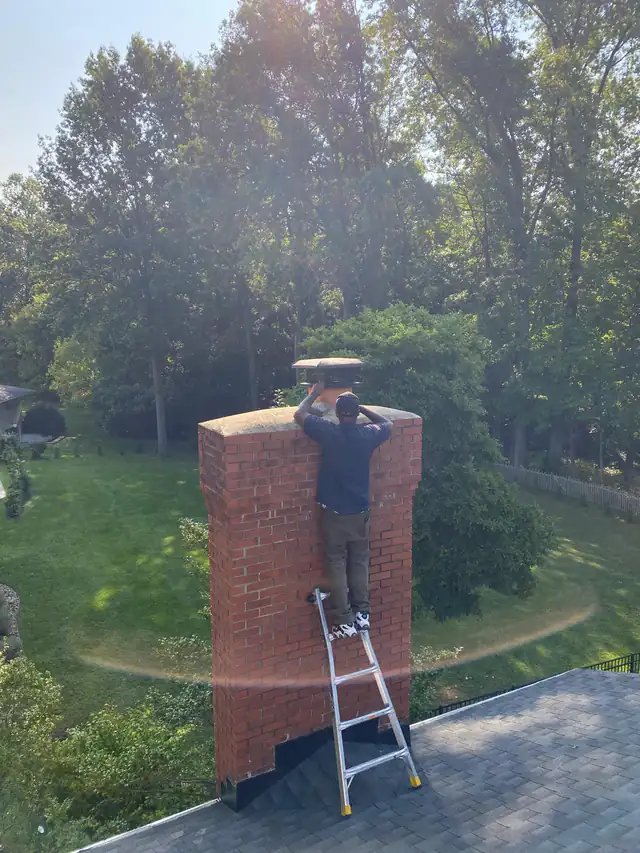
Ladder work on a tall stack — fitting the cap
Meet the team
The people behind the work
Manny, Zack and Myke — meet the people behind Chimney Expert Solutions.
Our team and story →
Manny
Owner
Zack
Manager

Myke
Technician
FAQ
Chimney Repair & Rebuilds: questions we hear
How long does a chimney rebuild take?
A partial rebuild above the roofline on a straightforward stack is usually a small number of working days, weather permitting. A full rebuild, a difficult roof, or a chimney with detailing to reproduce takes longer. The unpredictable variable is weather rather than labor: mortar work stops for rain and for cold, and we would rather lose a day than lay masonry that will not cure.
Can we still use the fireplace while the chimney is being rebuilt?
No — the flue is open at the top and the stack is partly dismantled. If the chimney also serves a furnace or water heater, that has to be planned around before the work starts, and it is one of the first things we check on a quote visit. Nobody should discover mid-rebuild that the water heater has nowhere to vent.
Does chimney repair need a permit in Cuyahoga County?
It depends on the municipality and on the scope — like-for-like repair is generally treated differently from structural rebuilding, and the inner-ring suburbs vary quite a bit in how they handle exterior work. We raise it during the quote for anything structural, and the requirements are worth confirming with your city's building department, because they do change.
Can a leaning chimney be straightened instead of rebuilt?
Generally not. A lean means the joints have failed and the courses have moved, and there is no way to push masonry back into plane and have it stay. What can be done is establishing where sound masonry begins and rebuilding from there, which on most leaning stacks is at or just below the roofline.
Is a chimney rebuild covered by homeowners insurance?
Long-term deterioration from weather is normally treated as maintenance and is not covered, while sudden events like a lightning strike, a storm or a chimney fire often are. That is a conversation with your carrier, not with us, but the photo documentation we produce is exactly the evidence that conversation needs — which is another reason we photograph before, during and after.
Where we do this work
Chimney Repair & Rebuilds across Greater Cleveland
Housing era changes this job more than anything else does, so the towns below have their own pages on it. The rest of our Greater Cleveland service area is on the areas page.
- Chimney Repair & Rebuilds in Cleveland
- Chimney Repair & Rebuilds in Lakewood
- Chimney Repair & Rebuilds in Cleveland Heights
- Chimney Repair & Rebuilds in Shaker Heights
- Chimney Repair & Rebuilds in Parma
- Chimney Repair & Rebuilds in Rocky River
- Chimney Repair & Rebuilds in Westlake
- Chimney Repair & Rebuilds in Strongsville
- Chimney Repair & Rebuilds in Euclid
- Chimney Repair & Rebuilds in South Euclid
- Chimney Repair & Rebuilds in University Heights
- Chimney Repair & Rebuilds in Beachwood
- Chimney Repair & Rebuilds in Bedford
- Chimney Repair & Rebuilds in Garfield Heights
- Chimney Repair & Rebuilds in North Olmsted
- Chimney Repair & Rebuilds in Mentor
- Chimney Repair & Rebuilds in Willoughby
- Chimney Repair & Rebuilds in Painesville
- Chimney Repair & Rebuilds in Chardon
- Chimney Repair & Rebuilds in Elyria
- Chimney Repair & Rebuilds in Lorain
- Chimney Repair & Rebuilds in Avon Lake
- Chimney Repair & Rebuilds in Medina
- Chimney Repair & Rebuilds in Brunswick
- Chimney Repair & Rebuilds in Akron
- Chimney Repair & Rebuilds in Cuyahoga Falls
- Chimney Repair & Rebuilds in Hudson
- Chimney Repair & Rebuilds in Kent
- Canton
- Wooster
- Warren
- Youngstown
- Boardman
- Sandusky
- Mansfield
- Ashland
Free estimate
Get this looked at properly
Describe what you're seeing and we'll call or text back to schedule. Photos of what we find, honest triage, and a written scope before any work starts — that method is the whole of how we work.
Call and tell us what the chimney's doing — if we're up on a roof, we'll call you back. All the ways to reach us are on the contact page.
Call216-647-1882