
Summit County, Ohio
Chimney Leak Repair & Waterproofing in Akron, OH
Finding where the water actually gets in — crown, cap, flashing, masonry or condensation — and fixing that, not caulking symptoms.
What chimney leak repair involves in Akron is set by the housing stock here: Company-era and boom-era housing built fast in the rubber years — unlined coal-built flues, mortar carrying a century of sulfate attack with leaning and bowing stacks to show for it, and two-family conversions sharing undersized flues.
Akron's residential neighborhoods were largely built in one extraordinary rush. The rubber industry pulled tens of thousands of workers into the city in the years around the First World War, and the housing went up as fast as it could be framed — Goodyear Heights and Firestone Park laid out by the companies themselves, plus North Hill, Kenmore, Highland Square and the streets between them. It is honest, modest housing built at speed on hilly ground, and its chimneys are exactly what you would expect: functional, unadorned, and built for coal.
A leaking chimney is a symptom with at least five different causes, and fixing the wrong one is why so many chimney leaks come back. Water can enter through a cracked crown, a missing or undersized cap, failed flashing where the chimney meets the roof, saturated porous masonry, or condensation forming inside an oversized flue. Each of those has a different repair, and none of them is solved by sealant on whatever surface was easiest to reach. Our leak work starts with diagnosis at roof level and inside the house, so the fix targets the actual entry point.
What goes wrong with chimneys in Akron
Stacks that lean or bow from sulfate expansion
A chimney that has vented coal for decades can have sulfates concentrated in the mortar of the flue-side and the weather-side joints, and as those salts crystallize they take up more room than the mortar had to give. Multiply a fraction of a millimeter by the number of joints in a stack and the top of the chimney moves measurably — usually leaning away from the flue side, sometimes bowing. The tells are a top that is visibly out of plumb, horizontal cracking on one face, and joints that look swollen or crushed rather than washed out. Assessment means a plumb line, a record of the crack pattern and a look at which face is affected, because a leaning stack is a rebuild question rather than a pointing question.
Speed-built housing with unlined heating flues
Houses put up quickly for a booming workforce got sound but economical construction, and flue liners were not a universal expectation in that era. Very large numbers of Akron chimneys were built as bare brick shafts, with the mortar between the courses as the only thing separating combustion gases from the wall cavity. A century of use, sulfate attack and condensation later, those joints are frequently open. It is invisible from the basement and the roof both, and it is the reason a camera scan is the starting point on a house of this vintage rather than an add-on to it.
Two appliances sharing a flue that cannot take both
A great many of these houses were doubled up during the boom, or converted to two-family later, and the pattern that follows is two heating appliances connected into one chimney flue. Common venting is not automatically wrong, but it has rules — the flue has to be sized for the combined input, the connectors have to enter at the right levels and slope upward toward the chimney, and the appliances have to be compatible. What we typically find instead is a second connector added in whatever decade it was needed, entering below the first, into a flue that was never sized for both. The consequence is spillage, which means combustion products into the house rather than up the chimney. The basement is where that gets found.
Why sealing the whole chimney is usually a mistake
The instinct when a masonry chimney leaks is to coat it, and the products that come to hand at a hardware store are mostly film-forming: acrylic sealers, masonry paint, silicone. In a freeze-thaw climate these do real damage. Brick and mortar have to be able to release moisture outward. A film-forming coating stops that while doing nothing about the water arriving from the crown or the flashing, so the moisture that gets in stays in — and every freeze then works on masonry that cannot dry. Painted and sealed chimneys spall spectacularly, and the damage shows up across the whole face rather than at one entry point.
Where a repellent is genuinely appropriate, the product class matters: silane and siloxane repellents penetrate and repel liquid water while remaining vapor permeable, so the wall still breathes. And it is applied after the joints are sound, never as a substitute for pointing them. A repellent is a raincoat, not a roof, and it will never fix a crown or a piece of flashing.
What water does if the leak is left
The stain on the ceiling is the least of it. Once water has an established route into a chimney, three things happen in parallel. The masonry deteriorates faster, because every wet freeze widens the path the water is already using. The framing around the chimney takes moisture it was never designed to take, and rot in a concealed chase around a chimney is both slow and expensive to find. And inside the flue, water attacks mortar joints between the flue tiles, so a water problem at the top becomes a liner problem in the middle.
There is a fourth, less obvious one: a chimney with water in it smells. The musty odour that shows up in a fireplace in warm weather is damp deposits, and it is a reliable early sign of a water path that has not yet produced a visible stain. Leak repairs sit near the top of the fix-this-season list, not because a small stain is an emergency, but because the path is established and Cleveland winters are very good at widening established paths.
This page covers chimney leak repair as it plays out in Akron. The full chimney leak repair & waterproofing page walks the whole job — every stage, what changes the scope, and what we do about each of them. For everything else we handle in this suburb, see chimney services in Akron.
How we handle a leaking chimney
- Roof-level diagnosis: crown, cap, flashing, masonry and shoulder — photographed
- Interior check: firebox, smoke chamber and damper for staining, rust and damp
- Flashing repair or a full re-flash where the roofline seal has failed
- Crown repair or full recast with a drip edge and an expansion joint at the flue
- Vapor-permeable masonry repellent on porous brick — never paint or film-forming sealers
- An honest call on whether the 'leak' is actually flue condensation
- The fix in writing, matched to the diagnosed entry point
Our work
Chimney Leak Repair & Waterproofing, photographed on the job
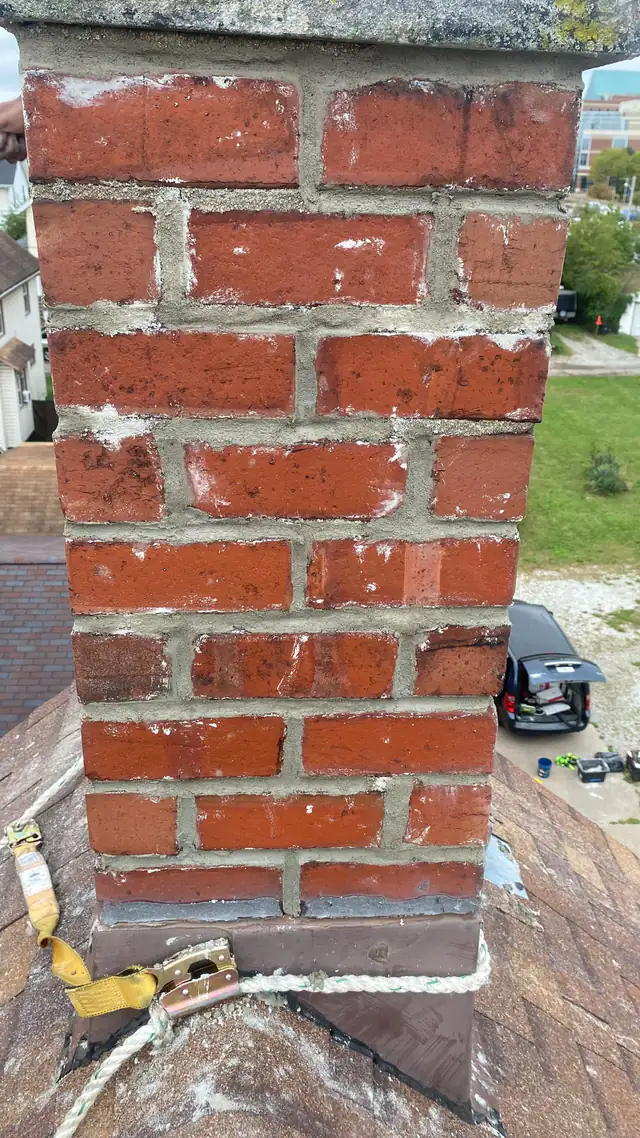
Roped in on a steep roof — repointed, flashing sealed 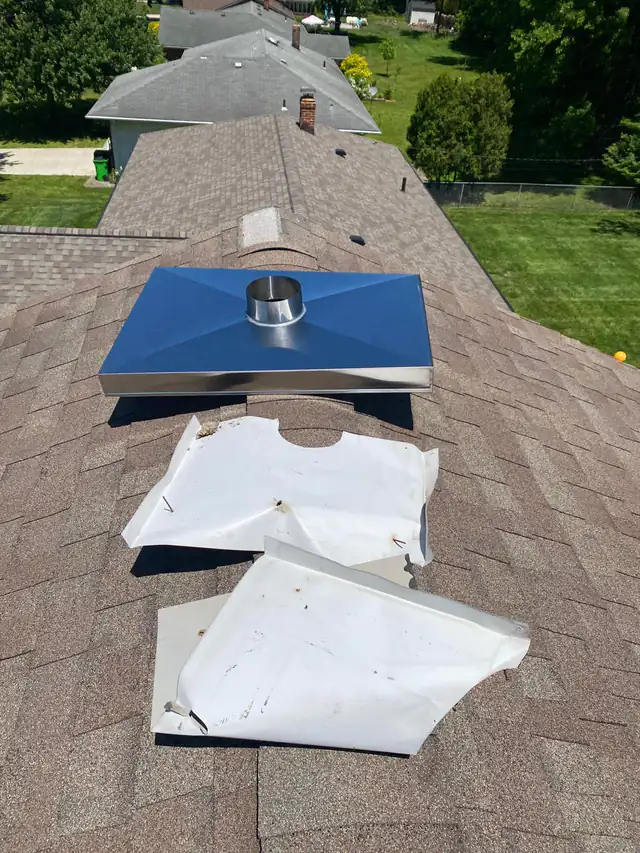
Replacement chase cover beside the removed cover sections on the roof 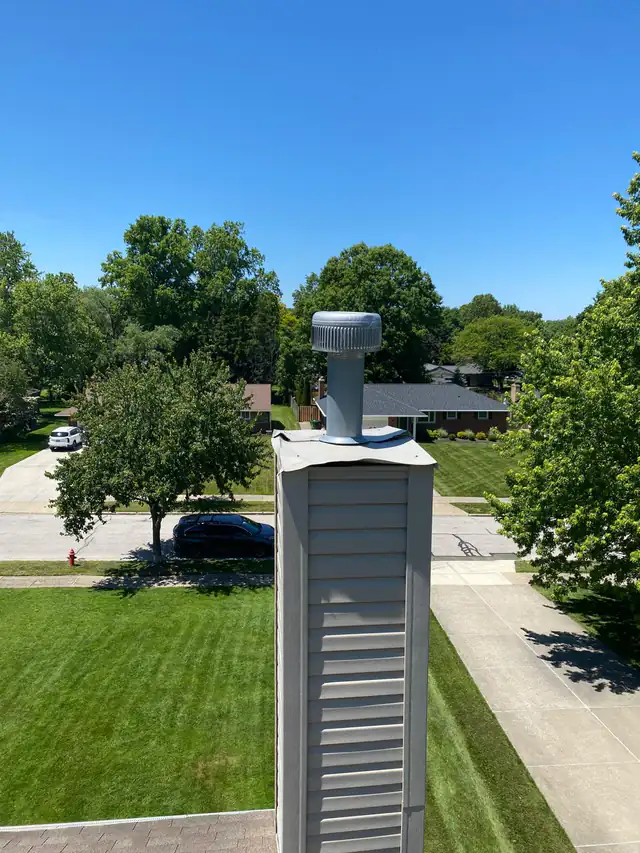
Before — the old chase cover, with bent and raised edges around the vent 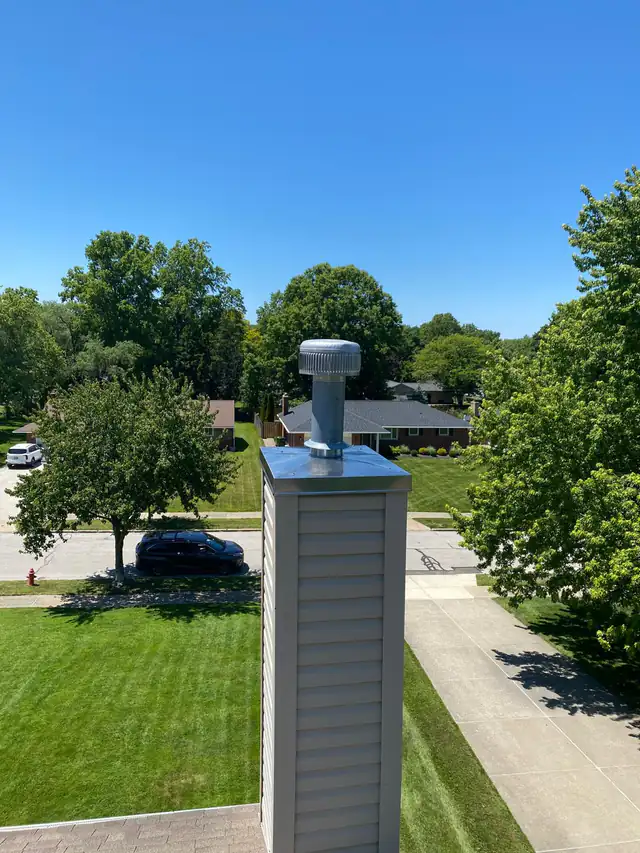
After — replacement chase cover fitted around the vent 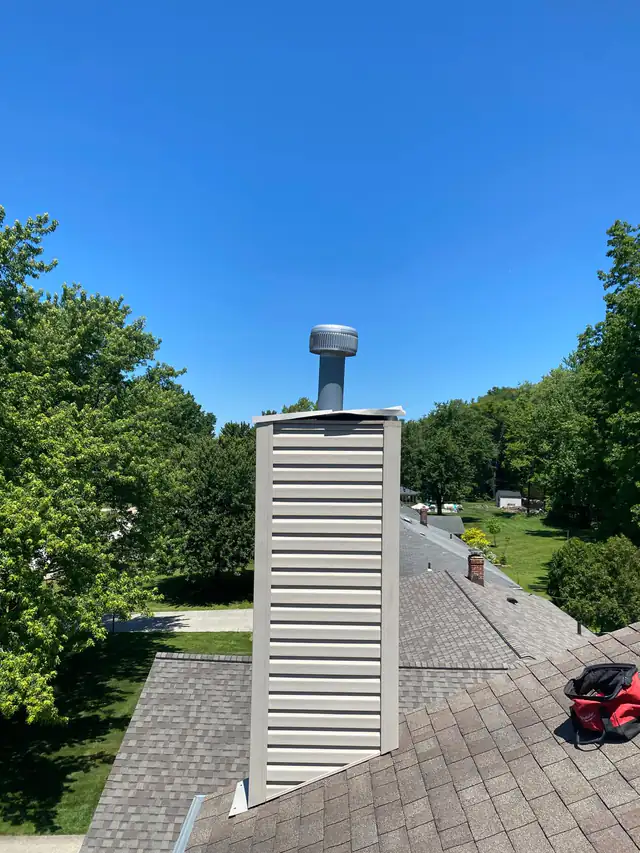
Before — the old cover from the roof side, with a raised edge 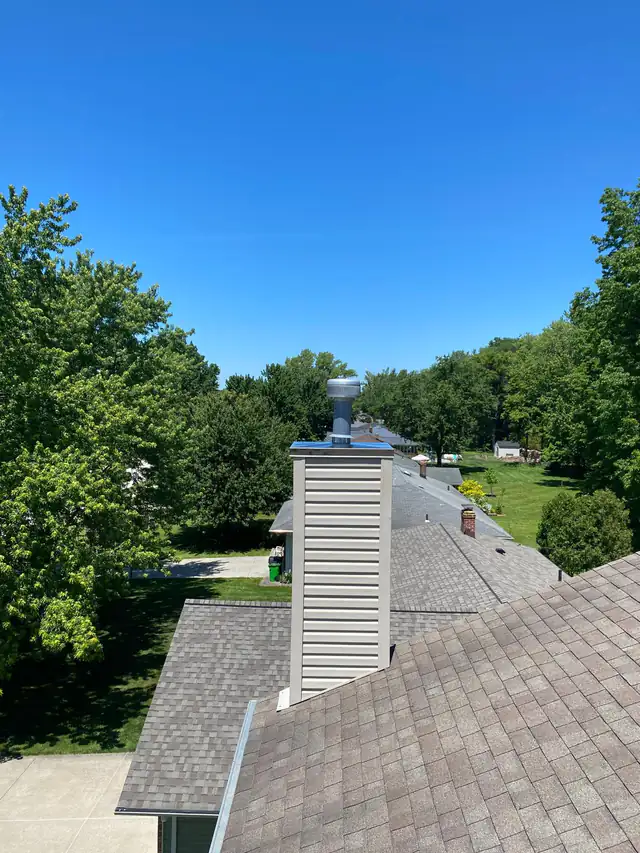
After — the replacement cover and chase, viewed from the roof
Meet the team
The people behind the work
Manny, Zack and Myke — meet the people behind Chimney Expert Solutions.
Our team and story →
Manny
Owner

Zack
Manager

Myke
Technician
FAQ
Chimney Leak Repair in Akron: questions we hear
What does coal have to do with a chimney that hasn't burned any since 1955?
The sulfates it left in the mortar are still there. They dissolve and recrystallize with every wetting and drying cycle, and each cycle expands the joint a little. That is why the deterioration in these chimneys can look different from ordinary weathering — swollen or crushed joints rather than washed-out ones — and why it kept progressing long after the fuel changed.
Is an unlined brick flue automatically unsafe?
Not automatically — its condition decides that, and some are in better shape than people expect. What is true is that there is nothing between the flue gases and the masonry except the mortar joints, so once those joints open there is a direct path into the structure. A camera scan tells you which situation you are in, and a stainless liner is the usual answer where the joints have gone.
How long does a chimney repellent last?
Vapor-permeable siloxane repellents on sound masonry are generally reapplied on a multi-year cycle rather than annually, and the exposure of the wall changes that a lot — a west-facing stack near the lake weathers faster than a sheltered interior one. Reapplication is straightforward when the masonry underneath has been kept sound, which is rather the point of doing the pointing first.
It leaked once and hasn't since. Do I still need it looked at?
Yes, and the intermittency is a clue rather than a reassurance. A leak that only appears under specific conditions usually means a directional entry point, most often driven rain on one face or ice damming at the roofline. The path is still there between events, and it is still admitting the water that does the freeze-thaw damage.
Free estimate
Chimney Leak Repair in Akron?
Tell us what you’re seeing and we’ll call or text back to schedule a look — with photos of what we find and an honest read on what’s urgent and what can wait. That evidence-first method is the way we work on every job.
Call and tell us what the chimney's doing — if we're up on a roof, we'll call you back. Other ways to reach us are on the contact page, and Akron is one of the communities we cover across Greater Cleveland.
Call216-647-1882