
Lorain County, Ohio
Chimney Leak Repair & Waterproofing in Elyria, OH
Finding where the water actually gets in — crown, cap, flashing, masonry or condensation — and fixing that, not caulking symptoms.
What chimney leak repair involves in Elyria is set by the housing stock here: A nineteenth-century county seat turned manufacturing town, built partly of the sandstone quarried in this county — stone that delaminates rather than crumbles, has usually been pointed too hard, and dries slowly in the river valleys.
Elyria grew up where the two branches of the Black River meet, and it has the building stock of a nineteenth-century county seat that then became a manufacturing town: substantial older houses around the square and Washington Avenue, worker housing near the industrial corridors, and postwar neighborhoods filling out from there. The distinctive material fact about the older half of it is stone.
A leaking chimney is a symptom with at least five different causes, and fixing the wrong one is why so many chimney leaks come back. Water can enter through a cracked crown, a missing or undersized cap, failed flashing where the chimney meets the roof, saturated porous masonry, or condensation forming inside an oversized flue. Each of those has a different repair, and none of them is solved by sealant on whatever surface was easiest to reach. Our leak work starts with diagnosis at roof level and inside the house, so the fix targets the actual entry point.
What we find on Elyria chimneys that leads to chimney leak repair
White bloom on the chimney breast in the basement
Efflorescence — the powdery white deposit that appears on interior masonry — is not a cosmetic problem, it is a message. It is salt that was dissolved in water inside the masonry and left behind when the water evaporated at the surface, which means water is moving through the chimney and coming out on your side of it. On a stack in the older housing here the source is almost always at the top: a cracked crown, a missing cap, an open abandoned flue, or joints that have washed out above the roofline. Wiping the wall and repainting it treats the symptom and hides the clock.
Sandstone delaminating along its bedding planes
Sandstone was laid down in layers, and it splits along them. When a block is set with the bedding running the wrong way, or when water gets into it and freezes, it does not crumble evenly the way brick does — it separates in sheets, and you get flat plates spalling off a face that otherwise looks solid. On a chimney base or a foundation this can take a surprising amount of section away before anyone notices. Repair means understanding the stone's orientation, and it frequently means resetting or replacing units rather than filling the face with mortar, which only traps water behind the next layer.
What drives the cost of leak work
- The diagnosis versus the repair. Finding the entry point is a defined piece of work; the fix depends entirely on what the finding is, which is why an honest quote for 'a chimney leak' cannot be given over the phone.
- Which component failed. A cap is a small job. A full crown recast is a bigger one. A complete re-flash with the roofing coordinated is bigger again.
- Roof access, pitch and material, as with all chimney work.
- Whether more than one entry point is active — which is common, because the conditions that kill a crown also kill flashing of the same age.
- How much interior damage there is. We do the chimney; drywall, plaster and framing repair inside is separate work and we will say so plainly rather than quietly including it.
- Whether the masonry needs pointing before any repellent is worth applying.
What water does if the leak is left
The stain on the ceiling is the least of it. Once water has an established route into a chimney, three things happen in parallel. The masonry deteriorates faster, because every wet freeze widens the path the water is already using. The framing around the chimney takes moisture it was never designed to take, and rot in a concealed chase around a chimney is both slow and expensive to find. And inside the flue, water attacks mortar joints between the flue tiles, so a water problem at the top becomes a liner problem in the middle.
There is a fourth, less obvious one: a chimney with water in it smells. The musty odour that shows up in a fireplace in warm weather is damp deposits, and it is a reliable early sign of a water path that has not yet produced a visible stain. Leak repairs sit near the top of the fix-this-season list, not because a small stain is an emergency, but because the path is established and Cleveland winters are very good at widening established paths.
This page covers chimney leak repair as it plays out in Elyria. The full chimney leak repair & waterproofing page walks the whole job — every stage, what changes the scope, and what we do about each of them. For everything else we handle in this suburb, see chimney services in Elyria.
How we handle a leaking chimney
- Roof-level diagnosis: crown, cap, flashing, masonry and shoulder — photographed
- Interior check: firebox, smoke chamber and damper for staining, rust and damp
- Flashing repair or a full re-flash where the roofline seal has failed
- Crown repair or full recast with a drip edge and an expansion joint at the flue
- Vapor-permeable masonry repellent on porous brick — never paint or film-forming sealers
- An honest call on whether the 'leak' is actually flue condensation
- The fix in writing, matched to the diagnosed entry point
Our work
Chimney Leak Repair & Waterproofing, photographed on the job
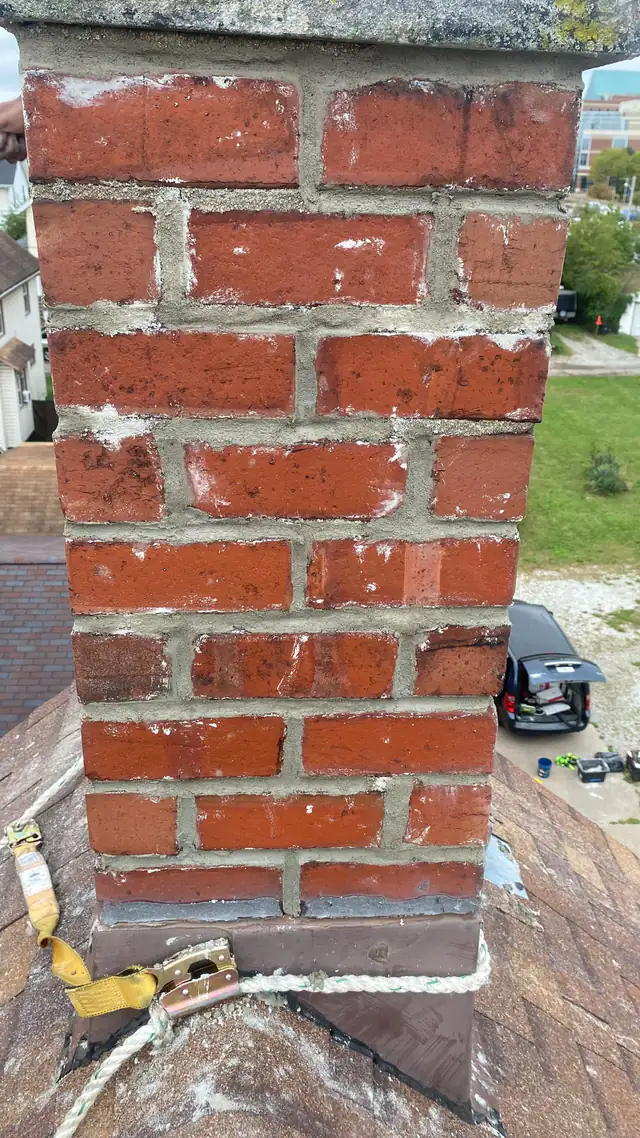
Roped in on a steep roof — repointed, flashing sealed 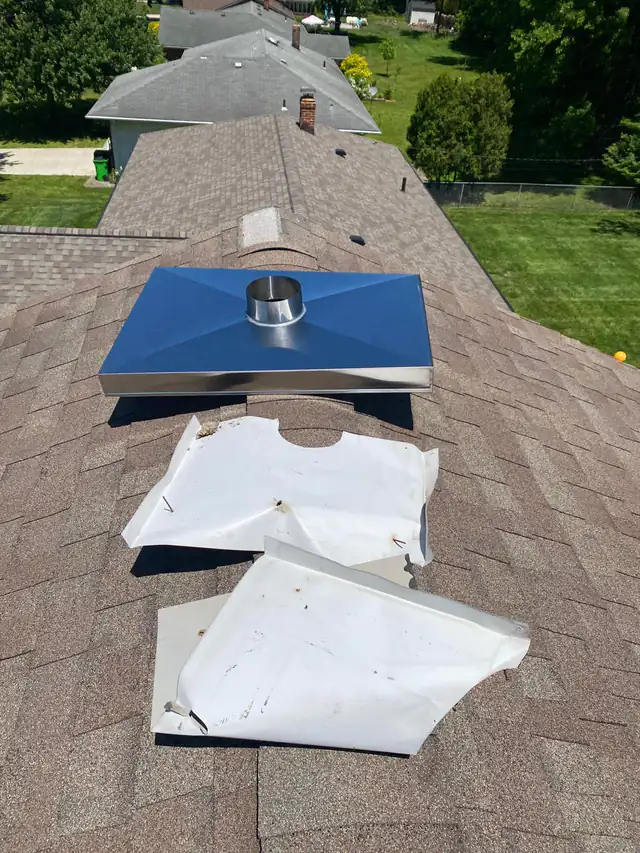
Replacement chase cover beside the removed cover sections on the roof 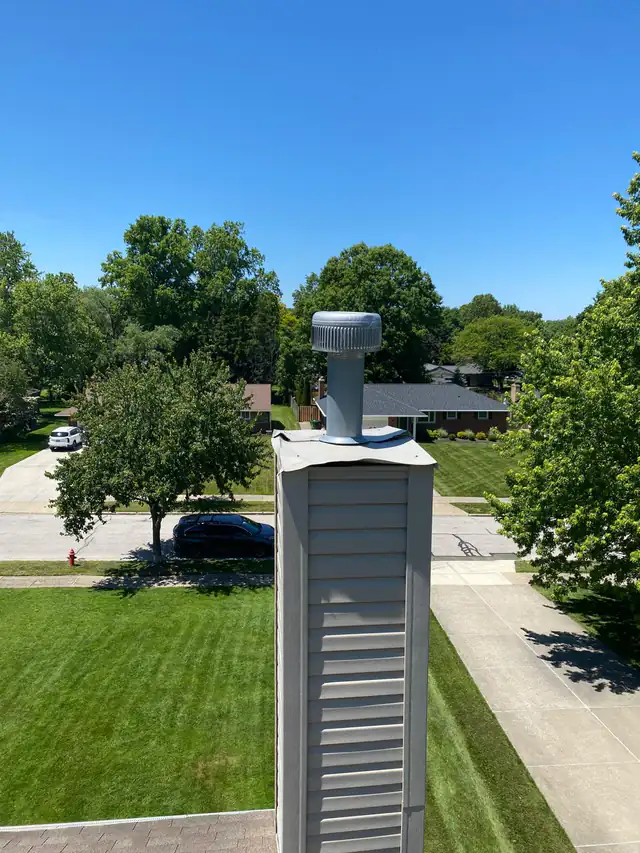
Before — the old chase cover, with bent and raised edges around the vent 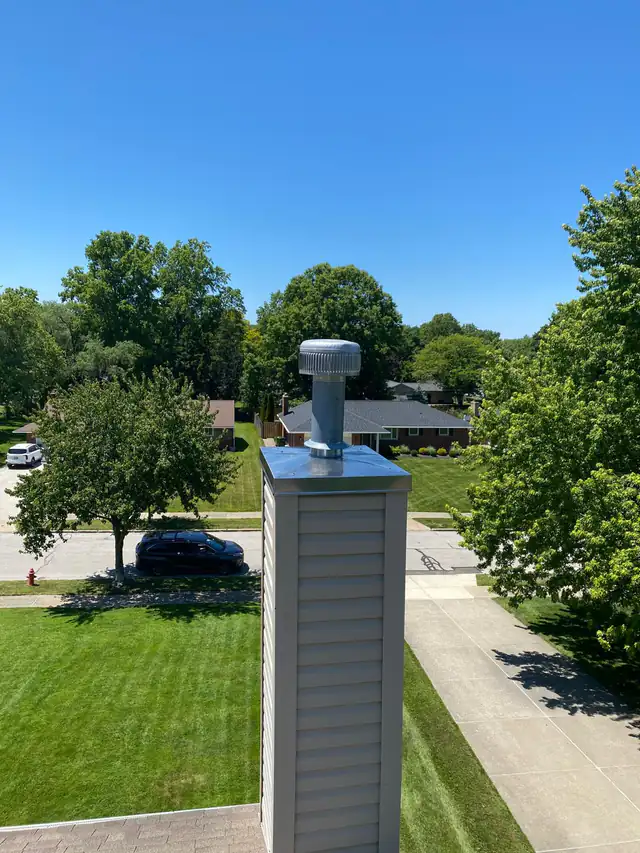
After — replacement chase cover fitted around the vent 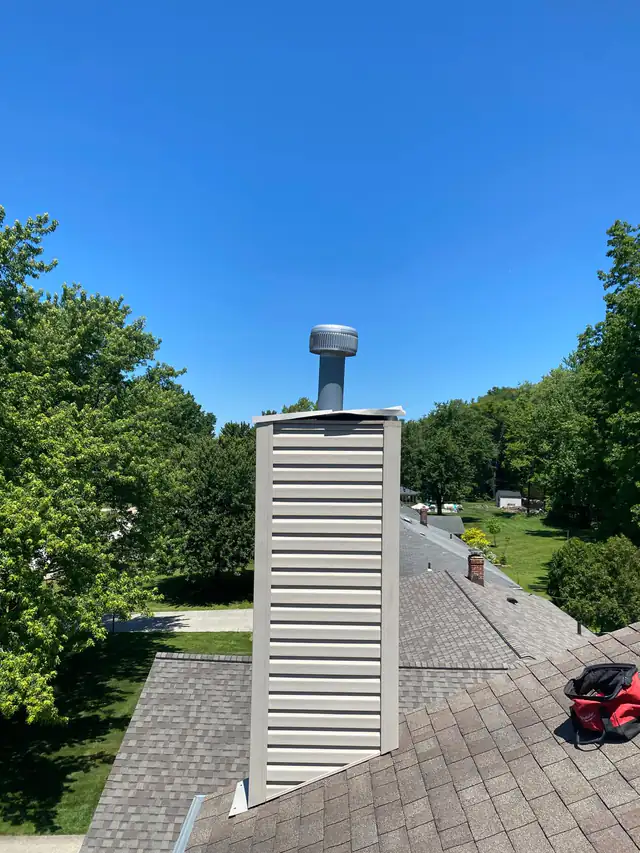
Before — the old cover from the roof side, with a raised edge 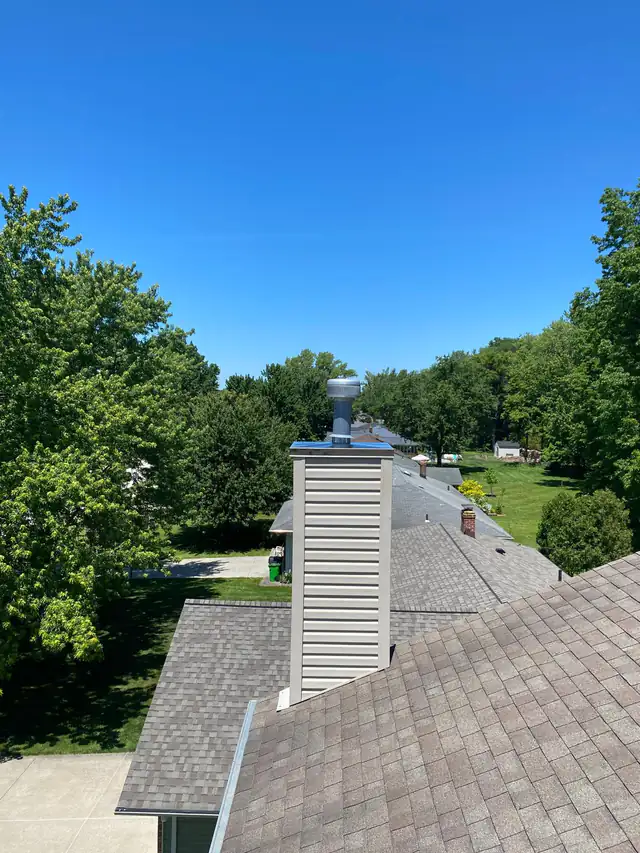
After — the replacement cover and chase, viewed from the roof
Meet the team
The people behind the work
Manny, Zack and Myke — meet the people behind Chimney Expert Solutions.
Our team and story →
Manny
Owner

Zack
Manager

Myke
Technician
FAQ
Chimney Leak Repair in Elyria: questions we hear
There's white powder on the chimney wall in our basement. Is that mold?
It is efflorescence — mineral salts left behind as water evaporates out of the masonry, not a biological growth. What matters is that it proves water is moving through the chimney. On this housing the entry point is nearly always at the top: a failed crown, a missing cap or open joints above the roof. Fixing the top stops the deposit; cleaning the wall alone just resets the clock.
Our sandstone chimney base is peeling off in flat sheets. What causes that?
Sandstone splits along the layers it was formed in. Once water gets into those layers and freezes, it lifts them apart, and the stone sheds in plates rather than crumbling. It is often worse where a block was set with its bedding running vertically rather than horizontally. The repair depends on how much section has been lost, and filling the face with mortar generally makes it worse rather than better.
How long does a chimney repellent last?
Vapor-permeable siloxane repellents on sound masonry are generally reapplied on a multi-year cycle rather than annually, and the exposure of the wall changes that a lot — a west-facing stack near the lake weathers faster than a sheltered interior one. Reapplication is straightforward when the masonry underneath has been kept sound, which is rather the point of doing the pointing first.
My roofer says it's the chimney and the chimney guy says it's the roof. Who's right?
That standoff almost always means flashing, the one joint where the two trades meet and neither owns it. We diagnose the whole intersection together — flashing, counterflashing, crown, cap and masonry — and give you one answer with photographs behind it. If the finding genuinely is the roof, we will tell you that too.
Free estimate
Chimney Leak Repair in Elyria?
Tell us what you’re seeing and we’ll call or text back to schedule a look — with photos of what we find and an honest read on what’s urgent and what can wait. That evidence-first method is the way we work on every job.
Call and tell us what the chimney's doing — if we're up on a roof, we'll call you back. Other ways to reach us are on the contact page, and Elyria is one of the communities we cover across Greater Cleveland.
Call216-647-1882