
Cuyahoga County, Ohio
Chimney Leak Repair & Waterproofing in Cleveland Heights, OH
Finding where the water actually gets in — crown, cap, flashing, masonry or condensation — and fixing that, not caulking symptoms.
What chimney leak repair involves in Cleveland Heights is set by the housing stock here: 1910s–20s Tudors and colonials with multiple fireplaces and tall, detailed multi-flue stacks — architectural chimneys on slate roofs, over clay flues that frequently need relining.
Cleveland Heights was built out as a streetcar suburb in the 1910s and 1920s, and the housing shows exactly that: brick Tudors, center-hall colonials and arts-and-crafts homes along Fairmount and through Cedar Fairmount, Coventry, Cedar Lee and the Forest Hill streets. These are houses with real masonry, and very often with more than one fireplace.
A leaking chimney is a symptom with at least five different causes, and fixing the wrong one is why so many chimney leaks come back. Water can enter through a cracked crown, a missing or undersized cap, failed flashing where the chimney meets the roof, saturated porous masonry, or condensation forming inside an oversized flue. Each of those has a different repair, and none of them is solved by sealant on whatever surface was easiest to reach. Our leak work starts with diagnosis at roof level and inside the house, so the fix targets the actual entry point.
What we find on Cleveland Heights chimneys that leads to chimney leak repair
Slate and tile roofs, which cannot be walked on
A great many Cleveland Heights houses have slate or clay tile roofs, and those roofs break under foot. That changes chimney work materially: access has to be staged with roof ladders or scaffolding rather than by walking up to the stack, protection under the work area matters more, and any flashing repair has to be done by someone who understands how the counterflashing ties into a slate field. A contractor who is casual about walking your slate is telling you something about the rest of the job.
Ornamental brickwork that a generic rebuild erases
Corbelled courses, banding, decorative caps and clay pots are why these chimneys look the way they do, and they are the first thing to disappear in a rebuild quoted by someone who does not intend to reproduce them. Every one of those details can be rebuilt: it takes photographs of the existing work before demolition and a willingness to match rather than simplify. On a visible Heights chimney we quote it that way by default and would rather lose the job than flatten the house.
The fixes, matched to the cause
- Cracked but structurally sound crown: a flexible elastomeric crown coating bridges the crazing and seals it for years.
- Failed or never-adequate crown: a full recast in reinforced concrete, with a drip edge overhanging the brick and an expansion joint around the flue tile so thermal movement does not crack it again.
- No cap or a failed cap: a stainless cap sized and anchored to the flue, with screen. This one repair often ends the leak entirely.
- Failed flashing: proper step flashing and counterflashing reset into a cut reglet in the mortar joint, not sealant over the old work. Where the roof is at the end of its life, this gets coordinated with the roofing rather than done twice.
- Open joints and spalled brick on the weather face: repointing and unit replacement, because a repellent over open joints is a waste of a product.
- Genuinely porous but sound masonry: a vapor-permeable siloxane-type water repellent that sheds driven rain while letting the wall dry outward.
- Condensation in an oversized flue: correctly sized liner, which is a relining job rather than a waterproofing one.
- A wide chimney with no cricket on the up-slope side: a cricket, the small saddle roof that diverts water and snow around the stack instead of letting it pool against it.
What drives the cost of leak work
- The diagnosis versus the repair. Finding the entry point is a defined piece of work; the fix depends entirely on what the finding is, which is why an honest quote for 'a chimney leak' cannot be given over the phone.
- Which component failed. A cap is a small job. A full crown recast is a bigger one. A complete re-flash with the roofing coordinated is bigger again.
- Roof access, pitch and material, as with all chimney work.
- Whether more than one entry point is active — which is common, because the conditions that kill a crown also kill flashing of the same age.
- How much interior damage there is. We do the chimney; drywall, plaster and framing repair inside is separate work and we will say so plainly rather than quietly including it.
- Whether the masonry needs pointing before any repellent is worth applying.
This page covers chimney leak repair as it plays out in Cleveland Heights. The full chimney leak repair & waterproofing page walks the whole job — every stage, what changes the scope, and what we do about each of them. For everything else we handle in this suburb, see chimney services in Cleveland Heights.
How we handle a leaking chimney
- Roof-level diagnosis: crown, cap, flashing, masonry and shoulder — photographed
- Interior check: firebox, smoke chamber and damper for staining, rust and damp
- Flashing repair or a full re-flash where the roofline seal has failed
- Crown repair or full recast with a drip edge and an expansion joint at the flue
- Vapor-permeable masonry repellent on porous brick — never paint or film-forming sealers
- An honest call on whether the 'leak' is actually flue condensation
- The fix in writing, matched to the diagnosed entry point
Our work
Chimney Leak Repair & Waterproofing, photographed on the job
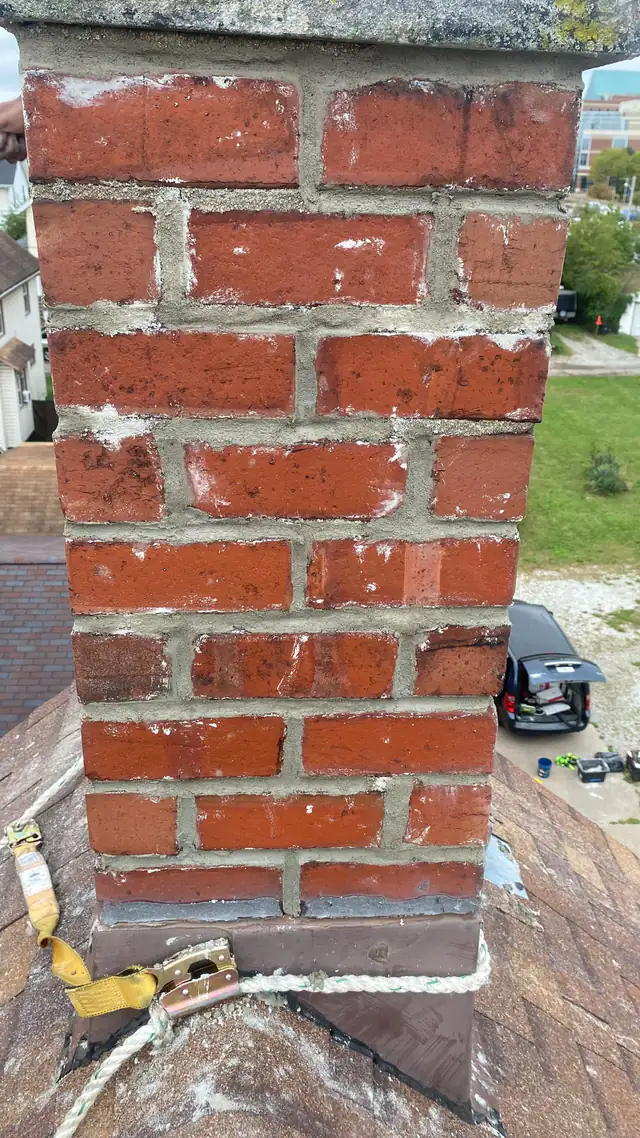
Roped in on a steep roof — repointed, flashing sealed 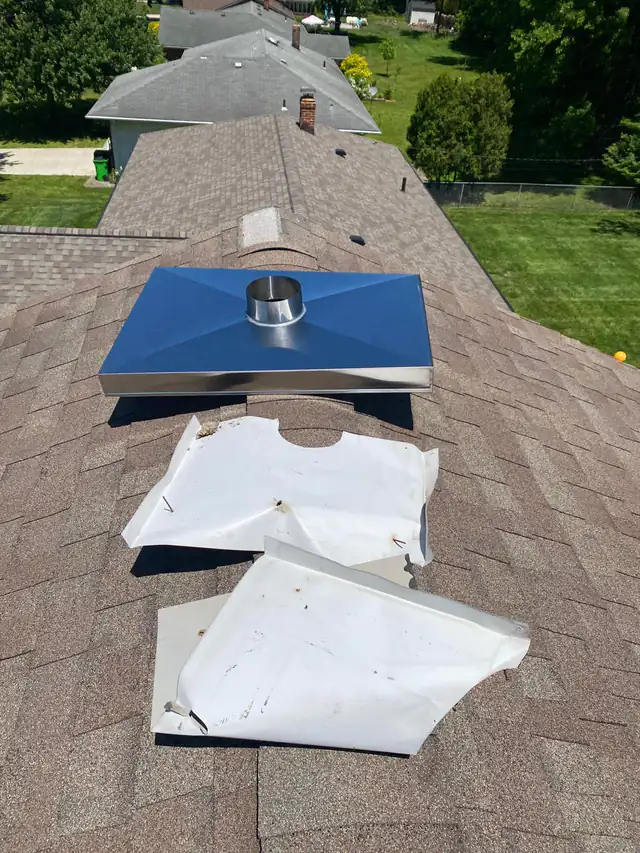
Replacement chase cover beside the removed cover sections on the roof 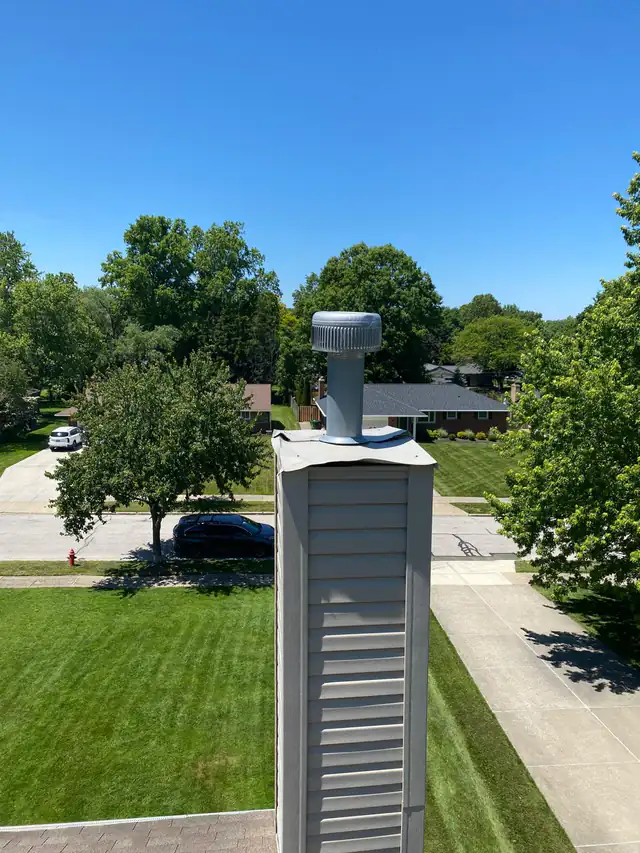
Before — the old chase cover, with bent and raised edges around the vent 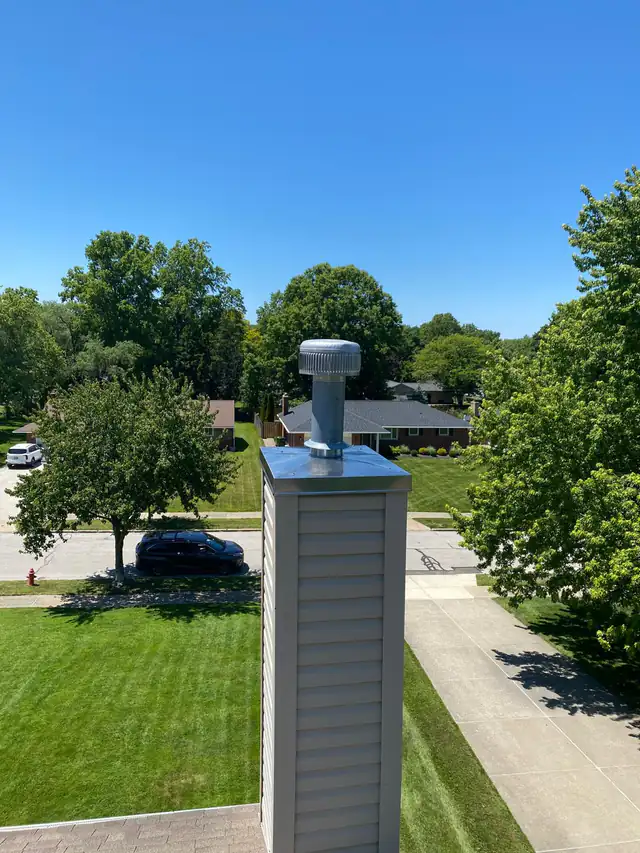
After — replacement chase cover fitted around the vent 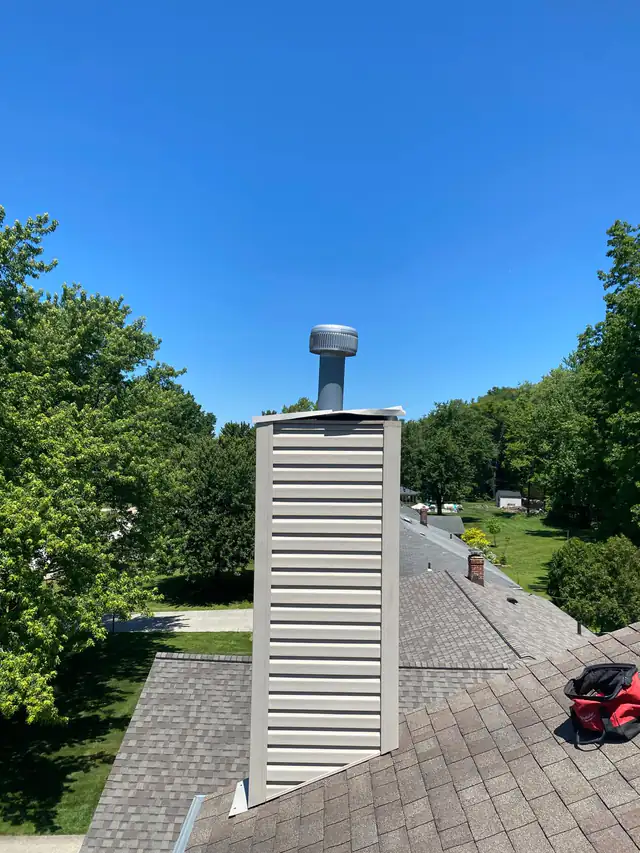
Before — the old cover from the roof side, with a raised edge 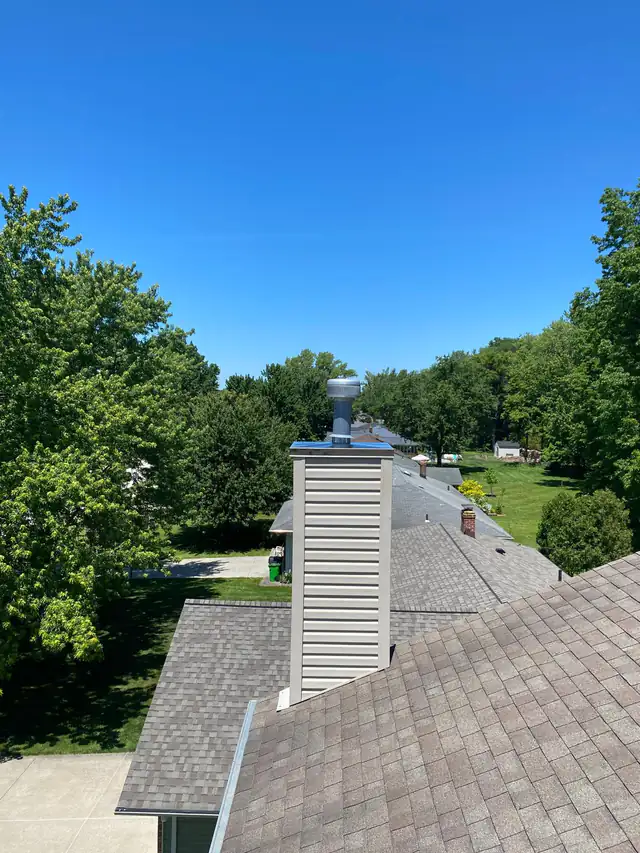
After — the replacement cover and chase, viewed from the roof
Meet the team
The people behind the work
Manny, Zack and Myke — meet the people behind Chimney Expert Solutions.
Our team and story →
Manny
Owner
Zack
Manager

Myke
Technician
FAQ
Chimney Leak Repair in Cleveland Heights: questions we hear
Our house has three flues in one chimney. Does each need its own service?
Each is inspected and treated on its own, because they age independently — in the Heights it is normal to find one flue in fair shape, one cracked and one abandoned. The efficiency is that one visit and one set-up covers all of them, and separate caps can often be replaced with a single custom multi-flue cover that also protects the crown.
The upstairs fireplace hasn't been used since we bought the house. Is that a problem?
It is unknown territory rather than a problem, which is the reason to scan it before lighting anything. Long-unused Heights flues commonly turn out to contain nests, a damper rusted shut, cracked tile from a fire nobody documented, or an abandoned connection left open. Any of those is straightforward to deal with once it is on camera.
We have a slate roof. Will chimney work damage it?
Not if the job is planned for slate from the start. It means no walking the field, staging or roof ladders for access, protection laid under the work zone, and flashing detailed the way slate requires. Broken slates from careless chimney access are a common and entirely avoidable expense, and it is a fair question to ask before hiring anyone.
Can you fix a chimney leak in winter?
Some of it. Caps, some flashing work and temporary measures can be done in cold weather. Anything involving mortar or a concrete crown recast needs sustained temperatures above roughly 40°F to cure, so a winter diagnosis often means a temporary fix now and the permanent one in spring. We will tell you which category yours is in rather than laying masonry that will not set.
How long does a chimney repellent last?
Vapor-permeable siloxane repellents on sound masonry are generally reapplied on a multi-year cycle rather than annually, and the exposure of the wall changes that a lot — a west-facing stack near the lake weathers faster than a sheltered interior one. Reapplication is straightforward when the masonry underneath has been kept sound, which is rather the point of doing the pointing first.
Free estimate
Chimney Leak Repair in Cleveland Heights?
Tell us what you’re seeing and we’ll call or text back to schedule a look — with photos of what we find and an honest read on what’s urgent and what can wait. That evidence-first method is the way we work on every job.
Call and tell us what the chimney's doing — if we're up on a roof, we'll call you back. Other ways to reach us are on the contact page, and Cleveland Heights is one of the communities we cover across Greater Cleveland.
Call216-647-1882