
Lorain County, Ohio
Chimney Leak Repair & Waterproofing in Lorain, OH
Finding where the water actually gets in — crown, cap, flashing, masonry or condensation — and fixing that, not caulking symptoms.
What chimney leak repair involves in Lorain is set by the housing stock here: Dense mill and harbor-era housing with an unusual concentration of 1920s rebuilding — small stacks with hollow-tile backup, open lake exposure from the north, and flues that have outlived several generations of heating equipment.
Lorain is a mill and harbor city at the mouth of the Black River, and its housing tells that story block by block: dense, modest, closely spaced houses built for people who worked the steel plant and the shipyards, laid out in tight grids from the waterfront south, with more spacious later neighborhoods further out. These are small houses with small chimneys, and they were built to a budget by people who did not waste material.
A leaking chimney is a symptom with at least five different causes, and fixing the wrong one is why so many chimney leaks come back. Water can enter through a cracked crown, a missing or undersized cap, failed flashing where the chimney meets the roof, saturated porous masonry, or condensation forming inside an oversized flue. Each of those has a different repair, and none of them is solved by sealant on whatever surface was easiest to reach. Our leak work starts with diagnosis at roof level and inside the house, so the fix targets the actual entry point.
What we find on Lorain chimneys that leads to chimney leak repair
Hollow clay tile behind the brick face
Structural clay tile — hollow rectangular blocks — was a common, economical backup material in this era, used behind a single wythe of face brick in walls and in chimneys. It is not a bad material, but it fails differently from solid masonry. Water that gets past the brick collects in the hollow cells, freezes, and breaks the thin webs inside the tile where nobody can see it, so a chimney can be substantially hollowed out internally while the outside face still looks presentable. When a stack like this finally moves, it moves suddenly. Finding it changes the assessment, which is why we look at what is behind the face rather than just at it.
A whole cohort of chimneys the same age
Where a city rebuilds after a disaster, it rebuilds fast and it rebuilds all at once. That is useful to know because it makes the condition of your neighbors' chimneys genuinely informative about your own in a way it usually is not — same year, same brick, same mortar, same crown detail, same hundred winters. When we start seeing the same failure at the same height on the same brick across several blocks, it is not a coincidence and it is not bad luck. It means a design life has been reached, and the sensible move is to get ahead of it rather than wait for the pieces to land in the yard.
Small stacks, small flues, and a modern appliance
These houses were built with a single modest chimney sized around a coal-burning heating plant and, in some cases, a kitchen range. Every conversion since — coal to gas, gravity to forced air, standard furnace to high-efficiency — changed what the flue is being asked to do without changing the flue. What is left in a lot of Lorain basements is an appliance connected to a masonry flue that is either far too large for it, or in a couple of cases genuinely too small, with a connector arrangement improvised in whichever decade the last change happened. It wants sizing properly and lining to match, and the basement is where that assessment starts.
What water does if the leak is left
The stain on the ceiling is the least of it. Once water has an established route into a chimney, three things happen in parallel. The masonry deteriorates faster, because every wet freeze widens the path the water is already using. The framing around the chimney takes moisture it was never designed to take, and rot in a concealed chase around a chimney is both slow and expensive to find. And inside the flue, water attacks mortar joints between the flue tiles, so a water problem at the top becomes a liner problem in the middle.
There is a fourth, less obvious one: a chimney with water in it smells. The musty odour that shows up in a fireplace in warm weather is damp deposits, and it is a reliable early sign of a water path that has not yet produced a visible stain. Leak repairs sit near the top of the fix-this-season list, not because a small stain is an emergency, but because the path is established and Cleveland winters are very good at widening established paths.
The five ways water gets into a chimney
Every chimney leak comes down to one or more of these. The diagnosis is figuring out which, and the honest ones are often a combination.
The crown
The slab that seals the top of the stack around the flue tiles. Most crowns on older Cleveland chimneys were struck flat out of leftover mortar on the day the chimney was finished, with no overhang and no expansion gap around the tile. Mortar is not a weatherproofing material and it cracks, usually radially from the flue outward, and once it does the crown is delivering water directly into the top of the brickwork. This is the single most common source of a chimney leak in this market.
The cap, or its absence
An uncapped flue is an open pipe pointed at the sky. Every rain puts water straight down inside it, onto the smoke shelf, into the firebox, and onto whatever masonry it touches on the way. A surprising number of chimneys in Greater Cleveland have never had a cap. Undersized or poorly fitted caps and rusted-through caps produce the same result more slowly.
Flashing
Where the chimney passes through the roof plane, the seal is made by step flashing woven into the shingle courses and counterflashing let into the mortar joints above it. Both parts have to be right. What we find instead, constantly, is a bead of roofing cement smeared over the joint by someone in a hurry, which lasts a couple of seasons and then cracks. Flashing is the classic leak nobody owns, because it is the exact point where the roofing trade and the masonry trade meet.
Porous or open masonry
Brick and mortar absorb water by design. When the joints have opened up or the brick faces have spalled, the absorption stops being harmless. On a wind-driven rain, water can be pushed into the wall of a stack faster than it can dry, travel through the masonry, and appear inside the house. This is the leak that only shows up in certain weather, which is what makes it confusing.
Condensation, which is not a leak at all
Sometimes the water inside the chimney was never rain. An oversized flue serving a modern appliance runs below its exhaust dew point and condenses moisture on its own walls, which runs down and appears as dampness at the base. The give-away is that it correlates with cold weather and appliance run time rather than with rain. Sealing the outside of that chimney does nothing, which is why condensation is one of the more commonly mis-diagnosed conditions in the trade.
This page covers chimney leak repair as it plays out in Lorain. The full chimney leak repair & waterproofing page walks the whole job — every stage, what changes the scope, and what we do about each of them. For everything else we handle in this suburb, see chimney services in Lorain.
How we handle a leaking chimney
- Roof-level diagnosis: crown, cap, flashing, masonry and shoulder — photographed
- Interior check: firebox, smoke chamber and damper for staining, rust and damp
- Flashing repair or a full re-flash where the roofline seal has failed
- Crown repair or full recast with a drip edge and an expansion joint at the flue
- Vapor-permeable masonry repellent on porous brick — never paint or film-forming sealers
- An honest call on whether the 'leak' is actually flue condensation
- The fix in writing, matched to the diagnosed entry point
Our work
Chimney Leak Repair & Waterproofing, photographed on the job
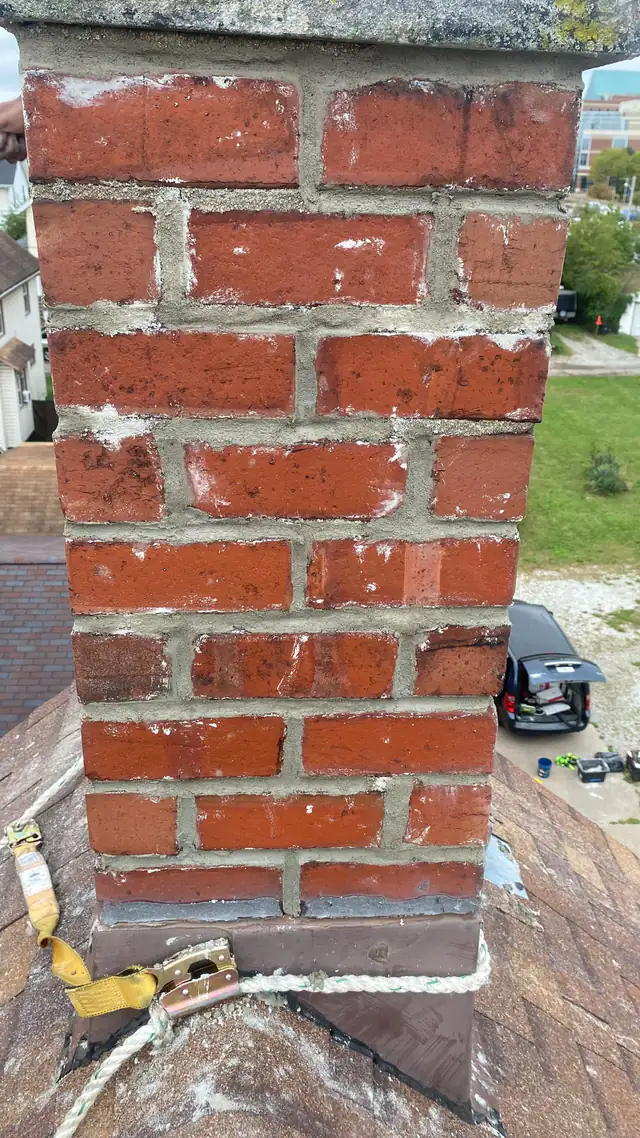
Roped in on a steep roof — repointed, flashing sealed 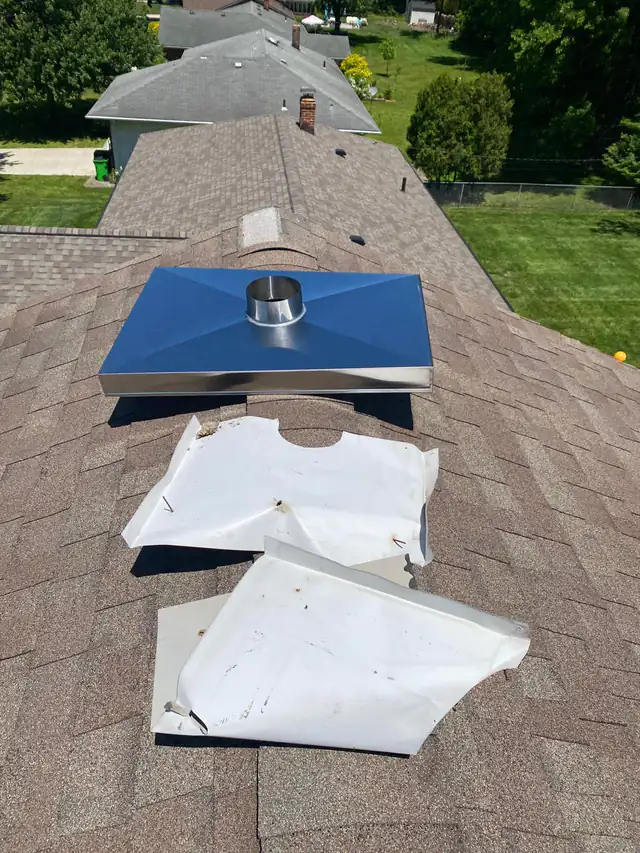
Replacement chase cover beside the removed cover sections on the roof 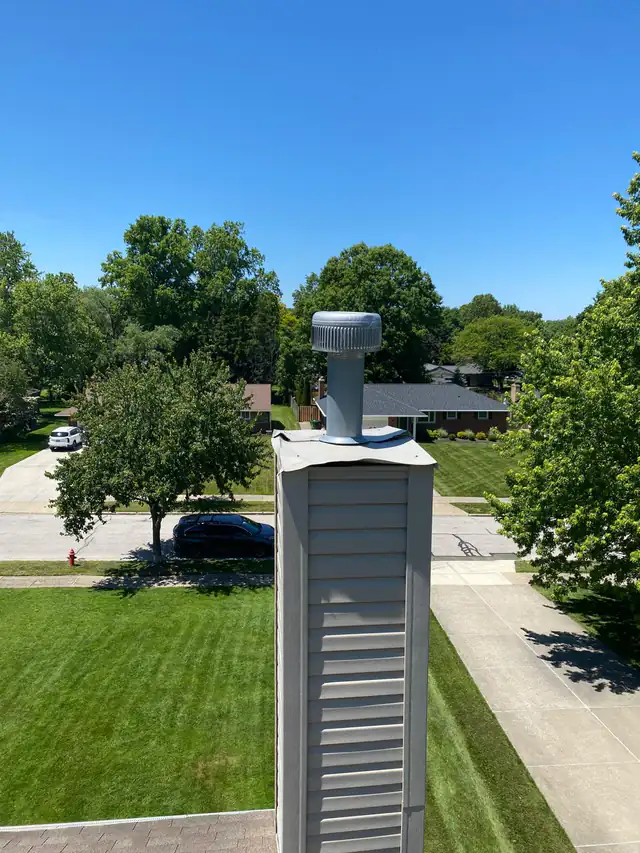
Before — the old chase cover, with bent and raised edges around the vent 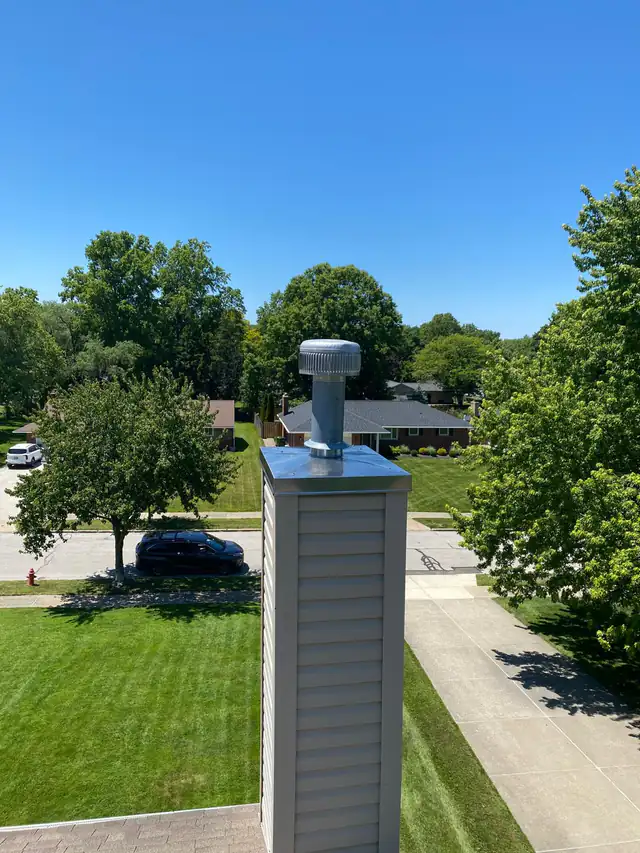
After — replacement chase cover fitted around the vent 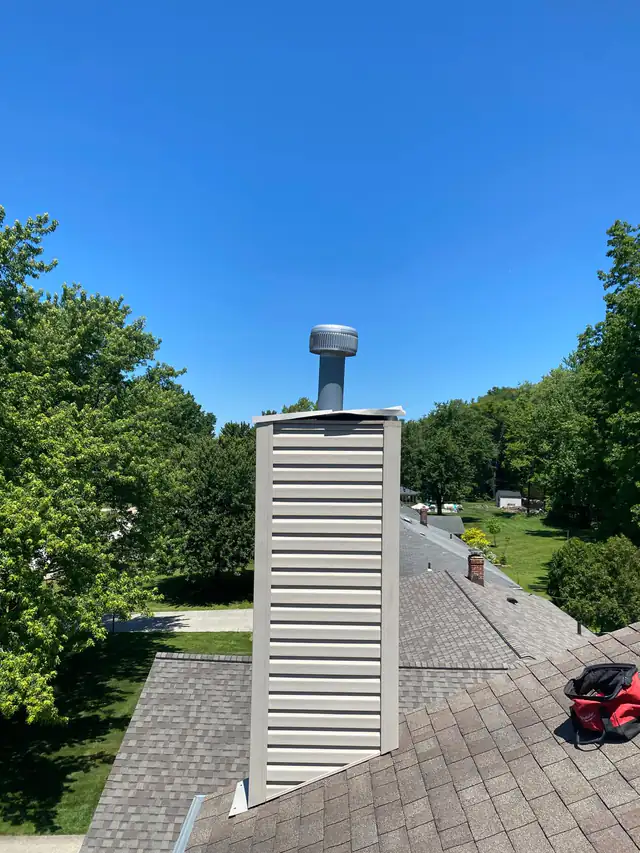
Before — the old cover from the roof side, with a raised edge 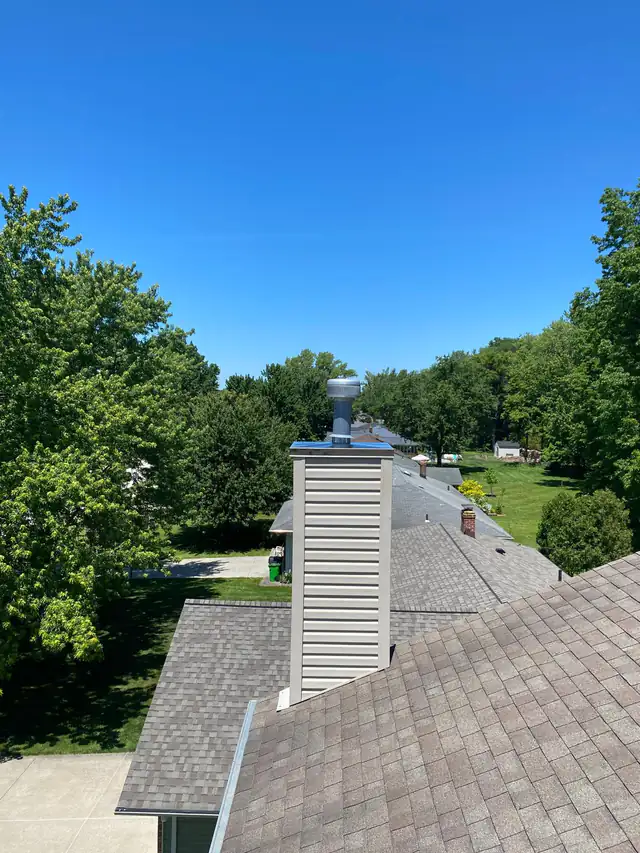
After — the replacement cover and chase, viewed from the roof
Meet the team
The people behind the work
Manny, Zack and Myke — meet the people behind Chimney Expert Solutions.
Our team and story →
Manny
Owner

Zack
Manager

Myke
Technician
FAQ
Chimney Leak Repair in Lorain: questions we hear
Does the lakefront exposure matter for a chimney a few streets back?
Some. The open north exposure means driven rain and snow reach the stack with force rather than falling on it, and it concentrates on one face. The practical effect is asymmetric wear — one side of a chimney much worse than the other — and a shorter useful life for caps and crowns. It is a reason to check the top of the chimney on a regular schedule rather than waiting for a symptom indoors.
How can a chimney look fine and still be unsound?
It happens most often where the stack is built with hollow clay tile behind a brick face. Water gets in, freezes in the hollow cells and breaks the internal webs, so the structure is being eaten from the inside while the visible face stays reasonably intact. It is one of the reasons a proper assessment includes the top, the interior of the flue and the base rather than a look from the driveway.
My roofer says it's the chimney and the chimney guy says it's the roof. Who's right?
That standoff almost always means flashing, the one joint where the two trades meet and neither owns it. We diagnose the whole intersection together — flashing, counterflashing, crown, cap and masonry — and give you one answer with photographs behind it. If the finding genuinely is the roof, we will tell you that too.
Can you fix a chimney leak in winter?
Some of it. Caps, some flashing work and temporary measures can be done in cold weather. Anything involving mortar or a concrete crown recast needs sustained temperatures above roughly 40°F to cure, so a winter diagnosis often means a temporary fix now and the permanent one in spring. We will tell you which category yours is in rather than laying masonry that will not set.
Free estimate
Chimney Leak Repair in Lorain?
Tell us what you’re seeing and we’ll call or text back to schedule a look — with photos of what we find and an honest read on what’s urgent and what can wait. That evidence-first method is the way we work on every job.
Call and tell us what the chimney's doing — if we're up on a roof, we'll call you back. Other ways to reach us are on the contact page, and Lorain is one of the communities we cover across Greater Cleveland.
Call216-647-1882