
Greater Cleveland
Chimney Tuckpointing in Cleveland, OH
Grinding out failed mortar joints and repacking them properly — matched in strength, color and profile, not smeared over the brick.
Mortar is the chimney's sacrificial material. It is deliberately softer than the brick so that movement, moisture and salt damage happen in the joint, where they can be replaced, instead of in the units, where they cannot. On a Cleveland chimney the joints take the worst of the lake weather, and after enough freeze-thaw cycles they go soft, sandy and open. Repointing at the right moment is what keeps a repairable chimney from becoming a rebuild.
Done properly it means cutting each failed joint out to sound depth and repacking it in layers with mortar matched to the original in strength, color and joint profile. Done the way it is too often done in this market, it means buttering fresh mortar over the face of old failed joints, where it flakes off within a few winters and hides the deterioration underneath in the meantime. The two jobs look similar from the ground on the day they are finished, and nothing alike after three winters.
How to tell your joints have failed
The scratch test settles it in about ten seconds. Take a key or a screwdriver to a joint. If it rakes out as powder or sand, the binder in the mortar is gone and the joint is open to water regardless of how it looks. Sound mortar resists a key.
The other signs are visual. Joints recessed noticeably back from the face of the brick. Missing sections. Mortar crumbs and sand collecting on the roof or at the base of the stack after rain. Hairline leaks inside that appear only in wind-driven rain, which is water coming through the wall rather than over the top of it. And gaps you can see daylight or sky through at the top courses, which is past repointing.
How repointing is supposed to be done
Cutting out
Each failed joint is ground or raked back to sound mortar, typically to a depth of about two to two and a half times the joint width. Anything shallower does not give the new mortar enough surface to bond to and it will pop out. This is the step that gets skipped, because it is by far the most labor in the job. On soft pre-war brick it is also the step that requires care — an aggressive grinder in the hands of someone in a hurry takes the edges off the brick and you can see it forever.
Matching the mortar
Strength first, appearance second. The new mortar has to be no harder than the original and no harder than the brick, which on pre-war Cleveland masonry usually means a lime-rich mix rather than a modern Portland-heavy one. Then color: mortar can be tinted and sand can be matched, and a joint that is bright gray against ninety-year-old buff mortar is a permanent visual repair scar on a visible chimney.
Packing and tooling
Mortar goes in compacted, in layers rather than one deep fill, so it consolidates against the sides of the joint. Then it is tooled to match the original profile once it has reached the right stiffness — concave, weathered, raked or flush, depending on what the wall has. The profile is not decoration; a weathered or concave joint sheds water and a badly struck one holds it.
Mortar hardness on pre-war brick: the local mistake
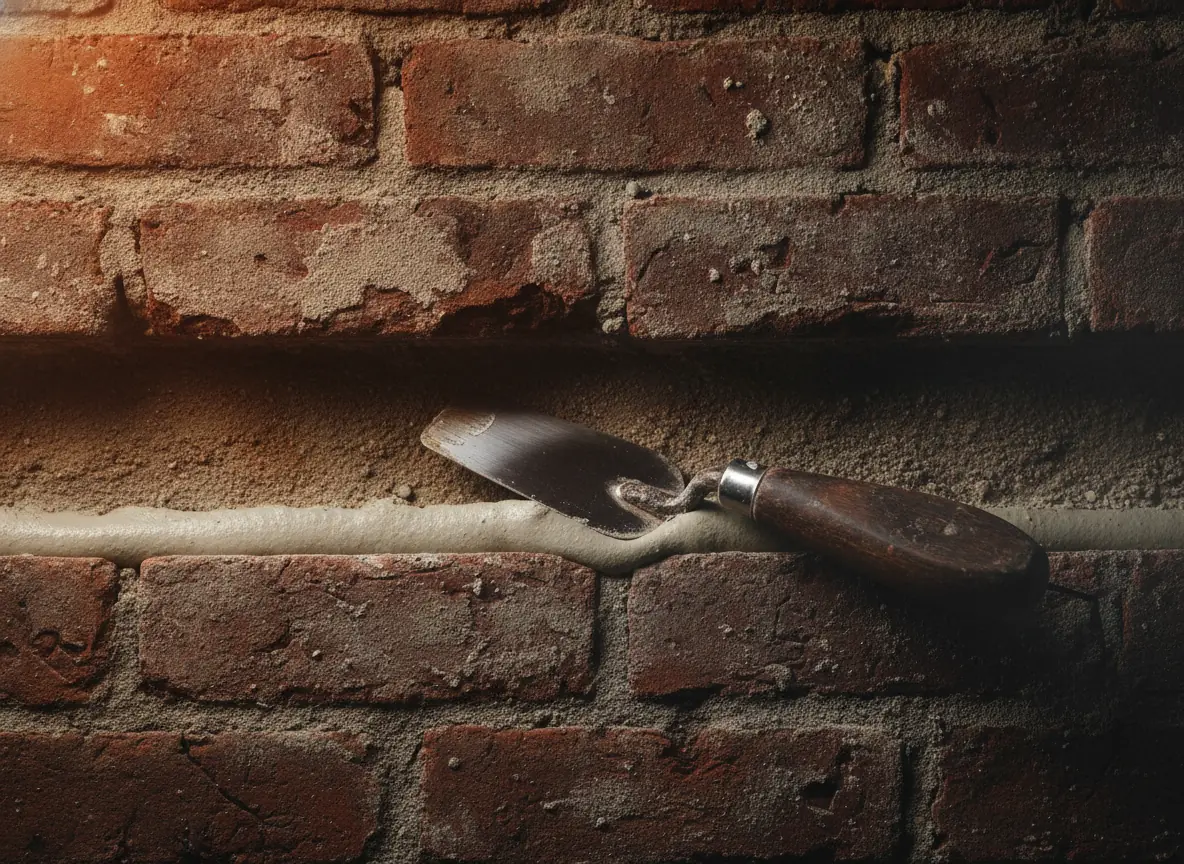
This deserves its own section because it causes a large share of the spalling on pre-war chimneys in Lakewood, Cleveland Heights, Shaker Heights and the older Cleveland neighborhoods. Brick fired before the war is generally softer and more porous than modern brick, and it was laid in soft lime mortar. That system works because the joint is the weak point: it absorbs movement and it lets moisture escape.
Repoint that wall with hard modern Portland-heavy mortar and you invert the relationship. Now the joint is stronger than the brick. Thermal movement, freeze expansion and moisture all have to go somewhere, and the only available path is through the brick faces. They spall. The repair accelerates the damage it was meant to stop, and it does it slowly enough that nobody connects the two. On an older chimney, the mortar mix is a real engineering decision.
What drives the cost
- Area. Spot-pointing a few failed joints and repointing all four faces of a tall stack are different jobs.
- Height and access, including whether staging is needed and whether the roof can be walked on.
- How far the joints have gone. Deeply eroded joints need more cutting and more material.
- Whether brick units also need replacing, which is common once joints have been open a while.
- Matching. A visible chimney on a period house needs a color and profile match; a utility stack behind a garage does not.
- Whether the crown and cap need doing at the same time, which they often do, and which is cheaper to combine while the access is already set up.
Timing it in Northeast Ohio
Mortar needs sustained temperatures above roughly 40°F to cure, so repointing runs about April through November here, with the shoulders depending on the actual weather. Fresh mortar that freezes before it sets does not recover.
The scheduling logic is simple: joints found in winter get booked for spring; joints found in fall get booked now, because the masonry season and the calendar year run out together and an open joint is an active water path through every freeze between now and April.
How we repoint
- Joints ground or raked to sound depth — no skim-coating over failure
- Mortar matched to the original in hardness, color and profile
- Lime-appropriate mortar on pre-war soft brick
- Spot brick replacement where units have spalled past saving
- Water management reviewed while we're up there — crown, cap, flashing
- Before and after photos of the joints, not just of the chimney
Our work
Tuckpointing & Repointing, photographed on the job
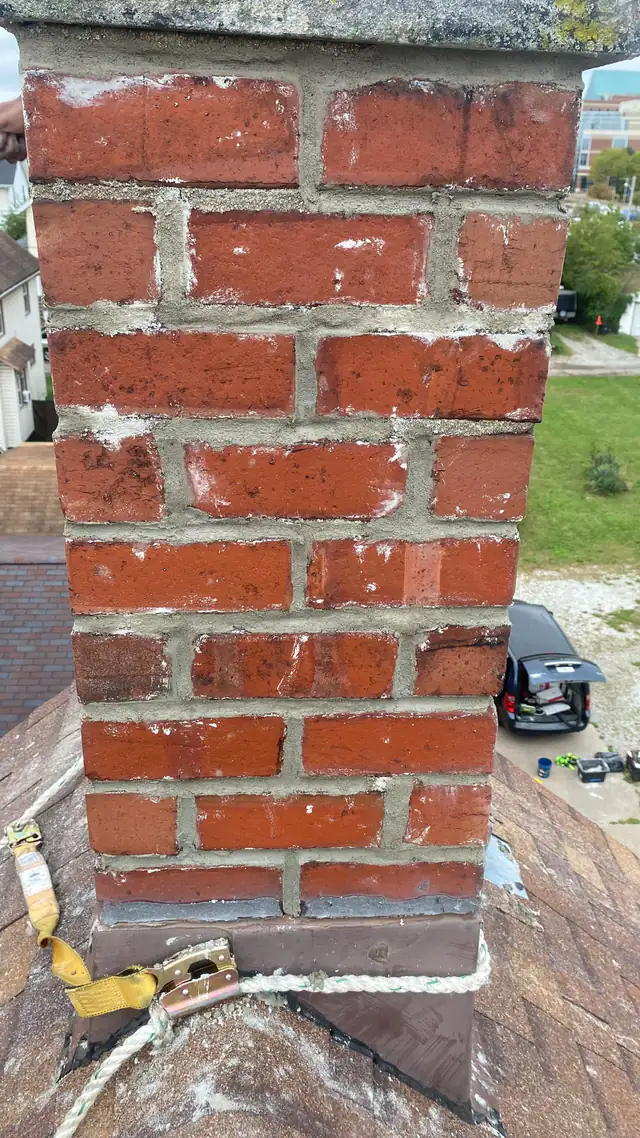
Roped in on a steep roof — repointed, flashing sealed 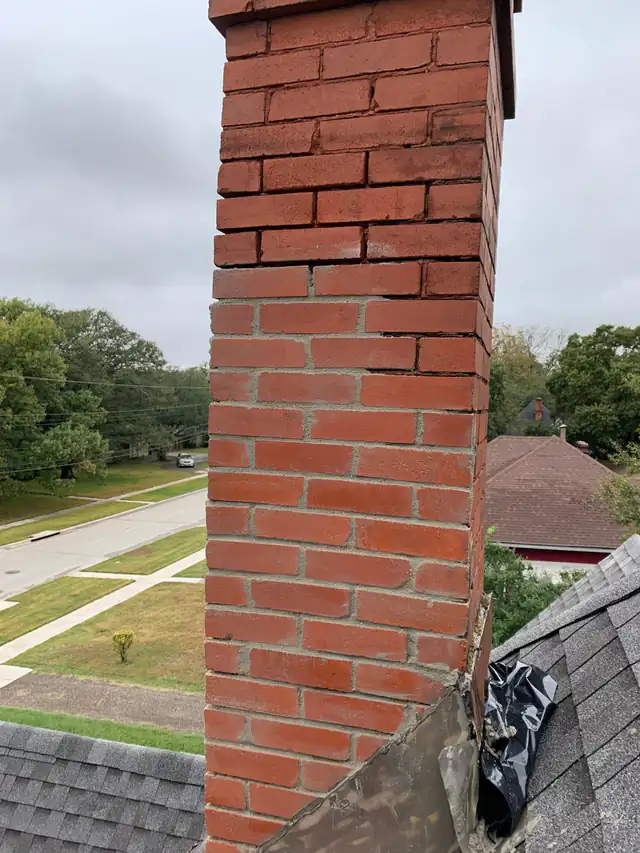
Mid-job — fresh joints below, the old eroded joints still waiting above
Meet the team
The people behind the work
Manny, Zack and Myke — meet the people behind Chimney Expert Solutions.
Our team and story →
Manny
Owner
Zack
Manager

Myke
Technician
FAQ
Tuckpointing & Repointing: questions we hear
Is tuckpointing the same as repointing?
In everyday use around here, yes — both mean cutting out failed mortar and replacing it. Strictly, tuckpointing is a historical decorative technique using two mortar colors to imitate fine joints. Nobody in this market is selling you that, and it is worth knowing so you are not confused by a contractor who insists on the distinction.
Can you repoint just one face of the chimney?
Often yes, and sometimes it is the right answer, because the weather-facing side of a stack genuinely deteriorates faster than the sheltered side. Where it stops being sensible is when the difference is small — setting up access twice costs more than doing all four faces once.
Will new mortar match the old exactly?
Close, not identical. Color can be matched with tinting and sand selection and the profile can be reproduced, but new mortar cures lighter and then weathers in over a couple of seasons. On a highly visible chimney we will show you a sample against the existing wall before doing the whole stack rather than asking you to trust the result.
How long should a proper repointing job last?
Correctly cut-out, correctly matched joints on a chimney with a sound crown and cap are a multi-decade repair, and the crown and cap are half of that sentence. Repointing a stack that is still taking water in from the top is the most common way a good repointing job gets a bad reputation.
Where we do this work
Tuckpointing & Repointing across Greater Cleveland
We handle this work in every community we cover. The rest of our Greater Cleveland service area is on the areas page.
- Cleveland
- Lakewood
- Cleveland Heights
- Shaker Heights
- Parma
- Rocky River
- Westlake
- Strongsville
- Euclid
- South Euclid
- University Heights
- Beachwood
- Bedford
- Garfield Heights
- North Olmsted
- Mentor
- Willoughby
- Painesville
- Chardon
- Elyria
- Lorain
- Avon Lake
- Medina
- Brunswick
- Akron
- Cuyahoga Falls
- Hudson
- Kent
- Canton
- Wooster
- Warren
- Youngstown
- Boardman
- Sandusky
- Mansfield
- Ashland
Free estimate
Get this looked at properly
Describe what you're seeing and we'll call or text back to schedule. Photos of what we find, honest triage, and a written scope before any work starts — that method is the whole of how we work.
Call and tell us what the chimney's doing — if we're up on a roof, we'll call you back. All the ways to reach us are on the contact page.
Call216-647-1882