
Cuyahoga County, Ohio
Chimney Leak Repair & Waterproofing in Garfield Heights, OH
Finding where the water actually gets in — crown, cap, flashing, masonry or condensation — and fixing that, not caulking symptoms.
What chimney leak repair involves in Garfield Heights is set by the housing stock here: 1920s–50s brick bungalows and Capes with warm interior stacks — decades of tar and roof-cement patching, leaks that surface at second-floor ceilings, and flues repurposed after heating conversions.
Garfield Heights sits on the high ground east of the Cuyahoga valley, above Mill Creek and the Garfield Park Reservation, and its housing is largely the brick bungalow and Cape Cod belt of the 1920s through the 1950s along Turney, Granger and the streets between them. It is well-built, unpretentious housing, and the chimneys are the same: a single sturdy interior stack, a fireplace flue on some houses and not on others, and a heating flue that has been in service continuously for the better part of a century.
A leaking chimney is a symptom with at least five different causes, and fixing the wrong one is why so many chimney leaks come back. Water can enter through a cracked crown, a missing or undersized cap, failed flashing where the chimney meets the roof, saturated porous masonry, or condensation forming inside an oversized flue. Each of those has a different repair, and none of them is solved by sealant on whatever surface was easiest to reach. Our leak work starts with diagnosis at roof level and inside the house, so the fix targets the actual entry point.
What we find on Garfield Heights chimneys that leads to chimney leak repair
An interior stack leaks in the wrong place
When an exterior chimney leaks, you get a stain at the flashing and everyone knows where to look. When an interior stack leaks, water comes in at the crown or an uncapped flue, runs down inside the masonry, and appears as a stain on a second-floor ceiling, a damp patch on the chimney breast, or white efflorescence blooming on plaster in a bedroom — several feet from the roof and nowhere near a roof penetration. People replace roofs over this. The diagnosis runs top-down: crown, cap, flue condition, then the interior evidence, photographed together so the path is visible rather than asserted.
Roof cement and tar applied as a chimney repair
Black roof cement smeared over a cracked crown, around a flue tile, or across a spalled brick face is the most common thing we find on these stacks, often two or three layers of it from different decades. It is not a repair. It is impermeable, so the water already in the masonry cannot get out and the masonry cannot dry; it is far more rigid than the brick, so it cracks and debonds at the edges and channels water into the joint; and it hides the actual condition underneath. Chimneys that have been tarred for twenty years are usually in worse shape than untouched ones, and the scope of the real repair starts with removing it.
Clothes dryers vented into an unused flue
It happens more here than most places, usually because the house had a spare flue after a heating conversion and a dryer needed to go somewhere. It is a bad arrangement on every count. A dryer produces a large volume of warm, wet, lint-laden air with a weak fan behind it; a masonry flue is rough, cold, and often much larger than the duct, so the air slows, the moisture condenses, and lint packs into the joints and the offsets where it cannot be reached. That is a fire load in a chimney and a moisture load in the masonry at the same time. A dryer belongs in smooth rigid metal duct going the shortest reasonable path to the outdoors.
What water does if the leak is left
The stain on the ceiling is the least of it. Once water has an established route into a chimney, three things happen in parallel. The masonry deteriorates faster, because every wet freeze widens the path the water is already using. The framing around the chimney takes moisture it was never designed to take, and rot in a concealed chase around a chimney is both slow and expensive to find. And inside the flue, water attacks mortar joints between the flue tiles, so a water problem at the top becomes a liner problem in the middle.
There is a fourth, less obvious one: a chimney with water in it smells. The musty odour that shows up in a fireplace in warm weather is damp deposits, and it is a reliable early sign of a water path that has not yet produced a visible stain. Leak repairs sit near the top of the fix-this-season list, not because a small stain is an emergency, but because the path is established and Cleveland winters are very good at widening established paths.
How we find which one it is
The diagnosis is systematic, because guessing is what produces repeat leaks. We start with what you can tell us: where the stain is, whether it appears in every rain or only in wind-driven rain, whether it correlates with snow melt, whether it started after a roof was done. That pattern narrows the list before anyone gets on a ladder. Sustained rain of any direction points at flashing or crown. Only wind-driven rain from one direction points at masonry on the weather face. Cold weather with no rain points at condensation. Snow melt at the roofline points at ice damming interacting with the flashing.
Then it is roof level: crown photographed and examined for cracks and for whether it has any overhang at all, cap condition and fit, flue tile terminations, flashing and counterflashing inspected at the joint rather than from six feet away, and the masonry faces looked over for open joints and spalling with attention to the side the weather comes from. Inside, the firebox, smoke chamber and damper get checked for water staining, rust and damp, and the ceiling or wall stain gets traced back to where it plausibly originates rather than where it appears.
You get the photographs, and the diagnosis explains itself. That matters more here than on almost any other chimney job, because leak repair is the area of this trade where guesswork is most often sold as expertise.
This page covers chimney leak repair as it plays out in Garfield Heights. The full chimney leak repair & waterproofing page walks the whole job — every stage, what changes the scope, and what we do about each of them. For everything else we handle in this suburb, see chimney services in Garfield Heights.
How we handle a leaking chimney
- Roof-level diagnosis: crown, cap, flashing, masonry and shoulder — photographed
- Interior check: firebox, smoke chamber and damper for staining, rust and damp
- Flashing repair or a full re-flash where the roofline seal has failed
- Crown repair or full recast with a drip edge and an expansion joint at the flue
- Vapor-permeable masonry repellent on porous brick — never paint or film-forming sealers
- An honest call on whether the 'leak' is actually flue condensation
- The fix in writing, matched to the diagnosed entry point
Our work
Chimney Leak Repair & Waterproofing, photographed on the job
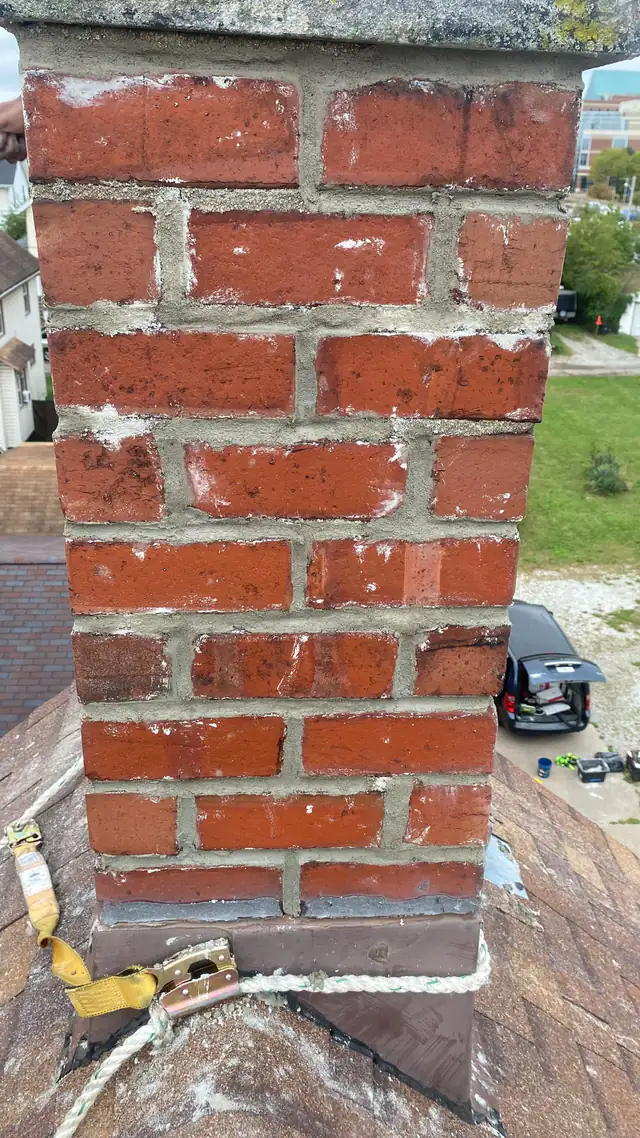
Roped in on a steep roof — repointed, flashing sealed 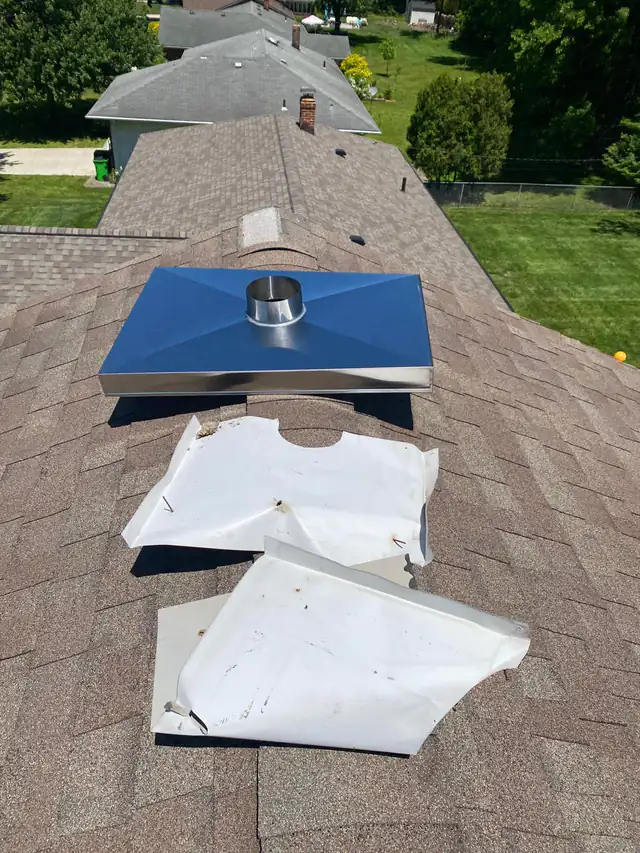
Replacement chase cover beside the removed cover sections on the roof 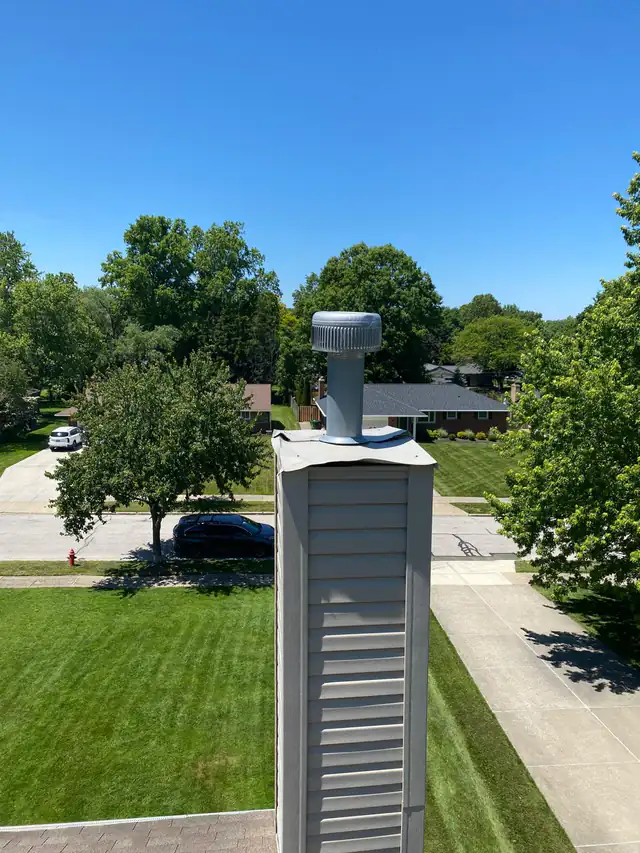
Before — the old chase cover, with bent and raised edges around the vent 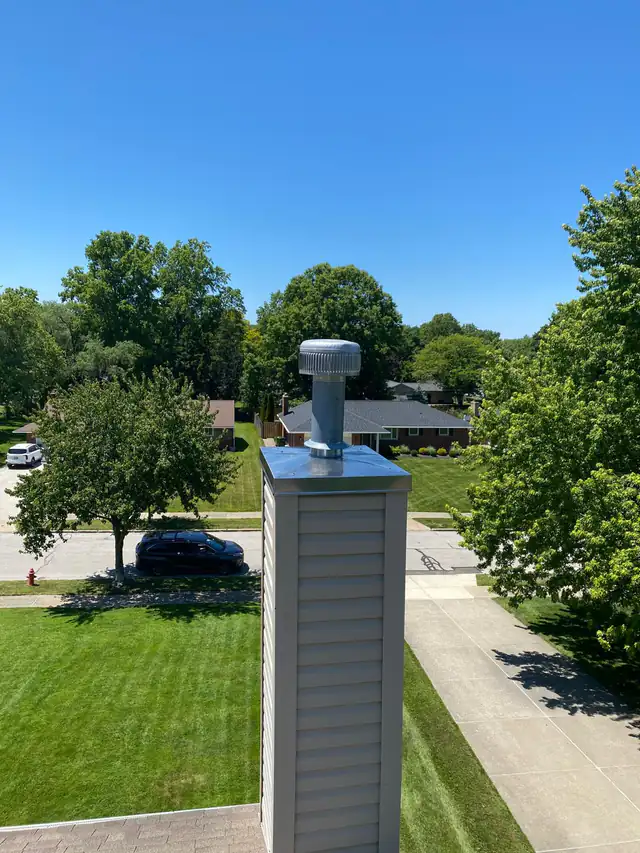
After — replacement chase cover fitted around the vent 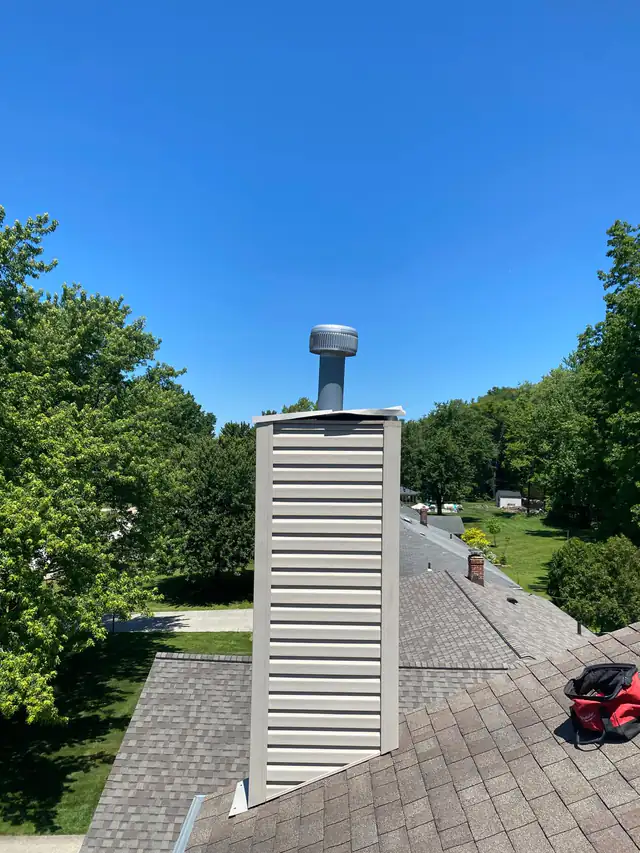
Before — the old cover from the roof side, with a raised edge 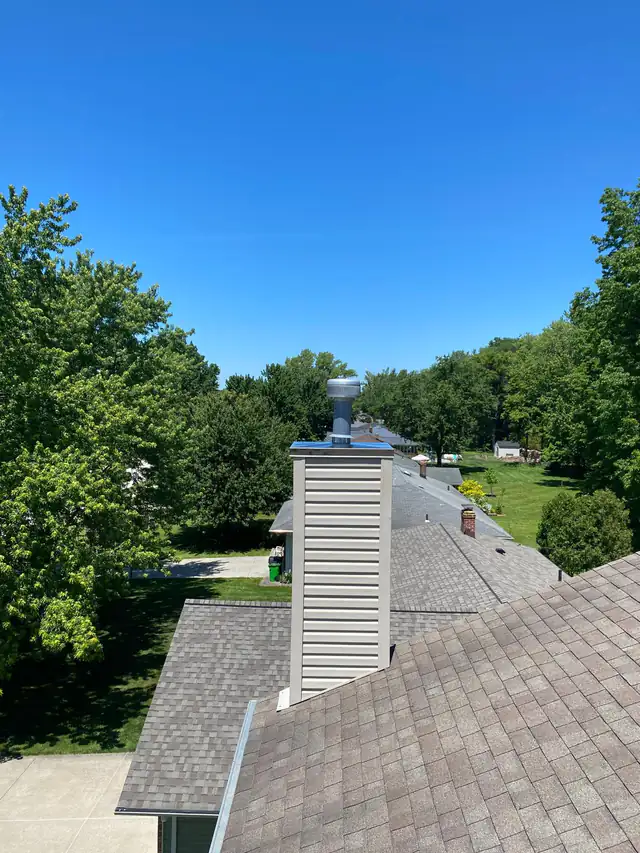
After — the replacement cover and chase, viewed from the roof
Meet the team
The people behind the work
Manny, Zack and Myke — meet the people behind Chimney Expert Solutions.
Our team and story →
Manny
Owner

Zack
Manager

Myke
Technician
FAQ
Chimney Leak Repair in Garfield Heights: questions we hear
We have a stain on an upstairs ceiling and a new roof. How is the chimney involved?
On an interior stack that is the classic pattern. Water entering at a cracked crown or an uncapped flue travels down inside the masonry and shows up at the ceiling line, well away from any roof penetration, so a roof replacement does not touch it. We check the crown, cap and flue from above and match what we find to where the stain is, with photographs of both.
Can our dryer keep venting into the old chimney flue?
We would move it. A masonry flue is too large, too cold and too rough for dryer exhaust: the air slows, the moisture condenses in the joints and the lint collects in places nobody can clean. That combination is both a fire load and a water problem in the stack. Rigid metal duct on the shortest sensible route outside is the right answer — and once the dryer is out, the flue it was using should be swept and capped, which is our side of the job.
Our chimney only serves the furnace and water heater. Is an inspection worthwhile?
It is the one most worth doing, because nothing about it is visible day to day. Heating flues in this stock have run continuously for decades, they have usually been through at least one appliance change, and the failure mode when they deteriorate is carbon monoxide rather than something you would smell or see. A camera scan and a look at the vent connectors in the basement covers it.
Should the chimney be waterproofed as routine maintenance?
Not as routine, no. A repellent is worth doing on masonry that is genuinely absorbing water and is otherwise sound, and it is pointless or harmful anywhere else. On a chimney with open joints, the joints get pointed first. On a chimney with a cracked crown, the crown is the actual hole. Selling a spray-on treatment to a chimney that needs masonry work is one of the more common bad practices in this trade.
My roofer says it's the chimney and the chimney guy says it's the roof. Who's right?
That standoff almost always means flashing, the one joint where the two trades meet and neither owns it. We diagnose the whole intersection together — flashing, counterflashing, crown, cap and masonry — and give you one answer with photographs behind it. If the finding genuinely is the roof, we will tell you that too.
Free estimate
Chimney Leak Repair in Garfield Heights?
Tell us what you’re seeing and we’ll call or text back to schedule a look — with photos of what we find and an honest read on what’s urgent and what can wait. That evidence-first method is the way we work on every job.
Call and tell us what the chimney's doing — if we're up on a roof, we'll call you back. Other ways to reach us are on the contact page, and Garfield Heights is one of the communities we cover across Greater Cleveland.
Call216-647-1882