
Geauga County, Ohio
Chimney Leak Repair & Waterproofing in Chardon, OH
Finding where the water actually gets in — crown, cap, flashing, masonry or condensation — and fixing that, not caulking symptoms.
What chimney leak repair involves in Chardon is set by the housing stock here: A nineteenth-century square, older village housing and rural township properties in Ohio's heaviest snow belt — households that burn seriously, with heavy and often glazed deposits, plus outbuilding stoves that rarely get inspected.
Chardon sits on the Geauga County highlands, and it takes more snow than anywhere else in Ohio. The elevation and the position downwind of the lake combine to produce winters that are longer, deeper and colder than what falls thirty miles west, and that single fact changes how people here heat their houses. Wood is not decorative in Chardon. Stoves run through the night, fireplaces run all weekend, and outbuildings and shops have their own flues.
A leaking chimney is a symptom with at least five different causes, and fixing the wrong one is why so many chimney leaks come back. Water can enter through a cracked crown, a missing or undersized cap, failed flashing where the chimney meets the roof, saturated porous masonry, or condensation forming inside an oversized flue. Each of those has a different repair, and none of them is solved by sealant on whatever surface was easiest to reach. Our leak work starts with diagnosis at roof level and inside the house, so the fix targets the actual entry point.
What we find on Chardon chimneys that leads to chimney leak repair
Wet wood, and how much difference it actually makes
Freshly cut hardwood is roughly half water by weight. Burning it means a large part of the fire's energy goes into boiling that water off instead of into the room, which lowers the flue temperature, which is exactly the condition that deposits creosote instead of carrying it out as smoke. Wood that has been split, stacked off the ground and covered on top for a full year — two for oak — burns hotter, cleaner and produces a fraction of the deposit. It is the cheapest chimney maintenance available and it is entirely within the homeowner's control. A moisture meter costs less than a service call.
Glazed creosote, which a brush will not touch
Creosote comes in stages. Loose soot and flaky deposit sweep out easily. But when a stove is damped down for a long overnight burn, or when the wood is wetter than it should be, the smoke leaves cool and loaded with unburned material and it condenses on the flue as a hard, shiny, tar-like glaze. That is third-stage creosote, it is fuel, and a chimney brush polishes it rather than removing it. Taking it off means a rotary system with chains or a chemical treatment applied over a period of burns to make it friable first, sometimes both. It also means the burning practice needs to change, or it will come straight back.
Lake Erie weather and what it does to the weather face
Wind-driven rain is the local variable that catches people out. Rain falling straight down mostly runs off a vertical brick face. Rain driven at a wall by thirty miles an hour of wind off the lake is pushed into it, and a masonry wall's ability to resist that is a function of its joints. This is why so many chimney leaks in Rocky River, Westlake, Lakewood and the lakefront stretch of Euclid appear only in storms from one particular direction, and why the weather-facing side of a stack is frequently in visibly worse condition than the sheltered side of the same chimney.
The second local factor is duration. Lake-effect conditions keep masonry wet for days rather than hours, so there is far less drying time between wetting events than the same chimney would get in a drier climate. Water that never fully leaves the wall is water available to freeze. That is the whole reason water management on a chimney matters more here than the average national advice suggests.
What drives the cost of leak work
- The diagnosis versus the repair. Finding the entry point is a defined piece of work; the fix depends entirely on what the finding is, which is why an honest quote for 'a chimney leak' cannot be given over the phone.
- Which component failed. A cap is a small job. A full crown recast is a bigger one. A complete re-flash with the roofing coordinated is bigger again.
- Roof access, pitch and material, as with all chimney work.
- Whether more than one entry point is active — which is common, because the conditions that kill a crown also kill flashing of the same age.
- How much interior damage there is. We do the chimney; drywall, plaster and framing repair inside is separate work and we will say so plainly rather than quietly including it.
- Whether the masonry needs pointing before any repellent is worth applying.
This page covers chimney leak repair as it plays out in Chardon. The full chimney leak repair & waterproofing page walks the whole job — every stage, what changes the scope, and what we do about each of them. For everything else we handle in this suburb, see chimney services in Chardon.
How we handle a leaking chimney
- Roof-level diagnosis: crown, cap, flashing, masonry and shoulder — photographed
- Interior check: firebox, smoke chamber and damper for staining, rust and damp
- Flashing repair or a full re-flash where the roofline seal has failed
- Crown repair or full recast with a drip edge and an expansion joint at the flue
- Vapor-permeable masonry repellent on porous brick — never paint or film-forming sealers
- An honest call on whether the 'leak' is actually flue condensation
- The fix in writing, matched to the diagnosed entry point
Our work
Chimney Leak Repair & Waterproofing, photographed on the job
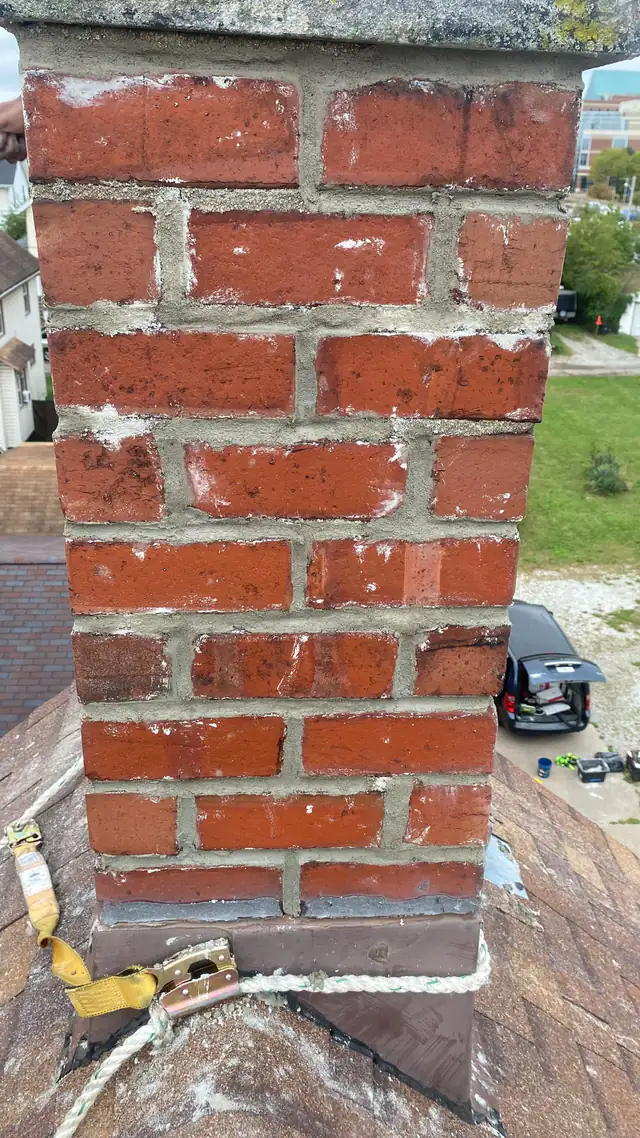
Roped in on a steep roof — repointed, flashing sealed 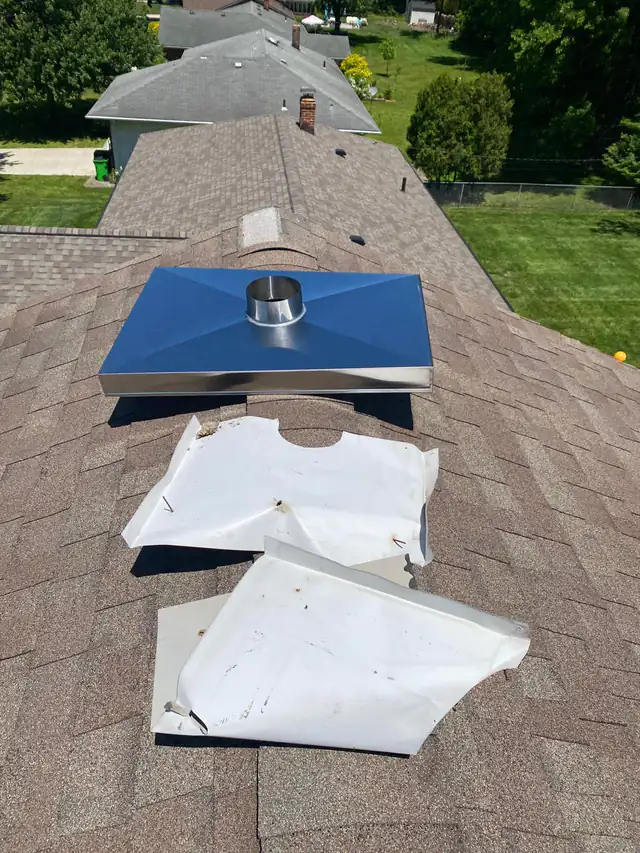
Replacement chase cover beside the removed cover sections on the roof 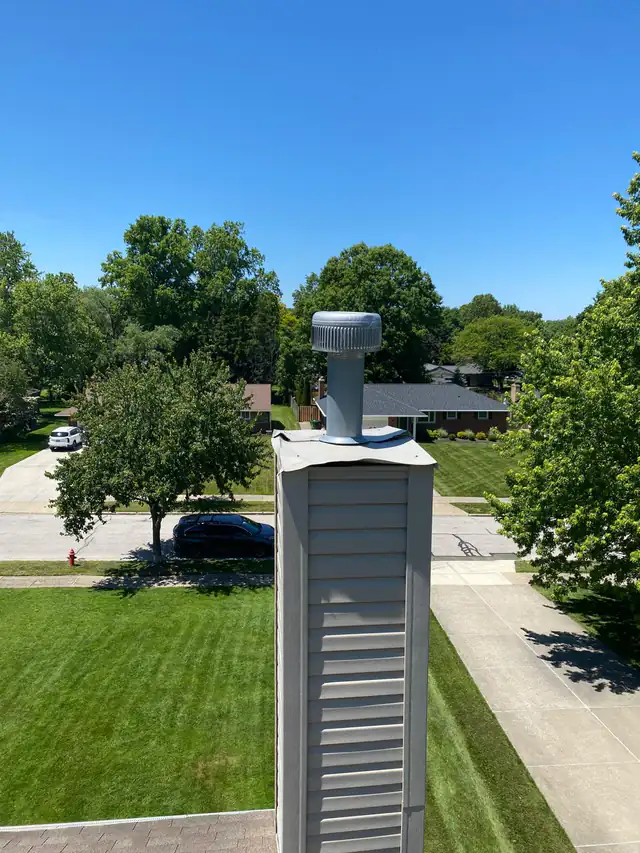
Before — the old chase cover, with bent and raised edges around the vent 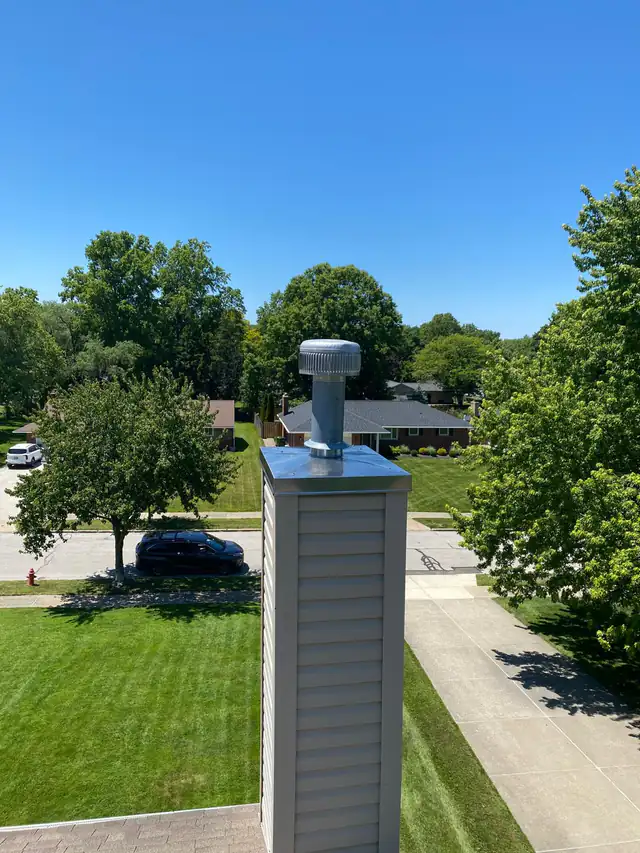
After — replacement chase cover fitted around the vent 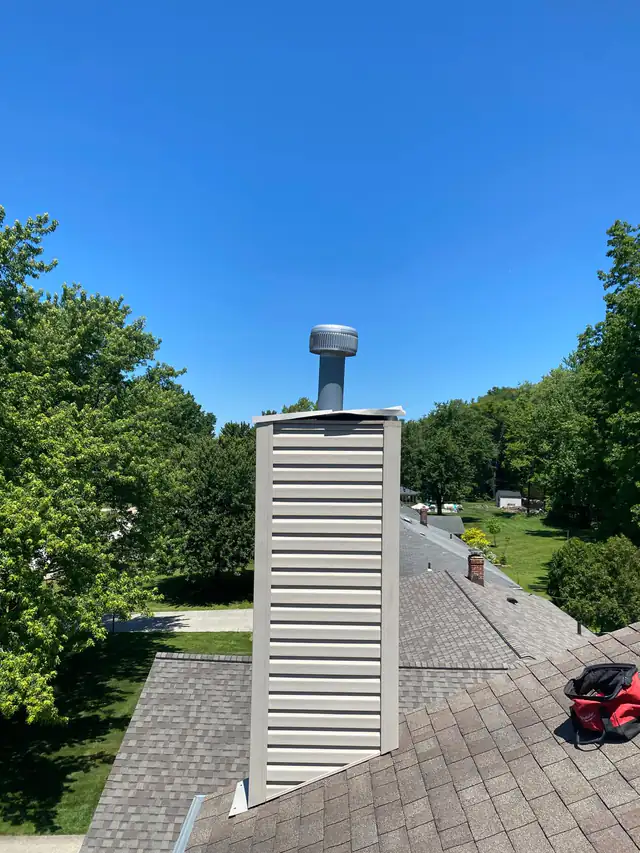
Before — the old cover from the roof side, with a raised edge 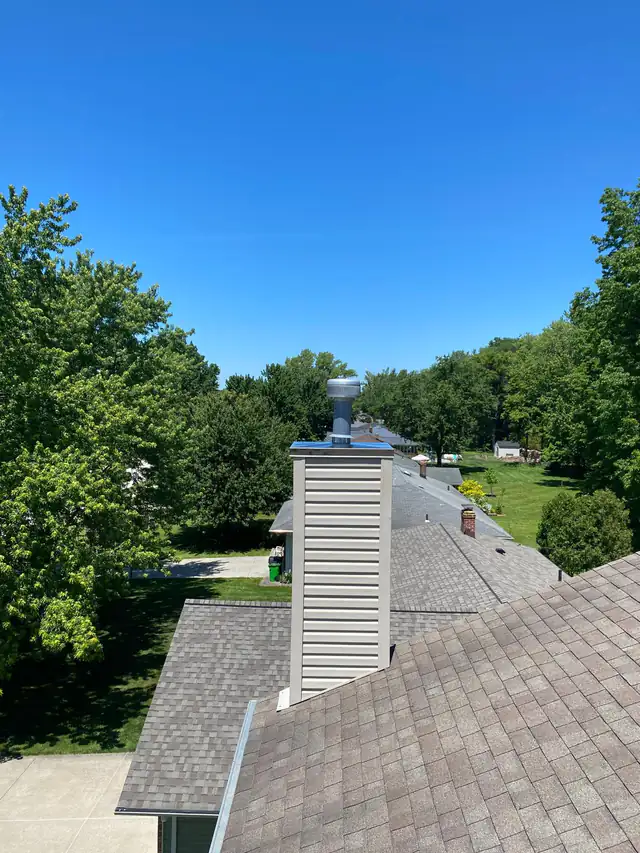
After — the replacement cover and chase, viewed from the roof
Meet the team
The people behind the work
Manny, Zack and Myke — meet the people behind Chimney Expert Solutions.
Our team and story →
Manny
Owner

Zack
Manager

Myke
Technician
FAQ
Chimney Leak Repair in Chardon: questions we hear
How can I tell if my firewood is dry enough?
Seasoned wood is noticeably lighter than green, has visible checking and cracks across the end grain, and knocks together with a sharp sound rather than a dull one. If you want to be certain, an inexpensive moisture meter on a freshly split face should read around twenty percent or below. Split, stacked off the ground and covered on top only — for a full year, and two for oak.
Should the chimney be waterproofed as routine maintenance?
Not as routine, no. A repellent is worth doing on masonry that is genuinely absorbing water and is otherwise sound, and it is pointless or harmful anywhere else. On a chimney with open joints, the joints get pointed first. On a chimney with a cracked crown, the crown is the actual hole. Selling a spray-on treatment to a chimney that needs masonry work is one of the more common bad practices in this trade.
How long does a chimney repellent last?
Vapor-permeable siloxane repellents on sound masonry are generally reapplied on a multi-year cycle rather than annually, and the exposure of the wall changes that a lot — a west-facing stack near the lake weathers faster than a sheltered interior one. Reapplication is straightforward when the masonry underneath has been kept sound, which is rather the point of doing the pointing first.
Free estimate
Chimney Leak Repair in Chardon?
Tell us what you’re seeing and we’ll call or text back to schedule a look — with photos of what we find and an honest read on what’s urgent and what can wait. That evidence-first method is the way we work on every job.
Call and tell us what the chimney's doing — if we're up on a roof, we'll call you back. Other ways to reach us are on the contact page, and Chardon is one of the communities we cover across Greater Cleveland.
Call216-647-1882