
Summit County, Ohio
Chimney Leak Repair & Waterproofing in Cuyahoga Falls, OH
Finding where the water actually gets in — crown, cap, flashing, masonry or condensation — and fixing that, not caulking symptoms.
What chimney leak repair involves in Cuyahoga Falls is set by the housing stock here: Older river-valley neighborhoods and postwar streets under a heavy mature canopy — blocked cap screens, permanently shaded masonry that never dries, tree-access animal entry, and draft affected by what is growing overhead.
Cuyahoga Falls follows the river gorge north of Akron, and the thing you notice about it from a roof is how much of the city is under trees. The older neighborhoods off Front Street and Portage Trail, the streets running down toward the gorge, and most of the postwar housing east and north of them all sit beneath a mature canopy that has had seventy or a hundred years to grow up over the rooflines.
A leaking chimney is a symptom with at least five different causes, and fixing the wrong one is why so many chimney leaks come back. Water can enter through a cracked crown, a missing or undersized cap, failed flashing where the chimney meets the roof, saturated porous masonry, or condensation forming inside an oversized flue. Each of those has a different repair, and none of them is solved by sealant on whatever surface was easiest to reach. Our leak work starts with diagnosis at roof level and inside the house, so the fix targets the actual entry point.
What we find on Cuyahoga Falls chimneys that leads to chimney leak repair
Debris in the cap, and a stack that never dries
A chimney under a canopy collects everything the trees shed — seeds, samaras, needles, twigs, leaf litter — and it collects it in the spark screen of the cap, where it packs down into a mat. A blocked screen restricts the flue, which shows up as poor draft or smoke in the room, and on a heating flue a restriction is a carbon monoxide question rather than a comfort one. The same shade means the masonry stays wet after every rain. Masonry that does not dry between wettings freezes wetter, spalls faster, and grows the green and black film you can see from the yard. Neither is expensive to deal with; both are invisible from the ground.
Animals, and the ones you are not allowed to remove
Raccoons treat an uncapped chimney as a hollow tree and squirrels and starlings do much the same, and an accessible roof under branches is how they get there. There is one case that catches people out. Chimney swifts are a migratory bird protected under federal law, and an active nest with eggs or young cannot legally be removed — the honest answer, when we find one, is that the flue is out of service until the birds fledge, usually a matter of weeks, and then it gets cleaned and capped so it does not happen again. We would rather tell you that than quietly do something we should not.
Branches over the chimney top
Limbs hanging above or immediately beside a flue termination are worth dealing with for two separate reasons. The obvious one is embers: a wood fire sends sparks up the flue, a screened cap catches most of them, and dry foliage directly overhead is the one place you do not want the rest to land. The less obvious one is draft. A chimney needs clear air above it to work, and a dense canopy can create the same kind of turbulence and downward pressure a taller building would. If your fireplace draws noticeably better in winter than it does in early autumn, the leaves are a reasonable suspect.
Lake Erie weather and what it does to the weather face
Wind-driven rain is the local variable that catches people out. Rain falling straight down mostly runs off a vertical brick face. Rain driven at a wall by thirty miles an hour of wind off the lake is pushed into it, and a masonry wall's ability to resist that is a function of its joints. This is why so many chimney leaks in Rocky River, Westlake, Lakewood and the lakefront stretch of Euclid appear only in storms from one particular direction, and why the weather-facing side of a stack is frequently in visibly worse condition than the sheltered side of the same chimney.
The second local factor is duration. Lake-effect conditions keep masonry wet for days rather than hours, so there is far less drying time between wetting events than the same chimney would get in a drier climate. Water that never fully leaves the wall is water available to freeze. That is the whole reason water management on a chimney matters more here than the average national advice suggests.
The five ways water gets into a chimney
Every chimney leak comes down to one or more of these. The diagnosis is figuring out which, and the honest ones are often a combination.
The crown
The slab that seals the top of the stack around the flue tiles. Most crowns on older Cleveland chimneys were struck flat out of leftover mortar on the day the chimney was finished, with no overhang and no expansion gap around the tile. Mortar is not a weatherproofing material and it cracks, usually radially from the flue outward, and once it does the crown is delivering water directly into the top of the brickwork. This is the single most common source of a chimney leak in this market.
The cap, or its absence
An uncapped flue is an open pipe pointed at the sky. Every rain puts water straight down inside it, onto the smoke shelf, into the firebox, and onto whatever masonry it touches on the way. A surprising number of chimneys in Greater Cleveland have never had a cap. Undersized or poorly fitted caps and rusted-through caps produce the same result more slowly.
Flashing
Where the chimney passes through the roof plane, the seal is made by step flashing woven into the shingle courses and counterflashing let into the mortar joints above it. Both parts have to be right. What we find instead, constantly, is a bead of roofing cement smeared over the joint by someone in a hurry, which lasts a couple of seasons and then cracks. Flashing is the classic leak nobody owns, because it is the exact point where the roofing trade and the masonry trade meet.
Porous or open masonry
Brick and mortar absorb water by design. When the joints have opened up or the brick faces have spalled, the absorption stops being harmless. On a wind-driven rain, water can be pushed into the wall of a stack faster than it can dry, travel through the masonry, and appear inside the house. This is the leak that only shows up in certain weather, which is what makes it confusing.
Condensation, which is not a leak at all
Sometimes the water inside the chimney was never rain. An oversized flue serving a modern appliance runs below its exhaust dew point and condenses moisture on its own walls, which runs down and appears as dampness at the base. The give-away is that it correlates with cold weather and appliance run time rather than with rain. Sealing the outside of that chimney does nothing, which is why condensation is one of the more commonly mis-diagnosed conditions in the trade.
This page covers chimney leak repair as it plays out in Cuyahoga Falls. The full chimney leak repair & waterproofing page walks the whole job — every stage, what changes the scope, and what we do about each of them. For everything else we handle in this suburb, see chimney services in Cuyahoga Falls.
How we handle a leaking chimney
- Roof-level diagnosis: crown, cap, flashing, masonry and shoulder — photographed
- Interior check: firebox, smoke chamber and damper for staining, rust and damp
- Flashing repair or a full re-flash where the roofline seal has failed
- Crown repair or full recast with a drip edge and an expansion joint at the flue
- Vapor-permeable masonry repellent on porous brick — never paint or film-forming sealers
- An honest call on whether the 'leak' is actually flue condensation
- The fix in writing, matched to the diagnosed entry point
Our work
Chimney Leak Repair & Waterproofing, photographed on the job
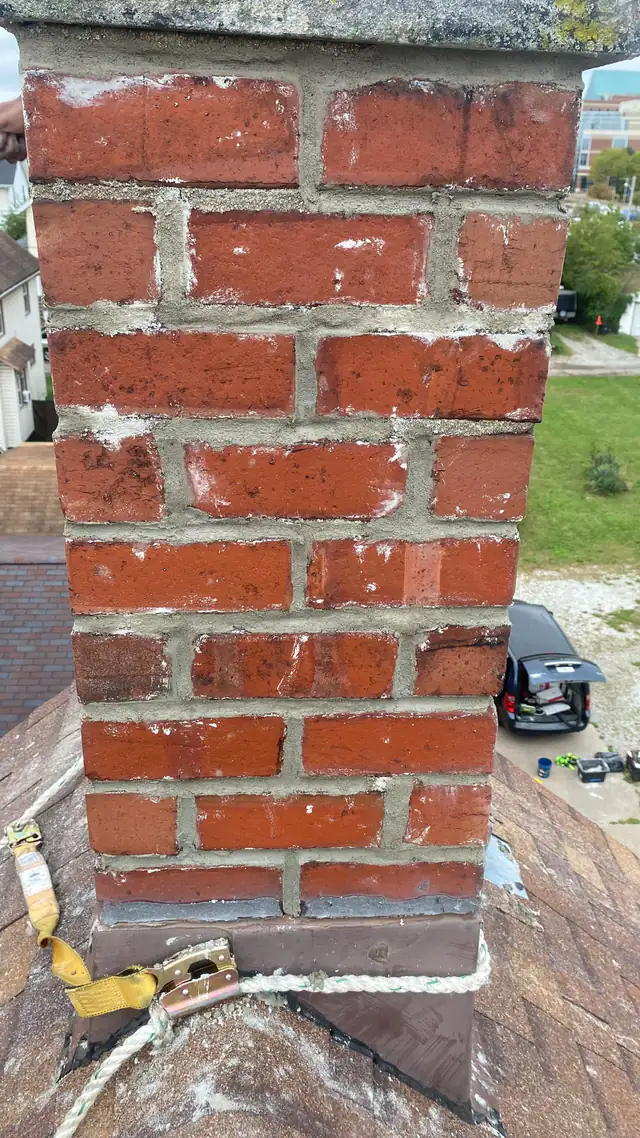
Roped in on a steep roof — repointed, flashing sealed 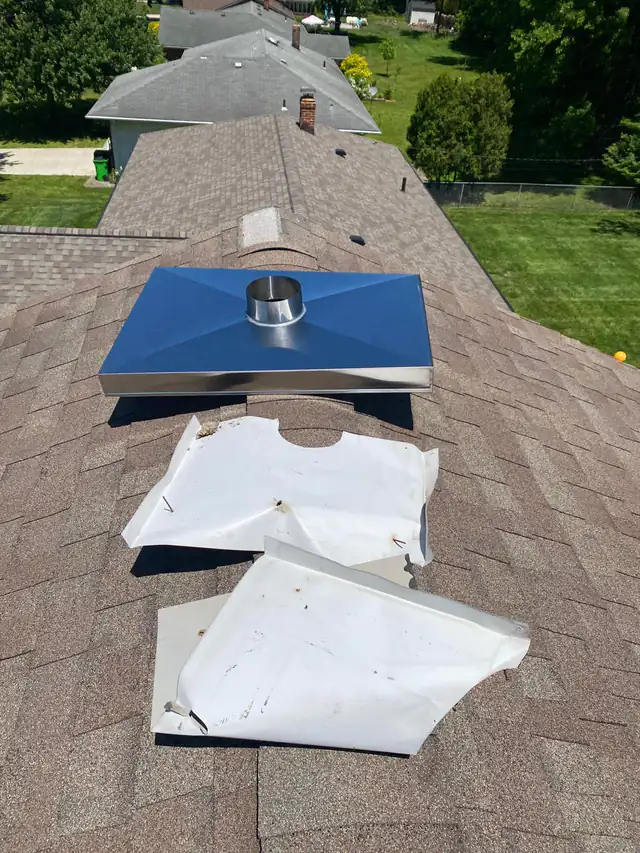
Replacement chase cover beside the removed cover sections on the roof 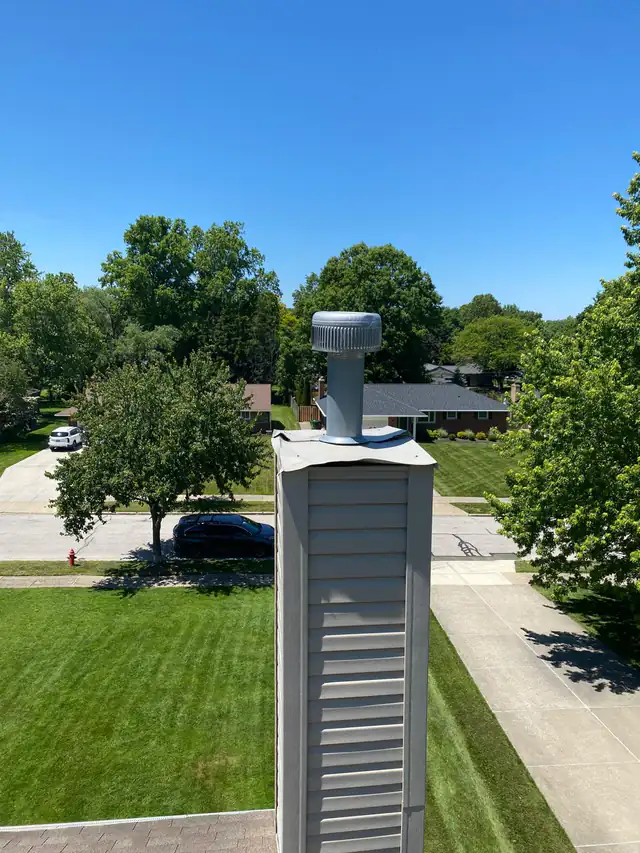
Before — the old chase cover, with bent and raised edges around the vent 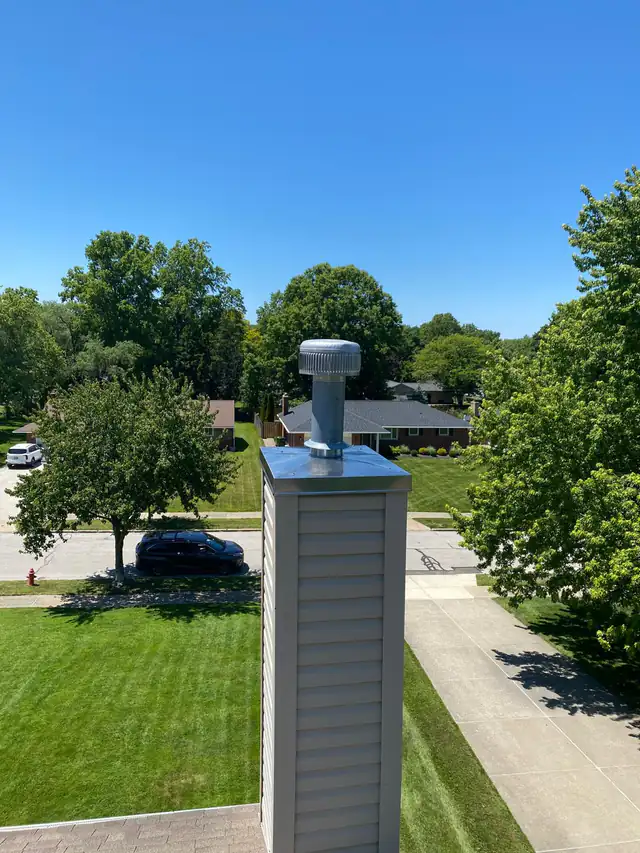
After — replacement chase cover fitted around the vent 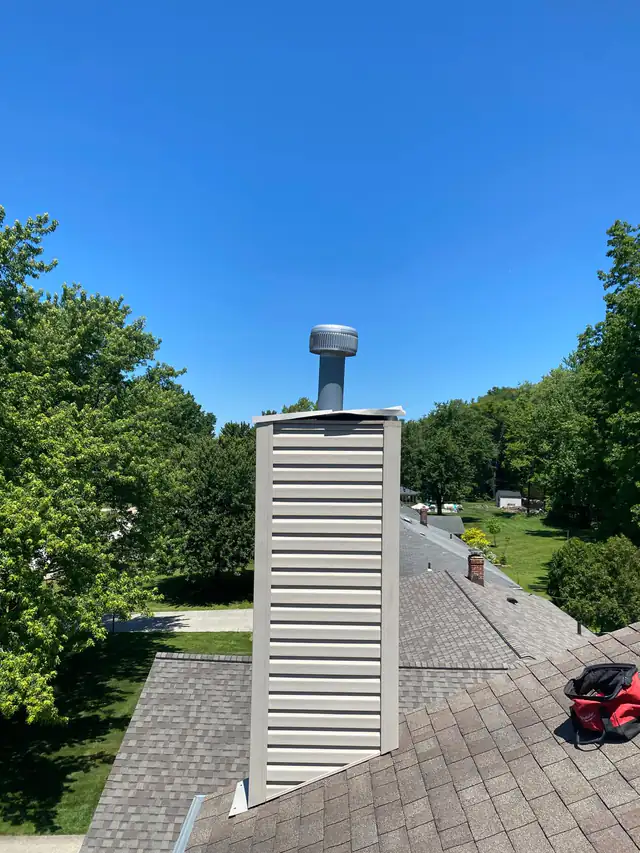
Before — the old cover from the roof side, with a raised edge 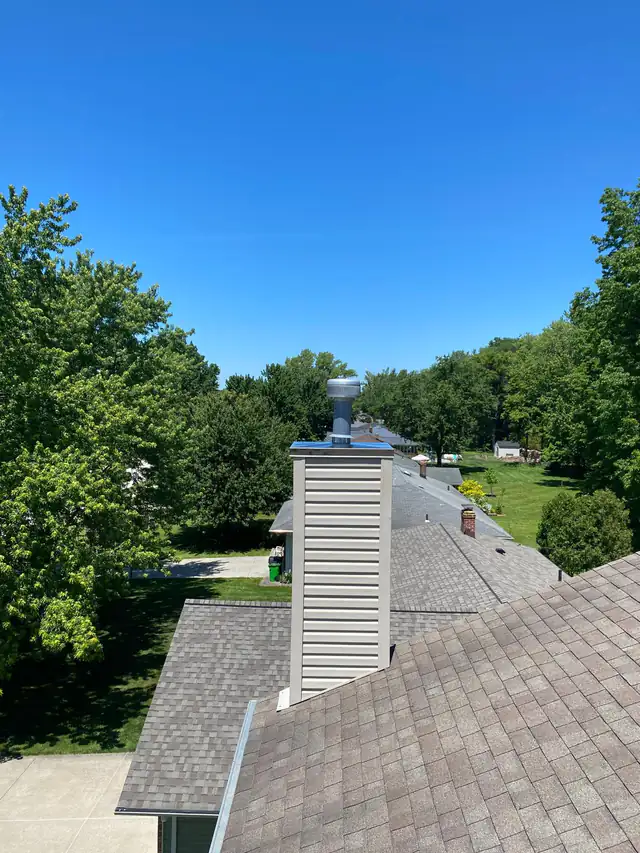
After — the replacement cover and chase, viewed from the roof
Meet the team
The people behind the work
Manny, Zack and Myke — meet the people behind Chimney Expert Solutions.
Our team and story →
Manny
Owner
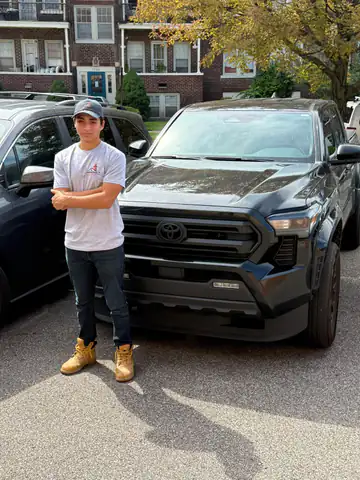
Zack
Manager

Myke
Technician
FAQ
Chimney Leak Repair in Cuyahoga Falls: questions we hear
Our chimney is always damp and greenish on one side. Is that a problem?
It means the masonry is not drying between rains, usually because it is permanently shaded. Wet masonry going into a freeze does far more damage than dry masonry does, so it accelerates joint erosion and spalling. Opening up the shade where that is possible helps; keeping the crown, cap and pointing in good order matters more here than it would on a sunny exposure.
We hear scratching in the chimney. What happens next?
First we identify what it is, because that determines what can be done. Raccoons, squirrels and starlings can be dealt with and the flue cleaned and capped. Chimney swifts are federally protected migratory birds, and an active nest has to be left alone until the young fledge — after which the flue gets cleaned and a proper cap goes on so it does not recur. We will tell you which you have before quoting anything.
Do we really need a cap with a screen if we are surrounded by trees?
Especially if you are. The screen is what keeps embers in and animals and debris out, and under a canopy it is doing all three jobs constantly. What it does need is a look each year, because the same screen that catches seeds and leaf litter will pack solid over a season and restrict the flue. A cap is not a fit-and-forget component in this neighborhood.
My roofer says it's the chimney and the chimney guy says it's the roof. Who's right?
That standoff almost always means flashing, the one joint where the two trades meet and neither owns it. We diagnose the whole intersection together — flashing, counterflashing, crown, cap and masonry — and give you one answer with photographs behind it. If the finding genuinely is the roof, we will tell you that too.
It leaked once and hasn't since. Do I still need it looked at?
Yes, and the intermittency is a clue rather than a reassurance. A leak that only appears under specific conditions usually means a directional entry point, most often driven rain on one face or ice damming at the roofline. The path is still there between events, and it is still admitting the water that does the freeze-thaw damage.
Free estimate
Chimney Leak Repair in Cuyahoga Falls?
Tell us what you’re seeing and we’ll call or text back to schedule a look — with photos of what we find and an honest read on what’s urgent and what can wait. That evidence-first method is the way we work on every job.
Call and tell us what the chimney's doing — if we're up on a roof, we'll call you back. Other ways to reach us are on the contact page, and Cuyahoga Falls is one of the communities we cover across Greater Cleveland.
Call216-647-1882