
Cuyahoga County, Ohio
Chimney Leak Repair & Waterproofing in Westlake, OH
Finding where the water actually gets in — crown, cap, flashing, masonry or condensation — and fixing that, not caulking symptoms.
What chimney leak repair involves in Westlake is set by the housing stock here: Later-era housing with a high share of factory-built fireplaces — rusting chase covers, cracked refractory panels and metal flues that still need annual sweeping, plus conventional masonry in the older pockets.
Westlake was farmland and township into the middle of the last century, and the bulk of its housing came later than the inner-ring suburbs: substantial building from the 1970s onward and strong 1990s and 2000s neighborhoods filling in around Dover Center, Columbia and Hilliard. That changes what chimney service means here in a way that catches a lot of contractors out.
A leaking chimney is a symptom with at least five different causes, and fixing the wrong one is why so many chimney leaks come back. Water can enter through a cracked crown, a missing or undersized cap, failed flashing where the chimney meets the roof, saturated porous masonry, or condensation forming inside an oversized flue. Each of those has a different repair, and none of them is solved by sealant on whatever surface was easiest to reach. Our leak work starts with diagnosis at roof level and inside the house, so the fix targets the actual entry point.
What we find on Westlake chimneys that leads to chimney leak repair
Chase covers rusting and dumping water into framing
The flat metal pan closing the top of a framed chimney chase is the highest-consequence component on a Westlake chimney. Builder-grade galvanized covers rust through, and because most were installed flat rather than with a cross-break, they pond water rather than shed it. Once they perforate, water goes directly into the framed chase, where it rots structure and soaks insulation out of sight. The rust stain running down the siding below the chimney top is the early warning, and the fix is a custom stainless cover with a proper cross-break and drip edge.
Metal flues still build creosote
There is a persistent belief that a factory-built fireplace does not need sweeping because there is no masonry. Wood smoke deposits creosote on a stainless flue exactly as it does on clay tile, and NFPA 211's annual inspection recommendation covers factory-built systems explicitly. What changes is technique: a wire brush that is fine in clay tile will damage a stainless flue, so it wants a poly brush sized to the pipe. If a sweep does not ask what kind of system you have before arriving, that is worth noticing.
What water does if the leak is left
The stain on the ceiling is the least of it. Once water has an established route into a chimney, three things happen in parallel. The masonry deteriorates faster, because every wet freeze widens the path the water is already using. The framing around the chimney takes moisture it was never designed to take, and rot in a concealed chase around a chimney is both slow and expensive to find. And inside the flue, water attacks mortar joints between the flue tiles, so a water problem at the top becomes a liner problem in the middle.
There is a fourth, less obvious one: a chimney with water in it smells. The musty odour that shows up in a fireplace in warm weather is damp deposits, and it is a reliable early sign of a water path that has not yet produced a visible stain. Leak repairs sit near the top of the fix-this-season list, not because a small stain is an emergency, but because the path is established and Cleveland winters are very good at widening established paths.
The fixes, matched to the cause
- Cracked but structurally sound crown: a flexible elastomeric crown coating bridges the crazing and seals it for years.
- Failed or never-adequate crown: a full recast in reinforced concrete, with a drip edge overhanging the brick and an expansion joint around the flue tile so thermal movement does not crack it again.
- No cap or a failed cap: a stainless cap sized and anchored to the flue, with screen. This one repair often ends the leak entirely.
- Failed flashing: proper step flashing and counterflashing reset into a cut reglet in the mortar joint, not sealant over the old work. Where the roof is at the end of its life, this gets coordinated with the roofing rather than done twice.
- Open joints and spalled brick on the weather face: repointing and unit replacement, because a repellent over open joints is a waste of a product.
- Genuinely porous but sound masonry: a vapor-permeable siloxane-type water repellent that sheds driven rain while letting the wall dry outward.
- Condensation in an oversized flue: correctly sized liner, which is a relining job rather than a waterproofing one.
- A wide chimney with no cricket on the up-slope side: a cricket, the small saddle roof that diverts water and snow around the stack instead of letting it pool against it.
This page covers chimney leak repair as it plays out in Westlake. The full chimney leak repair & waterproofing page walks the whole job — every stage, what changes the scope, and what we do about each of them. For everything else we handle in this suburb, see chimney services in Westlake.
How we handle a leaking chimney
- Roof-level diagnosis: crown, cap, flashing, masonry and shoulder — photographed
- Interior check: firebox, smoke chamber and damper for staining, rust and damp
- Flashing repair or a full re-flash where the roofline seal has failed
- Crown repair or full recast with a drip edge and an expansion joint at the flue
- Vapor-permeable masonry repellent on porous brick — never paint or film-forming sealers
- An honest call on whether the 'leak' is actually flue condensation
- The fix in writing, matched to the diagnosed entry point
Our work
Chimney Leak Repair & Waterproofing, photographed on the job
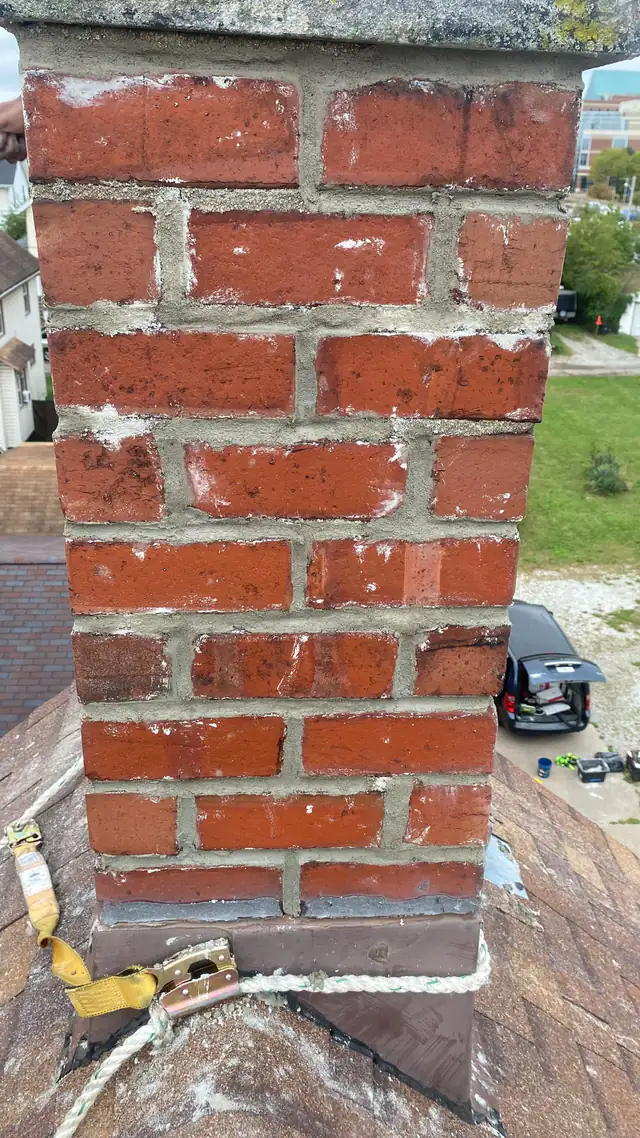
Roped in on a steep roof — repointed, flashing sealed 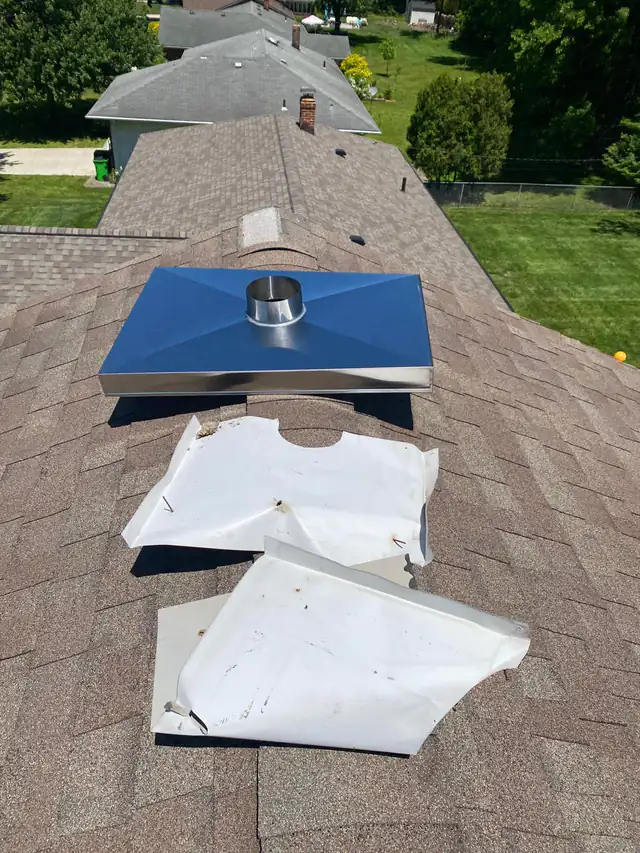
Replacement chase cover beside the removed cover sections on the roof 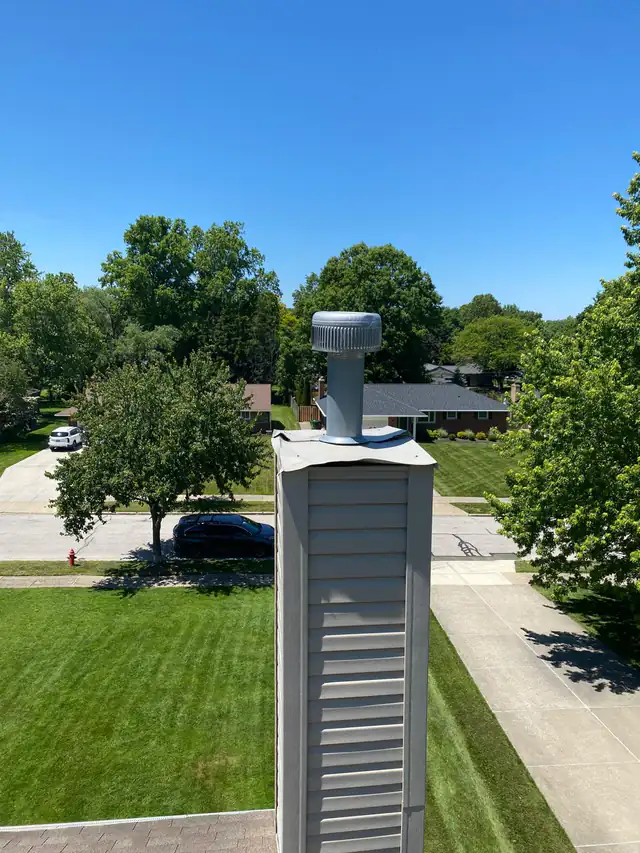
Before — the old chase cover, with bent and raised edges around the vent 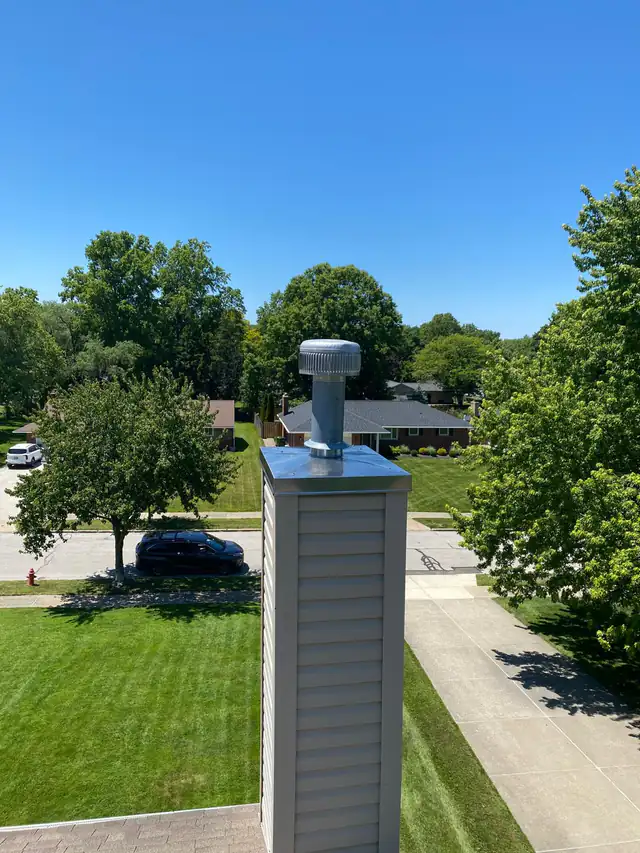
After — replacement chase cover fitted around the vent 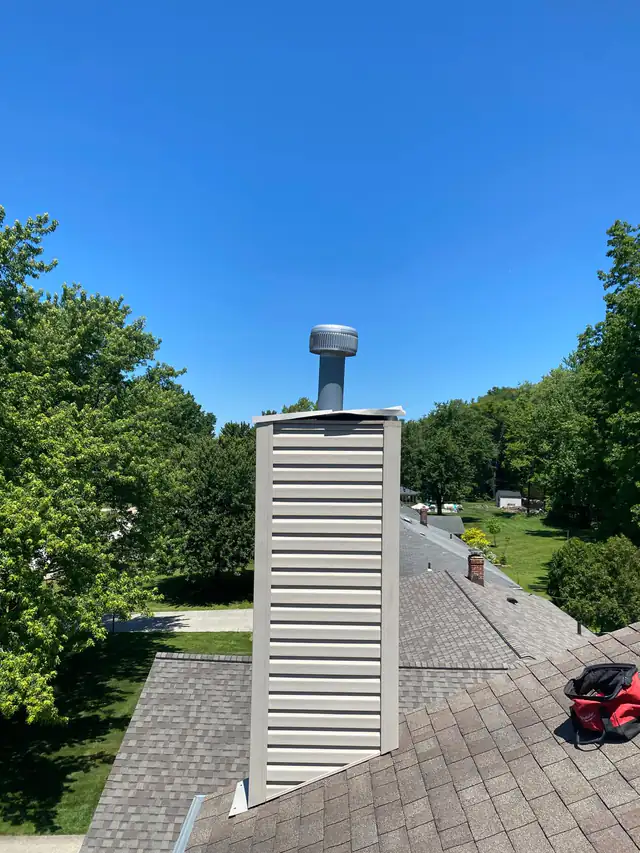
Before — the old cover from the roof side, with a raised edge 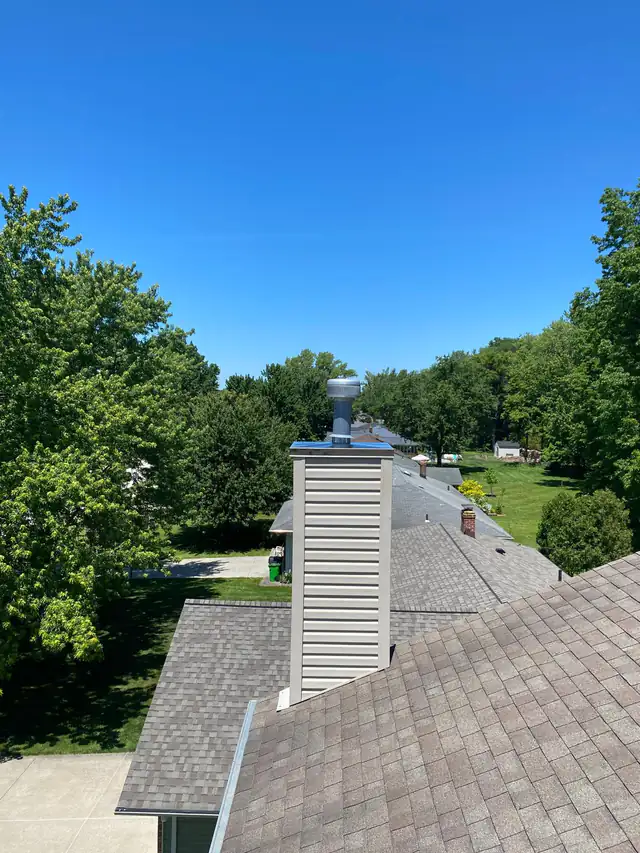
After — the replacement cover and chase, viewed from the roof
Meet the team
The people behind the work
Manny, Zack and Myke — meet the people behind Chimney Expert Solutions.
Our team and story →
Manny
Owner

Zack
Manager

Myke
Technician
FAQ
Chimney Leak Repair in Westlake: questions we hear
There's rust staining down the siding below our chimney top. What is that?
Almost always a corroding galvanized chase cover — the flat metal pan closing the top of the framed chase. The staining means it is already perforating or about to, and the water it is not shedding is going into the chase framing. A custom stainless cover with a cross-break so water runs off rather than ponding is the durable answer.
Do factory-built fireplaces really need annual service like masonry ones?
Yes. The flue is metal instead of clay, but wood smoke deposits creosote on it just the same, and the refractory panels, chase cover, cap and storm collar all have inspection points of their own. The NFPA 211 annual-inspection recommendation covers factory-built systems explicitly rather than treating them as exempt.
How do I know whether we have masonry or factory-built?
Look inside the firebox. Masonry is firebrick laid in courses with visible mortar joints and a masonry throat and damper above. Factory-built has smooth molded panels with seams, a metal surround, and usually a manufacturer's label somewhere on the frame, in the firebox, or behind the lower grille. If there is a label, photograph it before you call — it makes the whole conversation faster.
It leaked once and hasn't since. Do I still need it looked at?
Yes, and the intermittency is a clue rather than a reassurance. A leak that only appears under specific conditions usually means a directional entry point, most often driven rain on one face or ice damming at the roofline. The path is still there between events, and it is still admitting the water that does the freeze-thaw damage.
Can you fix a chimney leak in winter?
Some of it. Caps, some flashing work and temporary measures can be done in cold weather. Anything involving mortar or a concrete crown recast needs sustained temperatures above roughly 40°F to cure, so a winter diagnosis often means a temporary fix now and the permanent one in spring. We will tell you which category yours is in rather than laying masonry that will not set.
Free estimate
Chimney Leak Repair in Westlake?
Tell us what you’re seeing and we’ll call or text back to schedule a look — with photos of what we find and an honest read on what’s urgent and what can wait. That evidence-first method is the way we work on every job.
Call and tell us what the chimney's doing — if we're up on a roof, we'll call you back. Other ways to reach us are on the contact page, and Westlake is one of the communities we cover across Greater Cleveland.
Call216-647-1882