
Cuyahoga County, Ohio
Chimney Leak Repair & Waterproofing in South Euclid, OH
Finding where the water actually gets in — crown, cap, flashing, masonry or condensation — and fixing that, not caulking symptoms.
What chimney leak repair involves in South Euclid is set by the housing stock here: 1920s bungalows and colonials near Cedar Center alongside late-40s and 50s Capes and ranches toward Green Road — two building recipes, two failure profiles, often on the same block.
South Euclid was built in two clearly separated pushes, and that is the single most useful thing to know about its chimneys. The streets near Cedar Center and the Cleveland Heights line went up in the 1920s boom: brick and stucco bungalows, side-gable colonials, tile-roofed cottages. Then the war stopped everything, and the land north and east toward Green Road and Bexley Park filled in through the late 1940s and 1950s with Cape Cods and ranches built to a completely different recipe.
A leaking chimney is a symptom with at least five different causes, and fixing the wrong one is why so many chimney leaks come back. Water can enter through a cracked crown, a missing or undersized cap, failed flashing where the chimney meets the roof, saturated porous masonry, or condensation forming inside an oversized flue. Each of those has a different repair, and none of them is solved by sealant on whatever surface was easiest to reach. Our leak work starts with diagnosis at roof level and inside the house, so the fix targets the actual entry point.
What we find on South Euclid chimneys that leads to chimney leak repair
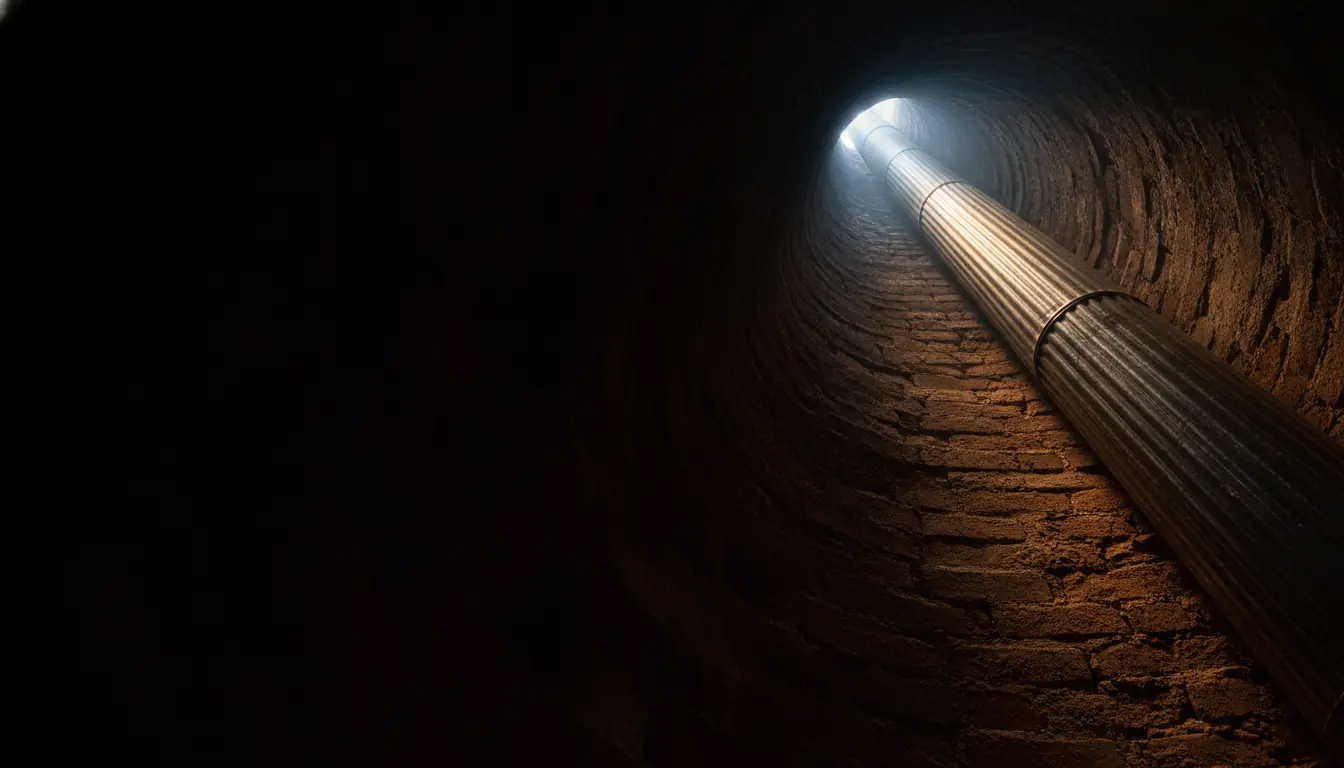
What the clean-out door at the base is telling you
Most South Euclid stacks have a small iron door at the bottom, usually in the basement, and most owners have never opened it. It is the most informative thirty seconds of an inspection. Sand and grit mean mortar joints are eroding somewhere above. Orange or buff shards mean flue tile is breaking up and falling. Standing water or a white salt bloom on the surrounding brick means the crown or cap is letting rain into the stack. Nothing at all is a good sign. We open it, photograph it, and show you what came out.
Two eras on one street, two completely different stacks
A 1920s South Euclid chimney is tall, usually interior, built with soft brick in lime-rich mortar, and its problems are flue-side: unlined or early tile, joints washed out, heat damage from a century of use. A 1950s chimney on the same street is short, exterior or half-exterior, harder brick, and its problems are water-side: a thin flush crown, a weathered face, and a flue that is now the wrong size for what vents into it. Assuming one when you have the other is how people buy a repair that does not address the actual defect.
Insulation packed against the stack in the knee-wall attic
The bungalows and Capes here have low, awkward attics with knee walls, and almost all of them have been re-insulated at some point. Blown-in cellulose and batt insulation routinely end up shoved hard against the masonry where the chimney passes through, and on the factory-built and metal-flue systems the same thing happens around the pipe. Masonry and listed metal chimneys are both designed with a required air gap and a firestop at the floor or ceiling penetration, and stuffing that gap closed removes the design. It is one of the more common things we photograph in an attic here, and it is cheap to correct once someone has actually looked.
The fixes, matched to the cause
- Cracked but structurally sound crown: a flexible elastomeric crown coating bridges the crazing and seals it for years.
- Failed or never-adequate crown: a full recast in reinforced concrete, with a drip edge overhanging the brick and an expansion joint around the flue tile so thermal movement does not crack it again.
- No cap or a failed cap: a stainless cap sized and anchored to the flue, with screen. This one repair often ends the leak entirely.
- Failed flashing: proper step flashing and counterflashing reset into a cut reglet in the mortar joint, not sealant over the old work. Where the roof is at the end of its life, this gets coordinated with the roofing rather than done twice.
- Open joints and spalled brick on the weather face: repointing and unit replacement, because a repellent over open joints is a waste of a product.
- Genuinely porous but sound masonry: a vapor-permeable siloxane-type water repellent that sheds driven rain while letting the wall dry outward.
- Condensation in an oversized flue: correctly sized liner, which is a relining job rather than a waterproofing one.
- A wide chimney with no cricket on the up-slope side: a cricket, the small saddle roof that diverts water and snow around the stack instead of letting it pool against it.
Lake Erie weather and what it does to the weather face
Wind-driven rain is the local variable that catches people out. Rain falling straight down mostly runs off a vertical brick face. Rain driven at a wall by thirty miles an hour of wind off the lake is pushed into it, and a masonry wall's ability to resist that is a function of its joints. This is why so many chimney leaks in Rocky River, Westlake, Lakewood and the lakefront stretch of Euclid appear only in storms from one particular direction, and why the weather-facing side of a stack is frequently in visibly worse condition than the sheltered side of the same chimney.
The second local factor is duration. Lake-effect conditions keep masonry wet for days rather than hours, so there is far less drying time between wetting events than the same chimney would get in a drier climate. Water that never fully leaves the wall is water available to freeze. That is the whole reason water management on a chimney matters more here than the average national advice suggests.
This page covers chimney leak repair as it plays out in South Euclid. The full chimney leak repair & waterproofing page walks the whole job — every stage, what changes the scope, and what we do about each of them. For everything else we handle in this suburb, see chimney services in South Euclid.
How we handle a leaking chimney
- Roof-level diagnosis: crown, cap, flashing, masonry and shoulder — photographed
- Interior check: firebox, smoke chamber and damper for staining, rust and damp
- Flashing repair or a full re-flash where the roofline seal has failed
- Crown repair or full recast with a drip edge and an expansion joint at the flue
- Vapor-permeable masonry repellent on porous brick — never paint or film-forming sealers
- An honest call on whether the 'leak' is actually flue condensation
- The fix in writing, matched to the diagnosed entry point
Our work
Chimney Leak Repair & Waterproofing, photographed on the job
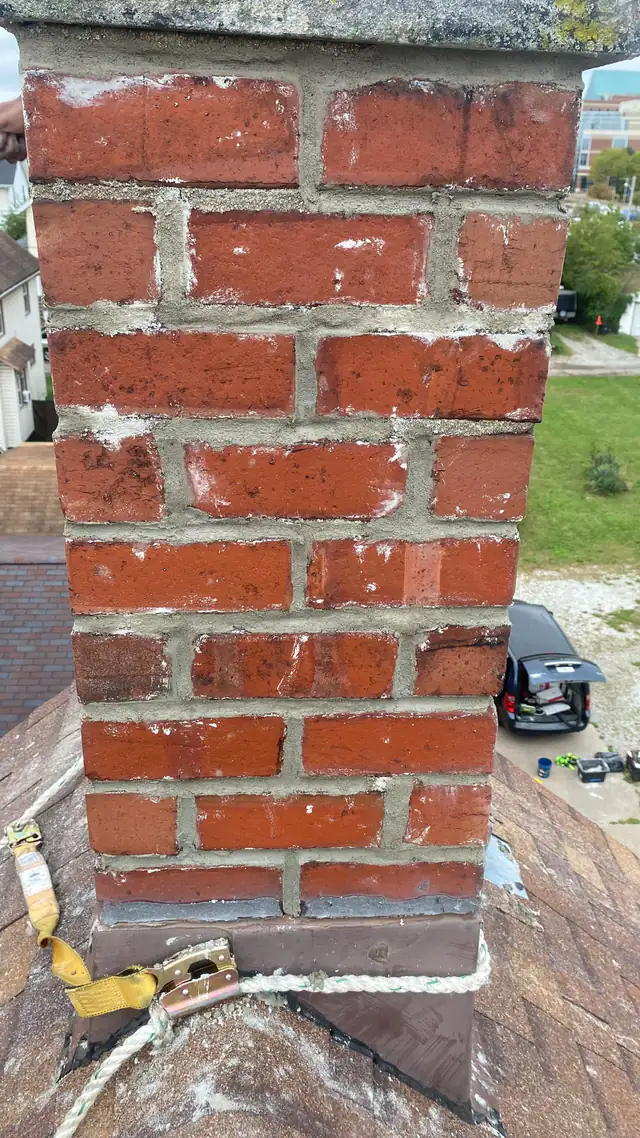
Roped in on a steep roof — repointed, flashing sealed 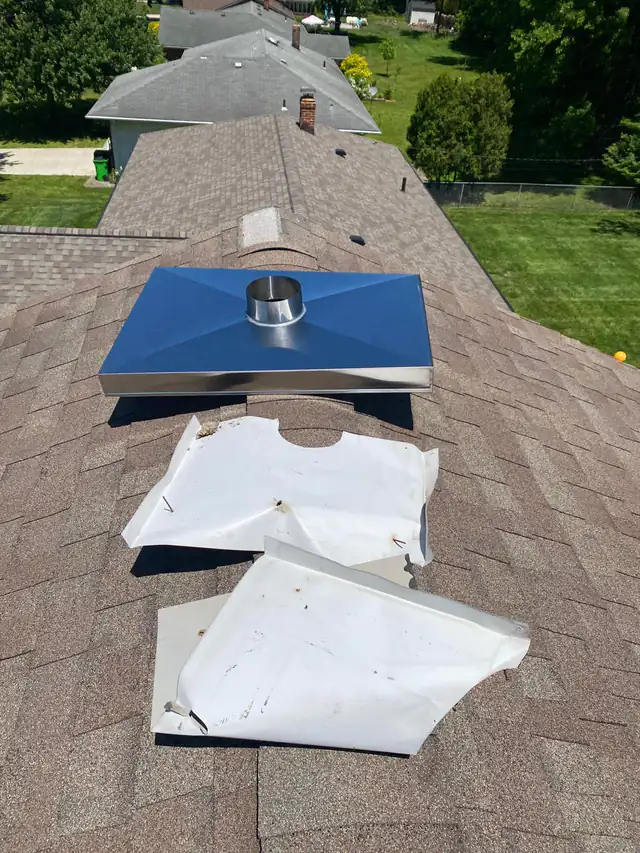
Replacement chase cover beside the removed cover sections on the roof 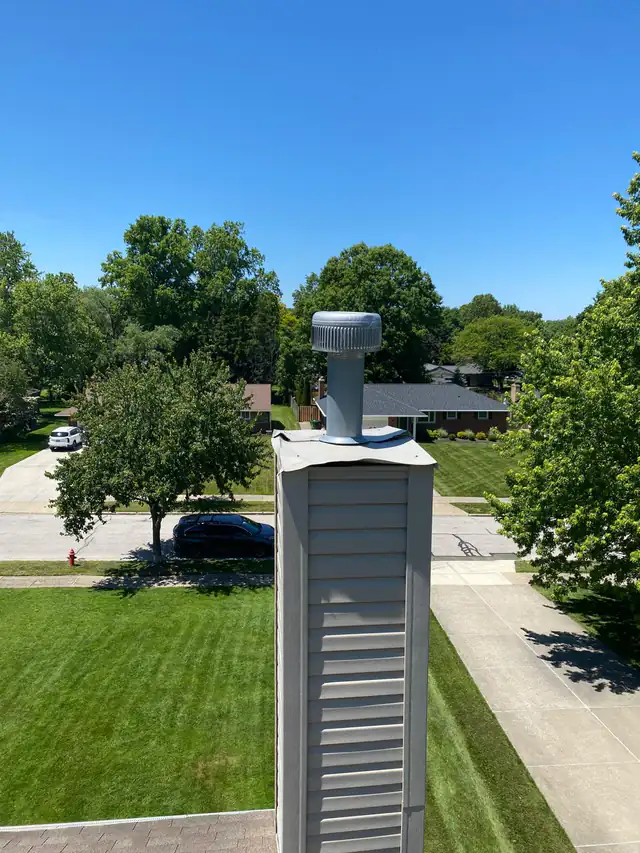
Before — the old chase cover, with bent and raised edges around the vent 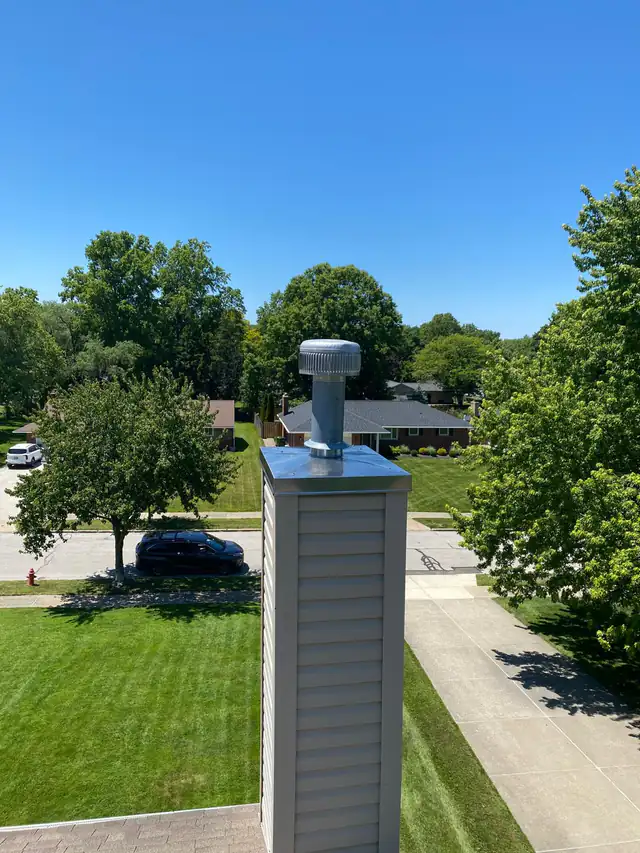
After — replacement chase cover fitted around the vent 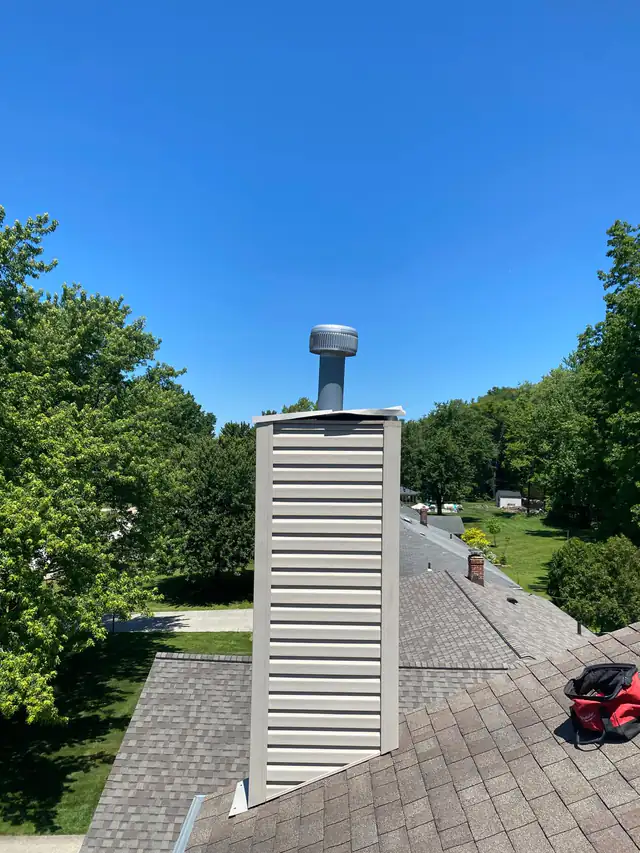
Before — the old cover from the roof side, with a raised edge 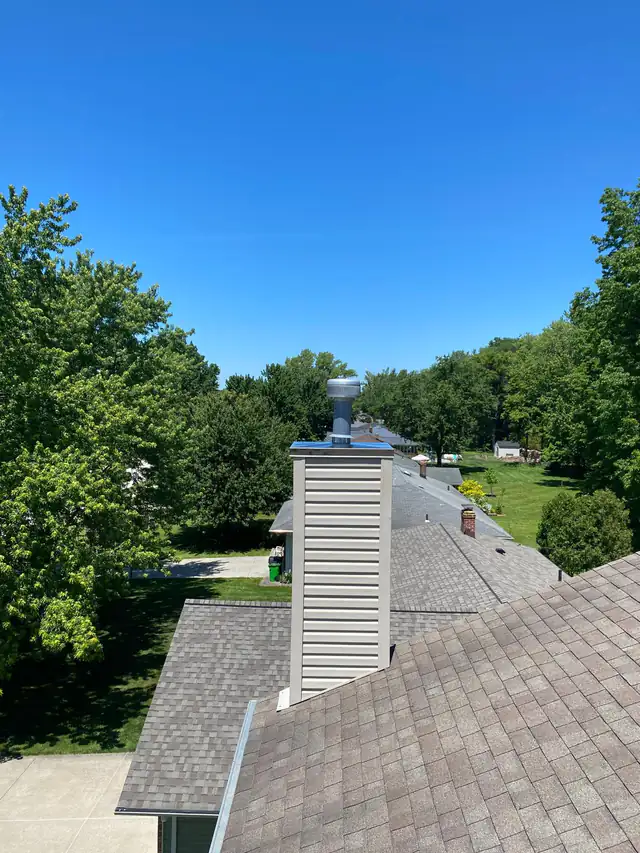
After — the replacement cover and chase, viewed from the roof
Meet the team
The people behind the work
Manny, Zack and Myke — meet the people behind Chimney Expert Solutions.
Our team and story →
Manny
Owner

Zack
Manager

Myke
Technician
FAQ
Chimney Leak Repair in South Euclid: questions we hear
Do you inspect the basement as well as the roof?
Yes, and on this housing it is where half the useful evidence is. The clean-out contents, the condition of the vent connector into the chimney, staining or efflorescence on the chimney breast and the state of the base itself all say something about what is happening sixty feet up. A rooftop-only look misses it.
How long does a chimney repellent last?
Vapor-permeable siloxane repellents on sound masonry are generally reapplied on a multi-year cycle rather than annually, and the exposure of the wall changes that a lot — a west-facing stack near the lake weathers faster than a sheltered interior one. Reapplication is straightforward when the masonry underneath has been kept sound, which is rather the point of doing the pointing first.
My roofer says it's the chimney and the chimney guy says it's the roof. Who's right?
That standoff almost always means flashing, the one joint where the two trades meet and neither owns it. We diagnose the whole intersection together — flashing, counterflashing, crown, cap and masonry — and give you one answer with photographs behind it. If the finding genuinely is the roof, we will tell you that too.
Free estimate
Chimney Leak Repair in South Euclid?
Tell us what you’re seeing and we’ll call or text back to schedule a look — with photos of what we find and an honest read on what’s urgent and what can wait. That evidence-first method is the way we work on every job.
Call and tell us what the chimney's doing — if we're up on a roof, we'll call you back. Other ways to reach us are on the contact page, and South Euclid is one of the communities we cover across Greater Cleveland.
Call216-647-1882