
Lake County, Ohio
Chimney Leak Repair & Waterproofing in Mentor, OH
Finding where the water actually gets in — crown, cap, flashing, masonry or condensation — and fixing that, not caulking symptoms.
What chimney leak repair involves in Mentor is set by the housing stock here: Mostly 1960s–90s subdivision housing under serious snow-belt loading — ice damming at chimney flashing, missing crickets behind wide stacks, and caps and chase covers taking sliding snow every winter.
Mentor is the largest city in Lake County and most of it is subdivision housing built from the 1960s through the 1990s, spreading off Mentor Avenue and Route 306 north toward the Headlands and south past the Great Lakes Mall. The houses are generally sound, the chimneys are generally younger than the county average, and the thing that dominates the work is not the building era. It is the snow.
A leaking chimney is a symptom with at least five different causes, and fixing the wrong one is why so many chimney leaks come back. Water can enter through a cracked crown, a missing or undersized cap, failed flashing where the chimney meets the roof, saturated porous masonry, or condensation forming inside an oversized flue. Each of those has a different repair, and none of them is solved by sealant on whatever surface was easiest to reach. Our leak work starts with diagnosis at roof level and inside the house, so the fix targets the actual entry point.
What we find on Mentor chimneys that leads to chimney leak repair
Snow sliding into caps, covers and storm collars
A slab of snow releasing off a steep roof carries real force, and the components at the top of a chimney are thin metal. We see rain caps torn off, chase covers dented into a shape that ponds water, storm collars pushed down or off the pipe entirely, and spark screens flattened. Most owners never look, because these parts are only visible from the roof, and a missing cap does not announce itself until a spring rain is running down the flue. A fall check of the top of the chimney is a small thing that catches all of it before the snow arrives.
Ice dams pushing water back up under the counterflashing
Roof flashing is designed to shed water running downhill. It is not designed to hold back standing water, and that is exactly what an ice dam creates: melt from the warm upper roof runs down, refreezes at the cold eave, and backs a pond of water up the slope. When that pond reaches the chimney it gets under the step flashing and behind the counterflashing, and it appears indoors as a stain at the ceiling near the stack. The chimney did not fail; it was asked to be a dam. The fixes are a combination of getting the flashing details right at the chimney and getting the heat and ventilation right in the attic above it.
No cricket behind a wide chimney
A chimney wider than about thirty inches sitting on a sloped roof needs a cricket — a small peaked structure built behind it that splits water and snow and sends it around each side. Plenty of houses here were built without one, or had it flattened during a re-roof. Without a cricket, snow packs into the uphill corner and stays there for months, meltwater sits against the masonry, and the back of the chimney rots its flashing and saturates its brick while the front three faces look perfect. If you have ever noticed the back of your stack is the ugly side, this is usually why.
How we find which one it is
The diagnosis is systematic, because guessing is what produces repeat leaks. We start with what you can tell us: where the stain is, whether it appears in every rain or only in wind-driven rain, whether it correlates with snow melt, whether it started after a roof was done. That pattern narrows the list before anyone gets on a ladder. Sustained rain of any direction points at flashing or crown. Only wind-driven rain from one direction points at masonry on the weather face. Cold weather with no rain points at condensation. Snow melt at the roofline points at ice damming interacting with the flashing.
Then it is roof level: crown photographed and examined for cracks and for whether it has any overhang at all, cap condition and fit, flue tile terminations, flashing and counterflashing inspected at the joint rather than from six feet away, and the masonry faces looked over for open joints and spalling with attention to the side the weather comes from. Inside, the firebox, smoke chamber and damper get checked for water staining, rust and damp, and the ceiling or wall stain gets traced back to where it plausibly originates rather than where it appears.
You get the photographs, and the diagnosis explains itself. That matters more here than on almost any other chimney job, because leak repair is the area of this trade where guesswork is most often sold as expertise.
The fixes, matched to the cause
- Cracked but structurally sound crown: a flexible elastomeric crown coating bridges the crazing and seals it for years.
- Failed or never-adequate crown: a full recast in reinforced concrete, with a drip edge overhanging the brick and an expansion joint around the flue tile so thermal movement does not crack it again.
- No cap or a failed cap: a stainless cap sized and anchored to the flue, with screen. This one repair often ends the leak entirely.
- Failed flashing: proper step flashing and counterflashing reset into a cut reglet in the mortar joint, not sealant over the old work. Where the roof is at the end of its life, this gets coordinated with the roofing rather than done twice.
- Open joints and spalled brick on the weather face: repointing and unit replacement, because a repellent over open joints is a waste of a product.
- Genuinely porous but sound masonry: a vapor-permeable siloxane-type water repellent that sheds driven rain while letting the wall dry outward.
- Condensation in an oversized flue: correctly sized liner, which is a relining job rather than a waterproofing one.
- A wide chimney with no cricket on the up-slope side: a cricket, the small saddle roof that diverts water and snow around the stack instead of letting it pool against it.
This page covers chimney leak repair as it plays out in Mentor. The full chimney leak repair & waterproofing page walks the whole job — every stage, what changes the scope, and what we do about each of them. For everything else we handle in this suburb, see chimney services in Mentor.
How we handle a leaking chimney
- Roof-level diagnosis: crown, cap, flashing, masonry and shoulder — photographed
- Interior check: firebox, smoke chamber and damper for staining, rust and damp
- Flashing repair or a full re-flash where the roofline seal has failed
- Crown repair or full recast with a drip edge and an expansion joint at the flue
- Vapor-permeable masonry repellent on porous brick — never paint or film-forming sealers
- An honest call on whether the 'leak' is actually flue condensation
- The fix in writing, matched to the diagnosed entry point
Our work
Chimney Leak Repair & Waterproofing, photographed on the job
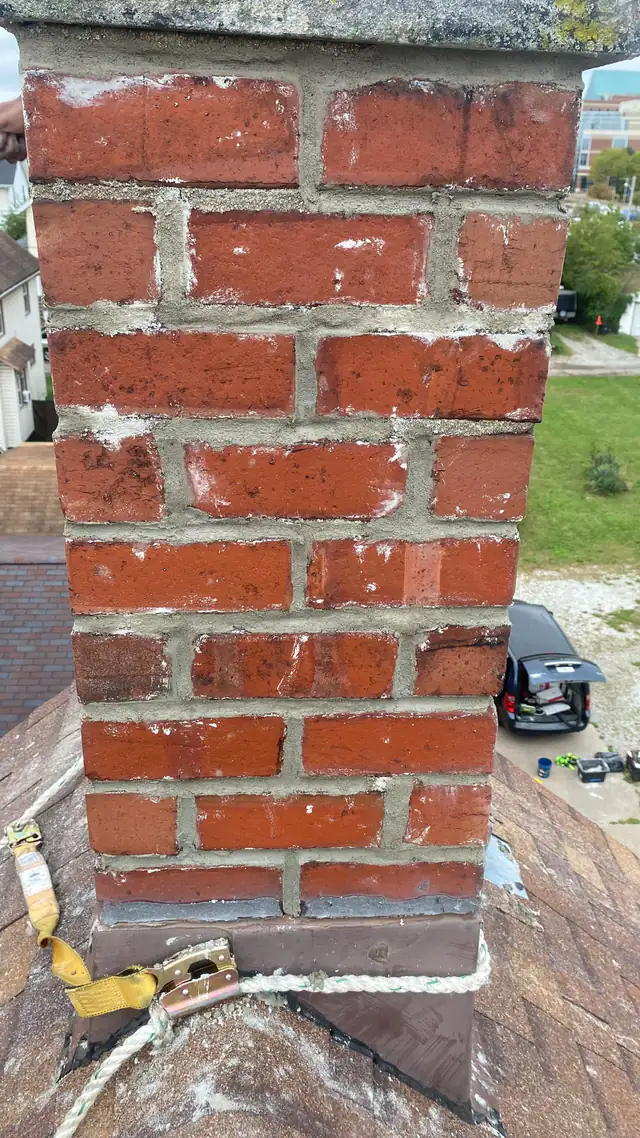
Roped in on a steep roof — repointed, flashing sealed 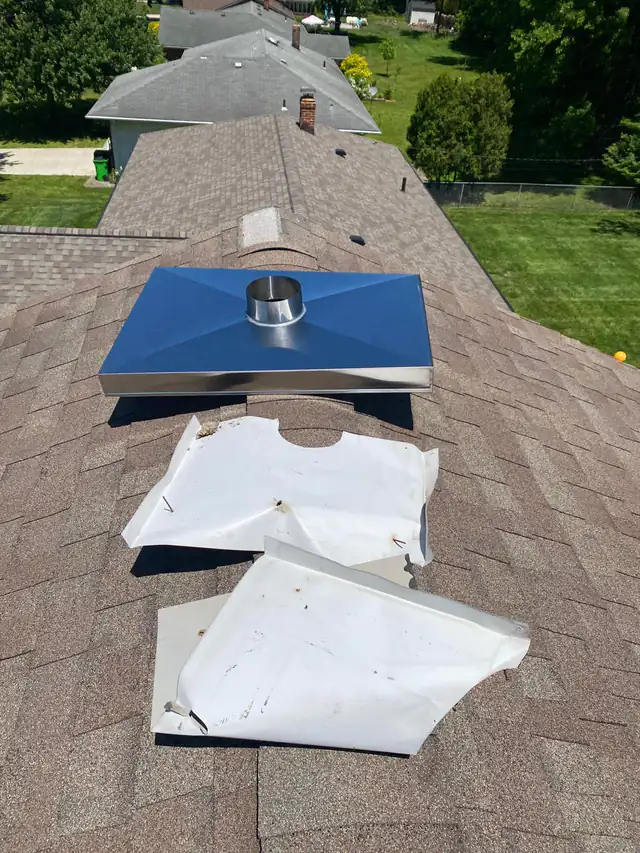
Replacement chase cover beside the removed cover sections on the roof 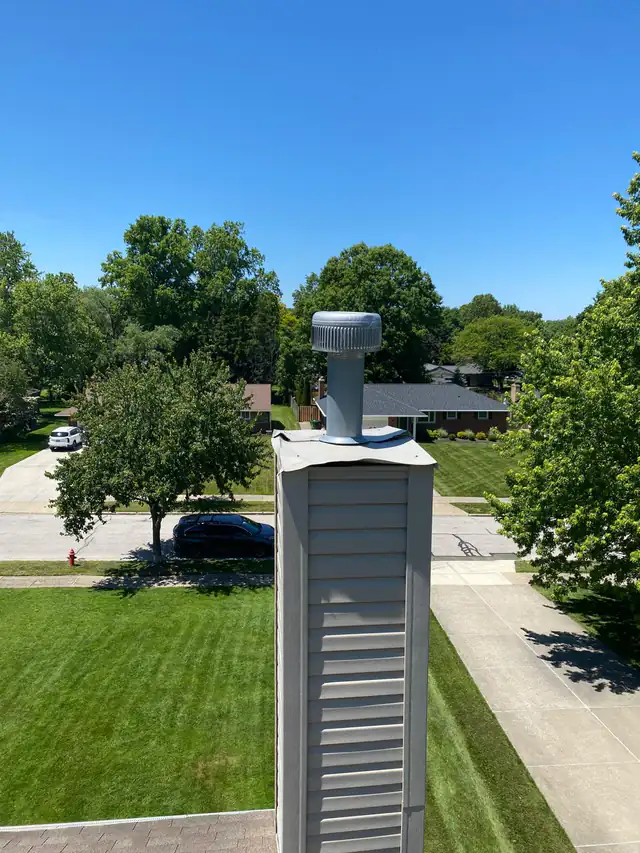
Before — the old chase cover, with bent and raised edges around the vent 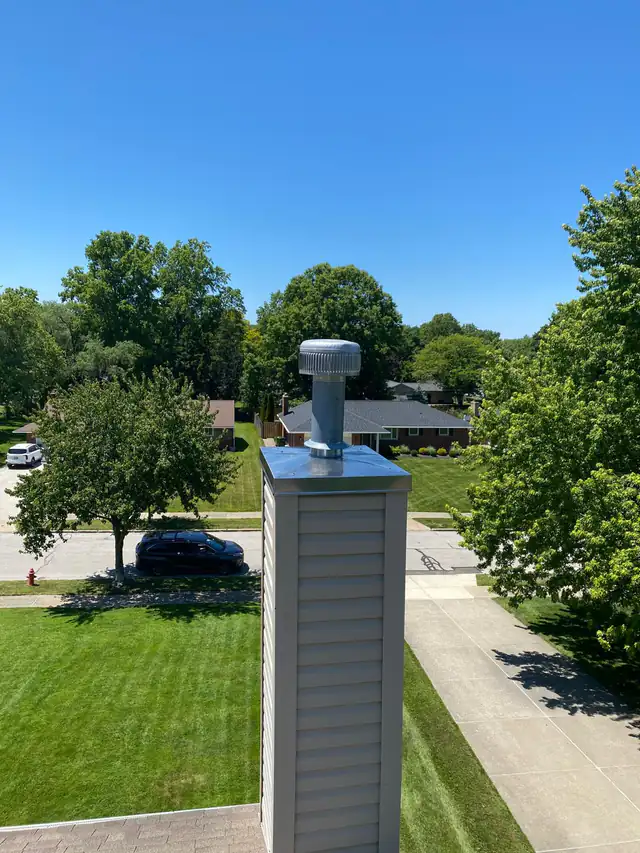
After — replacement chase cover fitted around the vent 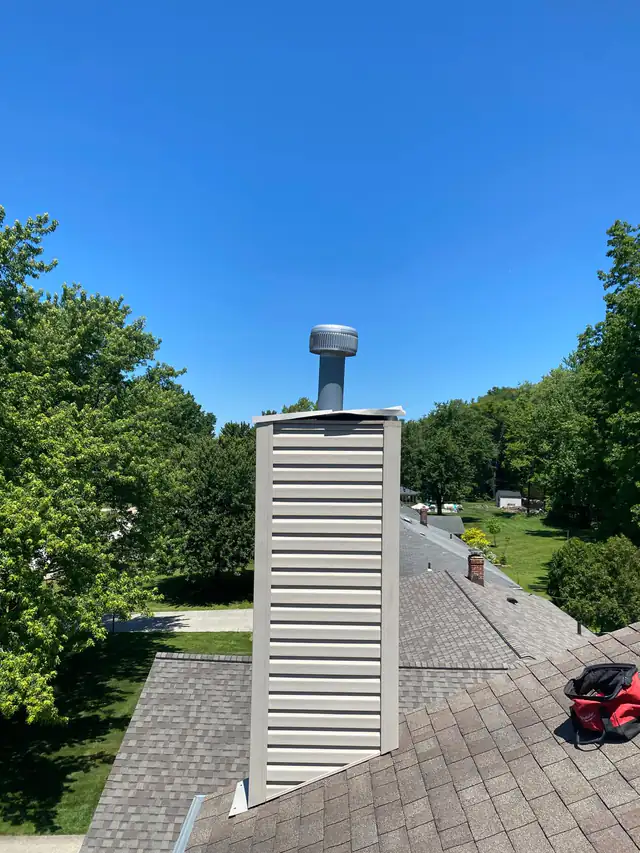
Before — the old cover from the roof side, with a raised edge 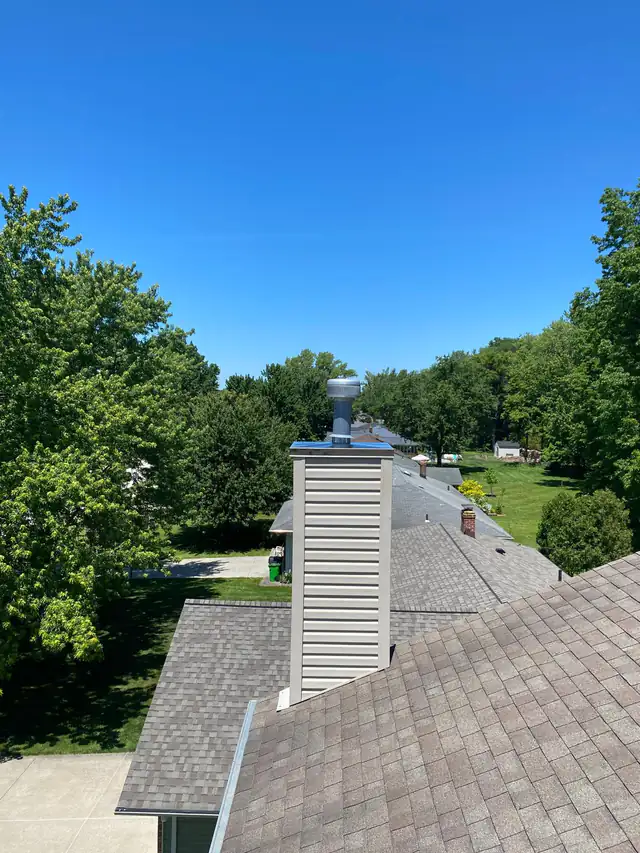
After — the replacement cover and chase, viewed from the roof
Meet the team
The people behind the work
Manny, Zack and Myke — meet the people behind Chimney Expert Solutions.
Our team and story →
Manny
Owner

Zack
Manager

Myke
Technician
FAQ
Chimney Leak Repair in Mentor: questions we hear
Should we get the chimney looked at before winter or after?
Before, if the choice is yours. Fall is when a missing cap, a dented cover, an open joint or a cracked crown can still be corrected before it takes on a season of snow and freeze cycles, and it is also when mortar work is still possible — masonry needs sustained temperatures above roughly 40°F to cure properly, so the season here effectively closes in November.
Water comes in near the chimney only in winter. Is the chimney leaking?
Usually not in the way people mean. A leak that appears in thaw conditions and never in summer downpours is the signature of an ice dam backing water up under the flashing rather than a defect in the crown or the masonry. We look at the flashing details and at what the attic is doing above them, because insulation and ventilation are usually half the answer.
Does more snow actually mean more chimney damage?
It means more of the specific kinds. Snow sits in contact with masonry for weeks rather than running off in an afternoon, so it melts and refreezes against the same joints repeatedly, and it loads the roof in ways that move flashing and shear off caps. The flue's interior condition is not much affected by snowfall; everything from the roofline up very much is.
My roofer says it's the chimney and the chimney guy says it's the roof. Who's right?
That standoff almost always means flashing, the one joint where the two trades meet and neither owns it. We diagnose the whole intersection together — flashing, counterflashing, crown, cap and masonry — and give you one answer with photographs behind it. If the finding genuinely is the roof, we will tell you that too.
It leaked once and hasn't since. Do I still need it looked at?
Yes, and the intermittency is a clue rather than a reassurance. A leak that only appears under specific conditions usually means a directional entry point, most often driven rain on one face or ice damming at the roofline. The path is still there between events, and it is still admitting the water that does the freeze-thaw damage.
Free estimate
Chimney Leak Repair in Mentor?
Tell us what you’re seeing and we’ll call or text back to schedule a look — with photos of what we find and an honest read on what’s urgent and what can wait. That evidence-first method is the way we work on every job.
Call and tell us what the chimney's doing — if we're up on a roof, we'll call you back. Other ways to reach us are on the contact page, and Mentor is one of the communities we cover across Greater Cleveland.
Call216-647-1882