

Lorain County, Ohio
Chimney Services in Avon Lake, OH
Open lakefront exposure with no shelter from the north — steady wind that beats chimney draft, houses under pressure that pull air back down unused flues, and converted seasonal cottages carrying year-round heating loads.
Avon Lake runs along the shoreline west of the county line, with older housing on and around Lake Road — a lot of it originally built as summer places — and large stretches of newer subdivision south of it toward Walker Road and the highway. The chimney work here is shaped less by building era than by the fact that there is nothing between these houses and the open water.
Wind is the variable. Inland, a house sits in the aerodynamic shelter of other houses, trees and terrain, and the wind that reaches a chimney is broken up and slowed. On an open lakefront it arrives at full speed and it arrives steadily, for hours at a time, from a consistent direction. That does two things to a chimney: it can overwhelm the draft directly, pushing air down the flue instead of letting it rise, and it pressurizes one side of the house while depressurizing the other, which changes how air moves inside the building.
Both of those show up as complaints that sound like flue problems and are not. The chimney can be clean, sound and correctly sized, and the fireplace can still misbehave — because the problem is outside the masonry entirely, in the air moving around the house.
What goes wrong with chimneys in Avon Lake
Wind pushing the draft back down the flue
Steady onshore wind striking a roof creates a zone of downward pressure on the lee side and turbulence over the ridge, and if the chimney terminates inside that zone the wind wins. The symptom is unmistakable once you know it: the fireplace draws perfectly on calm days and backpuffs or refuses to start when it is blowing, always from roughly the same direction. There are two levers. One is height — getting the flue termination up out of the turbulent layer, which means at least two feet above anything within ten feet of it. The other is the cap: wind-directional and vacuum-style caps use the wind itself to pull the flue rather than fight it, and on an exposed lakefront they earn their place.
The fireplace we never use, and the smell
The most common Avon Lake call has nothing to do with fire. A house under negative pressure — from wind on the lee side, from bath and kitchen exhaust, from the stack effect of warm air rising in winter — pulls replacement air in wherever it can, and an open flue is a large, easy opening. Air comes down the chimney, passes over old deposits in the smoke chamber and the firebox, and delivers the smell into the room. Cleaning removes the source, but the airflow is the actual cause, and the durable fix is a top-sealing damper that closes the flue at the top rather than at the throat. It also stops you heating the outdoors through the winter.
Cottages that became houses
A good number of the older places near the shore began as seasonal cottages and were converted to year-round living over the decades, gaining insulation, a real heating system and often a fireplace along the way. The masonry frequently did not keep up with the conversion. We find chimneys built for occasional summer use now venting a heating appliance through every Ohio winter, foundations and footings that were adequate for a light seasonal structure carrying a full-height stack, and flue arrangements assembled in stages by different people. None of that is necessarily unsafe, but it does mean the chimney deserves to be assessed on what it is doing now rather than on what it was built to do.
What we do here
Every chimney service we cover in Avon Lake
One crew for the whole system, so the diagnosis and the repair come from the same people. The pages marked for Avon Lake go into what this suburb’s housing stock does to that particular job; the rest cover the work across our whole service area.
Chimney Sweep & Cleaning
Full mechanical sweep of the flue, smoke chamber and firebox — creosote out, dust contained, and a look at the whole system while we're in it.
Chimney Sweep in Avon LakeChimney Inspection
Camera inspection of the full flue, plus the firebox, damper, crown, cap and flashing — documented in photos, explained in plain language.
Chimney Inspection in Avon LakeChimney Repair & Rebuilds
Masonry repair from spot fixes to full stack rebuilds — spalled brick, failed joints, and chimneys the freeze-thaw cycle has taken apart.
Chimney Repair in Avon LakeChimney Liner & Relining
Stainless steel relining for flues with cracked tiles, gaps, or no liner at all — sized to your appliance, insulated, done once.
Chimney Relining in Avon LakeChimney Leak Repair & Waterproofing
Finding where the water actually gets in — crown, cap, flashing, masonry or condensation — and fixing that, not caulking symptoms.
Chimney Leak Repair in Avon LakeChimney Caps & Crown Repair
The two parts that protect everything below them — stainless caps fitted right, and crowns rebuilt to actually shed water.
Chimney Caps & Crown RepairTuckpointing & Repointing
Grinding out failed mortar joints and repacking them properly — matched in strength, color and profile, not smeared over the brick.
Tuckpointing & RepointingFireplace & Damper Repair
Fireboxes rebuilt, refractory panels replaced, dampers that open, close and seal — the room side of the system, done right.
Fireplace & Damper Repair
Not sure which of these you need? That is what an inspection is for — or see how the whole chimney fits together and the way we work.
Working with us
What every Avon Lake job comes with
Evidence, not assertions
Photographs of every finding before you decide anything — including the parts of your chimney you have never seen.
Free estimates on repair work
Honest triage on what we find: urgent, plan-for, or fine.
One crew, whole system
One crew for the whole chimney — sweep, inspection, masonry, liner, crown, cap and flashing, with one person responsible for all of it.
Our work
The work Avon Lake chimneys usually need
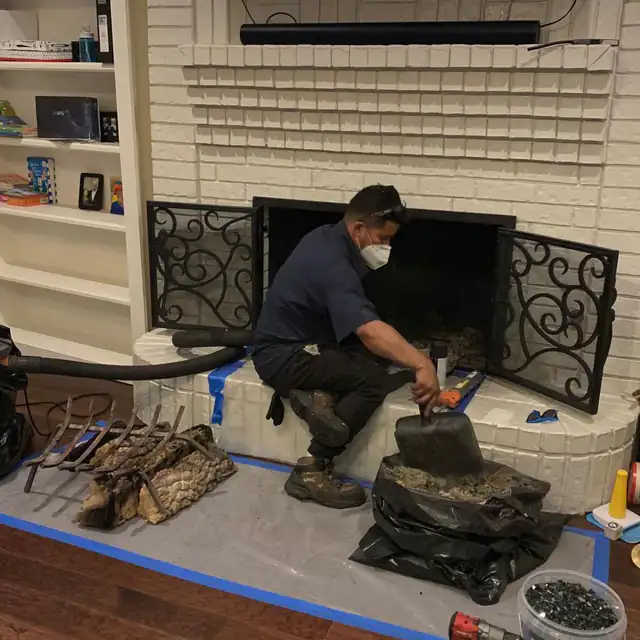
Drop cloths down and a vacuum on the hearth before anything is opened 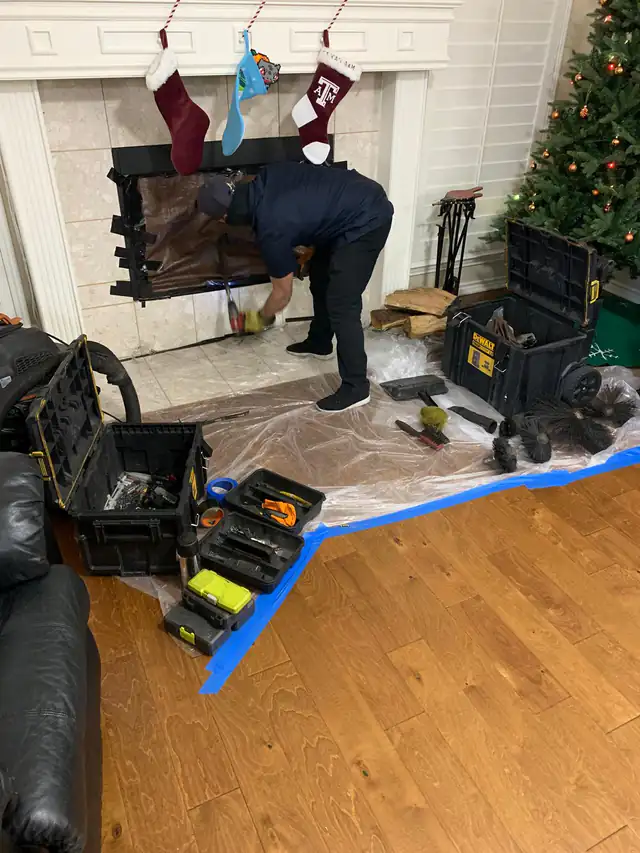
Working at the protected fireplace opening, with brushes and tools on covered floors 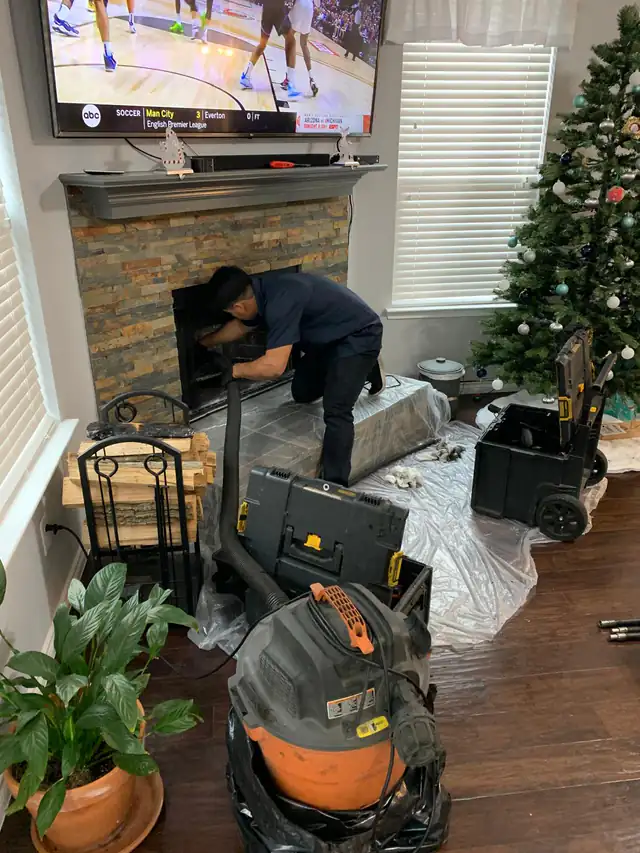
At the stone-front fireplace, with the hearth covered and a vacuum alongside
Meet the team
The people behind the work
Manny, Zack and Myke — meet the people behind Chimney Expert Solutions.
Our team and story →
Manny
Owner

Zack
Manager

Myke
Technician
Service area
Avon Lake is inside our service area
36 communities across Northeast Ohio · based in Cleveland Heights
- Cleveland
- Lakewood
- Cleveland Heights
- Shaker Heights
- Parma
- Rocky River
- Westlake
- Strongsville
- Euclid
- South Euclid
- University Heights
- Beachwood
- Bedford
- Garfield Heights
- North Olmsted
- Mentor
- Willoughby
- Painesville
- Chardon
- Elyria
- Lorain
- Avon Lake
- Medina
- Brunswick
- Akron
- Cuyahoga Falls
- Hudson
- Kent
- Canton
- Wooster
- Warren
- Youngstown
- Boardman
- Sandusky
- Mansfield
- Ashland
FAQ
Avon Lake chimney questions
Our fireplace only misbehaves when the wind is up. Is the chimney blocked?
Probably not, and a scan will settle it quickly. A fireplace that draws well on calm days and fails in wind from a particular direction is describing a pressure problem, not an obstruction. The usual causes are a flue that terminates too low relative to the ridge or a nearby structure, and a cap that fights the wind instead of using it. Both are fixable without touching the masonry below.
We smell the fireplace indoors even in summer. What is that?
Air coming down the flue rather than going up it, carrying odor off old deposits. It happens when the house is at lower pressure than the outside — which wind, exhaust fans and the stack effect all cause. Sweeping removes most of the smell source. A top-sealing damper, which seals the flue at the top rather than at the throat, is what stops the airflow itself.
Would a taller chimney really fix a wind problem?
Often, yes, because it gets the flue termination out of the turbulent air rolling over the roof. The rule of thumb is that a chimney should stand three feet above where it passes through the roof and two feet above anything within ten feet of it. Where height alone is not enough or is not practical, a wind-directional cap does the rest. We measure before recommending either.
Our house started as a summer cottage. Does that change anything?
It is worth knowing, yes. Chimneys on converted seasonal buildings were often built for light occasional use and have since been asked to vent a full heating system through Ohio winters, sometimes on footings sized for the original structure. Nothing about that is automatically a problem — it just means the chimney should be assessed against what it does now, including a look at the base and the footing.
Free estimate
Chimney trouble in Avon Lake?
Tell us what you're seeing and we'll call or text back to schedule a look — with photos of what we find and an honest read on what's urgent and what can wait.
Call and tell us what the chimney's doing — if we're up on a roof, we'll call you back. You can also reach us on the contact page, or look through the other communities we serve if you are calling about a second property.
Call216-647-1882