
Medina County, Ohio
Chimney Leak Repair & Waterproofing in Medina, OH
Finding where the water actually gets in — crown, cap, flashing, masonry or condensation — and fixing that, not caulking symptoms.
What chimney leak repair involves in Medina is set by the housing stock here: A Victorian square and its nineteenth-century streets alongside three decades of new subdivisions — traditional tall masonry stacks on one side of town and unserviced sealed direct-vent gas appliances on the other.
Medina is two towns wearing one name, and the chimney work splits cleanly along the same line. There is the old city — the Victorian square with its gaslights and storefronts, and the streets of nineteenth-century houses radiating out from it — and there is everything built since about 1990, which is a very large amount of subdivision housing pushing out toward Route 18 and the highway in every direction.
A leaking chimney is a symptom with at least five different causes, and fixing the wrong one is why so many chimney leaks come back. Water can enter through a cracked crown, a missing or undersized cap, failed flashing where the chimney meets the roof, saturated porous masonry, or condensation forming inside an oversized flue. Each of those has a different repair, and none of them is solved by sealant on whatever surface was easiest to reach. Our leak work starts with diagnosis at roof level and inside the house, so the fix targets the actual entry point.
What we find on Medina chimneys that leads to chimney leak repair
Horizontal terminations at head height
The vent for a direct-vent fireplace exits through an exterior wall, often only a few feet above the ground and often on a side of the house nobody walks past. That location invites problems a rooftop flue never has. Birds nest in the termination in spring. Snow drifts against it and blocks it, which on a sealed system stops combustion air as well as exhaust. Shrubs grow over it. Deck furniture gets stacked in front of it. And the exhaust stains the siding above it, which people usually notice long before they connect it to the fireplace. Keeping the required clearance around the termination clear is genuinely part of owning one of these.
How we find which one it is
The diagnosis is systematic, because guessing is what produces repeat leaks. We start with what you can tell us: where the stain is, whether it appears in every rain or only in wind-driven rain, whether it correlates with snow melt, whether it started after a roof was done. That pattern narrows the list before anyone gets on a ladder. Sustained rain of any direction points at flashing or crown. Only wind-driven rain from one direction points at masonry on the weather face. Cold weather with no rain points at condensation. Snow melt at the roofline points at ice damming interacting with the flashing.
Then it is roof level: crown photographed and examined for cracks and for whether it has any overhang at all, cap condition and fit, flue tile terminations, flashing and counterflashing inspected at the joint rather than from six feet away, and the masonry faces looked over for open joints and spalling with attention to the side the weather comes from. Inside, the firebox, smoke chamber and damper get checked for water staining, rust and damp, and the ceiling or wall stain gets traced back to where it plausibly originates rather than where it appears.
You get the photographs, and the diagnosis explains itself. That matters more here than on almost any other chimney job, because leak repair is the area of this trade where guesswork is most often sold as expertise.
Lake Erie weather and what it does to the weather face
Wind-driven rain is the local variable that catches people out. Rain falling straight down mostly runs off a vertical brick face. Rain driven at a wall by thirty miles an hour of wind off the lake is pushed into it, and a masonry wall's ability to resist that is a function of its joints. This is why so many chimney leaks in Rocky River, Westlake, Lakewood and the lakefront stretch of Euclid appear only in storms from one particular direction, and why the weather-facing side of a stack is frequently in visibly worse condition than the sheltered side of the same chimney.
The second local factor is duration. Lake-effect conditions keep masonry wet for days rather than hours, so there is far less drying time between wetting events than the same chimney would get in a drier climate. Water that never fully leaves the wall is water available to freeze. That is the whole reason water management on a chimney matters more here than the average national advice suggests.
This page covers chimney leak repair as it plays out in Medina. The full chimney leak repair & waterproofing page walks the whole job — every stage, what changes the scope, and what we do about each of them. For everything else we handle in this suburb, see chimney services in Medina.
How we handle a leaking chimney
- Roof-level diagnosis: crown, cap, flashing, masonry and shoulder — photographed
- Interior check: firebox, smoke chamber and damper for staining, rust and damp
- Flashing repair or a full re-flash where the roofline seal has failed
- Crown repair or full recast with a drip edge and an expansion joint at the flue
- Vapor-permeable masonry repellent on porous brick — never paint or film-forming sealers
- An honest call on whether the 'leak' is actually flue condensation
- The fix in writing, matched to the diagnosed entry point
Our work
Chimney Leak Repair & Waterproofing, photographed on the job
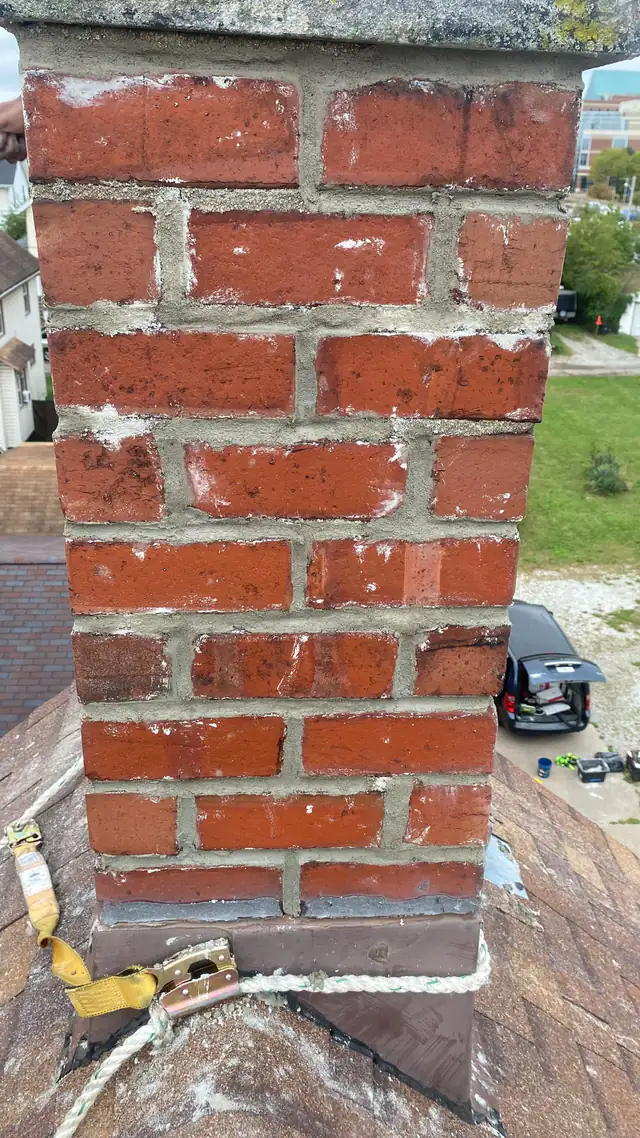
Roped in on a steep roof — repointed, flashing sealed 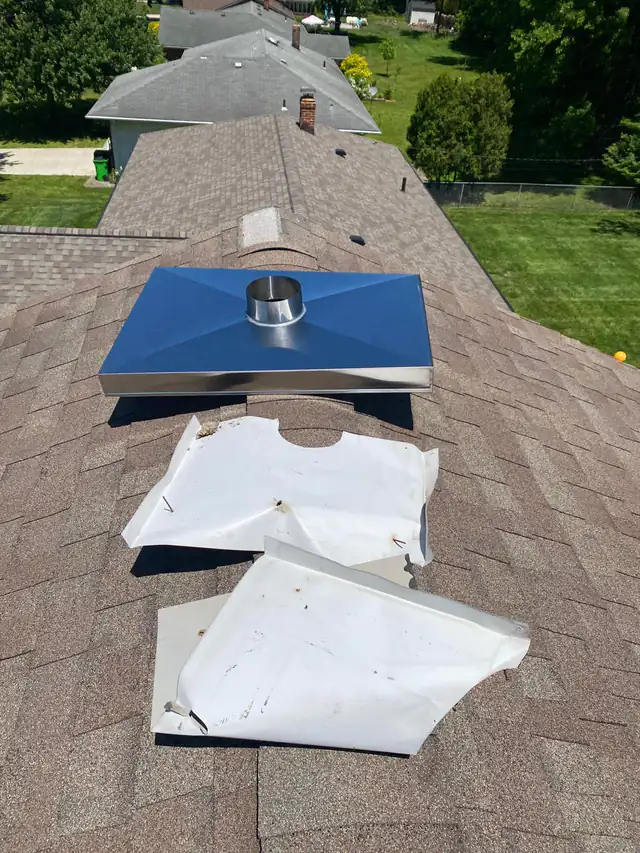
Replacement chase cover beside the removed cover sections on the roof 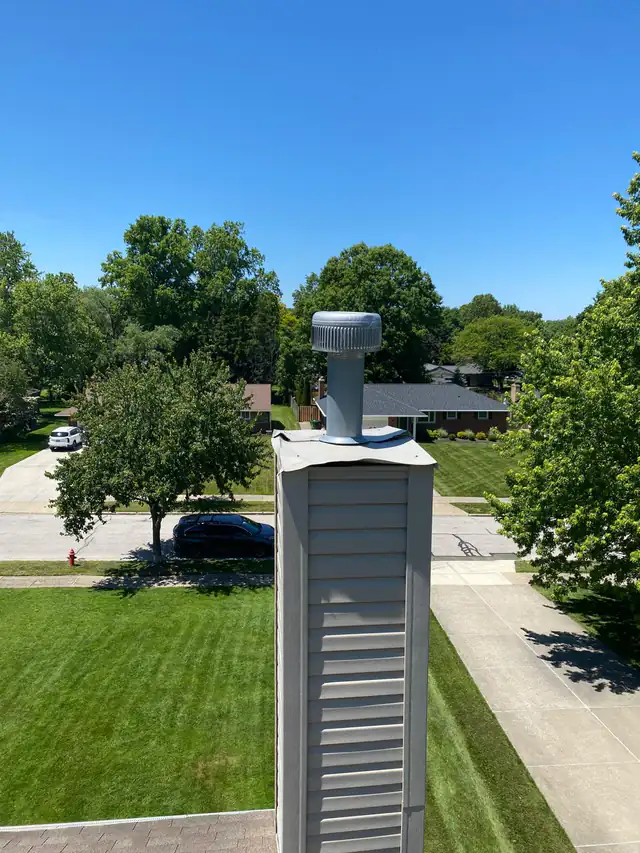
Before — the old chase cover, with bent and raised edges around the vent 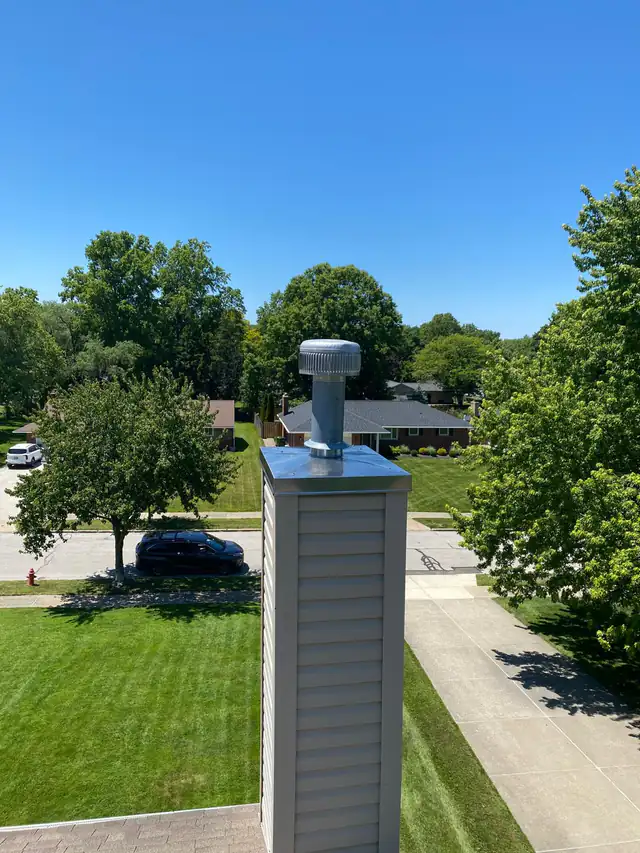
After — replacement chase cover fitted around the vent 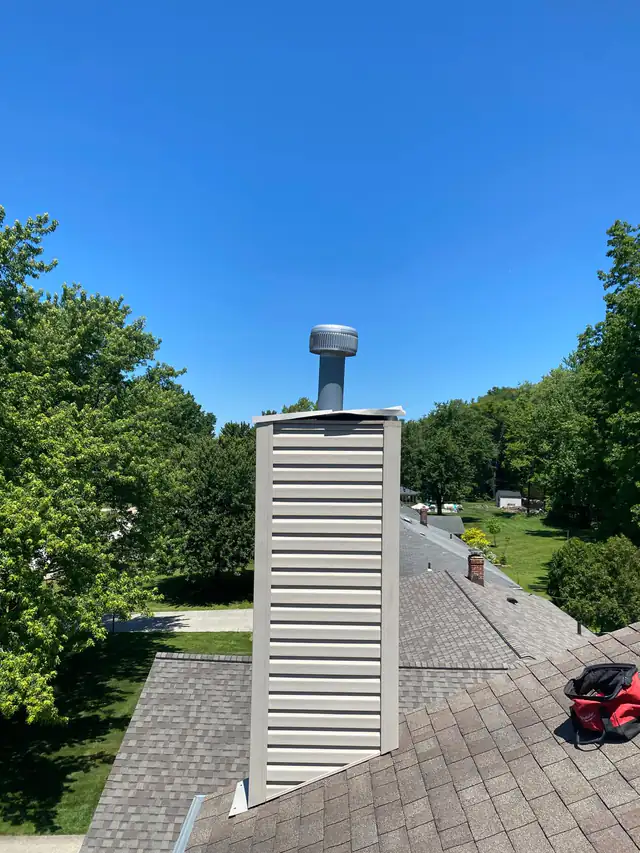
Before — the old cover from the roof side, with a raised edge 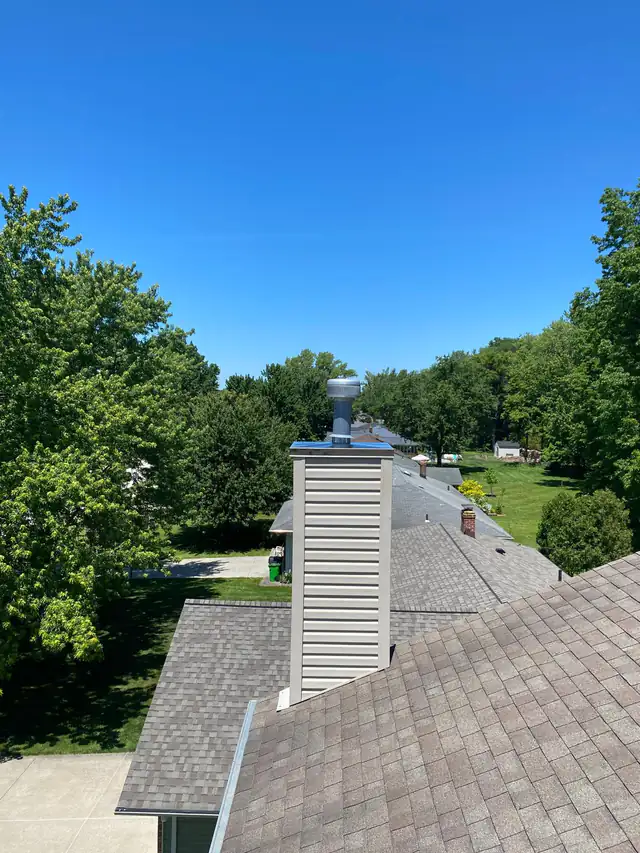
After — the replacement cover and chase, viewed from the roof
Meet the team
The people behind the work
Manny, Zack and Myke — meet the people behind Chimney Expert Solutions.
Our team and story →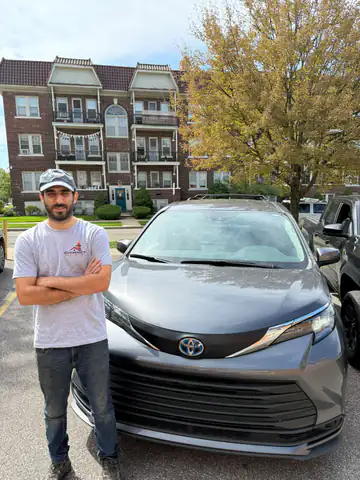
Manny
Owner

Zack
Manager

Myke
Technician
FAQ
Chimney Leak Repair in Medina: questions we hear
Can you work on both the old masonry chimneys and the newer gas units?
Yes — they are different jobs and we treat them that way. Masonry gets the camera, the crown and cap assessment, and the mortar and matching conversation. A sealed gas appliance gets its glass, gasket, burner, safety controls and vent termination gone through. Tell us which you have when you book so the right parts and tools come with us.
There's a dark stain on the siding above a vent outside. What is it?
That is almost certainly the exhaust termination for a gas appliance, and the staining means the combustion is not as clean as it should be or the termination is partly obstructed. It is worth having the unit and the vent checked rather than just cleaning the siding — the stain is the visible end of something happening inside the appliance.
Can you fix a chimney leak in winter?
Some of it. Caps, some flashing work and temporary measures can be done in cold weather. Anything involving mortar or a concrete crown recast needs sustained temperatures above roughly 40°F to cure, so a winter diagnosis often means a temporary fix now and the permanent one in spring. We will tell you which category yours is in rather than laying masonry that will not set.
How long does a chimney repellent last?
Vapor-permeable siloxane repellents on sound masonry are generally reapplied on a multi-year cycle rather than annually, and the exposure of the wall changes that a lot — a west-facing stack near the lake weathers faster than a sheltered interior one. Reapplication is straightforward when the masonry underneath has been kept sound, which is rather the point of doing the pointing first.
Free estimate
Chimney Leak Repair in Medina?
Tell us what you’re seeing and we’ll call or text back to schedule a look — with photos of what we find and an honest read on what’s urgent and what can wait. That evidence-first method is the way we work on every job.
Call and tell us what the chimney's doing — if we're up on a roof, we'll call you back. Other ways to reach us are on the contact page, and Medina is one of the communities we cover across Greater Cleveland.
Call216-647-1882