
Cuyahoga County, Ohio
Chimney Leak Repair & Waterproofing in Rocky River, OH
Finding where the water actually gets in — crown, cap, flashing, masonry or condensation — and fixing that, not caulking symptoms.
What chimney leak repair involves in Rocky River is set by the housing stock here: Lake exposure accelerating everything — older masonry taking wind-driven rain on its north and west faces, and newer chase-built fireplaces with rusting galvanized covers.
Rocky River sits between the lake and the river valley, and its housing runs in layers: an older core of 1920s–40s homes along Detroit Road and up toward Lake Road and Beachcliff, then solid postwar neighborhoods, then later contemporary building including condominium development near the river and the lakefront. Chimney work here spans the whole range, from pre-war masonry stacks to factory-built fireplaces in framed chases.
A leaking chimney is a symptom with at least five different causes, and fixing the wrong one is why so many chimney leaks come back. Water can enter through a cracked crown, a missing or undersized cap, failed flashing where the chimney meets the roof, saturated porous masonry, or condensation forming inside an oversized flue. Each of those has a different repair, and none of them is solved by sealant on whatever surface was easiest to reach. Our leak work starts with diagnosis at roof level and inside the house, so the fix targets the actual entry point.
What we find on Rocky River chimneys that leads to chimney leak repair
Chase-built fireplaces with galvanized covers
A lot of the newer housing here has a factory-built fireplace in a wood-framed chase, finished outside in siding or stone veneer and closed at the top with a flat metal chase cover instead of a masonry crown. Galvanized covers rust, pond water rather than shedding it, and then leak straight into the chase framing. The rust streak running down the siding below the chimney top is the giveaway. The durable fix is a custom stainless cover with a cross-break so water runs off.
Directional leaks that only appear in certain storms
The classic Rocky River call is a ceiling stain that shows up two or three times a year and never in ordinary rain. That pattern is diagnostic: it points at wind-driven rain entering through open joints or spalled brick on one specific face, rather than at a crown or flashing failure that would leak in any sustained rain. Knowing which weather produces the stain narrows the search before anyone gets on a ladder, so mention it when you call.
The leak nobody owns
Roofer says chimney, chimney contractor says roof, and the homeowner pays twice. It happens here more than most places because lake exposure puts real stress on exactly the joint where the two trades meet: the step flashing and counterflashing at the roofline. We diagnose the whole intersection together — flashing, counterflashing, crown, cap and masonry — and give one answer with photographs behind it, including when the honest answer is that the roof is the problem.
What drives the cost of leak work
- The diagnosis versus the repair. Finding the entry point is a defined piece of work; the fix depends entirely on what the finding is, which is why an honest quote for 'a chimney leak' cannot be given over the phone.
- Which component failed. A cap is a small job. A full crown recast is a bigger one. A complete re-flash with the roofing coordinated is bigger again.
- Roof access, pitch and material, as with all chimney work.
- Whether more than one entry point is active — which is common, because the conditions that kill a crown also kill flashing of the same age.
- How much interior damage there is. We do the chimney; drywall, plaster and framing repair inside is separate work and we will say so plainly rather than quietly including it.
- Whether the masonry needs pointing before any repellent is worth applying.
How we find which one it is
The diagnosis is systematic, because guessing is what produces repeat leaks. We start with what you can tell us: where the stain is, whether it appears in every rain or only in wind-driven rain, whether it correlates with snow melt, whether it started after a roof was done. That pattern narrows the list before anyone gets on a ladder. Sustained rain of any direction points at flashing or crown. Only wind-driven rain from one direction points at masonry on the weather face. Cold weather with no rain points at condensation. Snow melt at the roofline points at ice damming interacting with the flashing.
Then it is roof level: crown photographed and examined for cracks and for whether it has any overhang at all, cap condition and fit, flue tile terminations, flashing and counterflashing inspected at the joint rather than from six feet away, and the masonry faces looked over for open joints and spalling with attention to the side the weather comes from. Inside, the firebox, smoke chamber and damper get checked for water staining, rust and damp, and the ceiling or wall stain gets traced back to where it plausibly originates rather than where it appears.
You get the photographs, and the diagnosis explains itself. That matters more here than on almost any other chimney job, because leak repair is the area of this trade where guesswork is most often sold as expertise.
This page covers chimney leak repair as it plays out in Rocky River. The full chimney leak repair & waterproofing page walks the whole job — every stage, what changes the scope, and what we do about each of them. For everything else we handle in this suburb, see chimney services in Rocky River.
How we handle a leaking chimney
- Roof-level diagnosis: crown, cap, flashing, masonry and shoulder — photographed
- Interior check: firebox, smoke chamber and damper for staining, rust and damp
- Flashing repair or a full re-flash where the roofline seal has failed
- Crown repair or full recast with a drip edge and an expansion joint at the flue
- Vapor-permeable masonry repellent on porous brick — never paint or film-forming sealers
- An honest call on whether the 'leak' is actually flue condensation
- The fix in writing, matched to the diagnosed entry point
Our work
Chimney Leak Repair & Waterproofing, photographed on the job
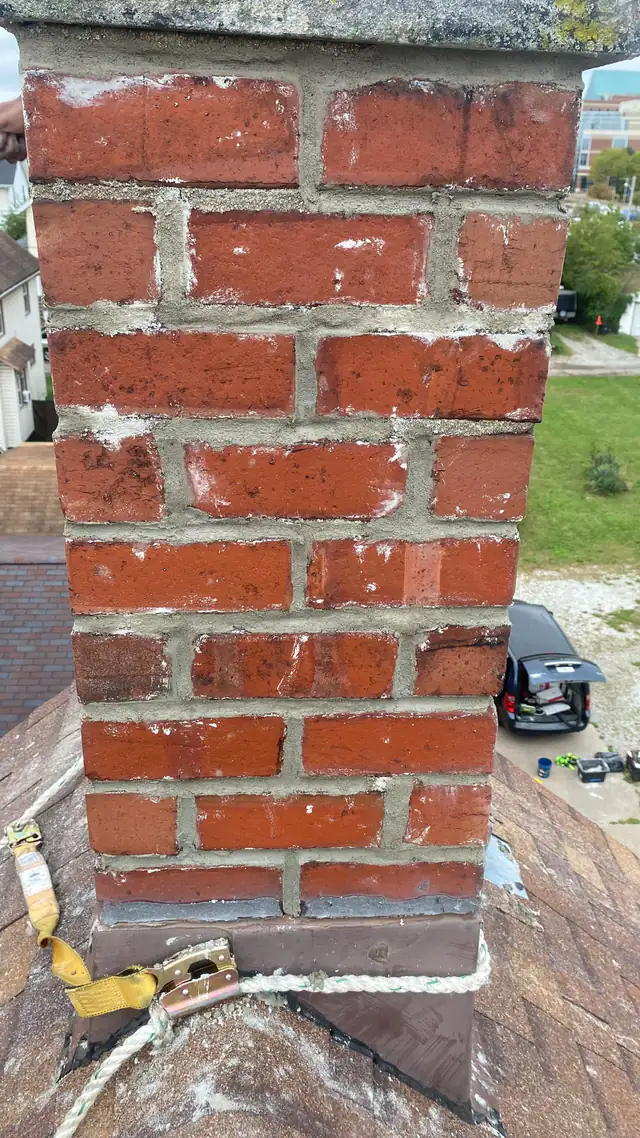
Roped in on a steep roof — repointed, flashing sealed 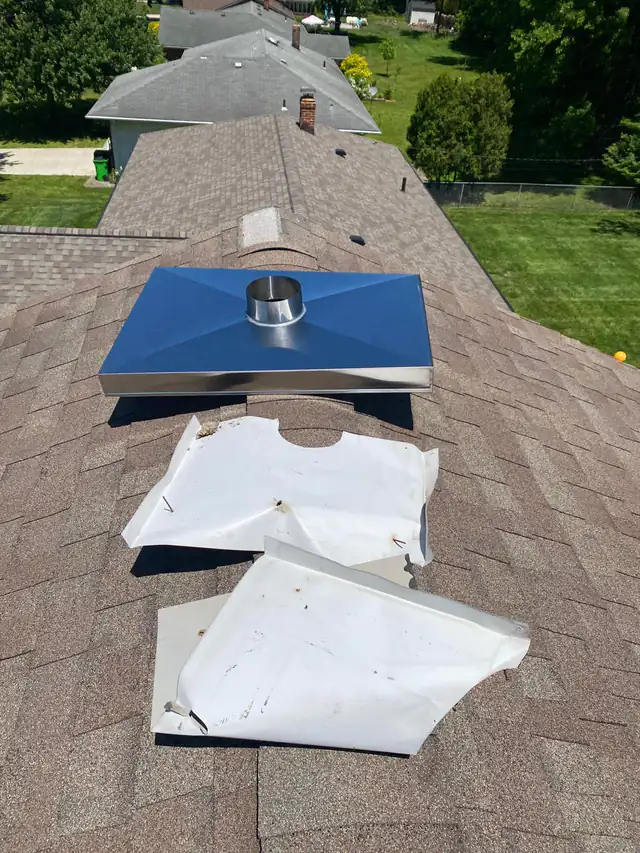
Replacement chase cover beside the removed cover sections on the roof 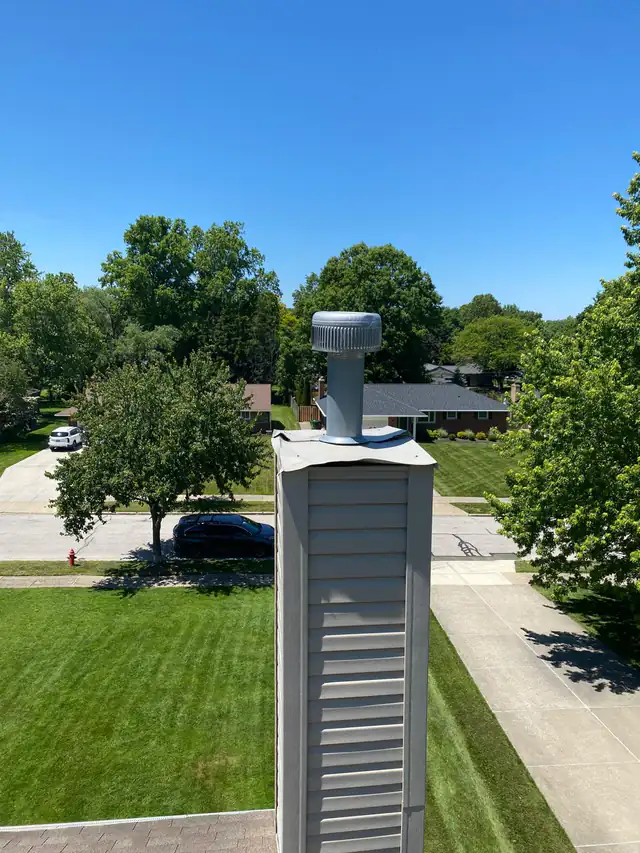
Before — the old chase cover, with bent and raised edges around the vent 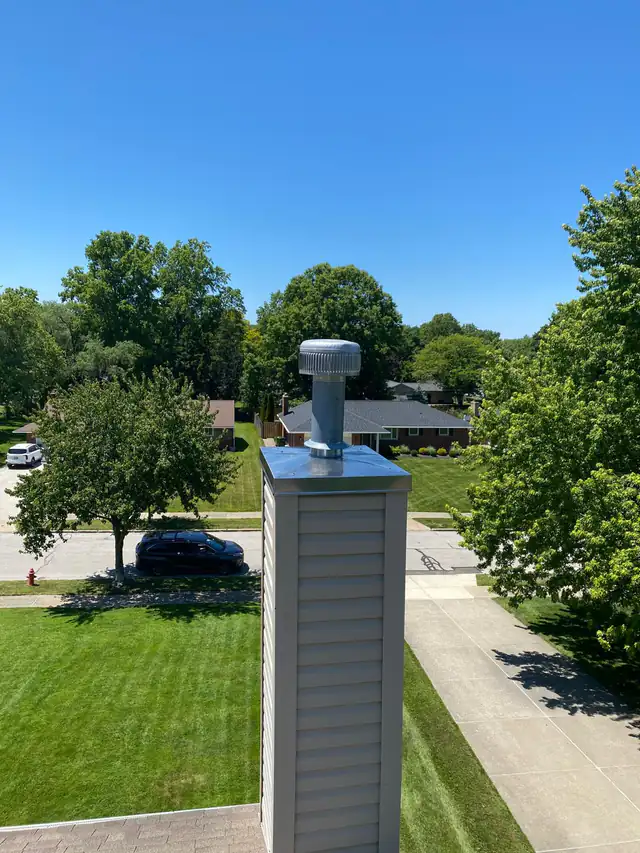
After — replacement chase cover fitted around the vent 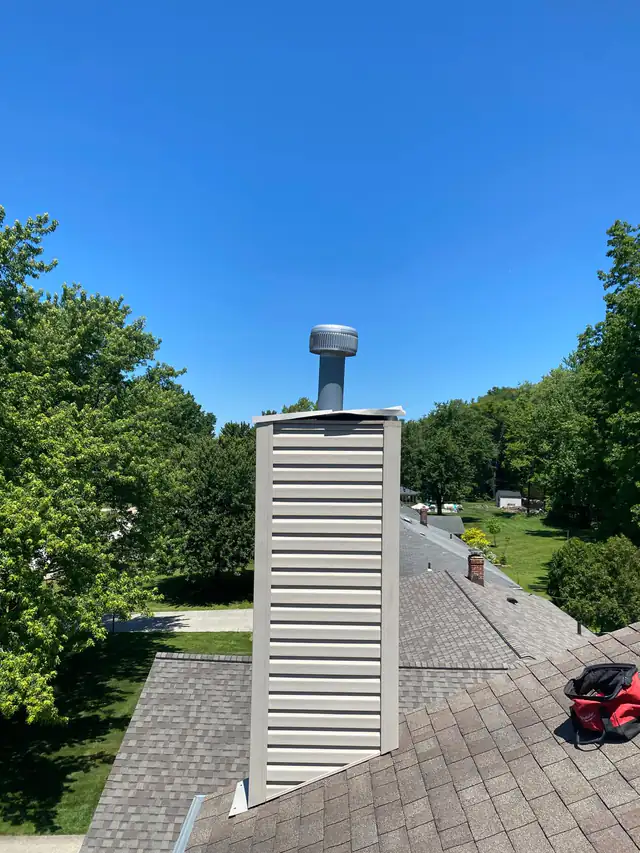
Before — the old cover from the roof side, with a raised edge 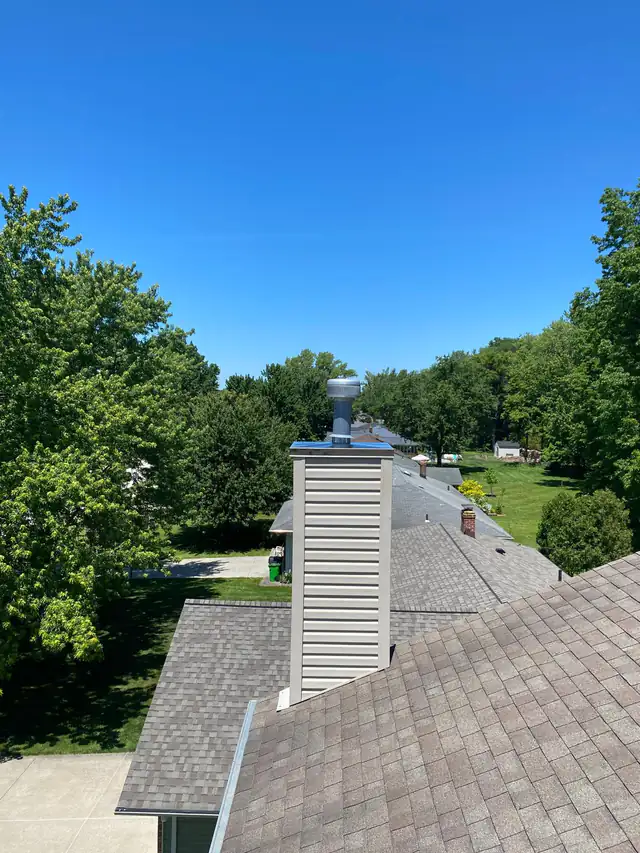
After — the replacement cover and chase, viewed from the roof
Meet the team
The people behind the work
Manny, Zack and Myke — meet the people behind Chimney Expert Solutions.
Our team and story →
Manny
Owner
Zack
Manager

Myke
Technician
FAQ
Chimney Leak Repair in Rocky River: questions we hear
Does being near the lake really change chimney maintenance?
Measurably. Lake-adjacent masonry takes more driven rain, gets more freeze-thaw cycles, and has less drying time between wettings than the same chimney would inland. The practical difference is not exotic: inspect annually without skipping years, keep the crown and cap ahead of failure rather than behind it, and treat leak symptoms as this-season repairs.
Our newer home has a metal box on top instead of a brick chimney. Is that yours to service?
Yes. That is a chase cover over a factory-built fireplace, and it is a chimney in every way that matters: the flue still builds creosote and needs sweeping, the cover rusts and pools water, and the refractory panels inside the firebox crack with age. Replacing a failing galvanized cover with stainless is one of the more common jobs on Rocky River's newer streets.
Should we waterproof the chimney given the exposure?
Only in the right circumstances, and only with the right product. A vapor-permeable siloxane-type repellent on masonry that is sound but genuinely absorbing water is worthwhile here. A film-forming sealer or masonry paint is actively harmful in a freeze-thaw climate because it traps moisture in the wall. And no repellent is a substitute for pointing open joints or recasting a failed crown — those are the actual holes.
My roofer says it's the chimney and the chimney guy says it's the roof. Who's right?
That standoff almost always means flashing, the one joint where the two trades meet and neither owns it. We diagnose the whole intersection together — flashing, counterflashing, crown, cap and masonry — and give you one answer with photographs behind it. If the finding genuinely is the roof, we will tell you that too.
It leaked once and hasn't since. Do I still need it looked at?
Yes, and the intermittency is a clue rather than a reassurance. A leak that only appears under specific conditions usually means a directional entry point, most often driven rain on one face or ice damming at the roofline. The path is still there between events, and it is still admitting the water that does the freeze-thaw damage.
Free estimate
Chimney Leak Repair in Rocky River?
Tell us what you’re seeing and we’ll call or text back to schedule a look — with photos of what we find and an honest read on what’s urgent and what can wait. That evidence-first method is the way we work on every job.
Call and tell us what the chimney's doing — if we're up on a roof, we'll call you back. Other ways to reach us are on the contact page, and Rocky River is one of the communities we cover across Greater Cleveland.
Call216-647-1882