
Lake County, Ohio
Chimney Leak Repair & Waterproofing in Painesville, OH
Finding where the water actually gets in — crown, cap, flashing, masonry or condensation — and fixing that, not caulking symptoms.
What chimney leak repair involves in Painesville is set by the housing stock here: A nineteenth-century county seat of Italianate and Queen Anne houses — tall exposed stacks that deteriorate from the top down, apartment conversions with layers of added flues, and balloon-framed walls with no firestopping.
Painesville is the Lake County seat, and it looks it: a courthouse square, streets of Italianate and Queen Anne houses around it, Lake Erie College, and a downtown built when this was the center of gravity for the whole county. The residential stock through the older districts is substantially nineteenth century, and Victorian chimneys are a different animal from anything else in this service area.
A leaking chimney is a symptom with at least five different causes, and fixing the wrong one is why so many chimney leaks come back. Water can enter through a cracked crown, a missing or undersized cap, failed flashing where the chimney meets the roof, saturated porous masonry, or condensation forming inside an oversized flue. Each of those has a different repair, and none of them is solved by sealant on whatever surface was easiest to reach. Our leak work starts with diagnosis at roof level and inside the house, so the fix targets the actual entry point.
What we find on Painesville chimneys that leads to chimney leak repair
The top of a tall Victorian stack fails first and fails alone
On these chimneys the deterioration is concentrated in the portion above the roof, and heavily concentrated in the top three or four courses. That is the masonry that is wet most often, freezes most often, dries slowest and is furthest from any lateral support. Below the roofline the same chimney is frequently in fine condition, protected by the building and never freezing. That has a practical consequence worth knowing before you get a quote: rebuilding from the roofline up is a legitimate, complete repair for a great many Painesville chimneys, and it costs a fraction of what a full-height rebuild does. Anyone quoting the whole stack should be able to show you why the lower section needs it.
Balloon framing turns a wall cavity into a chimney of its own
In a house framed this way, the stud bays run uninterrupted from the basement to the attic. Where those bays sit alongside a chimney with a cracked flue, a defective thimble or an open abandoned connection, there is a clear vertical path for heat, smoke and embers to reach the roof structure — which is the mechanism behind a lot of historic house fires that started at a chimney. The same open path lets water from a leaking stack travel two floors before it appears. Firestopping at each floor line and sealing the flue properly are what break the path.
Why sealing the whole chimney is usually a mistake
The instinct when a masonry chimney leaks is to coat it, and the products that come to hand at a hardware store are mostly film-forming: acrylic sealers, masonry paint, silicone. In a freeze-thaw climate these do real damage. Brick and mortar have to be able to release moisture outward. A film-forming coating stops that while doing nothing about the water arriving from the crown or the flashing, so the moisture that gets in stays in — and every freeze then works on masonry that cannot dry. Painted and sealed chimneys spall spectacularly, and the damage shows up across the whole face rather than at one entry point.
Where a repellent is genuinely appropriate, the product class matters: silane and siloxane repellents penetrate and repel liquid water while remaining vapor permeable, so the wall still breathes. And it is applied after the joints are sound, never as a substitute for pointing them. A repellent is a raincoat, not a roof, and it will never fix a crown or a piece of flashing.
Lake Erie weather and what it does to the weather face
Wind-driven rain is the local variable that catches people out. Rain falling straight down mostly runs off a vertical brick face. Rain driven at a wall by thirty miles an hour of wind off the lake is pushed into it, and a masonry wall's ability to resist that is a function of its joints. This is why so many chimney leaks in Rocky River, Westlake, Lakewood and the lakefront stretch of Euclid appear only in storms from one particular direction, and why the weather-facing side of a stack is frequently in visibly worse condition than the sheltered side of the same chimney.
The second local factor is duration. Lake-effect conditions keep masonry wet for days rather than hours, so there is far less drying time between wetting events than the same chimney would get in a drier climate. Water that never fully leaves the wall is water available to freeze. That is the whole reason water management on a chimney matters more here than the average national advice suggests.
This page covers chimney leak repair as it plays out in Painesville. The full chimney leak repair & waterproofing page walks the whole job — every stage, what changes the scope, and what we do about each of them. For everything else we handle in this suburb, see chimney services in Painesville.
How we handle a leaking chimney
- Roof-level diagnosis: crown, cap, flashing, masonry and shoulder — photographed
- Interior check: firebox, smoke chamber and damper for staining, rust and damp
- Flashing repair or a full re-flash where the roofline seal has failed
- Crown repair or full recast with a drip edge and an expansion joint at the flue
- Vapor-permeable masonry repellent on porous brick — never paint or film-forming sealers
- An honest call on whether the 'leak' is actually flue condensation
- The fix in writing, matched to the diagnosed entry point
Our work
Chimney Leak Repair & Waterproofing, photographed on the job
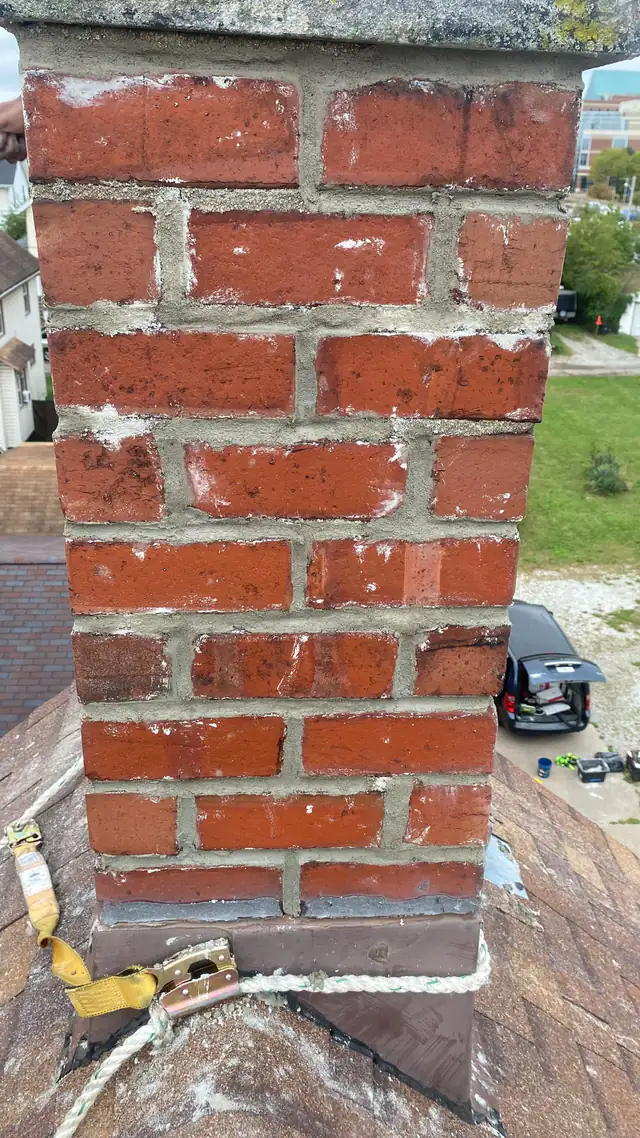
Roped in on a steep roof — repointed, flashing sealed 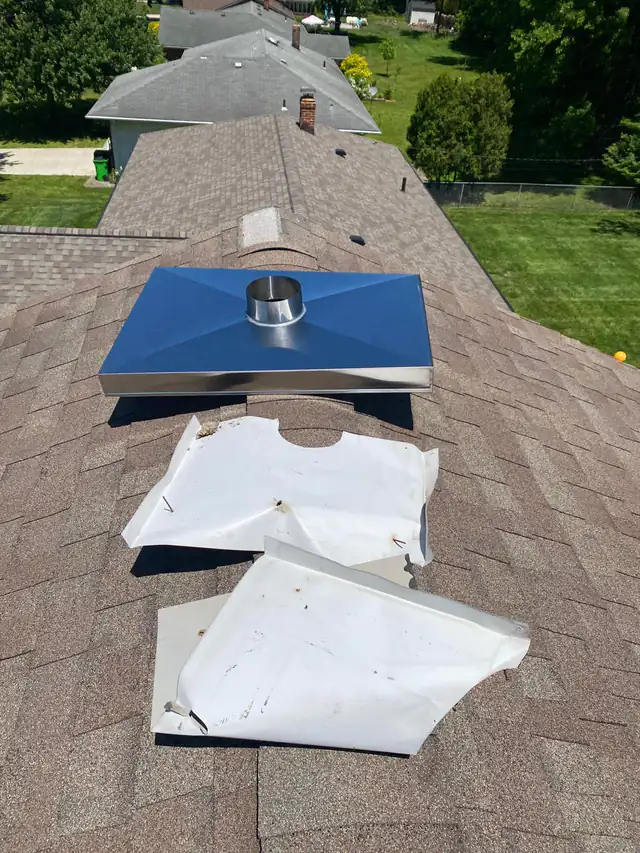
Replacement chase cover beside the removed cover sections on the roof 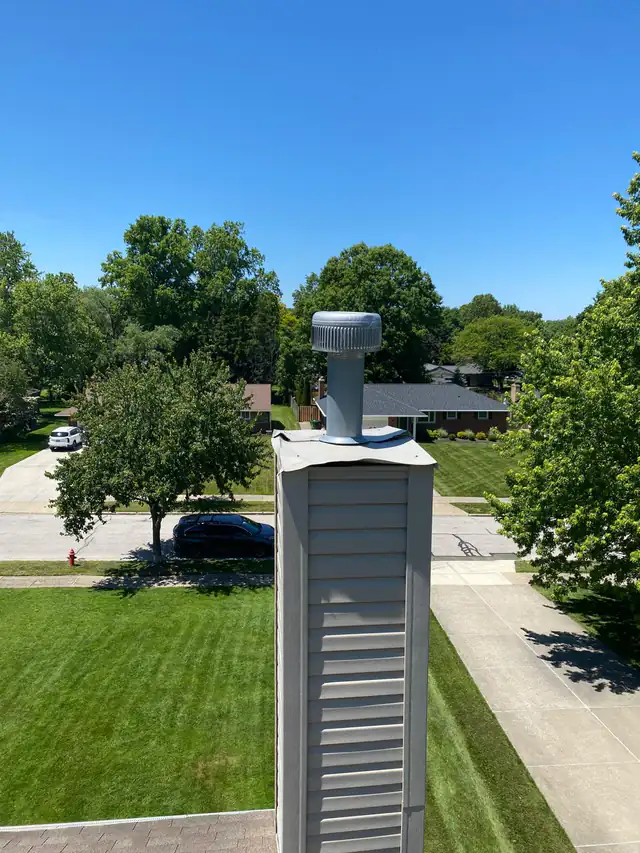
Before — the old chase cover, with bent and raised edges around the vent 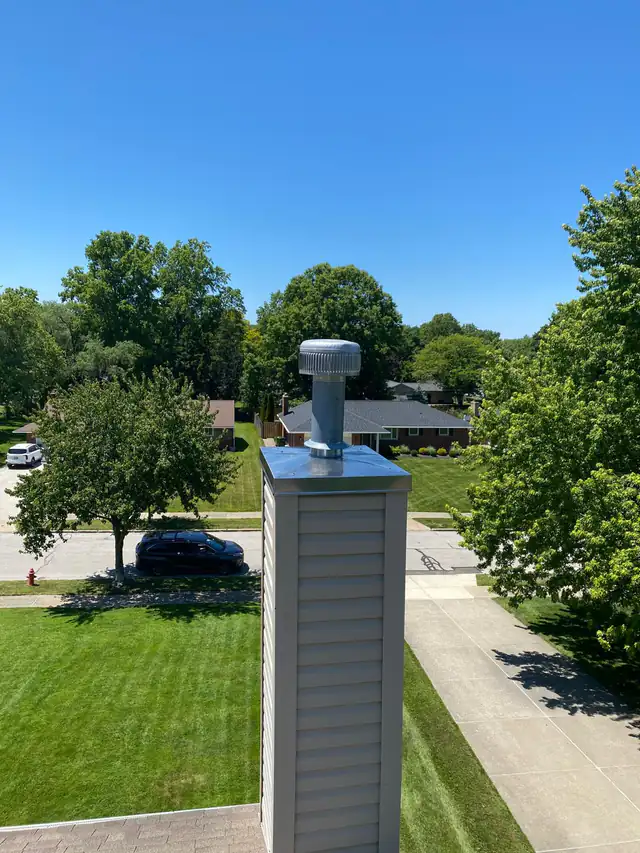
After — replacement chase cover fitted around the vent 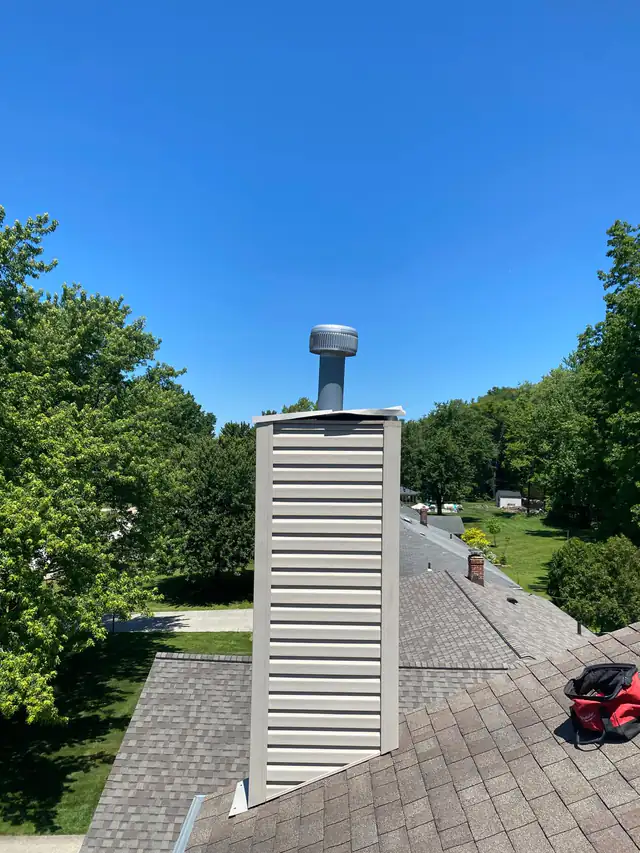
Before — the old cover from the roof side, with a raised edge 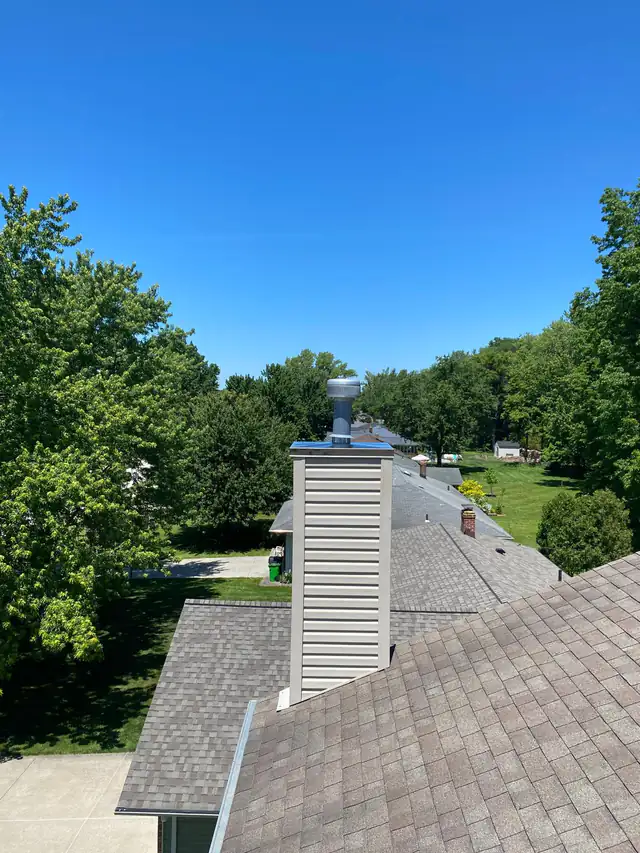
After — the replacement cover and chase, viewed from the roof
Meet the team
The people behind the work
Manny, Zack and Myke — meet the people behind Chimney Expert Solutions.
Our team and story →
Manny
Owner
Zack
Manager

Myke
Technician
FAQ
Chimney Leak Repair in Painesville: questions we hear
We were quoted a full rebuild. Is that always necessary on an old chimney?
Not usually on this housing. The section above the roof does nearly all the weathering, and the section inside the house is often sound because it never freezes. A rebuild from the roofline up is a complete repair in a lot of these cases. It is a fair question to put to any bidder: show me, in photographs, what is wrong with the part below the roof.
What is firestopping and why does our old house need it?
Houses of this era were framed with wall cavities running unbroken from the basement to the attic, so there is nothing to stop heat, smoke or water from traveling the full height of the wall beside a chimney. Firestopping means closing those cavities at each floor line with non-combustible material. It is normally done alongside chimney work rather than as a job of its own, because the chimney is where the risk is concentrated.
Can you fix a chimney leak in winter?
Some of it. Caps, some flashing work and temporary measures can be done in cold weather. Anything involving mortar or a concrete crown recast needs sustained temperatures above roughly 40°F to cure, so a winter diagnosis often means a temporary fix now and the permanent one in spring. We will tell you which category yours is in rather than laying masonry that will not set.
Should the chimney be waterproofed as routine maintenance?
Not as routine, no. A repellent is worth doing on masonry that is genuinely absorbing water and is otherwise sound, and it is pointless or harmful anywhere else. On a chimney with open joints, the joints get pointed first. On a chimney with a cracked crown, the crown is the actual hole. Selling a spray-on treatment to a chimney that needs masonry work is one of the more common bad practices in this trade.
Free estimate
Chimney Leak Repair in Painesville?
Tell us what you’re seeing and we’ll call or text back to schedule a look — with photos of what we find and an honest read on what’s urgent and what can wait. That evidence-first method is the way we work on every job.
Call and tell us what the chimney's doing — if we're up on a roof, we'll call you back. Other ways to reach us are on the contact page, and Painesville is one of the communities we cover across Greater Cleveland.
Call216-647-1882