
Cuyahoga County, Ohio
Chimney Leak Repair & Waterproofing in Euclid, OH
Finding where the water actually gets in — crown, cap, flashing, masonry or condensation — and fixing that, not caulking symptoms.
What chimney leak repair involves in Euclid is set by the housing stock here: Snow-belt lake exposure on mixed-age stock — early-century streets with soft brick and unlined flues, postwar bungalows with failing crowns, and abandoned flues left open after heating conversions.
Euclid runs along Lake Erie on Cleveland's east side, and its housing comes in two distinct waves. There are early-century streets near the older core and the Lakeshore Boulevard corridor, and there are broad postwar neighborhoods of brick bungalows and Capes filling the numbered streets inland toward the East 200th Street area. Both are well built. Both take east-side lake weather straight on.
A leaking chimney is a symptom with at least five different causes, and fixing the wrong one is why so many chimney leaks come back. Water can enter through a cracked crown, a missing or undersized cap, failed flashing where the chimney meets the roof, saturated porous masonry, or condensation forming inside an oversized flue. Each of those has a different repair, and none of them is solved by sealant on whatever surface was easiest to reach. Our leak work starts with diagnosis at roof level and inside the house, so the fix targets the actual entry point.
What we find on Euclid chimneys that leads to chimney leak repair
Abandoned flues left open at the top
Euclid's postwar stock has been through several generations of heating equipment, and every conversion tends to leave a flue behind. An abandoned flue with no cap is a funnel pointed at the middle of the house: it collects rain and snow, delivers it into the stack, and lets frost do its work on the masonry above the roof with nothing venting through to dry it. Capping a dead flue and keeping a sound crown over it is a small job that prevents a genuinely expensive one.
Snow-belt freeze-thaw load
Water expands by roughly nine percent when it freezes, and every wet freeze levers masonry apart a fraction more. Euclid's lake-effect position delivers more of those cycles per winter than the inland suburbs see, and it keeps the masonry wet for longer stretches between them so there is less drying time. That is why an open joint or a hairline crown crack progresses noticeably faster here, and why skipping an inspection year costs more on this side of the county.
Driven snow and rain on the north face
Onshore wind pushes precipitation into a wall rather than letting it run off, and on a stack near the lakefront the north-facing side takes the brunt of it. It is common to find one face of a Euclid chimney shedding brick while the sheltered side looks decades younger. Snow is the aggravating factor the rain-focused advice misses: snow piled against masonry stays in contact and melts and refreezes repeatedly, which is close to a laboratory test for spalling.
How we find which one it is
The diagnosis is systematic, because guessing is what produces repeat leaks. We start with what you can tell us: where the stain is, whether it appears in every rain or only in wind-driven rain, whether it correlates with snow melt, whether it started after a roof was done. That pattern narrows the list before anyone gets on a ladder. Sustained rain of any direction points at flashing or crown. Only wind-driven rain from one direction points at masonry on the weather face. Cold weather with no rain points at condensation. Snow melt at the roofline points at ice damming interacting with the flashing.
Then it is roof level: crown photographed and examined for cracks and for whether it has any overhang at all, cap condition and fit, flue tile terminations, flashing and counterflashing inspected at the joint rather than from six feet away, and the masonry faces looked over for open joints and spalling with attention to the side the weather comes from. Inside, the firebox, smoke chamber and damper get checked for water staining, rust and damp, and the ceiling or wall stain gets traced back to where it plausibly originates rather than where it appears.
You get the photographs, and the diagnosis explains itself. That matters more here than on almost any other chimney job, because leak repair is the area of this trade where guesswork is most often sold as expertise.
Why sealing the whole chimney is usually a mistake
The instinct when a masonry chimney leaks is to coat it, and the products that come to hand at a hardware store are mostly film-forming: acrylic sealers, masonry paint, silicone. In a freeze-thaw climate these do real damage. Brick and mortar have to be able to release moisture outward. A film-forming coating stops that while doing nothing about the water arriving from the crown or the flashing, so the moisture that gets in stays in — and every freeze then works on masonry that cannot dry. Painted and sealed chimneys spall spectacularly, and the damage shows up across the whole face rather than at one entry point.
Where a repellent is genuinely appropriate, the product class matters: silane and siloxane repellents penetrate and repel liquid water while remaining vapor permeable, so the wall still breathes. And it is applied after the joints are sound, never as a substitute for pointing them. A repellent is a raincoat, not a roof, and it will never fix a crown or a piece of flashing.
This page covers chimney leak repair as it plays out in Euclid. The full chimney leak repair & waterproofing page walks the whole job — every stage, what changes the scope, and what we do about each of them. For everything else we handle in this suburb, see chimney services in Euclid.
How we handle a leaking chimney
- Roof-level diagnosis: crown, cap, flashing, masonry and shoulder — photographed
- Interior check: firebox, smoke chamber and damper for staining, rust and damp
- Flashing repair or a full re-flash where the roofline seal has failed
- Crown repair or full recast with a drip edge and an expansion joint at the flue
- Vapor-permeable masonry repellent on porous brick — never paint or film-forming sealers
- An honest call on whether the 'leak' is actually flue condensation
- The fix in writing, matched to the diagnosed entry point
Our work
Chimney Leak Repair & Waterproofing, photographed on the job
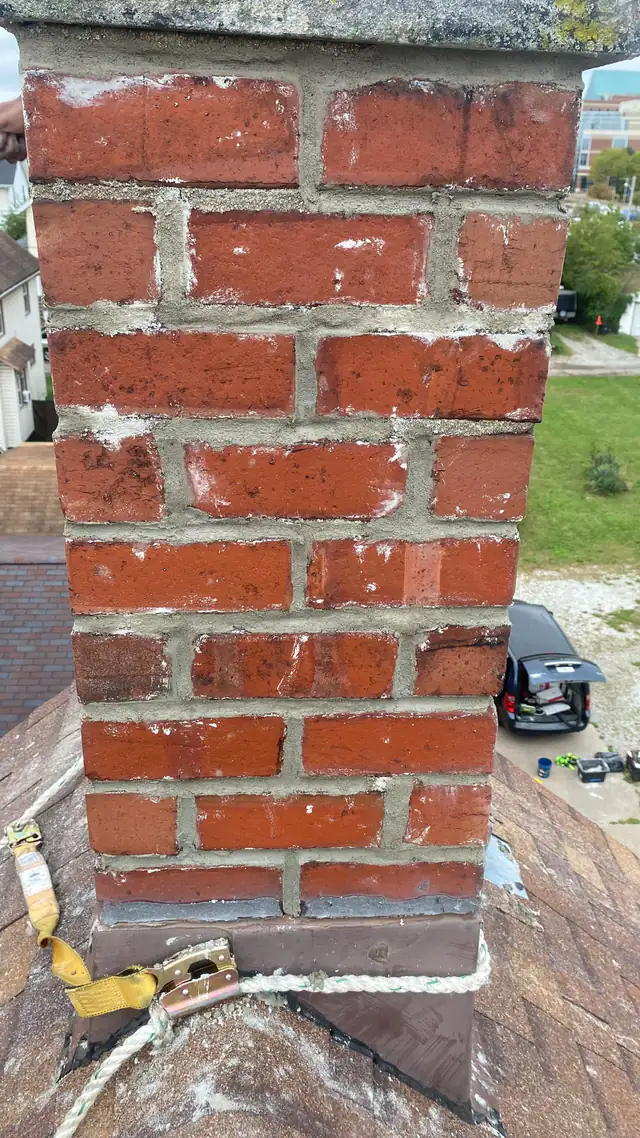
Roped in on a steep roof — repointed, flashing sealed 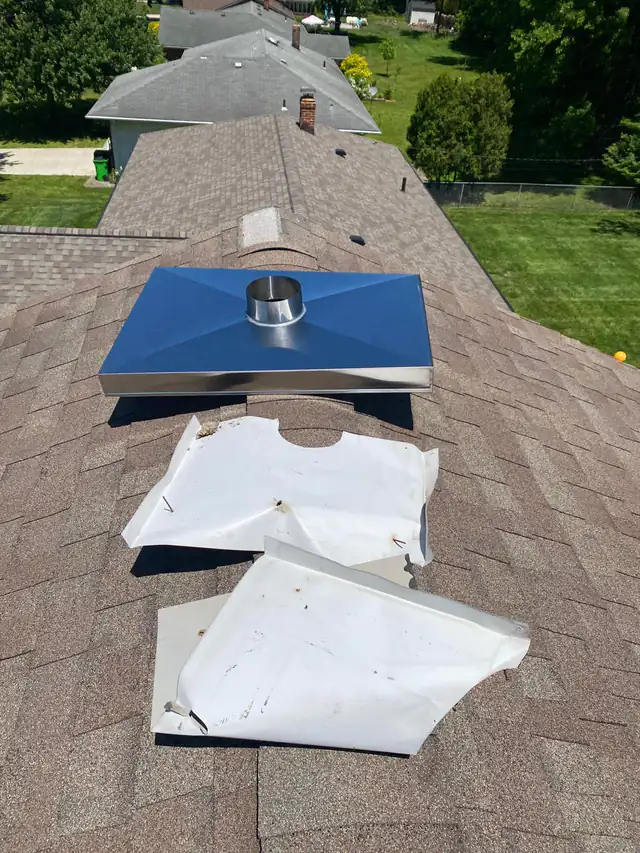
Replacement chase cover beside the removed cover sections on the roof 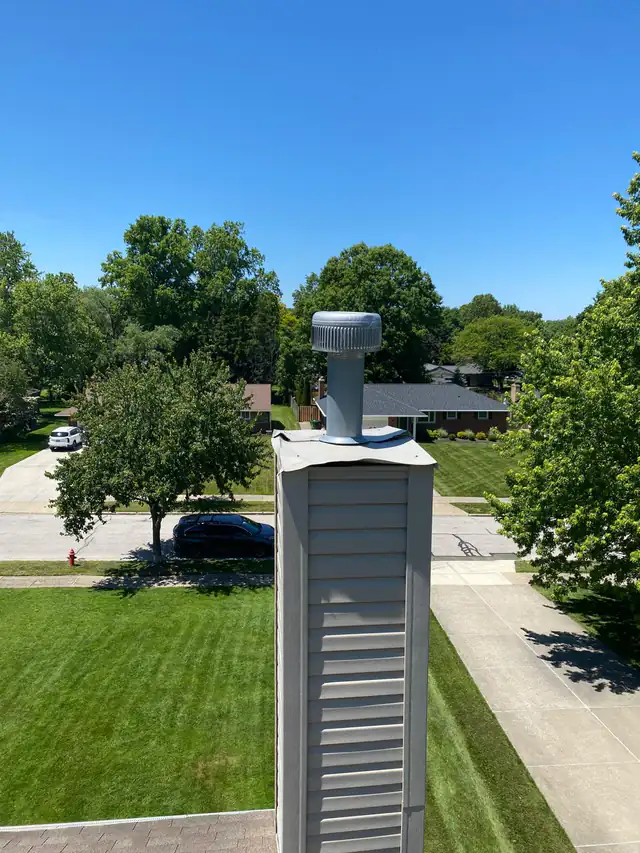
Before — the old chase cover, with bent and raised edges around the vent 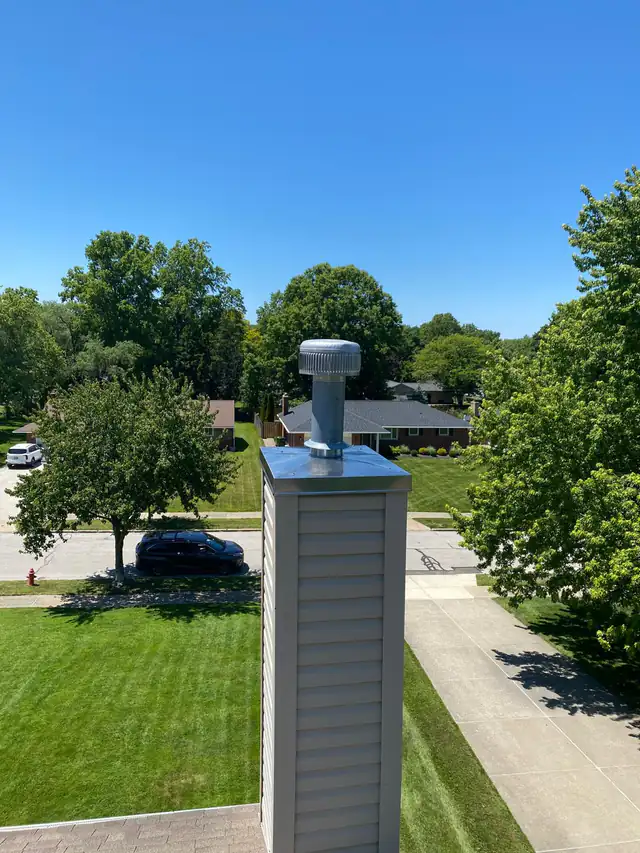
After — replacement chase cover fitted around the vent 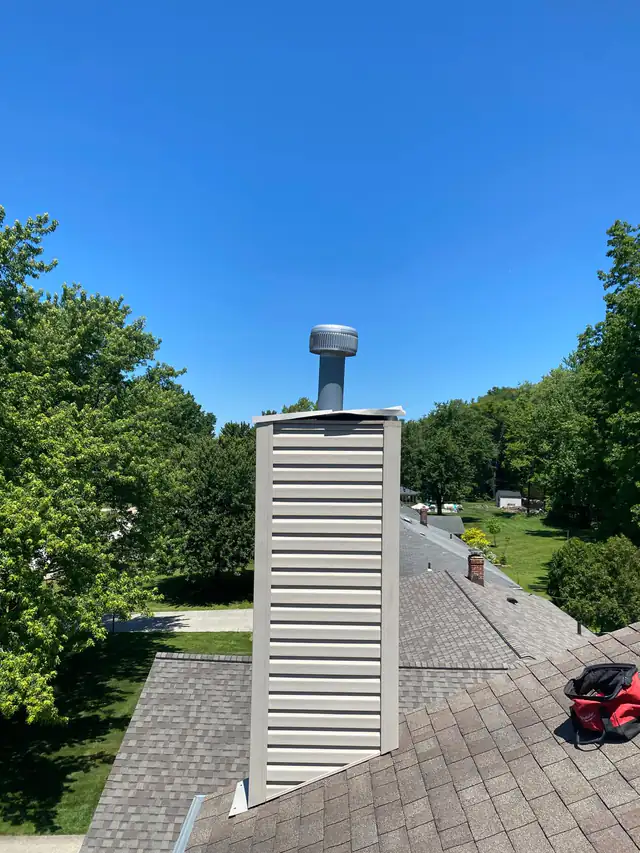
Before — the old cover from the roof side, with a raised edge 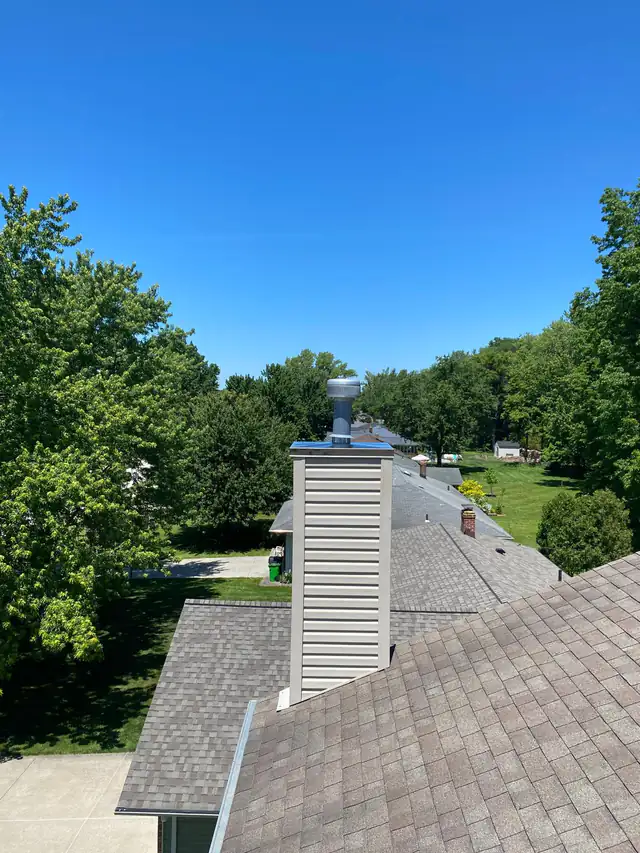
After — the replacement cover and chase, viewed from the roof
Meet the team
The people behind the work
Manny, Zack and Myke — meet the people behind Chimney Expert Solutions.
Our team and story →
Manny
Owner
Zack
Manager

Myke
Technician
FAQ
Chimney Leak Repair in Euclid: questions we hear
Does the snow belt actually make chimney damage worse?
Yes, and the mechanism is specific. Freeze-thaw damage scales with the number of wet-freeze cycles rather than with absolute cold, and Euclid's lake-effect position delivers more of them and keeps the masonry wetter between them. The practical consequence is that the crown, cap and joints need to be kept ahead of failure, because the same small defect erodes faster here than it would ten miles south.
Can chimney work be done here in the winter?
Inspections, sweeps, caps and most interior work, yes. Anything involving mortar or a concrete crown recast cannot, because it needs sustained temperatures above roughly 40°F to cure and mortar that freezes before it sets never reaches full strength. On a winter finding we will usually do what limits the water now and book the permanent masonry repair for spring.
Our postwar chimney only served the old furnace. Can we ignore it?
Not entirely. If genuinely nothing vents into it anymore, it still needs a cap and a sound crown — an open abandoned flue funnels water into the middle of the house and frost-damages the stack above the roof. If the water heater still uses it, it needs considerably more than that, because a single small appliance on an oversized flue is the classic condensation and corrosion situation.
Should the chimney be waterproofed as routine maintenance?
Not as routine, no. A repellent is worth doing on masonry that is genuinely absorbing water and is otherwise sound, and it is pointless or harmful anywhere else. On a chimney with open joints, the joints get pointed first. On a chimney with a cracked crown, the crown is the actual hole. Selling a spray-on treatment to a chimney that needs masonry work is one of the more common bad practices in this trade.
How long does a chimney repellent last?
Vapor-permeable siloxane repellents on sound masonry are generally reapplied on a multi-year cycle rather than annually, and the exposure of the wall changes that a lot — a west-facing stack near the lake weathers faster than a sheltered interior one. Reapplication is straightforward when the masonry underneath has been kept sound, which is rather the point of doing the pointing first.
Free estimate
Chimney Leak Repair in Euclid?
Tell us what you’re seeing and we’ll call or text back to schedule a look — with photos of what we find and an honest read on what’s urgent and what can wait. That evidence-first method is the way we work on every job.
Call and tell us what the chimney's doing — if we're up on a roof, we'll call you back. Other ways to reach us are on the contact page, and Euclid is one of the communities we cover across Greater Cleveland.
Call216-647-1882