
Lorain County, Ohio
Chimney Repair & Rebuilds in Lorain, OH
Masonry repair from spot fixes to full stack rebuilds — spalled brick, failed joints, and chimneys the freeze-thaw cycle has taken apart.
What chimney repair involves in Lorain is set by the housing stock here: Dense mill and harbor-era housing with an unusual concentration of 1920s rebuilding — small stacks with hollow-tile backup, open lake exposure from the north, and flues that have outlived several generations of heating equipment.
Lorain is a mill and harbor city at the mouth of the Black River, and its housing tells that story block by block: dense, modest, closely spaced houses built for people who worked the steel plant and the shipyards, laid out in tight grids from the waterfront south, with more spacious later neighborhoods further out. These are small houses with small chimneys, and they were built to a budget by people who did not waste material.
Northeast Ohio is close to a worst case for exterior masonry. A Cleveland chimney runs through dozens of freeze-thaw cycles every winter: water finds a hairline crack or an open joint, freezes, expands by about nine percent, and levers the masonry apart a little more each time. Repeat that across eighty winters on the most weather-exposed brickwork the house owns, and you get the local pattern. Brick faces shed, mortar goes soft and sandy, top courses shift, and eventually a stack that was fine at the last home sale needs rebuilding.
What we find on Lorain chimneys that leads to chimney repair
Hollow clay tile behind the brick face
Structural clay tile — hollow rectangular blocks — was a common, economical backup material in this era, used behind a single wythe of face brick in walls and in chimneys. It is not a bad material, but it fails differently from solid masonry. Water that gets past the brick collects in the hollow cells, freezes, and breaks the thin webs inside the tile where nobody can see it, so a chimney can be substantially hollowed out internally while the outside face still looks presentable. When a stack like this finally moves, it moves suddenly. Finding it changes the assessment, which is why we look at what is behind the face rather than just at it.
A whole cohort of chimneys the same age
Where a city rebuilds after a disaster, it rebuilds fast and it rebuilds all at once. That is useful to know because it makes the condition of your neighbors' chimneys genuinely informative about your own in a way it usually is not — same year, same brick, same mortar, same crown detail, same hundred winters. When we start seeing the same failure at the same height on the same brick across several blocks, it is not a coincidence and it is not bad luck. It means a design life has been reached, and the sensible move is to get ahead of it rather than wait for the pieces to land in the yard.
Small stacks, small flues, and a modern appliance
These houses were built with a single modest chimney sized around a coal-burning heating plant and, in some cases, a kitchen range. Every conversion since — coal to gas, gravity to forced air, standard furnace to high-efficiency — changed what the flue is being asked to do without changing the flue. What is left in a lot of Lorain basements is an appliance connected to a masonry flue that is either far too large for it, or in a couple of cases genuinely too small, with a connector arrangement improvised in whichever decade the last change happened. It wants sizing properly and lining to match, and the basement is where that assessment starts.
How freeze-thaw takes a chimney apart
Brick and mortar are porous. They take on water in a rain and give it back in dry weather, and in a normal climate that is fine. The problem is what happens when the water is still in there and the temperature crosses freezing. Ice occupies more space than the water it came from, so every wet freeze pushes outward from inside the pore structure. One cycle does nothing measurable. A few thousand cycles reduce the face of a brick to something that flakes off in sheets.
Greater Cleveland is unusually good at generating those cycles. Lake-effect weather keeps masonry wet for long stretches, and our winters swing across the freeze line repeatedly rather than settling below it. That combination — wet masonry and frequent crossings — is worse for brick than a colder, drier winter would be.
The chimney gets the worst of it for structural reasons. It is exposed on all four sides instead of one, it has no roof over it except its own crown, it sits at the highest and windiest point of the house, and it is the one masonry element that also has hot gas running through the middle of it. Chimneys fail first, and they fail from the top down.
Reading the damage: what your chimney is telling you
Spalling
Brick faces flaking, popping or crumbling away, leaving the softer core exposed. This is water damage that has already progressed — the face is what protects the brick, and once it is gone the unit absorbs water faster and deteriorates at an accelerating rate. Chips of brick on the roof or in the flower bed under the chimney mean it is happening now, not five years ago.
Open and eroded joints
Mortar recessed back from the face of the brick, or soft enough to rake out with a key. Mortar is meant to be the sacrificial material, so this is the system working as designed, right up until the joints open enough to let water into the middle of the wall. That is the moment repointing changes from maintenance to urgency.
Efflorescence
The white, chalky bloom on the brick face. It is salt carried out of the masonry by water moving through it and deposited when the water evaporates. Efflorescence is not itself damage. It is proof that water is actively traveling through the chimney, which is the more useful information.
Shifted, leaning or stepped top courses
When the joints in the top few courses have failed completely, the bricks stop acting as a wall and start acting as a stack of loose objects. Wind and ice do the rest. A visibly leaning stack or a top course that has slid out of plane is past repointing, and it is a genuine safety issue rather than a maintenance item.
A cracked or missing crown
Almost every serious masonry failure on an older Cleveland chimney can be traced back to the crown. It is the concrete or mortar cap that seals the top of the stack around the flue tiles, and when it cracks it feeds water straight down into the brickwork. If the crown is gone, everything below it is on a countdown.
This page covers chimney repair as it plays out in Lorain. The full chimney repair & rebuilds page walks the whole job — every stage, what changes the scope, and what we do about each of them. For everything else we handle in this suburb, see chimney services in Lorain.
Repair and rebuild work we take on
- Spalled and cracked brick replacement, matched to the existing brick
- Partial rebuilds from the roofline or shoulder up
- Full chimney rebuilds where the stack is beyond saving
- Crown replacement as part of any rebuild — a rebuild under a bad crown is wasted money
- Flue tile replacement while the stack is open, where it is warranted
- Firebox masonry and refractory panel repair
- Written scope with photos before, during and after the work
Our work
Chimney Repair & Rebuilds, photographed on the job
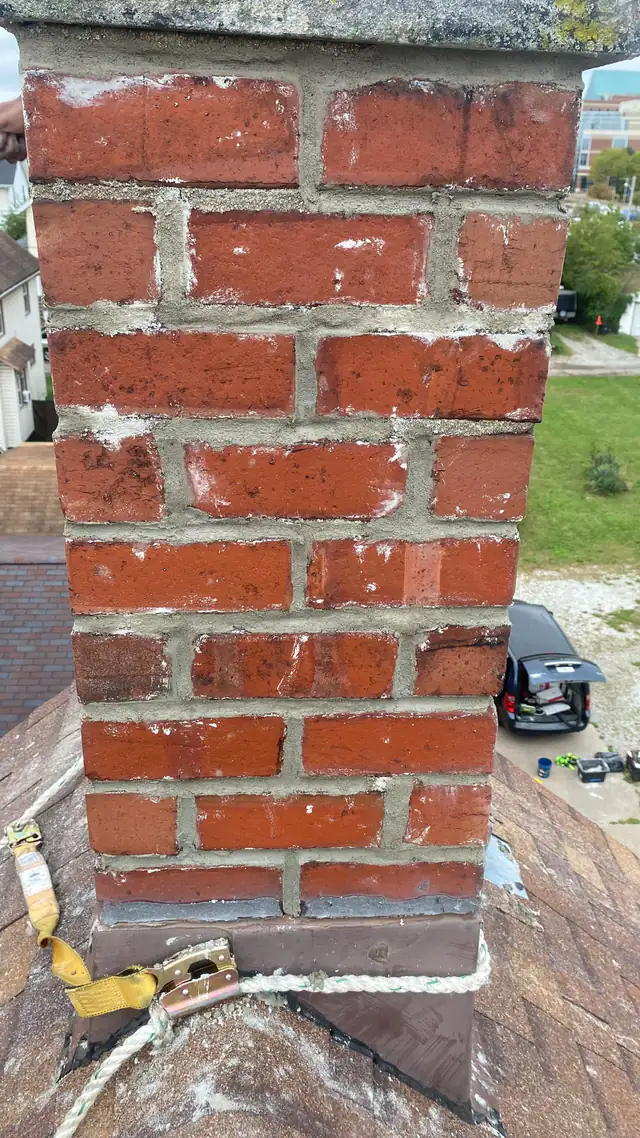
Roped in on a steep roof — repointed, flashing sealed 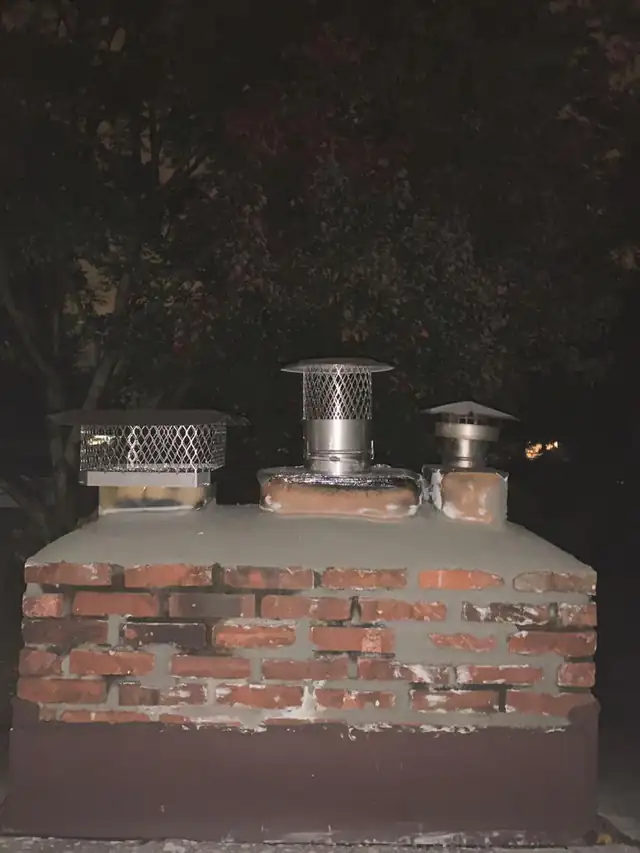
Three flues, three caps, one new crown 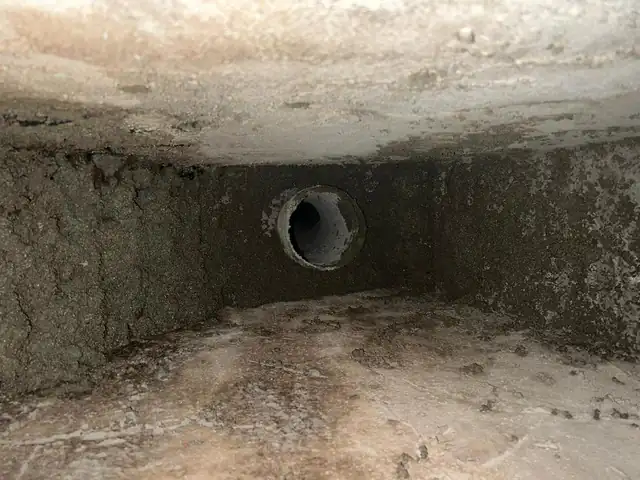
Inside the smoke chamber — the flue opening above the firebox 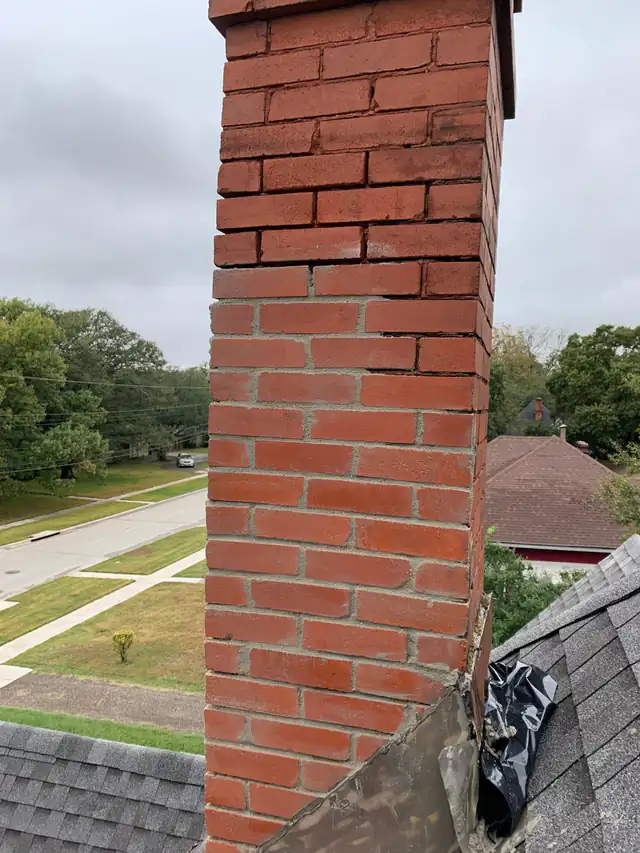
Mid-job — fresh joints below, the old eroded joints still waiting above 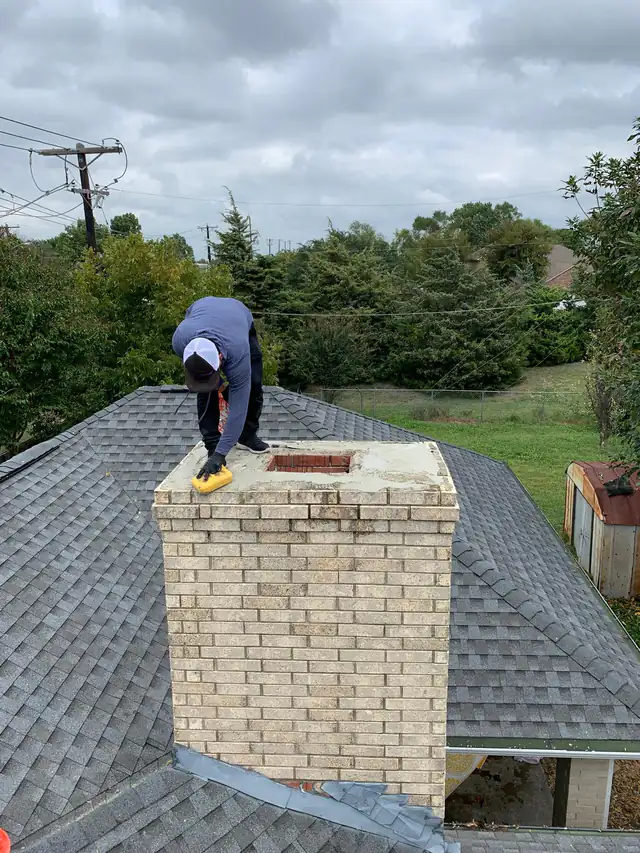
Finishing a fresh crown around the flue 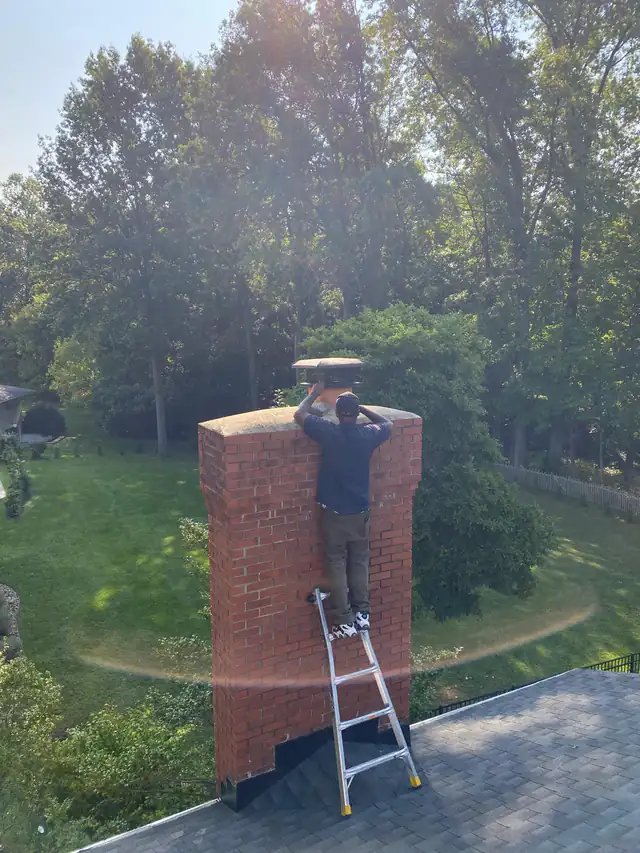
Ladder work on a tall stack — fitting the cap
Meet the team
The people behind the work
Manny, Zack and Myke — meet the people behind Chimney Expert Solutions.
Our team and story →
Manny
Owner

Zack
Manager

Myke
Technician
FAQ
Chimney Repair in Lorain: questions we hear
How can a chimney look fine and still be unsound?
It happens most often where the stack is built with hollow clay tile behind a brick face. Water gets in, freezes in the hollow cells and breaks the internal webs, so the structure is being eaten from the inside while the visible face stays reasonably intact. It is one of the reasons a proper assessment includes the top, the interior of the flue and the base rather than a look from the driveway.
Does the lakefront exposure matter for a chimney a few streets back?
Some. The open north exposure means driven rain and snow reach the stack with force rather than falling on it, and it concentrates on one face. The practical effect is asymmetric wear — one side of a chimney much worse than the other — and a shorter useful life for caps and crowns. It is a reason to check the top of the chimney on a regular schedule rather than waiting for a symptom indoors.
Several chimneys on our street have needed work recently. Should we be concerned?
It is worth an inspection rather than a worry. Much of this city's housing was built inside a short window, so the chimneys share an age, a material and a design life. When several on a block reach it at once that is the expected pattern, not a coincidence — and being early is the difference between a repair and a rebuild.
How long does a chimney rebuild take?
A partial rebuild above the roofline on a straightforward stack is usually a small number of working days, weather permitting. A full rebuild, a difficult roof, or a chimney with detailing to reproduce takes longer. The unpredictable variable is weather rather than labor: mortar work stops for rain and for cold, and we would rather lose a day than lay masonry that will not cure.
Does chimney repair need a permit in Cuyahoga County?
It depends on the municipality and on the scope — like-for-like repair is generally treated differently from structural rebuilding, and the inner-ring suburbs vary quite a bit in how they handle exterior work. We raise it during the quote for anything structural, and the requirements are worth confirming with your city's building department, because they do change.
Free estimate
Chimney Repair in Lorain?
Tell us what you’re seeing and we’ll call or text back to schedule a look — with photos of what we find and an honest read on what’s urgent and what can wait. That evidence-first method is the way we work on every job.
Call and tell us what the chimney's doing — if we're up on a roof, we'll call you back. Other ways to reach us are on the contact page, and Lorain is one of the communities we cover across Greater Cleveland.
Call216-647-1882