

Cuyahoga County, Ohio
Chimney Repair & Rebuilds in Shaker Heights, OH
Masonry repair from spot fixes to full stack rebuilds — spalled brick, failed joints, and chimneys the freeze-thaw cycle has taken apart.
What chimney repair involves in Shaker Heights is set by the housing stock here: Planned-suburb 1920s architecture with prominent detailed chimneys — multi-fireplace houses, aging clay flues, slate roofs, and a neighborhood standard that makes matched masonry non-negotiable.
Shaker Heights was laid out by the Van Sweringen brothers as a planned garden suburb, built around rapid transit lines that still run down the middle of Shaker and Van Aken. The 1920s Tudors, Georgians and French-influenced houses that define Fernway, Lomond, Malvern, Ludlow, Onaway and the Boulevard neighborhoods were built with serious masonry: slate roofs, real brick and stone, and chimneys designed as part of the elevation rather than as a vent that had to go somewhere.
Northeast Ohio is close to a worst case for exterior masonry. A Cleveland chimney runs through dozens of freeze-thaw cycles every winter: water finds a hairline crack or an open joint, freezes, expands by about nine percent, and levers the masonry apart a little more each time. Repeat that across eighty winters on the most weather-exposed brickwork the house owns, and you get the local pattern. Brick faces shed, mortar goes soft and sandy, top courses shift, and eventually a stack that was fine at the last home sale needs rebuilding.
What we find on Shaker Heights chimneys that leads to chimney repair
Century-old clay flues in multi-fireplace houses
A Shaker house with four fireplaces has four independent flue histories inside one or two stacks, and they were all built with clay tile in the 1920s. The joints between tile sections are the weak point, and a hundred years of heating cycles, condensation and freeze-thaw at the top of the stack washes them out. The result is a flue that is a series of separate tiles with gaps rather than a continuous passage. It is invisible without a camera and it is the single most common serious finding here.
Repair that has to survive the streetscape as well as the winter
Shaker takes exteriors seriously and so do its homeowners, which means like-for-like matching is effectively the standard for any visible chimney work. Practically that suits us, since matched materials and reproduced profiles are how we quote period masonry regardless. What it does mean is that a low bid which quietly assumes modern brick and a simplified top is not comparable to a bid that includes the match. Confirm any current exterior-review or permit requirements with the city's building department before a rebuild.
What a rebuild actually involves
Protecting the house first
Roof protection under the work area, the flue capped or sealed so debris does not fall down into the firebox and through the house, and a plan for getting brick and rubble down that does not involve the roof surface. On a slate or tile roof this part is most of the planning.
Down to sound masonry
The stack comes down course by course to a level where the brick and joints are genuinely sound, not to a level that was decided from the ground. Existing brick is salvaged where it is worth salvaging, and the flue tiles get evaluated as they are exposed — a rebuild is the one moment when replacing damaged tile is straightforward, and skipping that step because it was not in the original quote is a mistake you live with.
Rebuilding
New masonry laid with mortar matched to the original in strength and appearance, joints tooled to the same profile, and any original detailing reproduced. Flue tiles set with proper joints. Where the design calls for it, corbelling and decorative courses get rebuilt rather than simplified away.
The parts that make it last
A rebuild finishes with a proper cast crown with a drip edge and an expansion joint at the flue, a stainless cap on every flue, and flashing sorted at the roofline. A rebuild under a bad crown or with old failed flashing is money spent on a chimney that will start deteriorating again immediately. We treat those three as part of the scope, not as upsells at the end.
What happens if the masonry is left
The failure curve is not linear. A chimney with a few open joints deteriorates slowly, because the water is only reaching a small volume of masonry. Once the joints are open across a face, water enters the middle of the wall, and the number of surfaces available to freeze multiplies. That is when a stack goes from needing repointing to needing rebuilding in a handful of seasons.
There are three costs to waiting and only one of them is the masonry. The second is water inside the house: a chimney taking on water at the top delivers it to the ceiling, the framing and the drywall around the chase, and rot in the framing next to a chimney is both expensive and hard to see. The third is safety. Loose brickwork forty feet up over a driveway or a walkway is a different category of problem from a maintenance item, and a stack that has started to lean should not be left through a winter of ice loading.
This page covers chimney repair as it plays out in Shaker Heights. The full chimney repair & rebuilds page walks the whole job — every stage, what changes the scope, and what we do about each of them. For everything else we handle in this suburb, see chimney services in Shaker Heights.
Repair and rebuild work we take on
- Spalled and cracked brick replacement, matched to the existing brick
- Partial rebuilds from the roofline or shoulder up
- Full chimney rebuilds where the stack is beyond saving
- Crown replacement as part of any rebuild — a rebuild under a bad crown is wasted money
- Flue tile replacement while the stack is open, where it is warranted
- Firebox masonry and refractory panel repair
- Written scope with photos before, during and after the work
Our work
Chimney Repair & Rebuilds, photographed on the job
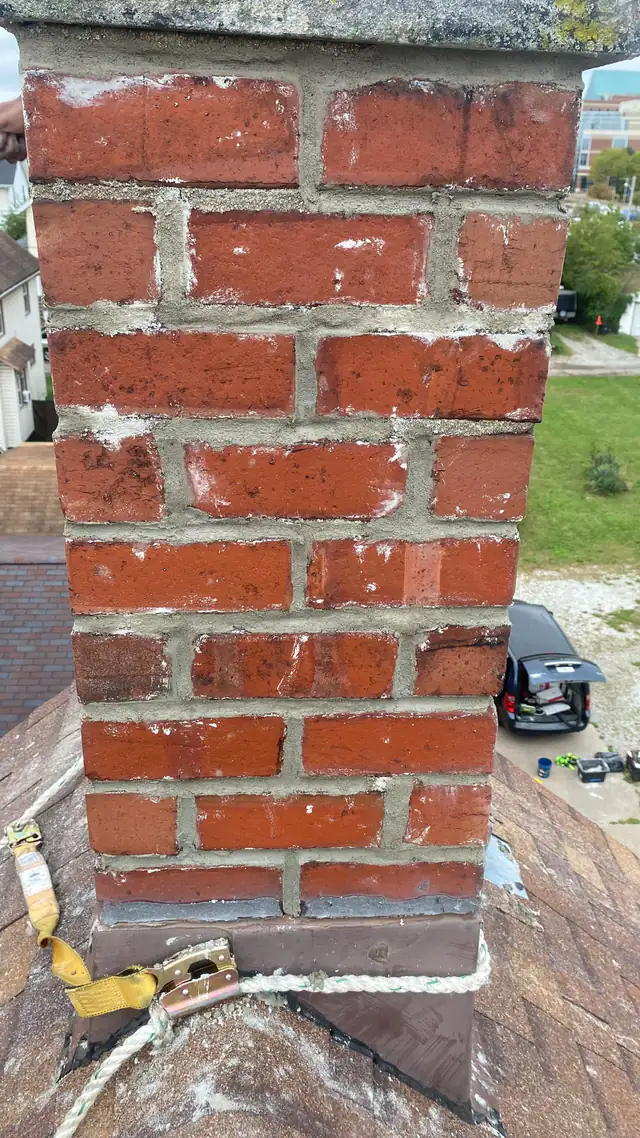
Roped in on a steep roof — repointed, flashing sealed 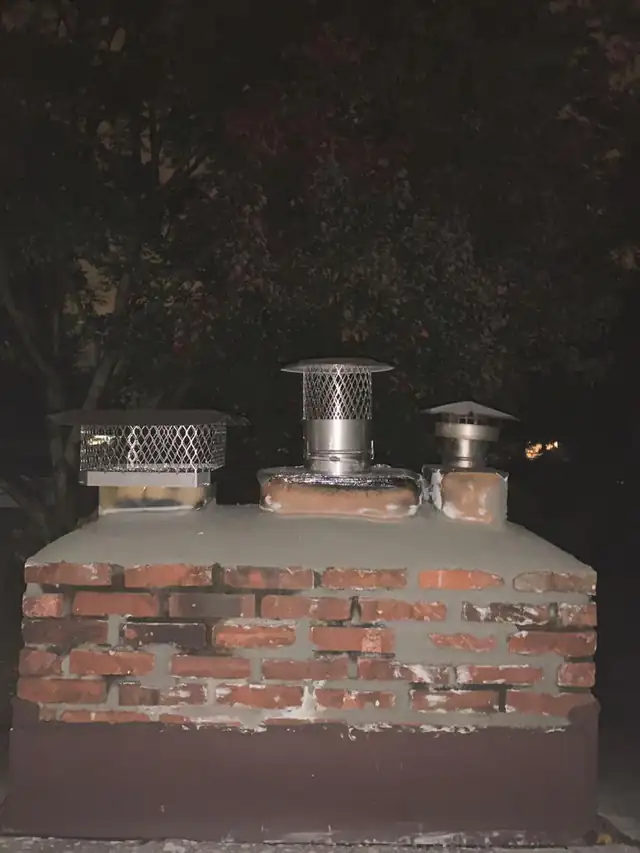
Three flues, three caps, one new crown 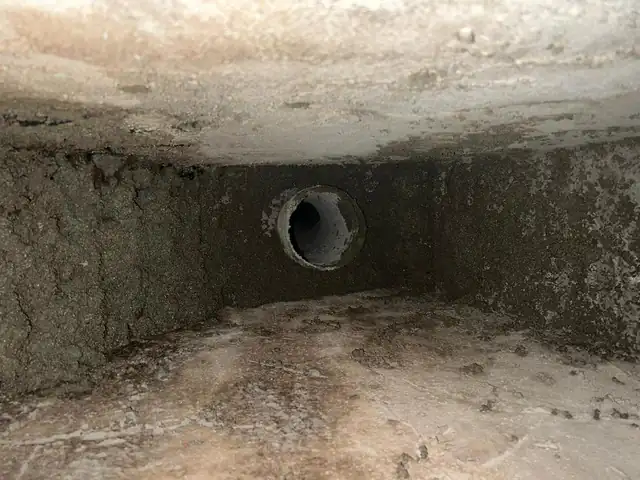
Inside the smoke chamber — the flue opening above the firebox 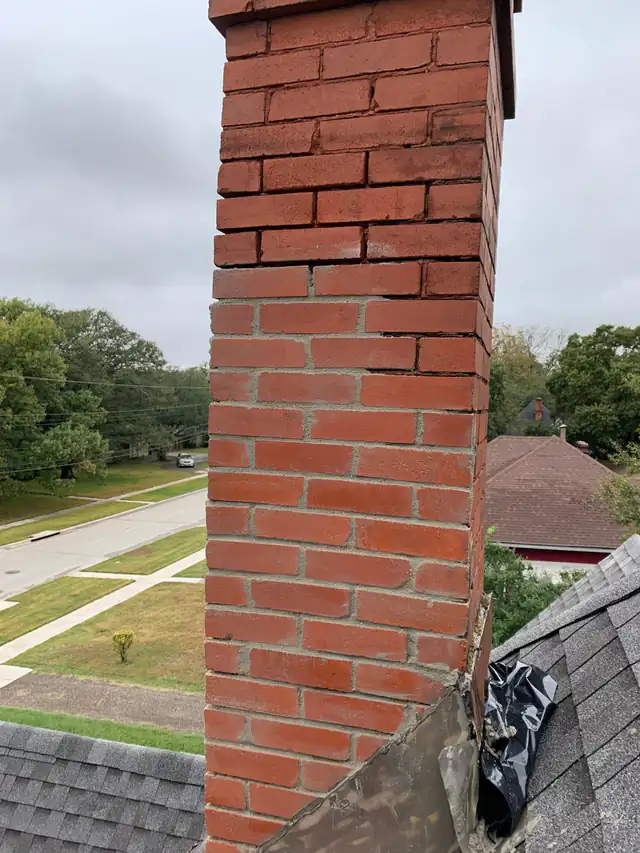
Mid-job — fresh joints below, the old eroded joints still waiting above 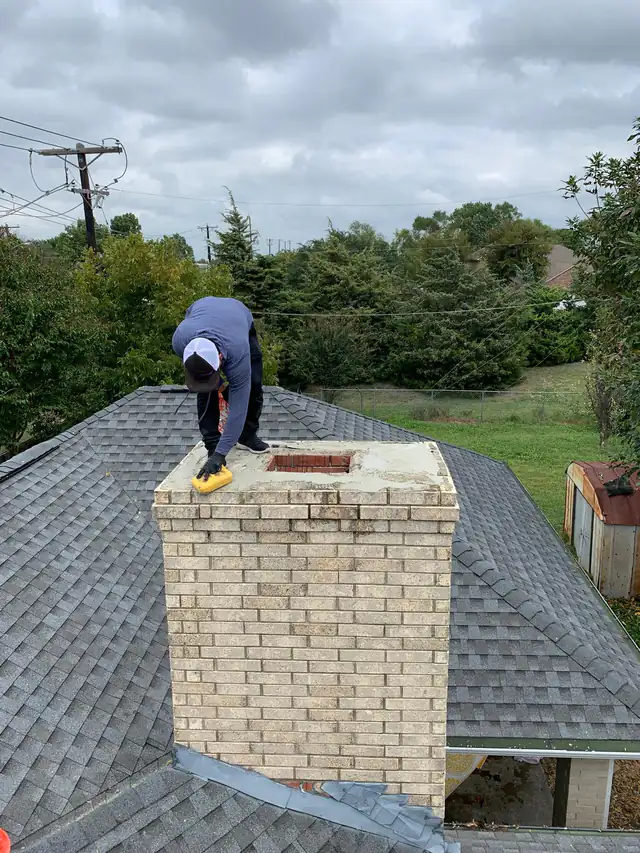
Finishing a fresh crown around the flue 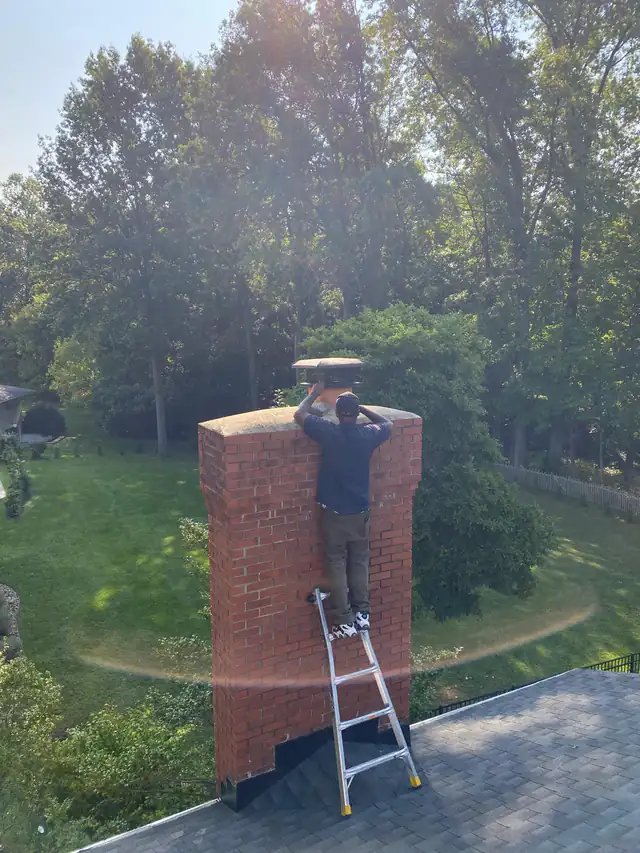
Ladder work on a tall stack — fitting the cap
Meet the team
The people behind the work
Manny, Zack and Myke — meet the people behind Chimney Expert Solutions.
Our team and story →
Manny
Owner
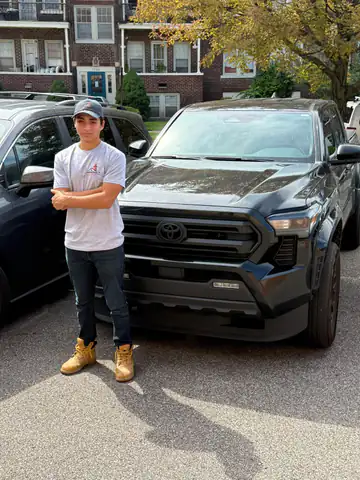
Zack
Manager

Myke
Technician
FAQ
Chimney Repair in Shaker Heights: questions we hear
Do you work on stone chimneys as well as brick?
Yes. A fair number of Shaker houses have stone or stone-detailed stacks, and the principles are the same: cut out failed joints to sound depth, repoint with mortar that is softer than the units around it, and match the joint profile. Stone is more demanding to match on the pointing because the joints are irregular, which is a reason to see a sample before the whole stack is done.
How disruptive is chimney work on a house this size?
Most of it happens outside and above you. The parts that come indoors are the inspection, the sweep and any firebox or damper work, all of which are set up with drop cloths and dust control. For rebuild work, the planning conversation is about access, protection of the roof and grounds, and where material stages — which on a Shaker lot is usually straightforward.
Can a leaning chimney be straightened instead of rebuilt?
Generally not. A lean means the joints have failed and the courses have moved, and there is no way to push masonry back into plane and have it stay. What can be done is establishing where sound masonry begins and rebuilding from there, which on most leaning stacks is at or just below the roofline.
How long does a chimney rebuild take?
A partial rebuild above the roofline on a straightforward stack is usually a small number of working days, weather permitting. A full rebuild, a difficult roof, or a chimney with detailing to reproduce takes longer. The unpredictable variable is weather rather than labor: mortar work stops for rain and for cold, and we would rather lose a day than lay masonry that will not cure.
Free estimate
Chimney Repair in Shaker Heights?
Tell us what you’re seeing and we’ll call or text back to schedule a look — with photos of what we find and an honest read on what’s urgent and what can wait. That evidence-first method is the way we work on every job.
Call and tell us what the chimney's doing — if we're up on a roof, we'll call you back. Other ways to reach us are on the contact page, and Shaker Heights is one of the communities we cover across Greater Cleveland.
Call216-647-1882