
Geauga County, Ohio
Chimney Repair & Rebuilds in Chardon, OH
Masonry repair from spot fixes to full stack rebuilds — spalled brick, failed joints, and chimneys the freeze-thaw cycle has taken apart.
What chimney repair involves in Chardon is set by the housing stock here: A nineteenth-century square, older village housing and rural township properties in Ohio's heaviest snow belt — households that burn seriously, with heavy and often glazed deposits, plus outbuilding stoves that rarely get inspected.
Chardon sits on the Geauga County highlands, and it takes more snow than anywhere else in Ohio. The elevation and the position downwind of the lake combine to produce winters that are longer, deeper and colder than what falls thirty miles west, and that single fact changes how people here heat their houses. Wood is not decorative in Chardon. Stoves run through the night, fireplaces run all weekend, and outbuildings and shops have their own flues.
Northeast Ohio is close to a worst case for exterior masonry. A Cleveland chimney runs through dozens of freeze-thaw cycles every winter: water finds a hairline crack or an open joint, freezes, expands by about nine percent, and levers the masonry apart a little more each time. Repeat that across eighty winters on the most weather-exposed brickwork the house owns, and you get the local pattern. Brick faces shed, mortar goes soft and sandy, top courses shift, and eventually a stack that was fine at the last home sale needs rebuilding.
What we find on Chardon chimneys that leads to chimney repair
Wet wood, and how much difference it actually makes
Freshly cut hardwood is roughly half water by weight. Burning it means a large part of the fire's energy goes into boiling that water off instead of into the room, which lowers the flue temperature, which is exactly the condition that deposits creosote instead of carrying it out as smoke. Wood that has been split, stacked off the ground and covered on top for a full year — two for oak — burns hotter, cleaner and produces a fraction of the deposit. It is the cheapest chimney maintenance available and it is entirely within the homeowner's control. A moisture meter costs less than a service call.
The masonry season in Northeast Ohio
Mortar cures through a chemical reaction that needs sustained temperatures above roughly 40°F. Below that it does not simply cure slowly; it can be damaged permanently, and freshly laid mortar that freezes before it has set never reaches the strength it was supposed to. That gives Greater Cleveland a working masonry season of roughly April through November, with the ends of it dependent on the actual weather rather than the calendar.
The practical consequence is a scheduling one. If your chimney needs structural work, the queue and the season run out at the same time in the fall. A chimney assessed in spring gets fixed that year. The same chimney assessed in late October frequently waits until spring, taking one more winter of freeze-thaw with an open path for water.
How freeze-thaw takes a chimney apart
Brick and mortar are porous. They take on water in a rain and give it back in dry weather, and in a normal climate that is fine. The problem is what happens when the water is still in there and the temperature crosses freezing. Ice occupies more space than the water it came from, so every wet freeze pushes outward from inside the pore structure. One cycle does nothing measurable. A few thousand cycles reduce the face of a brick to something that flakes off in sheets.
Greater Cleveland is unusually good at generating those cycles. Lake-effect weather keeps masonry wet for long stretches, and our winters swing across the freeze line repeatedly rather than settling below it. That combination — wet masonry and frequent crossings — is worse for brick than a colder, drier winter would be.
The chimney gets the worst of it for structural reasons. It is exposed on all four sides instead of one, it has no roof over it except its own crown, it sits at the highest and windiest point of the house, and it is the one masonry element that also has hot gas running through the middle of it. Chimneys fail first, and they fail from the top down.
This page covers chimney repair as it plays out in Chardon. The full chimney repair & rebuilds page walks the whole job — every stage, what changes the scope, and what we do about each of them. For everything else we handle in this suburb, see chimney services in Chardon.
Repair and rebuild work we take on
- Spalled and cracked brick replacement, matched to the existing brick
- Partial rebuilds from the roofline or shoulder up
- Full chimney rebuilds where the stack is beyond saving
- Crown replacement as part of any rebuild — a rebuild under a bad crown is wasted money
- Flue tile replacement while the stack is open, where it is warranted
- Firebox masonry and refractory panel repair
- Written scope with photos before, during and after the work
Our work
Chimney Repair & Rebuilds, photographed on the job
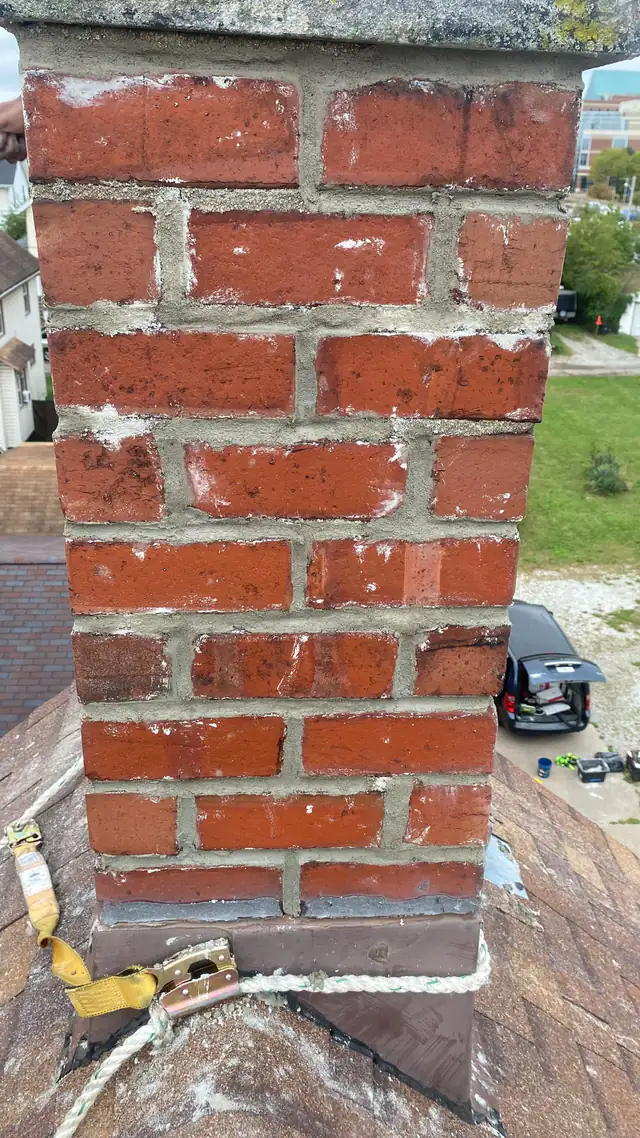
Roped in on a steep roof — repointed, flashing sealed 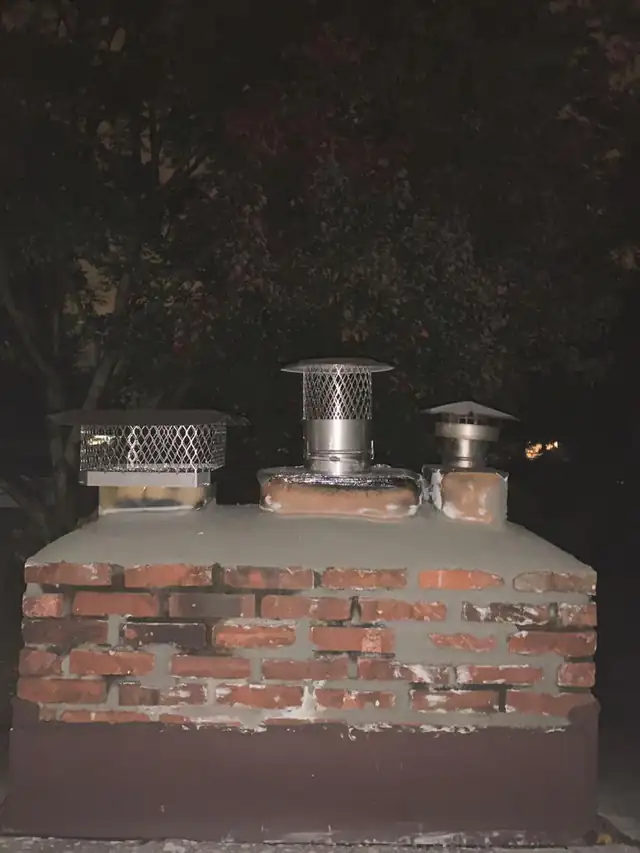
Three flues, three caps, one new crown 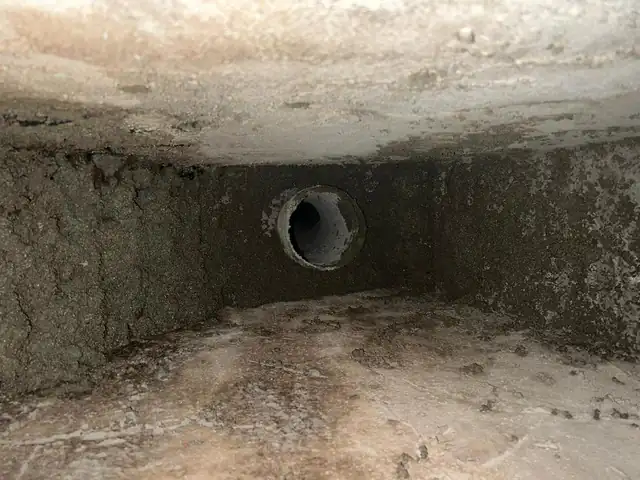
Inside the smoke chamber — the flue opening above the firebox 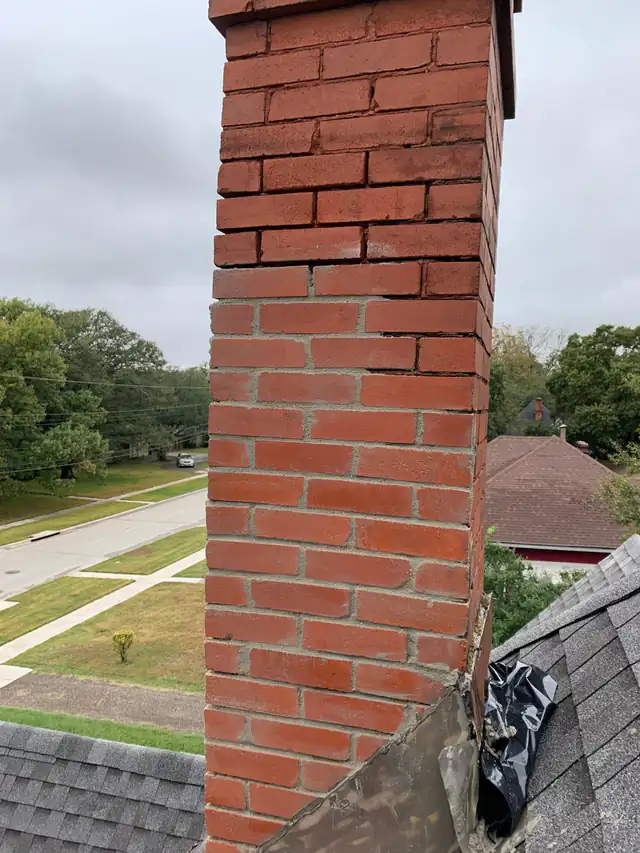
Mid-job — fresh joints below, the old eroded joints still waiting above 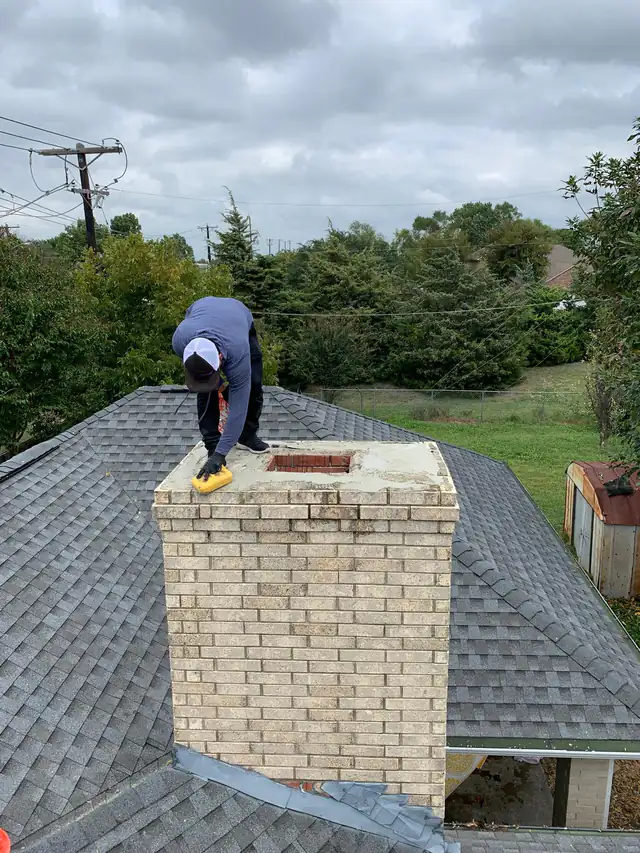
Finishing a fresh crown around the flue 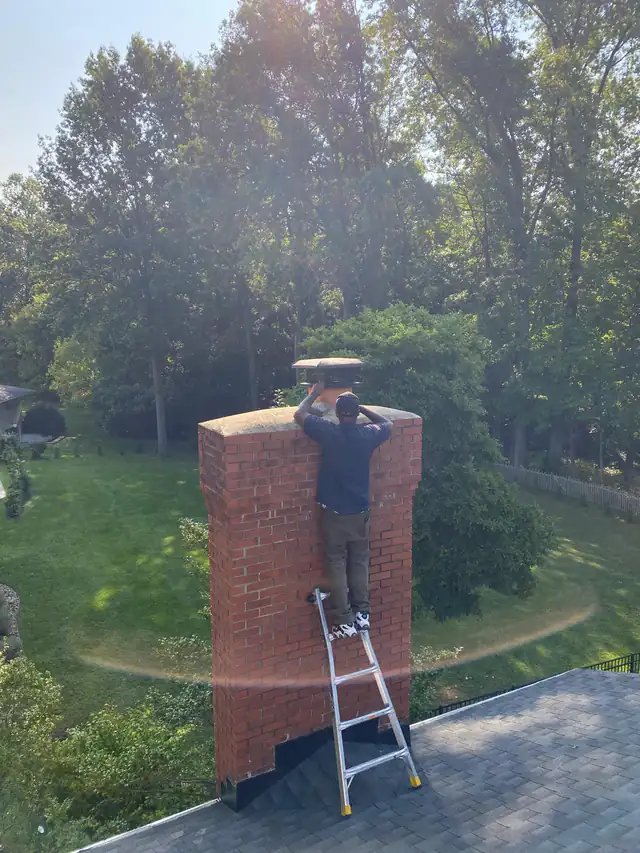
Ladder work on a tall stack — fitting the cap
Meet the team
The people behind the work
Manny, Zack and Myke — meet the people behind Chimney Expert Solutions.
Our team and story →
Manny
Owner
Zack
Manager

Myke
Technician
FAQ
Chimney Repair in Chardon: questions we hear
How can I tell if my firewood is dry enough?
Seasoned wood is noticeably lighter than green, has visible checking and cracks across the end grain, and knocks together with a sharp sound rather than a dull one. If you want to be certain, an inexpensive moisture meter on a freshly split face should read around twenty percent or below. Split, stacked off the ground and covered on top only — for a full year, and two for oak.
What is glazed creosote and why can't it just be brushed out?
It is creosote that condensed as a liquid tar and then hardened into a shiny layer bonded to the flue. A brush slides over it. Removing it takes a rotary tool with chains, or a chemical treatment that is burned over several fires to make the glaze crumbly enough to sweep, and often a combination. It is also a signal about how the appliance is being run, so we would talk about the burn as well as the cleaning.
Can a leaning chimney be straightened instead of rebuilt?
Generally not. A lean means the joints have failed and the courses have moved, and there is no way to push masonry back into plane and have it stay. What can be done is establishing where sound masonry begins and rebuilding from there, which on most leaning stacks is at or just below the roofline.
Is a chimney rebuild covered by homeowners insurance?
Long-term deterioration from weather is normally treated as maintenance and is not covered, while sudden events like a lightning strike, a storm or a chimney fire often are. That is a conversation with your carrier, not with us, but the photo documentation we produce is exactly the evidence that conversation needs — which is another reason we photograph before, during and after.
Free estimate
Chimney Repair in Chardon?
Tell us what you’re seeing and we’ll call or text back to schedule a look — with photos of what we find and an honest read on what’s urgent and what can wait. That evidence-first method is the way we work on every job.
Call and tell us what the chimney's doing — if we're up on a roof, we'll call you back. Other ways to reach us are on the contact page, and Chardon is one of the communities we cover across Greater Cleveland.
Call216-647-1882