
Cuyahoga County, Ohio
Chimney Repair & Rebuilds in North Olmsted, OH
Masonry repair from spot fixes to full stack rebuilds — spalled brick, failed joints, and chimneys the freeze-thaw cycle has taken apart.
What chimney repair involves in North Olmsted is set by the housing stock here: 1950s–60s ranches, splits and Capes on shifting lake-plain clay, plus a wave of 70s and 80s family-room fireplaces — settling exterior stacks, short flues with draft problems, and masonry and factory-built systems on the same house.
North Olmsted filled in fast during the 1950s and 1960s, spreading north and south of Lorain Road across flat, heavy lake-plain clay, and the housing is mostly what that decade built: ranches, split-levels and Capes on generous lots, with later subdivisions added around Great Northern and out toward Columbia and Clague. It is a market with two distinct chimney questions, and most houses here have one or the other.
Northeast Ohio is close to a worst case for exterior masonry. A Cleveland chimney runs through dozens of freeze-thaw cycles every winter: water finds a hairline crack or an open joint, freezes, expands by about nine percent, and levers the masonry apart a little more each time. Repeat that across eighty winters on the most weather-exposed brickwork the house owns, and you get the local pattern. Brick faces shed, mortar goes soft and sandy, top courses shift, and eventually a stack that was fine at the last home sale needs rebuilding.
What we find on North Olmsted chimneys that leads to chimney repair
Exterior stacks settling and pulling away from the house
The clay under this part of the county swells when it is wet and shrinks when it dries, and it does that on a different schedule at the shallow footing of an added-on chimney than under the original house foundation. Over decades the stack moves independently. The signs are specific and easy to see once you know them: a tapered gap between the chimney and the siding that is wider at the top than the bottom, flashing pulled open, stair-step cracking in the brick near the base, and doors or trim in the adjoining room going out of square. That is settlement, not weathering, and it is diagnosed with a level and a plumb line before anyone talks about tuckpointing — repointing a moving chimney just gives it new joints to crack.
Two different systems on one house
It is routine here to find a 1957 masonry heating chimney on the original part of the house and a 1979 factory-built fireplace in a framed chase on the back. They are different machines. The masonry stack wants a crown, tuckpointing, a clay-tile scan and a look at the vent connectors. The chase wants a stainless cover with a cross-break, a check of the storm collar, an inspection of the refractory panels and a poly brush rather than a wire one. Homeowners often do not know they have both, and a contractor who prices one and finds the other on the day is a contractor who is about to change the number.
Short ranch stacks and the height rule
A chimney is expected to stand at least three feet above the point where it comes through the roof, and at least two feet higher than anything within ten feet of it horizontally — the roof ridge, a dormer, an addition. Ranch chimneys frequently fail the second half of that, especially where a later addition or a matured tree changed what is around them. The result is wind rolling over the ridge and pressing down the flue, which shows up as a fireplace that smokes on windy days, backdrafts at startup, or smells. Extending the flue, sometimes only by a course or two plus the right cap, is often the whole fix.
Repair, partial rebuild, or full rebuild
Depth of damage decides it, and there is a defensible line between the three that we will show you on your own chimney before quoting anything.
Repair and repointing hold well when the brick units themselves are sound and the failure is in the joints, with a limited number of spalled bricks to swap out. This is the cheapest outcome and the right one more often than a homeowner braced for bad news expects.
A partial rebuild — taking the stack down to sound masonry, usually at the roofline or the shoulder, and rebuilding from there — is the correct call when the damage is concentrated above the roof, which is the norm here. The masonry inside the heated envelope of the house is usually in far better shape, because it never sees the freeze-thaw exposure. Rebuilding only what has failed is not a compromise, it is the accurate scope.
A full rebuild from the foundation or the firebox up is for stacks that have deteriorated below the roofline, that have structural cracking through the body, or where the flue itself has to be reconstructed. It is a substantial job and we do not recommend it lightly. What we also will not do is repoint a chimney into another two winters when the evidence says it needs rebuilding, because that is the same money spent twice.
Matching brick and mortar on older Cleveland houses
On the pre-war housing stock in Cleveland, Lakewood, Cleveland Heights and Shaker Heights, matching is not a cosmetic nicety. A chimney is one of the most visible elements on the front elevation of a Tudor or a foursquare, and a rebuild in the wrong brick blend is something you look at for the next thirty years. Much of the brick used across this housing stock has close modern equivalents, and salvaged brick is available for the rest. Mortar can be tinted and struck to match the original joint color and profile.
The technical half of matching matters more than the visual half. Mortar must always be softer than the brick around it. Pre-war Cleveland brick was fired softer and more porous than modern brick, and it was laid in lime-rich mortar that could move and breathe with it. Point that wall with hard modern Portland-heavy mortar and the joints become stronger than the units. Seasonal movement and trapped moisture then have to escape through the brick instead of the joint, and the brick faces spall off. A great deal of the spalling on inner-ring suburb chimneys was caused by a repointing job that was supposed to help.
This page covers chimney repair as it plays out in North Olmsted. The full chimney repair & rebuilds page walks the whole job — every stage, what changes the scope, and what we do about each of them. For everything else we handle in this suburb, see chimney services in North Olmsted.
Repair and rebuild work we take on
- Spalled and cracked brick replacement, matched to the existing brick
- Partial rebuilds from the roofline or shoulder up
- Full chimney rebuilds where the stack is beyond saving
- Crown replacement as part of any rebuild — a rebuild under a bad crown is wasted money
- Flue tile replacement while the stack is open, where it is warranted
- Firebox masonry and refractory panel repair
- Written scope with photos before, during and after the work
Our work
Chimney Repair & Rebuilds, photographed on the job
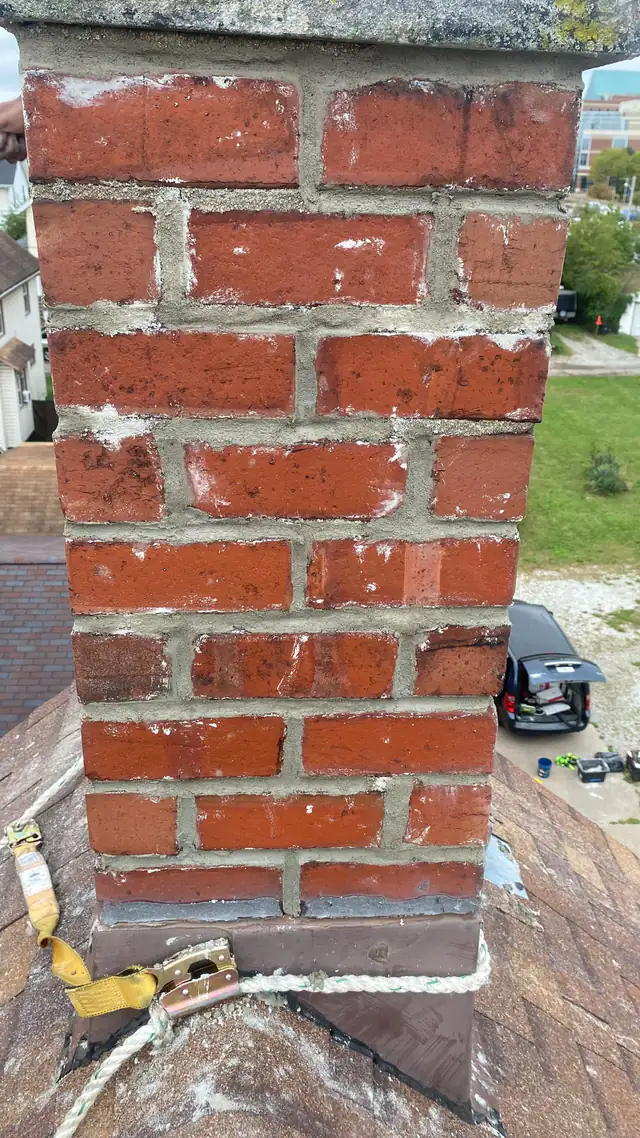
Roped in on a steep roof — repointed, flashing sealed 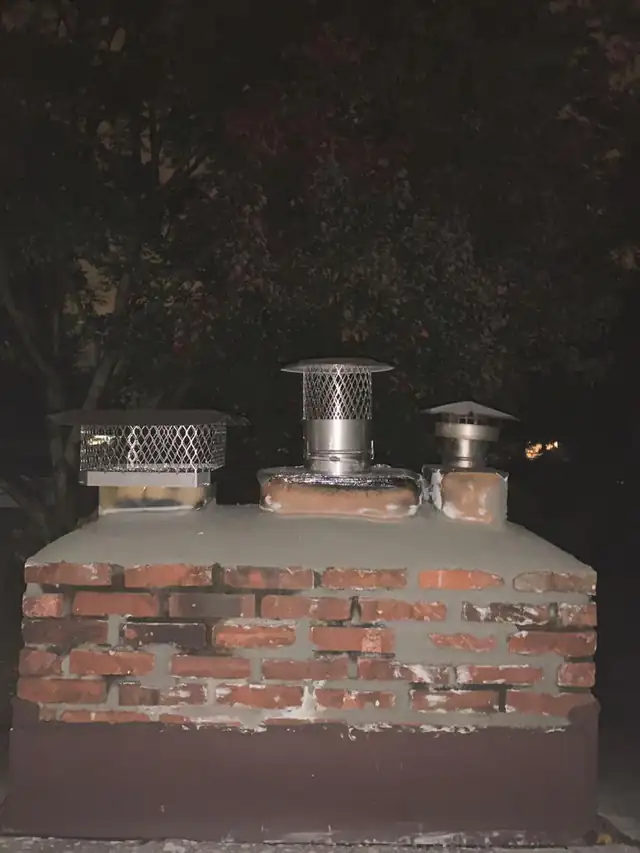
Three flues, three caps, one new crown 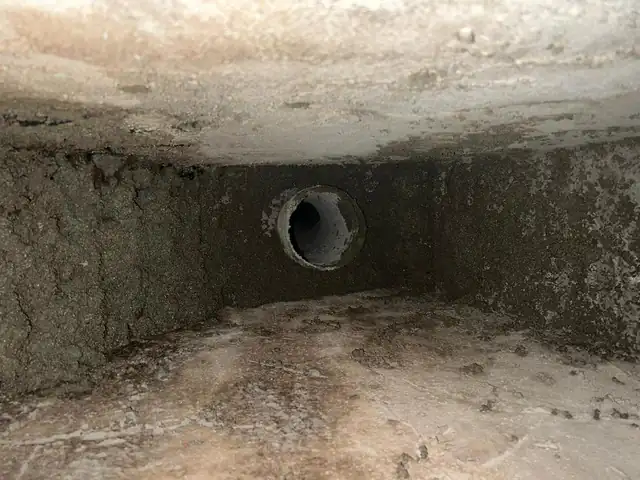
Inside the smoke chamber — the flue opening above the firebox 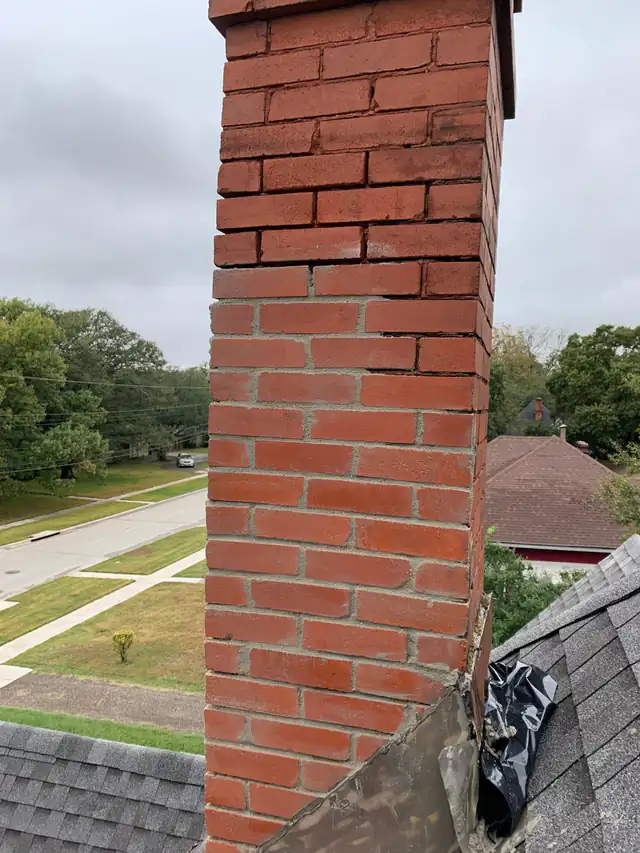
Mid-job — fresh joints below, the old eroded joints still waiting above 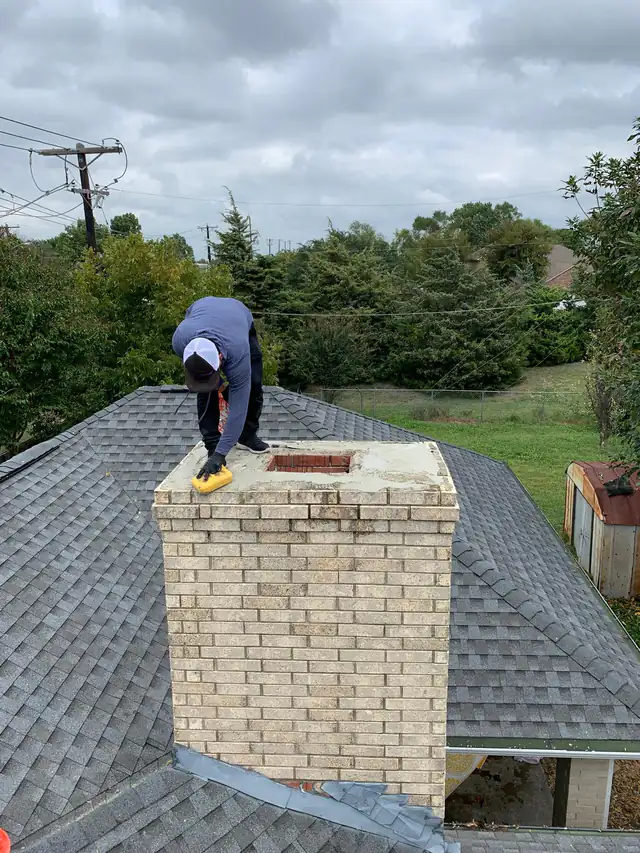
Finishing a fresh crown around the flue 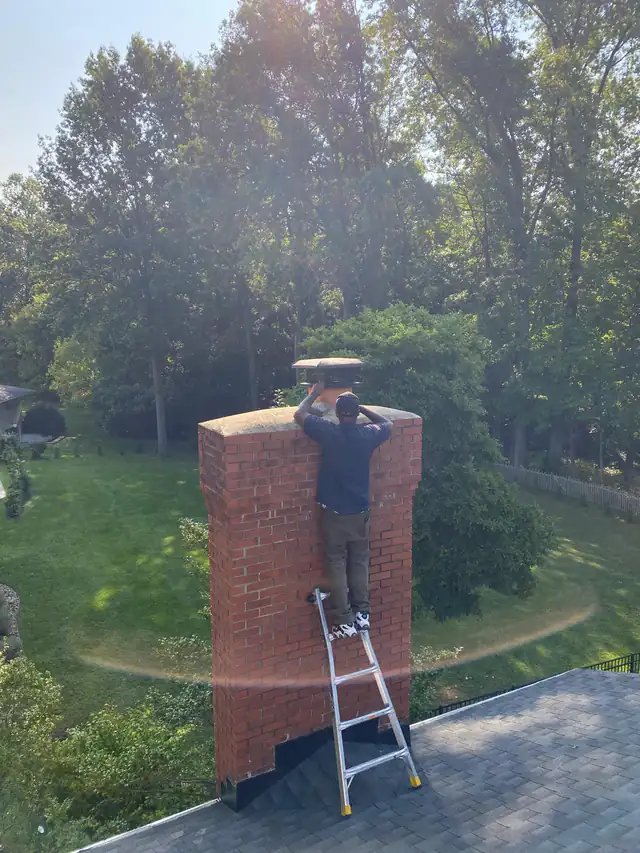
Ladder work on a tall stack — fitting the cap
Meet the team
The people behind the work
Manny, Zack and Myke — meet the people behind Chimney Expert Solutions.
Our team and story →
Manny
Owner
Zack
Manager
Myke
Technician
FAQ
Chimney Repair in North Olmsted: questions we hear
Would extending the chimney damage how it looks?
Not if it is done with matching brick and the same joint profile, which is how we would quote it. On a short ranch stack the extension is usually modest — a few courses and a properly sized cap — and once it is weathered in for a season it reads as original. We will show you what the match looks like before it goes up.
There's a gap opening between our chimney and the house. Is that serious?
It depends on whether it is stable or moving, which is exactly what we assess. A tapered gap that is wider at the top usually means the stack is leaning away on a footing that is moving with the clay. Some of these have been stable for thirty years and need only the flashing and the joint made weathertight; others are progressing and need structural attention. Photographs and a plumb-line reading now give you a baseline to measure against.
We have a brick chimney and a metal one. Do they get serviced the same way?
No, and they should not be. A masonry stack and a factory-built system in a chase have different components, different inspection points, different brushes and different parts. Tell us both are there when you book — or send a photo of each — and the right equipment comes along the first time instead of turning into a second visit.
Is a chimney rebuild covered by homeowners insurance?
Long-term deterioration from weather is normally treated as maintenance and is not covered, while sudden events like a lightning strike, a storm or a chimney fire often are. That is a conversation with your carrier, not with us, but the photo documentation we produce is exactly the evidence that conversation needs — which is another reason we photograph before, during and after.
Can we still use the fireplace while the chimney is being rebuilt?
No — the flue is open at the top and the stack is partly dismantled. If the chimney also serves a furnace or water heater, that has to be planned around before the work starts, and it is one of the first things we check on a quote visit. Nobody should discover mid-rebuild that the water heater has nowhere to vent.
Free estimate
Chimney Repair in North Olmsted?
Tell us what you’re seeing and we’ll call or text back to schedule a look — with photos of what we find and an honest read on what’s urgent and what can wait. That evidence-first method is the way we work on every job.
Call and tell us what the chimney's doing — if we're up on a roof, we'll call you back. Other ways to reach us are on the contact page, and North Olmsted is one of the communities we cover across Greater Cleveland.
Call216-647-1882