
Lorain County, Ohio
Chimney Repair & Rebuilds in Avon Lake, OH
Masonry repair from spot fixes to full stack rebuilds — spalled brick, failed joints, and chimneys the freeze-thaw cycle has taken apart.
What chimney repair involves in Avon Lake is set by the housing stock here: Open lakefront exposure with no shelter from the north — steady wind that beats chimney draft, houses under pressure that pull air back down unused flues, and converted seasonal cottages carrying year-round heating loads.
Avon Lake runs along the shoreline west of the county line, with older housing on and around Lake Road — a lot of it originally built as summer places — and large stretches of newer subdivision south of it toward Walker Road and the highway. The chimney work here is shaped less by building era than by the fact that there is nothing between these houses and the open water.
Northeast Ohio is close to a worst case for exterior masonry. A Cleveland chimney runs through dozens of freeze-thaw cycles every winter: water finds a hairline crack or an open joint, freezes, expands by about nine percent, and levers the masonry apart a little more each time. Repeat that across eighty winters on the most weather-exposed brickwork the house owns, and you get the local pattern. Brick faces shed, mortar goes soft and sandy, top courses shift, and eventually a stack that was fine at the last home sale needs rebuilding.
What we find on Avon Lake chimneys that leads to chimney repair
Cottages that became houses
A good number of the older places near the shore began as seasonal cottages and were converted to year-round living over the decades, gaining insulation, a real heating system and often a fireplace along the way. The masonry frequently did not keep up with the conversion. We find chimneys built for occasional summer use now venting a heating appliance through every Ohio winter, foundations and footings that were adequate for a light seasonal structure carrying a full-height stack, and flue arrangements assembled in stages by different people. None of that is necessarily unsafe, but it does mean the chimney deserves to be assessed on what it is doing now rather than on what it was built to do.
The fireplace we never use, and the smell
The most common Avon Lake call has nothing to do with fire. A house under negative pressure — from wind on the lee side, from bath and kitchen exhaust, from the stack effect of warm air rising in winter — pulls replacement air in wherever it can, and an open flue is a large, easy opening. Air comes down the chimney, passes over old deposits in the smoke chamber and the firebox, and delivers the smell into the room. Cleaning removes the source, but the airflow is the actual cause, and the durable fix is a top-sealing damper that closes the flue at the top rather than at the throat. It also stops you heating the outdoors through the winter.
Reading the damage: what your chimney is telling you
Spalling
Brick faces flaking, popping or crumbling away, leaving the softer core exposed. This is water damage that has already progressed — the face is what protects the brick, and once it is gone the unit absorbs water faster and deteriorates at an accelerating rate. Chips of brick on the roof or in the flower bed under the chimney mean it is happening now, not five years ago.
Open and eroded joints
Mortar recessed back from the face of the brick, or soft enough to rake out with a key. Mortar is meant to be the sacrificial material, so this is the system working as designed, right up until the joints open enough to let water into the middle of the wall. That is the moment repointing changes from maintenance to urgency.
Efflorescence
The white, chalky bloom on the brick face. It is salt carried out of the masonry by water moving through it and deposited when the water evaporates. Efflorescence is not itself damage. It is proof that water is actively traveling through the chimney, which is the more useful information.
Shifted, leaning or stepped top courses
When the joints in the top few courses have failed completely, the bricks stop acting as a wall and start acting as a stack of loose objects. Wind and ice do the rest. A visibly leaning stack or a top course that has slid out of plane is past repointing, and it is a genuine safety issue rather than a maintenance item.
A cracked or missing crown
Almost every serious masonry failure on an older Cleveland chimney can be traced back to the crown. It is the concrete or mortar cap that seals the top of the stack around the flue tiles, and when it cracks it feeds water straight down into the brickwork. If the crown is gone, everything below it is on a countdown.
Repair, partial rebuild, or full rebuild
Depth of damage decides it, and there is a defensible line between the three that we will show you on your own chimney before quoting anything.
Repair and repointing hold well when the brick units themselves are sound and the failure is in the joints, with a limited number of spalled bricks to swap out. This is the cheapest outcome and the right one more often than a homeowner braced for bad news expects.
A partial rebuild — taking the stack down to sound masonry, usually at the roofline or the shoulder, and rebuilding from there — is the correct call when the damage is concentrated above the roof, which is the norm here. The masonry inside the heated envelope of the house is usually in far better shape, because it never sees the freeze-thaw exposure. Rebuilding only what has failed is not a compromise, it is the accurate scope.
A full rebuild from the foundation or the firebox up is for stacks that have deteriorated below the roofline, that have structural cracking through the body, or where the flue itself has to be reconstructed. It is a substantial job and we do not recommend it lightly. What we also will not do is repoint a chimney into another two winters when the evidence says it needs rebuilding, because that is the same money spent twice.
This page covers chimney repair as it plays out in Avon Lake. The full chimney repair & rebuilds page walks the whole job — every stage, what changes the scope, and what we do about each of them. For everything else we handle in this suburb, see chimney services in Avon Lake.
Repair and rebuild work we take on
- Spalled and cracked brick replacement, matched to the existing brick
- Partial rebuilds from the roofline or shoulder up
- Full chimney rebuilds where the stack is beyond saving
- Crown replacement as part of any rebuild — a rebuild under a bad crown is wasted money
- Flue tile replacement while the stack is open, where it is warranted
- Firebox masonry and refractory panel repair
- Written scope with photos before, during and after the work
Our work
Chimney Repair & Rebuilds, photographed on the job
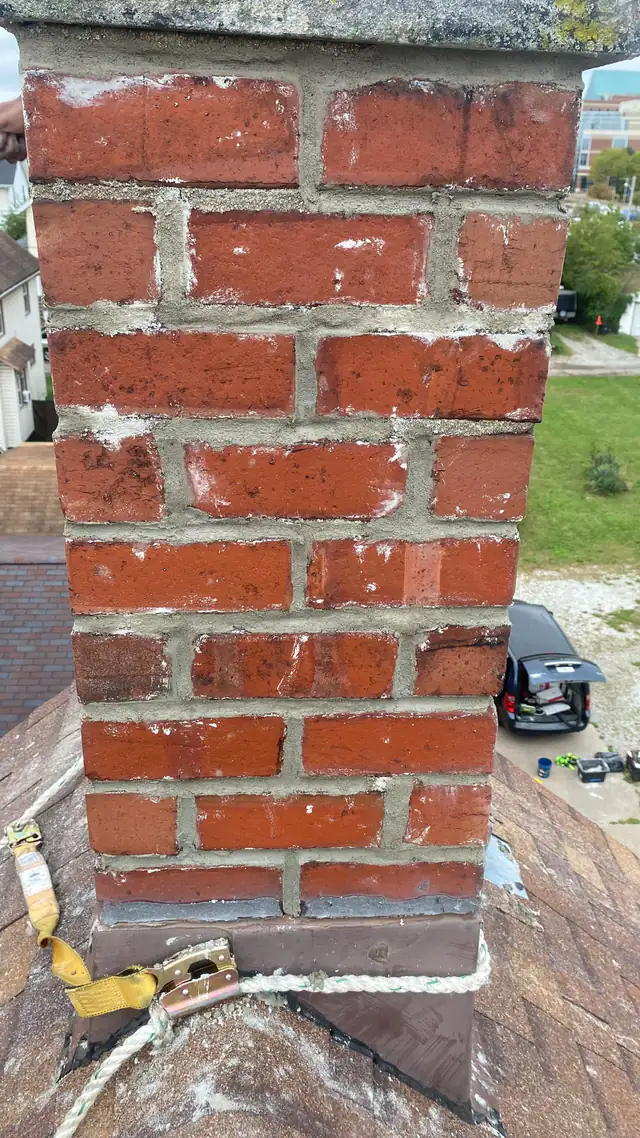
Roped in on a steep roof — repointed, flashing sealed 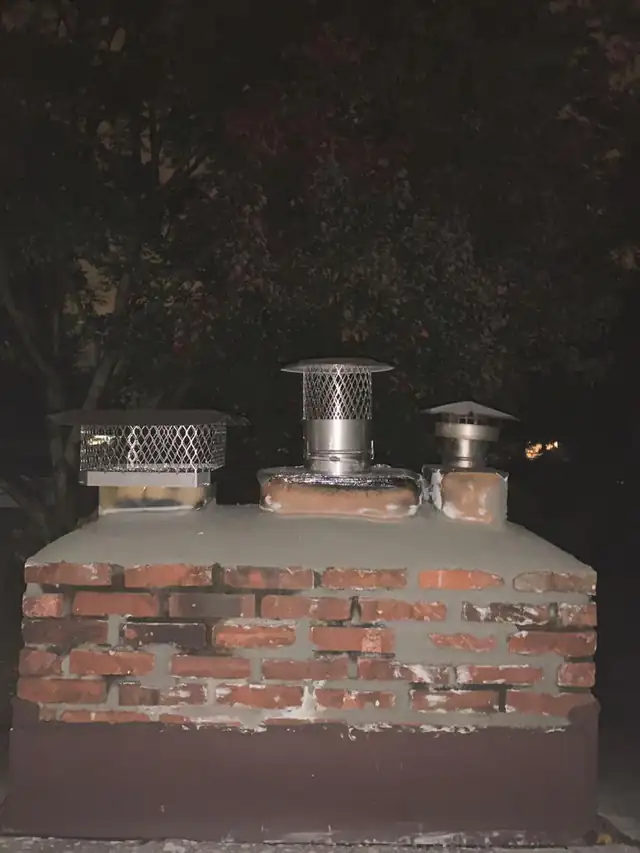
Three flues, three caps, one new crown 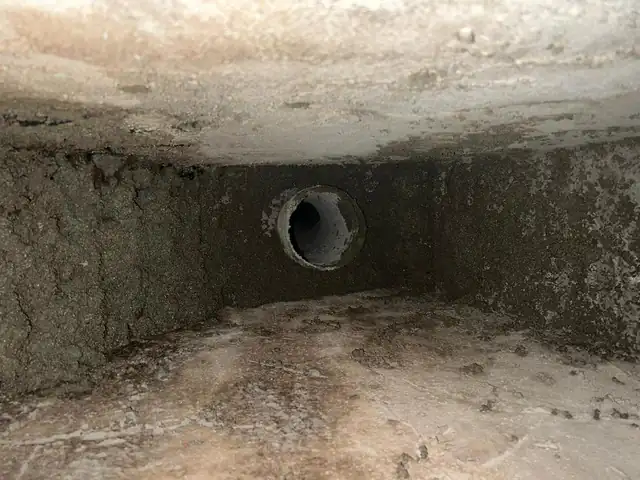
Inside the smoke chamber — the flue opening above the firebox 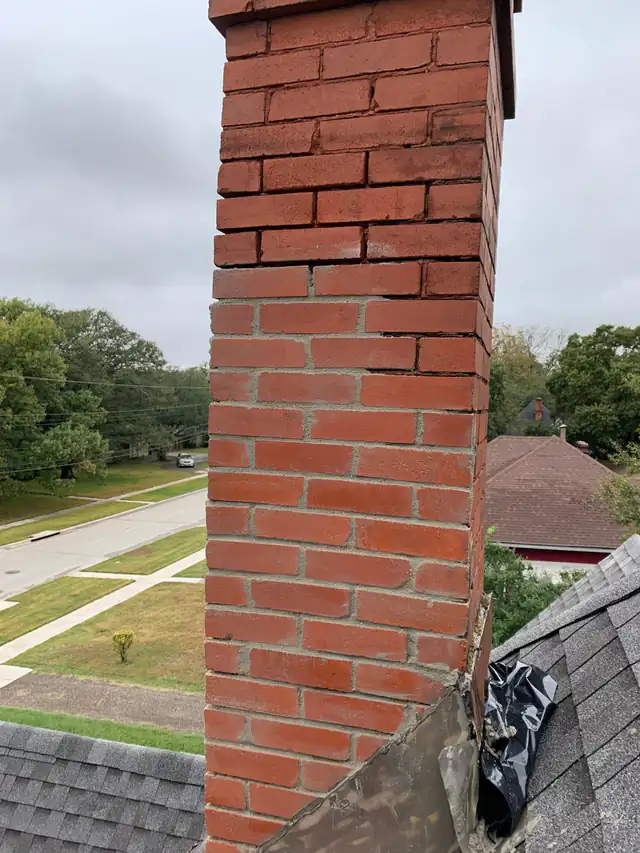
Mid-job — fresh joints below, the old eroded joints still waiting above 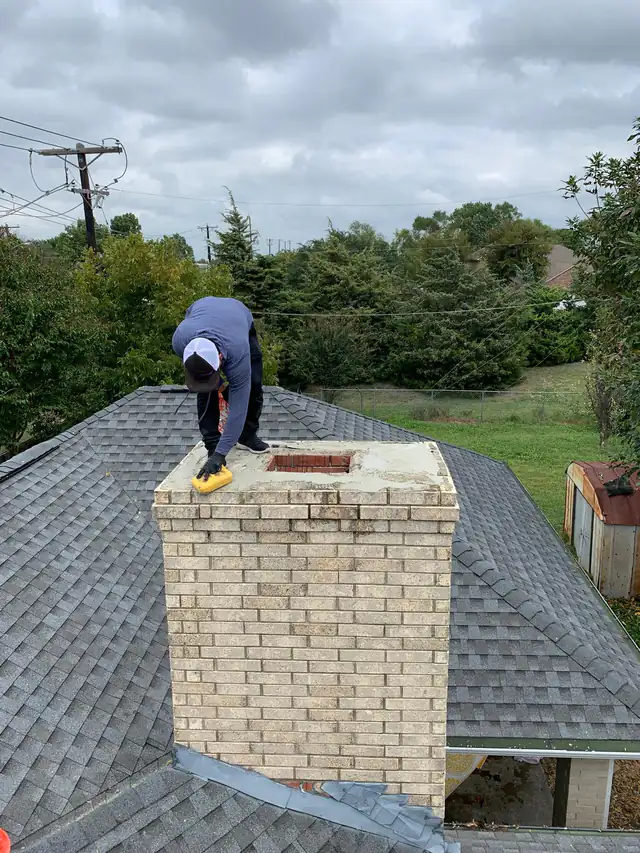
Finishing a fresh crown around the flue 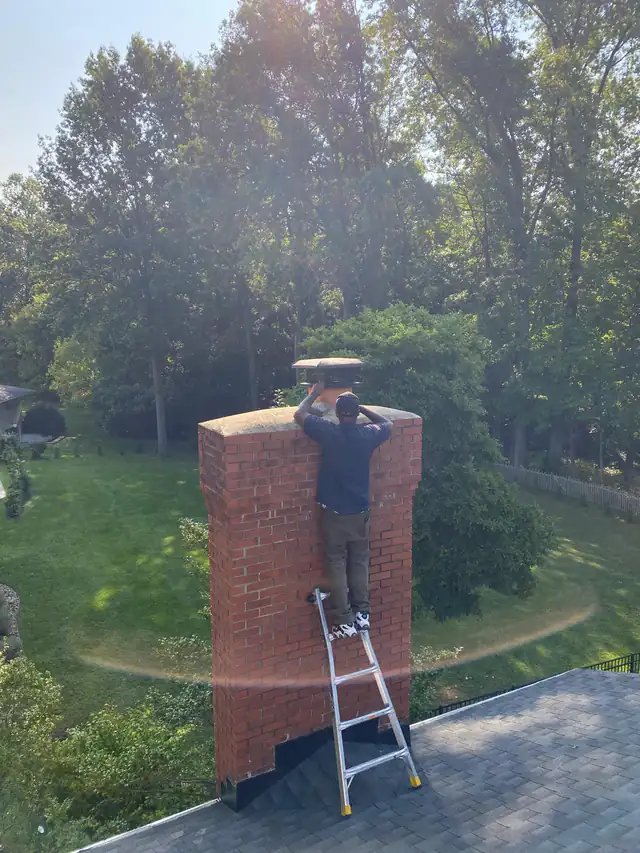
Ladder work on a tall stack — fitting the cap
Meet the team
The people behind the work
Manny, Zack and Myke — meet the people behind Chimney Expert Solutions.
Our team and story →
Manny
Owner
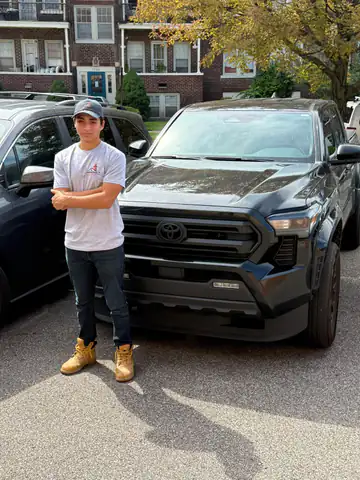
Zack
Manager

Myke
Technician
FAQ
Chimney Repair in Avon Lake: questions we hear
Our fireplace only misbehaves when the wind is up. Is the chimney blocked?
Probably not, and a scan will settle it quickly. A fireplace that draws well on calm days and fails in wind from a particular direction is describing a pressure problem, not an obstruction. The usual causes are a flue that terminates too low relative to the ridge or a nearby structure, and a cap that fights the wind instead of using it. Both are fixable without touching the masonry below.
We smell the fireplace indoors even in summer. What is that?
Air coming down the flue rather than going up it, carrying odor off old deposits. It happens when the house is at lower pressure than the outside — which wind, exhaust fans and the stack effect all cause. Sweeping removes most of the smell source. A top-sealing damper, which seals the flue at the top rather than at the throat, is what stops the airflow itself.
Can we still use the fireplace while the chimney is being rebuilt?
No — the flue is open at the top and the stack is partly dismantled. If the chimney also serves a furnace or water heater, that has to be planned around before the work starts, and it is one of the first things we check on a quote visit. Nobody should discover mid-rebuild that the water heater has nowhere to vent.
Can a leaning chimney be straightened instead of rebuilt?
Generally not. A lean means the joints have failed and the courses have moved, and there is no way to push masonry back into plane and have it stay. What can be done is establishing where sound masonry begins and rebuilding from there, which on most leaning stacks is at or just below the roofline.
Free estimate
Chimney Repair in Avon Lake?
Tell us what you’re seeing and we’ll call or text back to schedule a look — with photos of what we find and an honest read on what’s urgent and what can wait. That evidence-first method is the way we work on every job.
Call and tell us what the chimney's doing — if we're up on a roof, we'll call you back. Other ways to reach us are on the contact page, and Avon Lake is one of the communities we cover across Greater Cleveland.
Call216-647-1882