
Lake County, Ohio
Chimney Sweep & Cleaning in Painesville, OH
Full mechanical sweep of the flue, smoke chamber and firebox — creosote out, dust contained, and a look at the whole system while we're in it.
What chimney sweep involves in Painesville is set by the housing stock here: A nineteenth-century county seat of Italianate and Queen Anne houses — tall exposed stacks that deteriorate from the top down, apartment conversions with layers of added flues, and balloon-framed walls with no firestopping.
Painesville is the Lake County seat, and it looks it: a courthouse square, streets of Italianate and Queen Anne houses around it, Lake Erie College, and a downtown built when this was the center of gravity for the whole county. The residential stock through the older districts is substantially nineteenth century, and Victorian chimneys are a different animal from anything else in this service area.
Creosote is what wood smoke leaves behind on the inside of a flue, and it is the fuel in nearly every chimney fire. It leaves the fire as vapor, condenses on any flue wall cool enough to catch it, and hardens over a season into something closer to tar than soot. A real sweep takes the flue back to bare liner with rods and brushes sized to that specific flue, works the smoke chamber and smoke shelf where the deposits sit heaviest, and finishes in the firebox, with the room sealed off and a HEPA vacuum running the whole time.
What we find on Painesville chimneys that leads to chimney sweep
Balloon framing turns a wall cavity into a chimney of its own
In a house framed this way, the stud bays run uninterrupted from the basement to the attic. Where those bays sit alongside a chimney with a cracked flue, a defective thimble or an open abandoned connection, there is a clear vertical path for heat, smoke and embers to reach the roof structure — which is the mechanism behind a lot of historic house fires that started at a chimney. The same open path lets water from a leaking stack travel two floors before it appears. Firestopping at each floor line and sealing the flue properly are what break the path.
Grand houses divided into apartments, with the flues to match
A lot of the large houses in the older districts were subdivided into apartments during the twentieth century, and each division tended to add heating equipment. The result is stacks with more flues than the house was built with, connections made at different eras with different standards, and abandoned openings left where a unit's arrangement changed again. On these buildings the first inspection is genuinely a survey: every flue scanned, every connection traced to its appliance, everything abandoned identified and properly closed. It usually takes longer than a single-family visit and it produces a document the owner should keep.
What happens if it does not get done
Two failure paths, and they look nothing alike. The first is fire. Creosote ignites at temperatures an ordinary hot fire reaches without trying, and a chimney fire is often not the dramatic roaring event people expect. Plenty of them are slow and nearly silent, and the only evidence is found later: puffed, honeycombed deposits, warped damper, cracked flue tiles, a cap discolored by heat. The tiles are the problem. Once thermal shock has cracked them, the flue no longer contains what it is supposed to contain, and the next fire has a path toward the framing that surrounds every masonry chimney.
The second is blockage, and it kills quietly. Nests, leaf litter, fallen tile shards and heavy deposits all reduce the usable flue area. Exhaust that cannot get out comes back in, and with any fuel-burning appliance that means carbon monoxide. This is why we look at furnace and water-heater flues with the same seriousness as fireplaces, and why working CO alarms on every level of the house, near the sleeping areas, are not optional in a home with any combustion appliance.
The Northeast Ohio timing problem
Every chimney company in Greater Cleveland gets the same phone calls in the same two weeks of October, and nothing about that is good for homeowners. Booking a sweep between late spring and early fall gets you a real appointment slot instead of a queue position.
The bigger reason to go early is what happens if the sweep finds masonry work. Mortar needs sustained temperatures above roughly 40°F to cure properly, so the masonry season here runs about April through November. A failed crown discovered in late September may not get properly rebuilt until spring. Found in June, it is a scheduled repair rather than a winter of water going into the stack.
This page covers chimney sweep as it plays out in Painesville. The full chimney sweep & cleaning page walks the whole job — every stage, what changes the scope, and what we do about each of them. For everything else we handle in this suburb, see chimney services in Painesville.
What a sweep with us includes
- Drop cloths, sealed fireplace opening and HEPA dust control before a brush touches the flue
- Mechanical sweep of the full flue length, with brush size and shape matched to your liner
- Smoke chamber and smoke shelf hand-cleaned — the corners most sweeps skip
- Firebox and ash dump cleared, damper cleaned and operated through full travel
- A visual once-over of the whole system, with photos of anything that needs attention
- Straight advice at the end: what's urgent, what can wait, what's fine
Our work
Chimney Sweep & Cleaning, photographed on the job
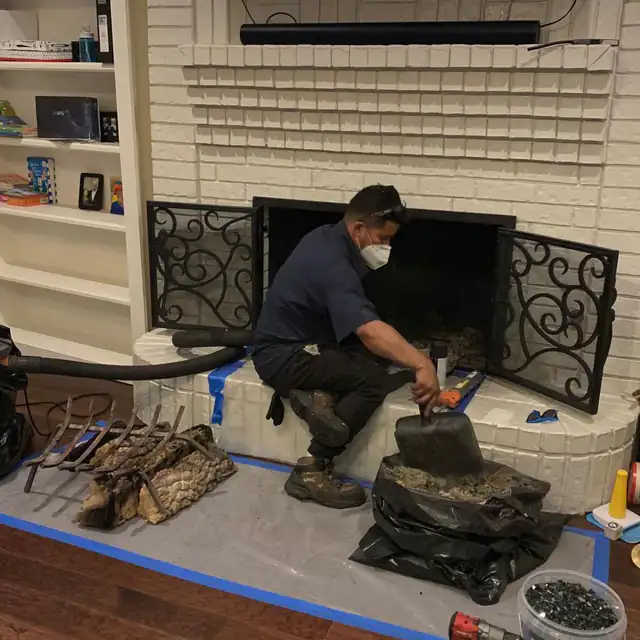
Drop cloths down and a vacuum on the hearth before anything is opened 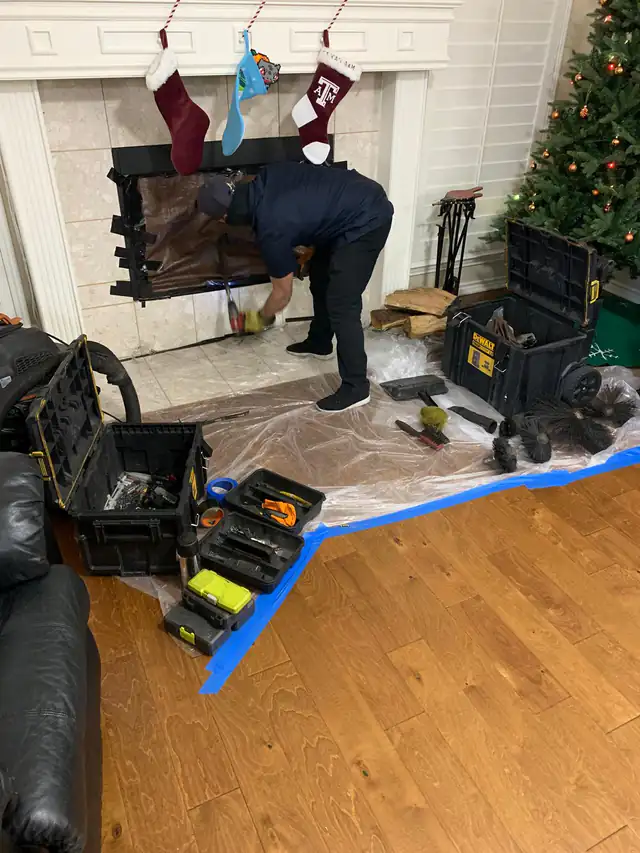
Working at the protected fireplace opening, with brushes and tools on covered floors 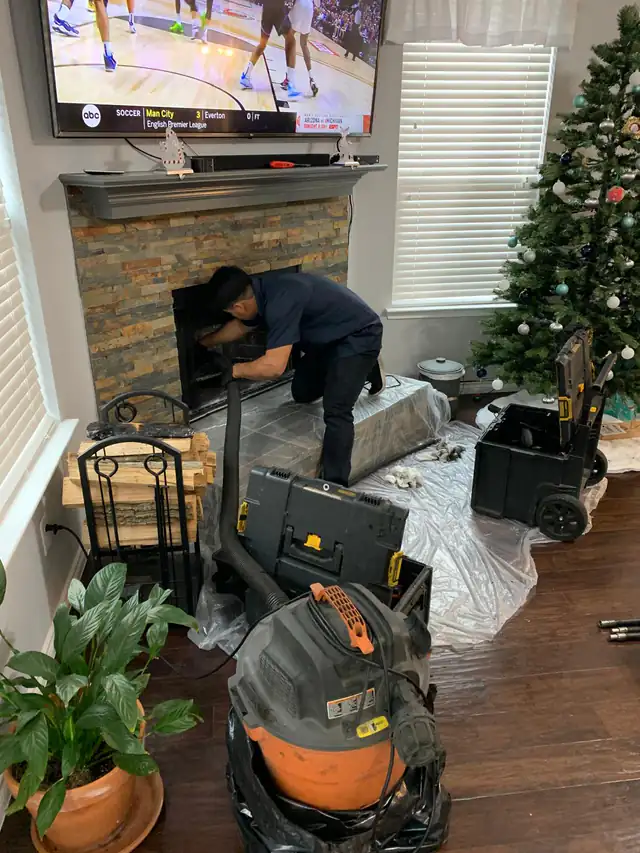
At the stone-front fireplace, with the hearth covered and a vacuum alongside 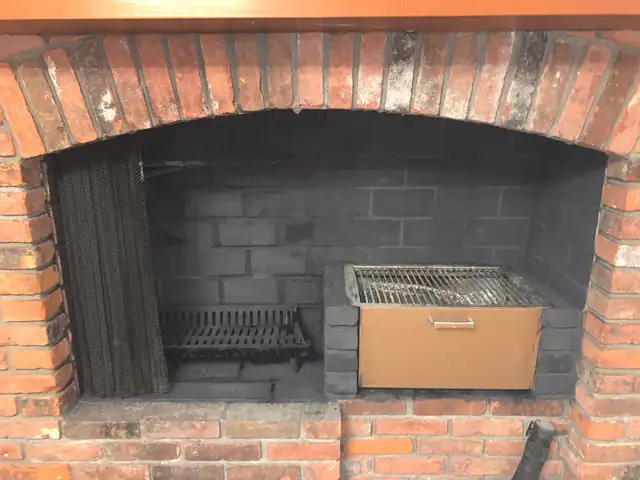
Firebox cleaned back to the brick, damper working 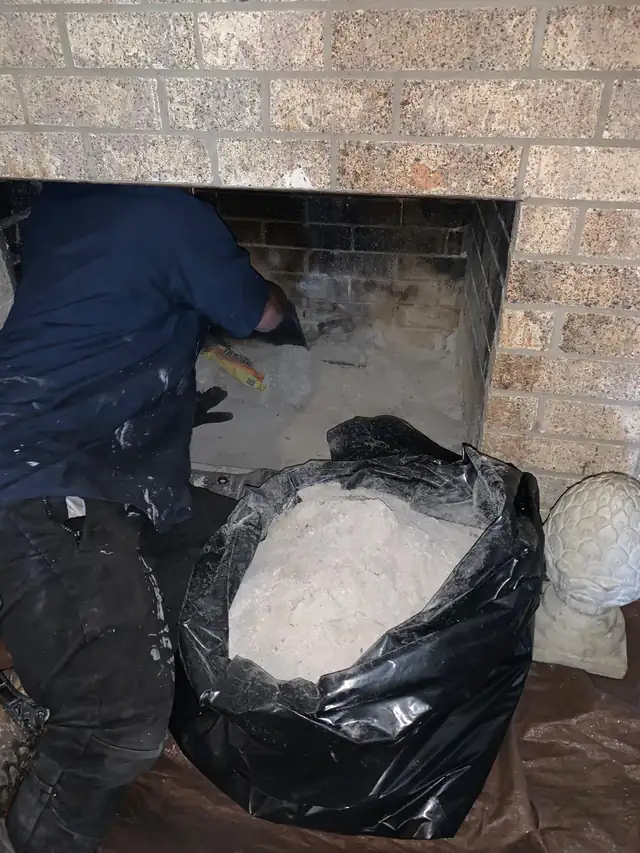
Clearing the firebox down to bare brick, floors covered
Meet the team
The people behind the work
Manny, Zack and Myke — meet the people behind Chimney Expert Solutions.
Our team and story →
Manny
Owner

Zack
Manager

Myke
Technician
FAQ
Chimney Sweep in Painesville: questions we hear
What is firestopping and why does our old house need it?
Houses of this era were framed with wall cavities running unbroken from the basement to the attic, so there is nothing to stop heat, smoke or water from traveling the full height of the wall beside a chimney. Firestopping means closing those cavities at each floor line with non-combustible material. It is normally done alongside chimney work rather than as a job of its own, because the chimney is where the risk is concentrated.
We were quoted a full rebuild. Is that always necessary on an old chimney?
Not usually on this housing. The section above the roof does nearly all the weathering, and the section inside the house is often sound because it never freezes. A rebuild from the roofline up is a complete repair in a lot of these cases. It is a fair question to put to any bidder: show me, in photographs, what is wrong with the part below the roof.
Can the decorative brickwork on top be reproduced?
Yes, and on a house of this period it should be. Corbelled courses, banding and shaped tops are all rebuildable if the existing detail is photographed and measured before anything comes down. The part to confirm with any contractor is whether the detailing is inside their number or whether they intend to top it out square and call it done.
What should I do before you arrive?
Do not burn for at least 24 hours, and 48 is better — a warm firebox is a miserable place to work and hot ash and drop cloths do not mix. Clear a path to the fireplace, take fragile things off the mantel, and keep pets in another room. If you have an insert or a stove, tell us the make and model when you book so the right brushes are on the truck.
What if you find damage while you're in there?
You get photos, a plain explanation of what it is and what it does if left alone, and a written scope. No scare tactics: most of what we find can be scheduled rather than panicked over. What we will not do is sweep a chimney that is not safe to use and say nothing about it.
Free estimate
Chimney Sweep in Painesville?
Tell us what you’re seeing and we’ll call or text back to schedule a look — with photos of what we find and an honest read on what’s urgent and what can wait. That evidence-first method is the way we work on every job.
Call and tell us what the chimney's doing — if we're up on a roof, we'll call you back. Other ways to reach us are on the contact page, and Painesville is one of the communities we cover across Greater Cleveland.
Call216-647-1882