
Lake County, Ohio
Chimney Liner & Relining in Mentor, OH
Stainless steel relining for flues with cracked tiles, gaps, or no liner at all — sized to your appliance, insulated, done once.
What chimney relining involves in Mentor is set by the housing stock here: Mostly 1960s–90s subdivision housing under serious snow-belt loading — ice damming at chimney flashing, missing crickets behind wide stacks, and caps and chase covers taking sliding snow every winter.
Mentor is the largest city in Lake County and most of it is subdivision housing built from the 1960s through the 1990s, spreading off Mentor Avenue and Route 306 north toward the Headlands and south past the Great Lakes Mall. The houses are generally sound, the chimneys are generally younger than the county average, and the thing that dominates the work is not the building era. It is the snow.
The liner is the part of the chimney that does the actual work. Everything else is structure; the liner is what contains the heat and the combustion gases and delivers them out of the house without letting either reach the brickwork or the framing around it. Most Cleveland chimneys were built with clay tile liners, and clay has a hard life here. Thermal shock cracks it, settlement shifts it, and moisture eats the mortar joints between tiles until the sections stop behaving as one continuous passage. A cracked or gapped liner is invisible without a camera, and it is the failure that turns into house fires and carbon monoxide.
What we find on Mentor chimneys that leads to chimney relining
Ice dams pushing water back up under the counterflashing
Roof flashing is designed to shed water running downhill. It is not designed to hold back standing water, and that is exactly what an ice dam creates: melt from the warm upper roof runs down, refreezes at the cold eave, and backs a pond of water up the slope. When that pond reaches the chimney it gets under the step flashing and behind the counterflashing, and it appears indoors as a stain at the ceiling near the stack. The chimney did not fail; it was asked to be a dam. The fixes are a combination of getting the flashing details right at the chimney and getting the heat and ventilation right in the attic above it.
Snow sliding into caps, covers and storm collars
A slab of snow releasing off a steep roof carries real force, and the components at the top of a chimney are thin metal. We see rain caps torn off, chase covers dented into a shape that ponds water, storm collars pushed down or off the pipe entirely, and spark screens flattened. Most owners never look, because these parts are only visible from the roof, and a missing cap does not announce itself until a spring rain is running down the flue. A fall check of the top of the chimney is a small thing that catches all of it before the snow arrives.
Sizing: the part that decides whether it drafts
More relining jobs are ruined by wrong sizing than by bad installation. A flue that is too large runs cool, drafts weakly, and condenses moisture and creosote onto its own walls. A flue that is too small cannot move the volume of exhaust the appliance produces, and the surplus comes into the room. Neither problem announces itself as a sizing problem; both present as 'the fireplace smokes' or 'the chimney keeps getting dirty'.
For an open fireplace, the flue is sized against the area of the fireplace opening — the long-standing rule in NFPA 211 puts a round flue at no less than about a twelfth of the opening area, and a rectangular one at no less than about a tenth. For a stove, insert or appliance, the liner is sized to the manufacturer's specified outlet and the listed installation instructions, not to whatever is currently in the chimney. Getting this right is the difference between a fireplace that pulls crisply the moment it is lit and one the family stops using.
Furnace and water heater flues: the Cleveland problem
This one affects tens of thousands of houses across Parma, Old Brooklyn, Euclid, Garfield Heights and every other postwar neighborhood, and almost nobody has been told about it. The sequence goes like this. The original furnace and the water heater both vented into the masonry chimney, and the flue was sized for the two of them together. The furnace gets replaced with a high-efficiency condensing unit, which vents through white PVC out a side wall. The water heater is left where it is.
Now a small appliance is venting into a flue sized for a large one. The exhaust volume is nowhere near enough to keep that flue warm, so it condenses on the way up. The condensate is acidic. It attacks the tile and the mortar joints, and over a decade it can take a flue apart from the inside while everything looks perfectly normal from the basement. The industry name for this is an orphaned water heater, and the standard fix is a correctly sized metal liner that matches the appliance rather than the chimney.
The signs are worth knowing: rust or scaling on the draft hood or the vent connector, dampness or white crusty deposits at the base of the chimney, tile fragments in the clean-out, or a chimney exterior that is staining on the outside near the top. If your furnace was upgraded in the last fifteen years and nobody looked at the chimney afterwards, that is the situation this section is describing.
This page covers chimney relining as it plays out in Mentor. The full chimney liner & relining page walks the whole job — every stage, what changes the scope, and what we do about each of them. For everything else we handle in this suburb, see chimney services in Mentor.
What a relining job includes
- Camera inspection first — you see why (or whether) the flue needs relining
- Continuous stainless steel liner in the correct alloy, sized to the fireplace or appliance it serves
- Insulation wrap or pour so the flue drafts correctly and meets the liner's listing
- Existing flue cleared, and broken tile removed where it obstructs the run
- New top plate, storm collar and cap terminating the system
- Correct listed connection at the appliance — no improvised adapters
- Photos of the completed run top to bottom, and the liner's product documentation
Our work
Chimney Liner & Relining, photographed on the job
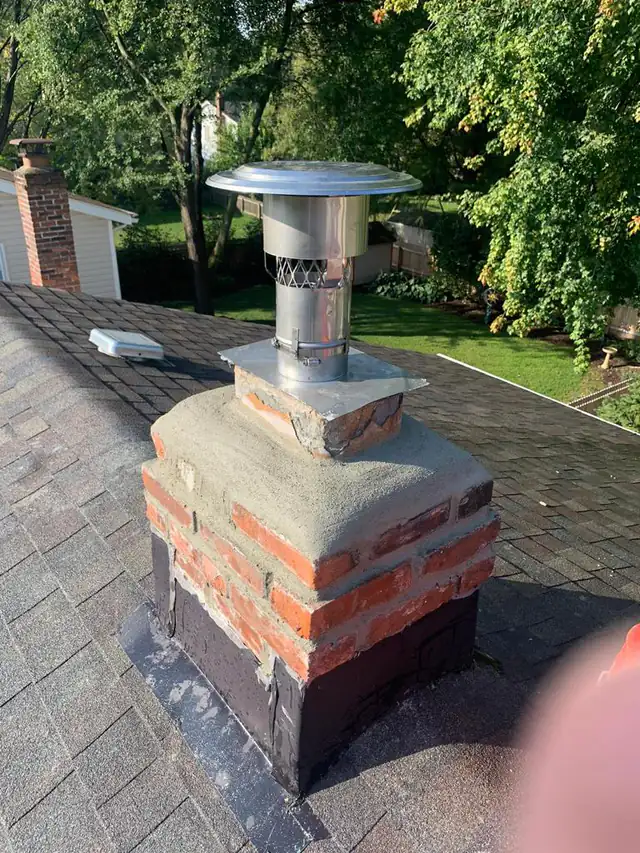
Stainless liner brought through a new crown, capped 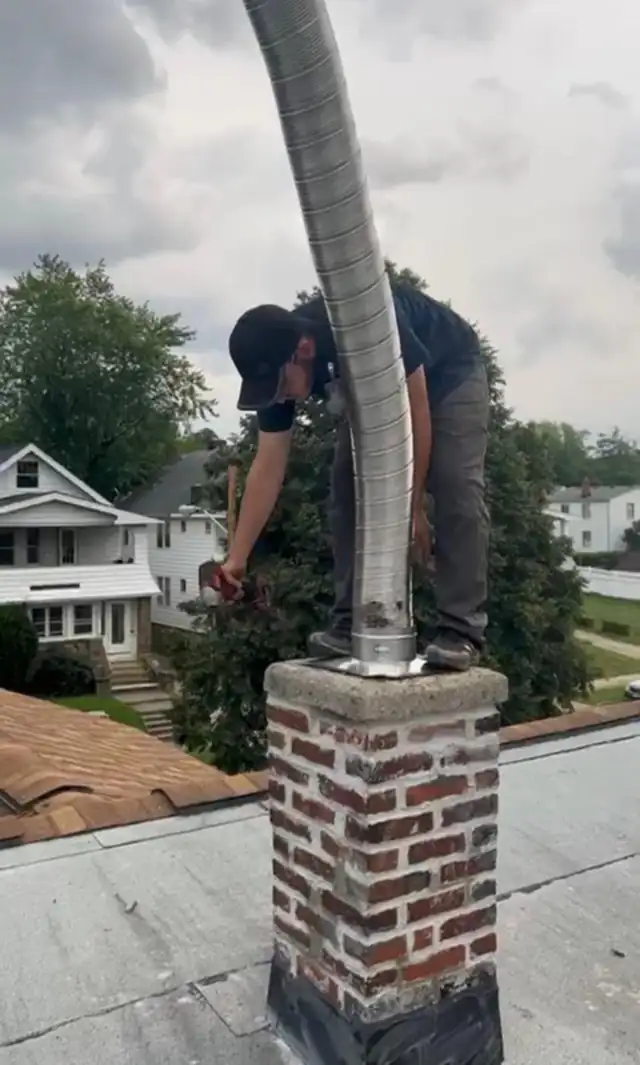
Feeding a new stainless liner down the flue
Meet the team
The people behind the work
Manny, Zack and Myke — meet the people behind Chimney Expert Solutions.
Our team and story →
Manny
Owner
Zack
Manager

Myke
Technician
FAQ
Chimney Relining in Mentor: questions we hear
Water comes in near the chimney only in winter. Is the chimney leaking?
Usually not in the way people mean. A leak that appears in thaw conditions and never in summer downpours is the signature of an ice dam backing water up under the flashing rather than a defect in the crown or the masonry. We look at the flashing details and at what the attic is doing above them, because insulation and ventilation are usually half the answer.
Does more snow actually mean more chimney damage?
It means more of the specific kinds. Snow sits in contact with masonry for weeks rather than running off in an afternoon, so it melts and refreezes against the same joints repeatedly, and it loads the roof in ways that move flashing and shear off caps. The flue's interior condition is not much affected by snowfall; everything from the roofline up very much is.
Why stainless instead of replacing the broken clay tiles?
Access. Clay tiles are stacked inside a sealed masonry shaft, so reaching a cracked one partway up means opening the chimney to get to it — which usually costs more than relining and leaves you with a repaired eighty-year-old flue. A stainless liner installs from the top, restores a continuous sealed passage in a day or two on most jobs, and the liner itself typically carries a manufacturer lifetime warranty.
How long does a reline take and is my house disrupted?
Most single-flue relines are a one- or two-day job, and the majority of the work happens on the roof. Inside, the disruption is at the fireplace or the appliance for the connection. If the chimney vents your water heater, we plan the sequence so it is not left without a vent overnight.
Free estimate
Chimney Relining in Mentor?
Tell us what you’re seeing and we’ll call or text back to schedule a look — with photos of what we find and an honest read on what’s urgent and what can wait. That evidence-first method is the way we work on every job.
Call and tell us what the chimney's doing — if we're up on a roof, we'll call you back. Other ways to reach us are on the contact page, and Mentor is one of the communities we cover across Greater Cleveland.
Call216-647-1882