
Lake County, Ohio
Chimney Sweep & Cleaning in Willoughby, OH
Full mechanical sweep of the flue, smoke chamber and firebox — creosote out, dust contained, and a look at the whole system while we're in it.
What chimney sweep involves in Willoughby is set by the housing stock here: A nineteenth-century downtown core plus decades of suburban growth, in a market where wood heat is genuinely used — a high concentration of stoves and inserts, many of them venting into oversized original flues.
Willoughby has a real nineteenth-century downtown — the Erie Street blocks by the Chagrin River, with brick commercial buildings and older houses on the streets behind them — and then decades of suburban building spreading east and south around it. What ties the market together is not a building era. It is that people here genuinely burn wood, and have for a long time, because Lake County winters make supplemental heat worth the trouble.
Creosote is what wood smoke leaves behind on the inside of a flue, and it is the fuel in nearly every chimney fire. It leaves the fire as vapor, condenses on any flue wall cool enough to catch it, and hardens over a season into something closer to tar than soot. A real sweep takes the flue back to bare liner with rods and brushes sized to that specific flue, works the smoke chamber and smoke shelf where the deposits sit heaviest, and finishes in the firebox, with the room sealed off and a HEPA vacuum running the whole time.
What we find on Willoughby chimneys that leads to chimney sweep
Inserts installed without a full-length liner
The common older installation was a slip connector or a short length of pipe from the insert's outlet up into the smoke chamber, venting into the original masonry flue. The problem is volume and temperature. A modern insert burns efficiently, so the exhaust leaves cooler and in far smaller quantity than an open fire's did, and it is now expanding into a flue several times larger than it needs. It slows, it cools, and it deposits creosote heavily up in the cold masonry where nobody can brush it. The current standard is a correctly sized stainless liner running the full height from the appliance to the top, insulated where the situation calls for it. It drafts better and it is dramatically easier to keep clean.
Nobody has looked behind the insert since it went in
An insert is a plug in the fireplace. Everything behind it — the original firebox, the damper area, the smoke chamber, the point where the connector enters the flue — is out of sight and out of mind, sometimes for decades. What we find back there when a unit finally comes out is the interesting part: creosote packed into the smoke shelf, a rusted damper frame, a connector that has come loose from its collar, deteriorated firebrick, and occasionally a masonry defect that has been getting worse in the dark since the Clinton administration. If your insert has never been pulled, that is the single highest-value thing to do to it.
Old downtown stacks against a neighboring wall
In the older Erie Street blocks and the streets right behind them, buildings sit close together or share walls, and chimneys were built into those walls. That changes the work in a few specific ways: one side of the stack may be inaccessible from either property, roof access sometimes has to be arranged with a neighbor, and flues in shared walls occasionally turn out to serve — or to have once served — the building next door. On older mixed commercial and residential buildings, sorting out which flue belongs to which occupancy is a real part of the first inspection rather than a formality.
What drives the cost of a sweep
Sweeping is one of the more predictable jobs in the trade, and we would rather explain the variables than have you compare two numbers that were never quoting the same work.
- Number of flues. Older Cleveland and Heights homes routinely have two or three in one stack, and each is a separate job.
- Access. A walkable asphalt roof on a ranch is one thing. A steep slate roof on a three-story Tudor, where walking the slate would break it, means roof ladders and staging.
- Appliance type. An insert or stove with no direct liner connection usually has to be pulled out, swept, and re-seated with fresh gasket, which is real extra labor.
- Deposit stage. Stage one and two are inside the standard visit. Stage three glaze is rotary work, sometimes with a chemical pre-treatment and a return trip, and we will not quote it sight unseen.
- Condition. A flue with cracked or loose tiles cannot take aggressive brushing. Sometimes the right sequence is inspect first, stabilise, then clean.
- How long it has been. Ten years of accumulation is not ten times the work of one, but it is not the same visit either.
Wood stoves, inserts, and what changes with gas
Stoves and inserts run hotter and load their flues faster than open fireplaces, and they are usually connected to a stainless liner that requires a different brush than clay tile. Many older Cleveland installations have an insert simply slid into an existing masonry fireplace with no liner at all, venting into a flue several times too large for it. Those build deposits quickly in the smoke chamber and the bottom of the flue, and they are worth a camera look before another season.
Gas is a different conversation and we will not oversell it. A gas fireplace or a gas-fired appliance does not make creosote. What it does produce is scale, rust flake, and corrosion at the base of an oversized flue, and its flue is still an attractive place for a bird or a squirrel. The annual look stays the same standard; the brushing schedule honestly does not.
This page covers chimney sweep as it plays out in Willoughby. The full chimney sweep & cleaning page walks the whole job — every stage, what changes the scope, and what we do about each of them. For everything else we handle in this suburb, see chimney services in Willoughby.
What a sweep with us includes
- Drop cloths, sealed fireplace opening and HEPA dust control before a brush touches the flue
- Mechanical sweep of the full flue length, with brush size and shape matched to your liner
- Smoke chamber and smoke shelf hand-cleaned — the corners most sweeps skip
- Firebox and ash dump cleared, damper cleaned and operated through full travel
- A visual once-over of the whole system, with photos of anything that needs attention
- Straight advice at the end: what's urgent, what can wait, what's fine
Our work
Chimney Sweep & Cleaning, photographed on the job
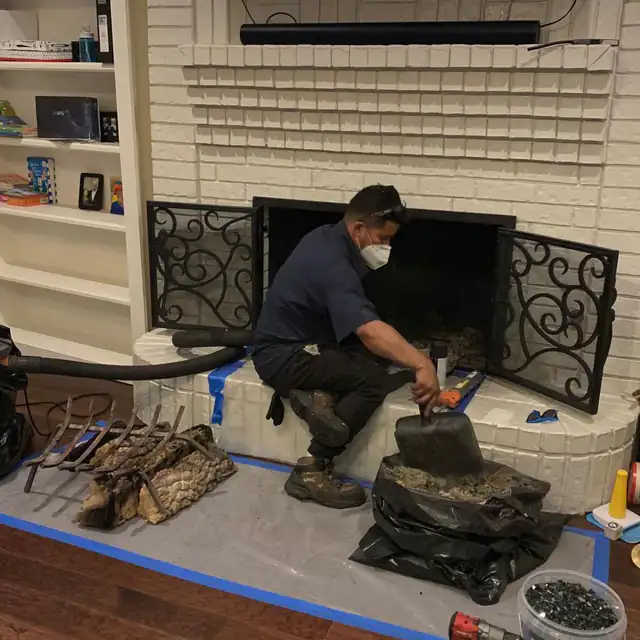
Drop cloths down and a vacuum on the hearth before anything is opened 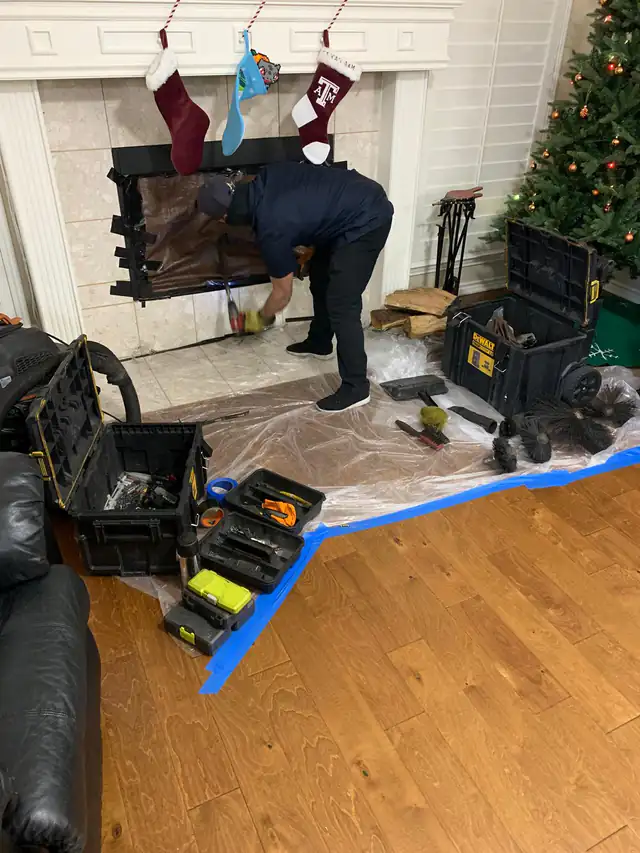
Working at the protected fireplace opening, with brushes and tools on covered floors 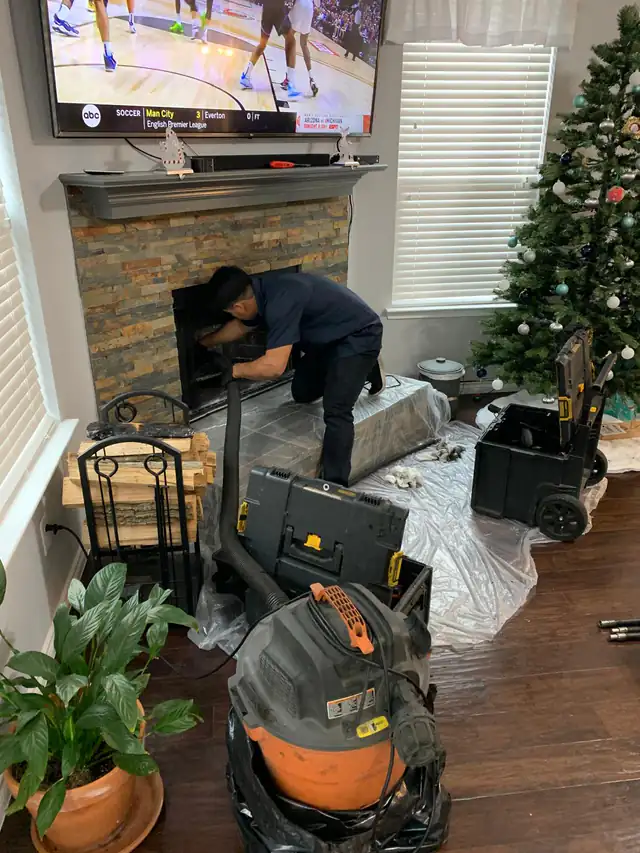
At the stone-front fireplace, with the hearth covered and a vacuum alongside 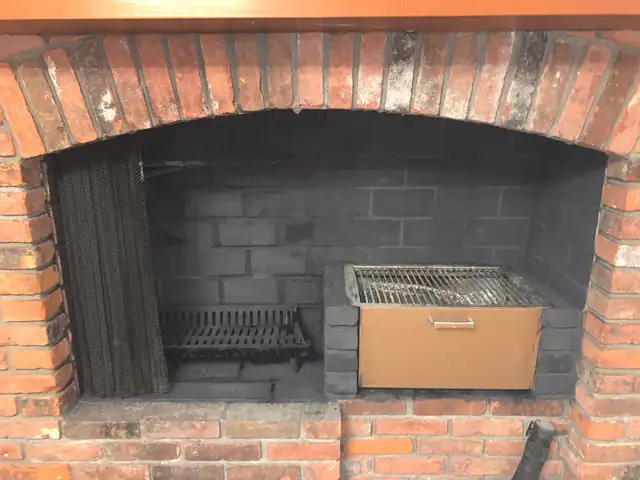
Firebox cleaned back to the brick, damper working 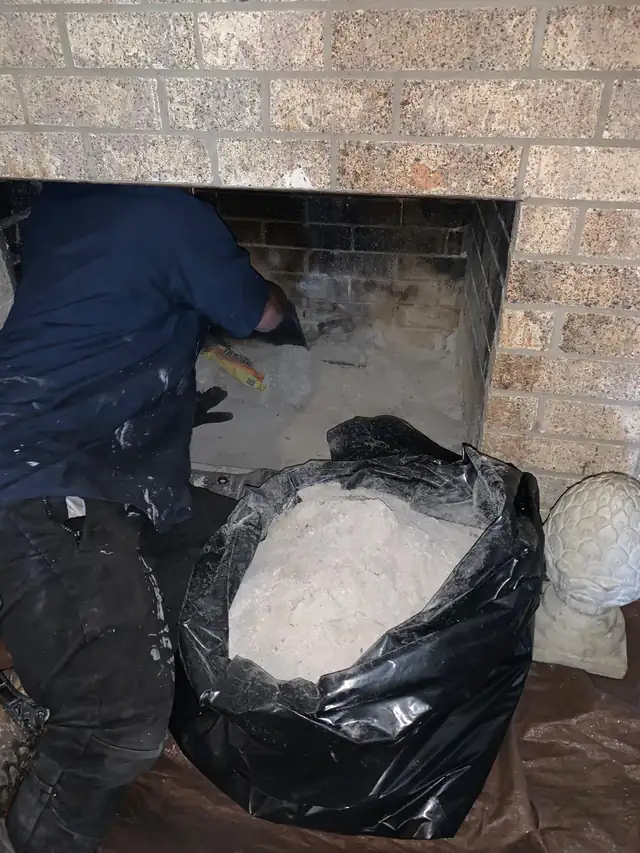
Clearing the firebox down to bare brick, floors covered
Meet the team
The people behind the work
Manny, Zack and Myke — meet the people behind Chimney Expert Solutions.
Our team and story →
Manny
Owner

Zack
Manager

Myke
Technician
FAQ
Chimney Sweep in Willoughby: questions we hear
Does our fireplace insert need to be pulled out to be swept?
To be swept and genuinely inspected, in most cases yes. There is no other way to see the smoke chamber, the damper area and the connection into the flue, and those are the places deposits and defects accumulate. It is more work than a straightforward sweep, so we would rather tell you that when you book than surprise you with it at the door.
How often should a stove or insert be swept if we burn regularly?
Frequency follows how much wood goes through it, not the calendar. A household that burns most evenings through a Lake County winter will typically need attention more than once a season; occasional weekend burning may not. The honest way to set it is to have it looked at after the first full season and use what is actually in there to decide the interval.
Our insert vents into the old flue with a short pipe. Is that acceptable?
It is a very common older arrangement and it is worth replacing. A modern insert produces cooler, lower-volume exhaust than the flue was built for, so it slows down in the oversized masonry, cools, and lays creosote in the part of the chimney nobody can brush. A full-height stainless liner sized to the appliance draws better, burns cleaner and is far easier to maintain. We will show you the camera footage before recommending it.
How long does it take, and do I need to be home?
A single straightforward fireplace flue usually runs a couple of hours including setup, cleanup and the walkthrough. Multiple flues, an insert that has to be pulled, or heavy deposits take longer. Someone should be home to let us in and to hear the findings at the end — that conversation is half the value of the visit.
The fireplace was converted to gas years ago. Does the old creosote still matter?
Yes. Wood-era deposits stay where they are and stay combustible, and a conversion usually leaves the flue badly oversized for the new appliance — so it runs cold and condenses moisture onto exactly those deposits. Conversions are a good reason for a sweep and a camera look, not a reason to skip one.
Free estimate
Chimney Sweep in Willoughby?
Tell us what you’re seeing and we’ll call or text back to schedule a look — with photos of what we find and an honest read on what’s urgent and what can wait. That evidence-first method is the way we work on every job.
Call and tell us what the chimney's doing — if we're up on a roof, we'll call you back. Other ways to reach us are on the contact page, and Willoughby is one of the communities we cover across Greater Cleveland.
Call216-647-1882