
Summit County, Ohio
Chimney Liner & Relining in Akron, OH
Stainless steel relining for flues with cracked tiles, gaps, or no liner at all — sized to your appliance, insulated, done once.
What chimney relining involves in Akron is set by the housing stock here: Company-era and boom-era housing built fast in the rubber years — unlined coal-built flues, mortar carrying a century of sulfate attack with leaning and bowing stacks to show for it, and two-family conversions sharing undersized flues.
Akron's residential neighborhoods were largely built in one extraordinary rush. The rubber industry pulled tens of thousands of workers into the city in the years around the First World War, and the housing went up as fast as it could be framed — Goodyear Heights and Firestone Park laid out by the companies themselves, plus North Hill, Kenmore, Highland Square and the streets between them. It is honest, modest housing built at speed on hilly ground, and its chimneys are exactly what you would expect: functional, unadorned, and built for coal.
The liner is the part of the chimney that does the actual work. Everything else is structure; the liner is what contains the heat and the combustion gases and delivers them out of the house without letting either reach the brickwork or the framing around it. Most Cleveland chimneys were built with clay tile liners, and clay has a hard life here. Thermal shock cracks it, settlement shifts it, and moisture eats the mortar joints between tiles until the sections stop behaving as one continuous passage. A cracked or gapped liner is invisible without a camera, and it is the failure that turns into house fires and carbon monoxide.
What we find on Akron chimneys that leads to chimney relining
Speed-built housing with unlined heating flues
Houses put up quickly for a booming workforce got sound but economical construction, and flue liners were not a universal expectation in that era. Very large numbers of Akron chimneys were built as bare brick shafts, with the mortar between the courses as the only thing separating combustion gases from the wall cavity. A century of use, sulfate attack and condensation later, those joints are frequently open. It is invisible from the basement and the roof both, and it is the reason a camera scan is the starting point on a house of this vintage rather than an add-on to it.
Stacks that lean or bow from sulfate expansion
A chimney that has vented coal for decades can have sulfates concentrated in the mortar of the flue-side and the weather-side joints, and as those salts crystallize they take up more room than the mortar had to give. Multiply a fraction of a millimeter by the number of joints in a stack and the top of the chimney moves measurably — usually leaning away from the flue side, sometimes bowing. The tells are a top that is visibly out of plumb, horizontal cracking on one face, and joints that look swollen or crushed rather than washed out. Assessment means a plumb line, a record of the crack pattern and a look at which face is affected, because a leaning stack is a rebuild question rather than a pointing question.
Two appliances sharing a flue that cannot take both
A great many of these houses were doubled up during the boom, or converted to two-family later, and the pattern that follows is two heating appliances connected into one chimney flue. Common venting is not automatically wrong, but it has rules — the flue has to be sized for the combined input, the connectors have to enter at the right levels and slope upward toward the chimney, and the appliances have to be compatible. What we typically find instead is a second connector added in whatever decade it was needed, entering below the first, into a flue that was never sized for both. The consequence is spillage, which means combustion products into the house rather than up the chimney. The basement is where that gets found.
What a relining job involves
Preparing the flue
The existing flue is swept and cleared. Where broken tile is obstructing the passage or protruding into it, it has to be removed or broken out so the liner can run straight. On some older chimneys with tight offsets, this is the part that takes the time, and it is the part a quote can get wrong if nobody looked first.
The liner and its insulation
A continuous stainless liner in the correct alloy for the fuel — 316Ti-grade stainless is the normal choice for wood and oil, and a listed alloy is used for high-efficiency condensing appliances, because condensate chemistry differs. It goes in insulated, either with a factory or field-applied wrap or a pour-around insulation mix. Insulation is not optional dressing: it is often required by the liner's own listing, it keeps the flue warm enough to draft properly, and it dramatically reduces condensation and creosote formation. An uninsulated liner rattling around inside an oversized masonry chase is a cheaper job and a worse chimney.
Termination at the top
A top plate seals the liner to the top of the chimney, a storm collar sheds water off the joint, and a cap sized to the new liner finishes it. Done properly, the top of the chimney is now sealed against rain for the first time in decades, which is a side benefit that quietly protects the masonry below.
The connection at the bottom
The liner is connected to the fireplace, stove or appliance with the correct listed components. Improvised adapters and unsupported connector pipe are common findings on older installations and they are exactly where the system leaks. On a fireplace, this usually means a connection at the smoke chamber; on an insert or stove, a direct connect to the appliance outlet.
Documentation
Photos of the completed run top to bottom, and the liner's product documentation handed over, so the manufacturer's warranty on the liner is something you actually hold rather than something you were told about.
Furnace and water heater flues: the Cleveland problem
This one affects tens of thousands of houses across Parma, Old Brooklyn, Euclid, Garfield Heights and every other postwar neighborhood, and almost nobody has been told about it. The sequence goes like this. The original furnace and the water heater both vented into the masonry chimney, and the flue was sized for the two of them together. The furnace gets replaced with a high-efficiency condensing unit, which vents through white PVC out a side wall. The water heater is left where it is.
Now a small appliance is venting into a flue sized for a large one. The exhaust volume is nowhere near enough to keep that flue warm, so it condenses on the way up. The condensate is acidic. It attacks the tile and the mortar joints, and over a decade it can take a flue apart from the inside while everything looks perfectly normal from the basement. The industry name for this is an orphaned water heater, and the standard fix is a correctly sized metal liner that matches the appliance rather than the chimney.
The signs are worth knowing: rust or scaling on the draft hood or the vent connector, dampness or white crusty deposits at the base of the chimney, tile fragments in the clean-out, or a chimney exterior that is staining on the outside near the top. If your furnace was upgraded in the last fifteen years and nobody looked at the chimney afterwards, that is the situation this section is describing.
This page covers chimney relining as it plays out in Akron. The full chimney liner & relining page walks the whole job — every stage, what changes the scope, and what we do about each of them. For everything else we handle in this suburb, see chimney services in Akron.
What a relining job includes
- Camera inspection first — you see why (or whether) the flue needs relining
- Continuous stainless steel liner in the correct alloy, sized to the fireplace or appliance it serves
- Insulation wrap or pour so the flue drafts correctly and meets the liner's listing
- Existing flue cleared, and broken tile removed where it obstructs the run
- New top plate, storm collar and cap terminating the system
- Correct listed connection at the appliance — no improvised adapters
- Photos of the completed run top to bottom, and the liner's product documentation
Our work
Chimney Liner & Relining, photographed on the job
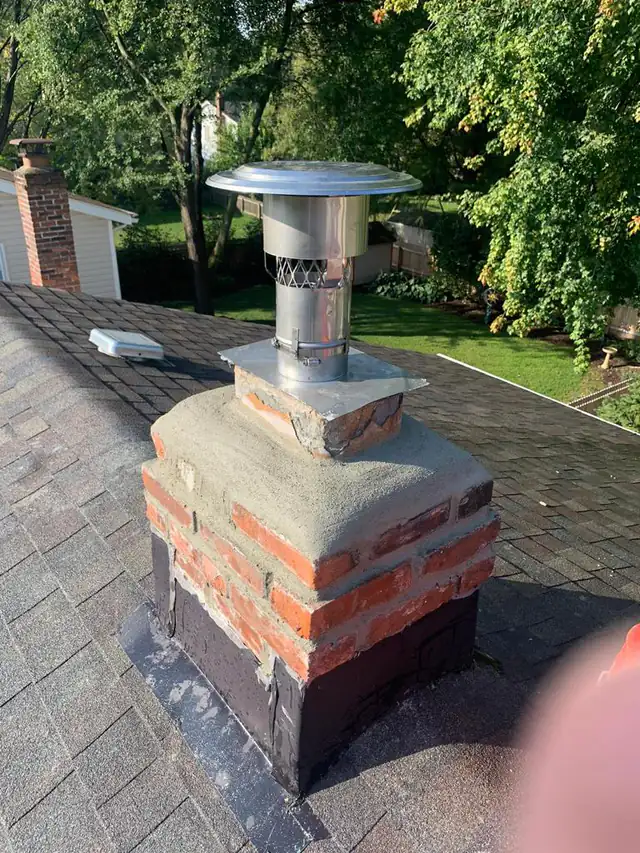
Stainless liner brought through a new crown, capped 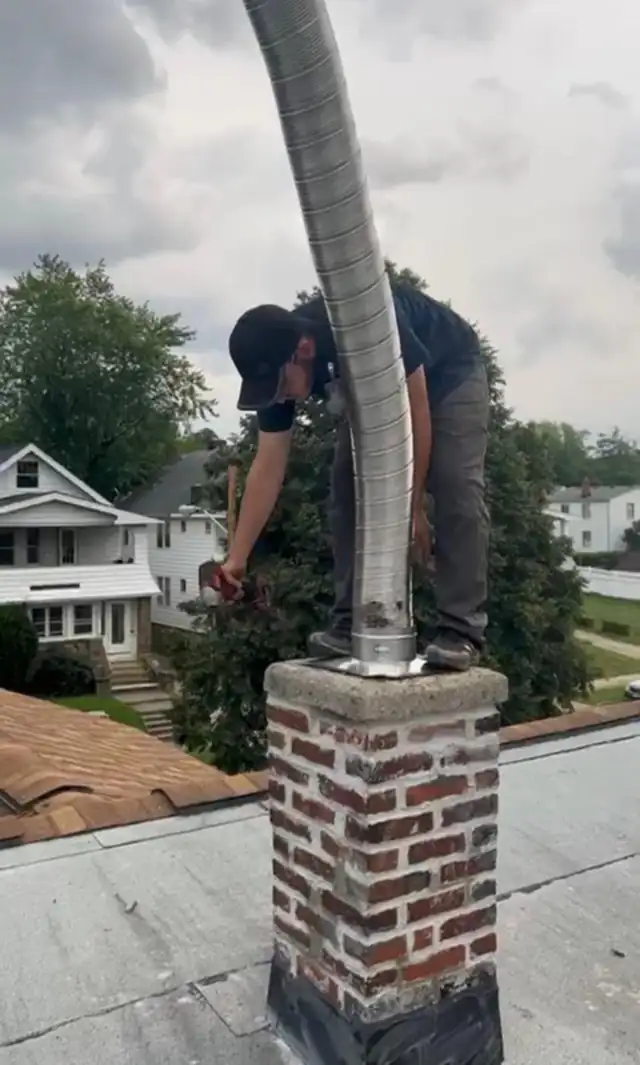
Feeding a new stainless liner down the flue
Meet the team
The people behind the work
Manny, Zack and Myke — meet the people behind Chimney Expert Solutions.
Our team and story →
Manny
Owner

Zack
Manager

Myke
Technician
FAQ
Chimney Relining in Akron: questions we hear
Is an unlined brick flue automatically unsafe?
Not automatically — its condition decides that, and some are in better shape than people expect. What is true is that there is nothing between the flue gases and the masonry except the mortar joints, so once those joints open there is a direct path into the structure. A camera scan tells you which situation you are in, and a stainless liner is the usual answer where the joints have gone.
Two appliances vent into our chimney. Is that allowed?
It can be, but it has conditions: the flue must be sized for the combined input, the connectors have to enter properly and rise toward the chimney, and the appliances need to be compatible. What we usually find in this housing is a second connector added later into a flue sized for one. That causes spillage into the basement rather than draft up the flue, and it is worth checking on any house that was ever a two-family.
Our chimney is visibly leaning. Is it about to fall?
Usually not imminently, but it does need an assessment rather than a repointing quote. In this housing a lean often comes from sulfate expansion in mortar that spent decades venting coal, which pushes one face of the stack open fractionally at every joint. What we do is take a plumb reading, photograph the crack pattern and establish whether it is stable or progressing, and that determines whether it is a monitored condition or a rebuild.
The chimney is being rebuilt anyway. Do the liner at the same time?
Almost always yes. A rebuild is the one moment the flue is open and accessible, and doing both together avoids paying twice for access, staging and roof protection. If we are rebuilding the top of a stack and the camera shows a compromised flue below it, we will say so before the scope is agreed rather than after.
How long does a reline take and is my house disrupted?
Most single-flue relines are a one- or two-day job, and the majority of the work happens on the roof. Inside, the disruption is at the fireplace or the appliance for the connection. If the chimney vents your water heater, we plan the sequence so it is not left without a vent overnight.
Free estimate
Chimney Relining in Akron?
Tell us what you’re seeing and we’ll call or text back to schedule a look — with photos of what we find and an honest read on what’s urgent and what can wait. That evidence-first method is the way we work on every job.
Call and tell us what the chimney's doing — if we're up on a roof, we'll call you back. Other ways to reach us are on the contact page, and Akron is one of the communities we cover across Greater Cleveland.
Call216-647-1882