
Cuyahoga County, Ohio
Chimney Sweep & Cleaning in South Euclid, OH
Full mechanical sweep of the flue, smoke chamber and firebox — creosote out, dust contained, and a look at the whole system while we're in it.
What chimney sweep involves in South Euclid is set by the housing stock here: 1920s bungalows and colonials near Cedar Center alongside late-40s and 50s Capes and ranches toward Green Road — two building recipes, two failure profiles, often on the same block.
South Euclid was built in two clearly separated pushes, and that is the single most useful thing to know about its chimneys. The streets near Cedar Center and the Cleveland Heights line went up in the 1920s boom: brick and stucco bungalows, side-gable colonials, tile-roofed cottages. Then the war stopped everything, and the land north and east toward Green Road and Bexley Park filled in through the late 1940s and 1950s with Cape Cods and ranches built to a completely different recipe.
Creosote is what wood smoke leaves behind on the inside of a flue, and it is the fuel in nearly every chimney fire. It leaves the fire as vapor, condenses on any flue wall cool enough to catch it, and hardens over a season into something closer to tar than soot. A real sweep takes the flue back to bare liner with rods and brushes sized to that specific flue, works the smoke chamber and smoke shelf where the deposits sit heaviest, and finishes in the firebox, with the room sealed off and a HEPA vacuum running the whole time.
What we find on South Euclid chimneys that leads to chimney sweep
Two eras on one street, two completely different stacks
A 1920s South Euclid chimney is tall, usually interior, built with soft brick in lime-rich mortar, and its problems are flue-side: unlined or early tile, joints washed out, heat damage from a century of use. A 1950s chimney on the same street is short, exterior or half-exterior, harder brick, and its problems are water-side: a thin flush crown, a weathered face, and a flue that is now the wrong size for what vents into it. Assuming one when you have the other is how people buy a repair that does not address the actual defect.
Insulation packed against the stack in the knee-wall attic
The bungalows and Capes here have low, awkward attics with knee walls, and almost all of them have been re-insulated at some point. Blown-in cellulose and batt insulation routinely end up shoved hard against the masonry where the chimney passes through, and on the factory-built and metal-flue systems the same thing happens around the pipe. Masonry and listed metal chimneys are both designed with a required air gap and a firestop at the floor or ceiling penetration, and stuffing that gap closed removes the design. It is one of the more common things we photograph in an attic here, and it is cheap to correct once someone has actually looked.
What the clean-out door at the base is telling you
Most South Euclid stacks have a small iron door at the bottom, usually in the basement, and most owners have never opened it. It is the most informative thirty seconds of an inspection. Sand and grit mean mortar joints are eroding somewhere above. Orange or buff shards mean flue tile is breaking up and falling. Standing water or a white salt bloom on the surrounding brick means the crown or cap is letting rain into the stack. Nothing at all is a good sign. We open it, photograph it, and show you what came out.
What happens if it does not get done
Two failure paths, and they look nothing alike. The first is fire. Creosote ignites at temperatures an ordinary hot fire reaches without trying, and a chimney fire is often not the dramatic roaring event people expect. Plenty of them are slow and nearly silent, and the only evidence is found later: puffed, honeycombed deposits, warped damper, cracked flue tiles, a cap discolored by heat. The tiles are the problem. Once thermal shock has cracked them, the flue no longer contains what it is supposed to contain, and the next fire has a path toward the framing that surrounds every masonry chimney.
The second is blockage, and it kills quietly. Nests, leaf litter, fallen tile shards and heavy deposits all reduce the usable flue area. Exhaust that cannot get out comes back in, and with any fuel-burning appliance that means carbon monoxide. This is why we look at furnace and water-heater flues with the same seriousness as fireplaces, and why working CO alarms on every level of the house, near the sleeping areas, are not optional in a home with any combustion appliance.
What creosote is, and why it changes the job
Wood does not burn completely. Volatile gases leave the fire unburned, travel up the flue as vapor, and condense wherever the flue wall drops below roughly 250°F. Every fire adds a layer. What that layer becomes depends on how the chimney runs: a hot, well-drafted flue burning dry wood makes very little, and a cool flue full of smoldering smoke makes a lot of the worst kind.
The stage of the deposit decides the tools, the time, and sometimes whether the flue can be cleaned at all. This is why an honest sweep looks before quoting anything beyond the standard visit.
Stage one: soot and fine flake
Dry, dusty, sometimes velvety. It brushes off the liner easily and vacuums up without a fight. A fireplace burning properly seasoned hardwood in a warm flue mostly produces this, and an annual sweep keeps it at this stage indefinitely.
Stage two: hard flake and crust
Shiny black flakes that snap rather than crumble, often thick enough to feel ridged against a brush. This is the most common thing we find on Cleveland fireplaces that have gone two or three seasons. It comes off with a proper mechanical sweep, but a nylon brush pushed quickly through the flue will not do it.
Stage three: glaze
A hard, tarry coating fused to the liner, sometimes running in drips. It will not brush off. Removing it takes rotary chain or whip heads run at the right speed, sometimes preceded by a chemical modifier to dry it out, and occasionally more than one visit. Glaze is also the single most dangerous deposit, because it holds an enormous amount of fuel in a thin layer. If a flue is glazed badly enough and the tile underneath is already compromised, the honest answer is not more brushing — it is a camera inspection and a conversation about relining.
This page covers chimney sweep as it plays out in South Euclid. The full chimney sweep & cleaning page walks the whole job — every stage, what changes the scope, and what we do about each of them. For everything else we handle in this suburb, see chimney services in South Euclid.
What a sweep with us includes
- Drop cloths, sealed fireplace opening and HEPA dust control before a brush touches the flue
- Mechanical sweep of the full flue length, with brush size and shape matched to your liner
- Smoke chamber and smoke shelf hand-cleaned — the corners most sweeps skip
- Firebox and ash dump cleared, damper cleaned and operated through full travel
- A visual once-over of the whole system, with photos of anything that needs attention
- Straight advice at the end: what's urgent, what can wait, what's fine
Our work
Chimney Sweep & Cleaning, photographed on the job
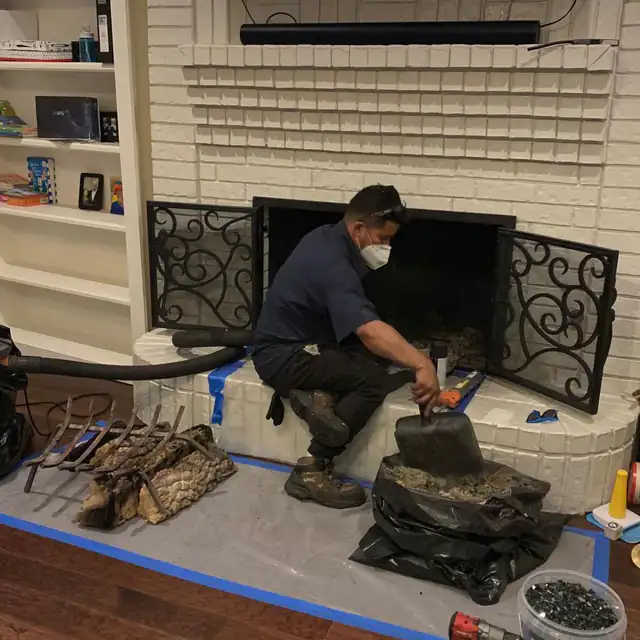
Drop cloths down and a vacuum on the hearth before anything is opened 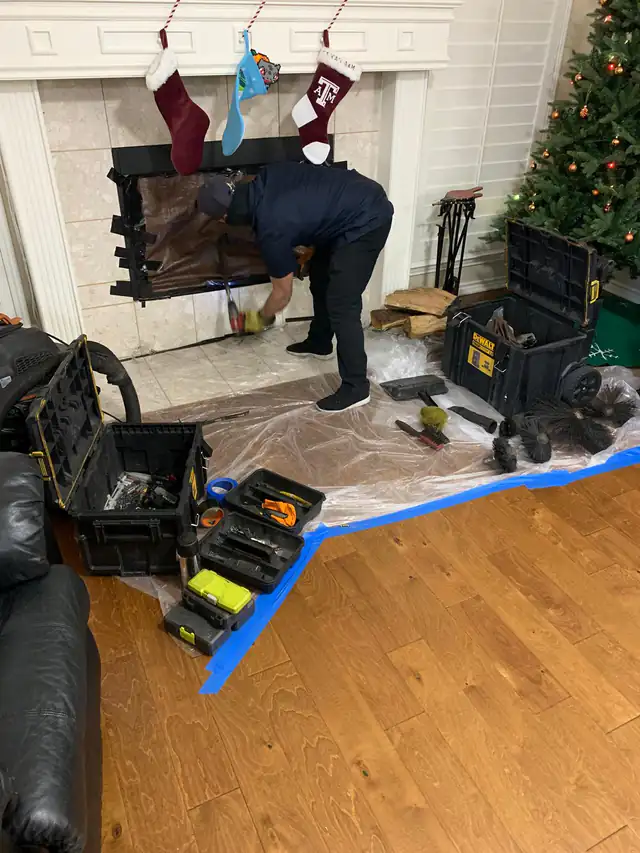
Working at the protected fireplace opening, with brushes and tools on covered floors 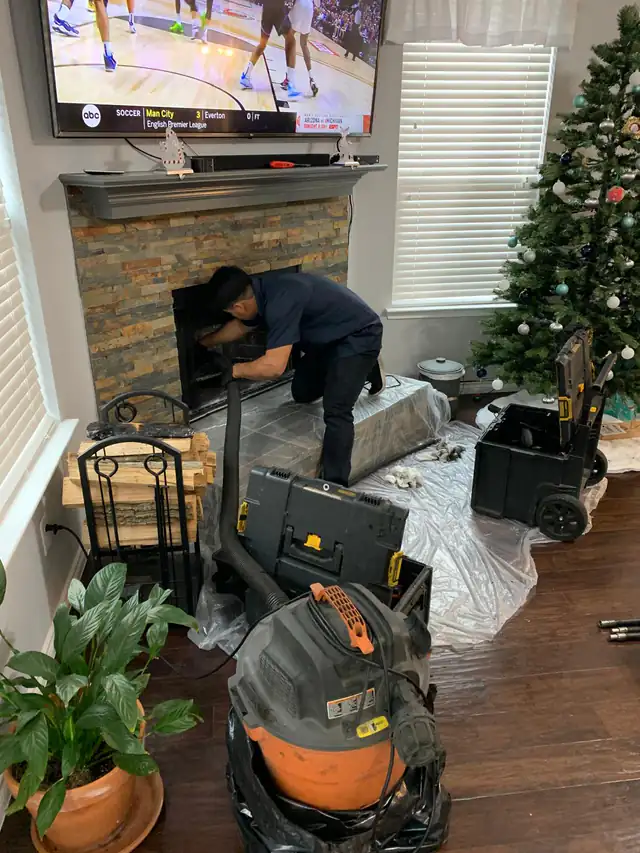
At the stone-front fireplace, with the hearth covered and a vacuum alongside 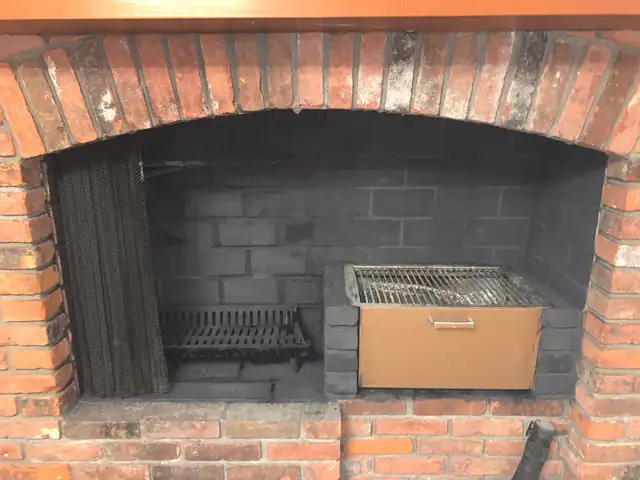
Firebox cleaned back to the brick, damper working 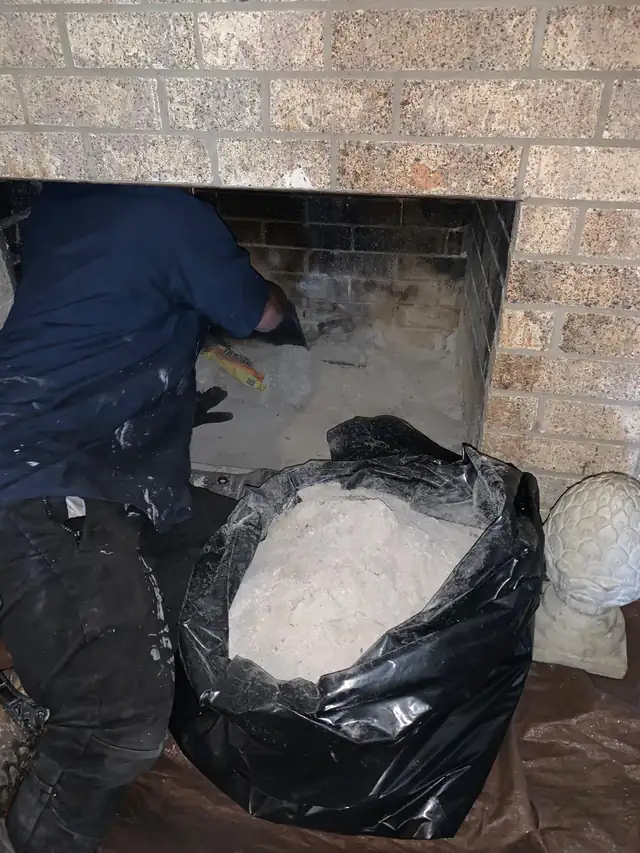
Clearing the firebox down to bare brick, floors covered
Meet the team
The people behind the work
Manny, Zack and Myke — meet the people behind Chimney Expert Solutions.
Our team and story →
Manny
Owner

Zack
Manager

Myke
Technician
FAQ
Chimney Sweep in South Euclid: questions we hear
How do I know which era my chimney is from?
The roofline usually tells you before we get inside. A tall stack rising out of the middle of a steep roof is almost always the older build; a short stack near a gable end on a shallower roof is postwar. Inside, the pre-war fireboxes are narrower and deeper with a hand-laid look to the firebrick. If it is genuinely ambiguous, the flue tile itself dates it — the sizes and joint styles changed.
Our neighbor was told they needed a full rebuild. Should we assume the same?
No, and on these streets that is a specifically bad assumption. Houses four doors apart here can be twenty-five years apart in construction, with different brick, different mortar and different flues. Even two identical houses weather differently depending on which way the stack faces and whether a tree has been shading it for forty years. Yours gets its own scan and its own photographs.
Is insulation touching the chimney really a problem?
It removes a clearance the chimney was built to have. Masonry chimneys are detailed with an air gap at floor and ceiling penetrations, and listed metal chimneys have a manufacturer-specified clearance that is part of what the system was tested to. Packing that gap with insulation or debris defeats it. Pulling it back and installing a proper firestop is a small job, and the attic is worth a look on any house that has been re-insulated.
Do you sweep from the roof or from inside the house?
Whichever puts less risk in your house. Roof access, cap design and the pitch and material of the roof all factor in — we will not walk a slate roof that will break underfoot. Both directions clean the same flue; the part that decides whether your living room stays clean is the sealed opening and the vacuum at the firebox, not which end the rods go in.
How long does it take, and do I need to be home?
A single straightforward fireplace flue usually runs a couple of hours including setup, cleanup and the walkthrough. Multiple flues, an insert that has to be pulled, or heavy deposits take longer. Someone should be home to let us in and to hear the findings at the end — that conversation is half the value of the visit.
Free estimate
Chimney Sweep in South Euclid?
Tell us what you’re seeing and we’ll call or text back to schedule a look — with photos of what we find and an honest read on what’s urgent and what can wait. That evidence-first method is the way we work on every job.
Call and tell us what the chimney's doing — if we're up on a roof, we'll call you back. Other ways to reach us are on the contact page, and South Euclid is one of the communities we cover across Greater Cleveland.
Call216-647-1882