
Cuyahoga County, Ohio
Chimney Liner & Relining in South Euclid, OH
Stainless steel relining for flues with cracked tiles, gaps, or no liner at all — sized to your appliance, insulated, done once.
What chimney relining involves in South Euclid is set by the housing stock here: 1920s bungalows and colonials near Cedar Center alongside late-40s and 50s Capes and ranches toward Green Road — two building recipes, two failure profiles, often on the same block.
South Euclid was built in two clearly separated pushes, and that is the single most useful thing to know about its chimneys. The streets near Cedar Center and the Cleveland Heights line went up in the 1920s boom: brick and stucco bungalows, side-gable colonials, tile-roofed cottages. Then the war stopped everything, and the land north and east toward Green Road and Bexley Park filled in through the late 1940s and 1950s with Cape Cods and ranches built to a completely different recipe.
The liner is the part of the chimney that does the actual work. Everything else is structure; the liner is what contains the heat and the combustion gases and delivers them out of the house without letting either reach the brickwork or the framing around it. Most Cleveland chimneys were built with clay tile liners, and clay has a hard life here. Thermal shock cracks it, settlement shifts it, and moisture eats the mortar joints between tiles until the sections stop behaving as one continuous passage. A cracked or gapped liner is invisible without a camera, and it is the failure that turns into house fires and carbon monoxide.
What we find on South Euclid chimneys that leads to chimney relining
Two eras on one street, two completely different stacks
A 1920s South Euclid chimney is tall, usually interior, built with soft brick in lime-rich mortar, and its problems are flue-side: unlined or early tile, joints washed out, heat damage from a century of use. A 1950s chimney on the same street is short, exterior or half-exterior, harder brick, and its problems are water-side: a thin flush crown, a weathered face, and a flue that is now the wrong size for what vents into it. Assuming one when you have the other is how people buy a repair that does not address the actual defect.
What the clean-out door at the base is telling you
Most South Euclid stacks have a small iron door at the bottom, usually in the basement, and most owners have never opened it. It is the most informative thirty seconds of an inspection. Sand and grit mean mortar joints are eroding somewhere above. Orange or buff shards mean flue tile is breaking up and falling. Standing water or a white salt bloom on the surrounding brick means the crown or cap is letting rain into the stack. Nothing at all is a good sign. We open it, photograph it, and show you what came out.
Insulation packed against the stack in the knee-wall attic
The bungalows and Capes here have low, awkward attics with knee walls, and almost all of them have been re-insulated at some point. Blown-in cellulose and batt insulation routinely end up shoved hard against the masonry where the chimney passes through, and on the factory-built and metal-flue systems the same thing happens around the pipe. Masonry and listed metal chimneys are both designed with a required air gap and a firestop at the floor or ceiling penetration, and stuffing that gap closed removes the design. It is one of the more common things we photograph in an attic here, and it is cheap to correct once someone has actually looked.
Furnace and water heater flues: the Cleveland problem
This one affects tens of thousands of houses across Parma, Old Brooklyn, Euclid, Garfield Heights and every other postwar neighborhood, and almost nobody has been told about it. The sequence goes like this. The original furnace and the water heater both vented into the masonry chimney, and the flue was sized for the two of them together. The furnace gets replaced with a high-efficiency condensing unit, which vents through white PVC out a side wall. The water heater is left where it is.
Now a small appliance is venting into a flue sized for a large one. The exhaust volume is nowhere near enough to keep that flue warm, so it condenses on the way up. The condensate is acidic. It attacks the tile and the mortar joints, and over a decade it can take a flue apart from the inside while everything looks perfectly normal from the basement. The industry name for this is an orphaned water heater, and the standard fix is a correctly sized metal liner that matches the appliance rather than the chimney.
The signs are worth knowing: rust or scaling on the draft hood or the vent connector, dampness or white crusty deposits at the base of the chimney, tile fragments in the clean-out, or a chimney exterior that is staining on the outside near the top. If your furnace was upgraded in the last fifteen years and nobody looked at the chimney afterwards, that is the situation this section is describing.
What the liner is actually for
A flue liner does three jobs at once, and losing any one of them matters. It keeps heat away from the wood framing that surrounds every masonry chimney — the code clearances that framing was built to assume an intact liner. It protects the masonry from the corrosive by-products of combustion, which will otherwise attack mortar and brick from the inside. And it provides a correctly sized, smooth passage so the appliance drafts the way it was designed to.
This is why 'the chimney is structurally fine' and 'the chimney is safe to use' are two different statements. A perfectly sound-looking stack with a broken flue is not a working chimney. It is a masonry column with a fire hazard running through the middle of it.
This page covers chimney relining as it plays out in South Euclid. The full chimney liner & relining page walks the whole job — every stage, what changes the scope, and what we do about each of them. For everything else we handle in this suburb, see chimney services in South Euclid.
What a relining job includes
- Camera inspection first — you see why (or whether) the flue needs relining
- Continuous stainless steel liner in the correct alloy, sized to the fireplace or appliance it serves
- Insulation wrap or pour so the flue drafts correctly and meets the liner's listing
- Existing flue cleared, and broken tile removed where it obstructs the run
- New top plate, storm collar and cap terminating the system
- Correct listed connection at the appliance — no improvised adapters
- Photos of the completed run top to bottom, and the liner's product documentation
Our work
Chimney Liner & Relining, photographed on the job
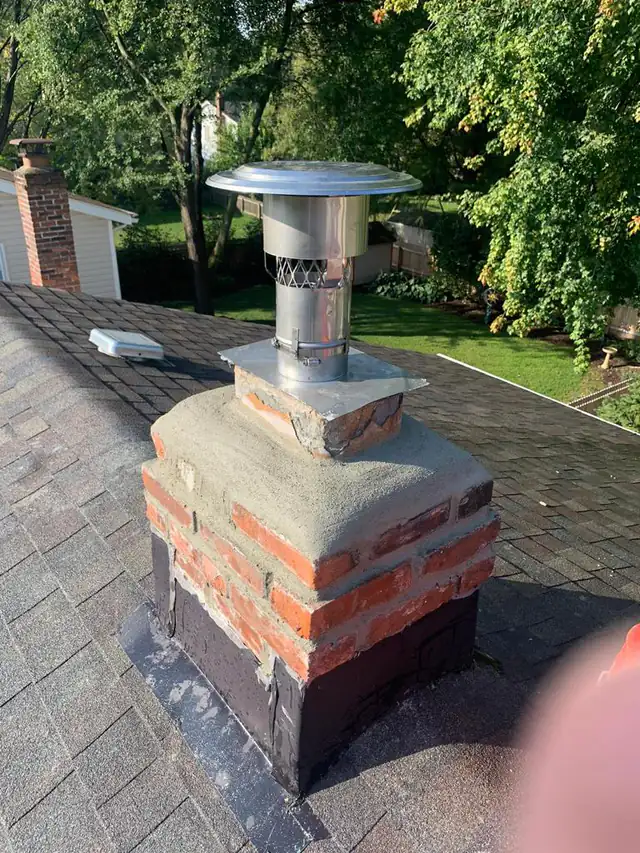
Stainless liner brought through a new crown, capped 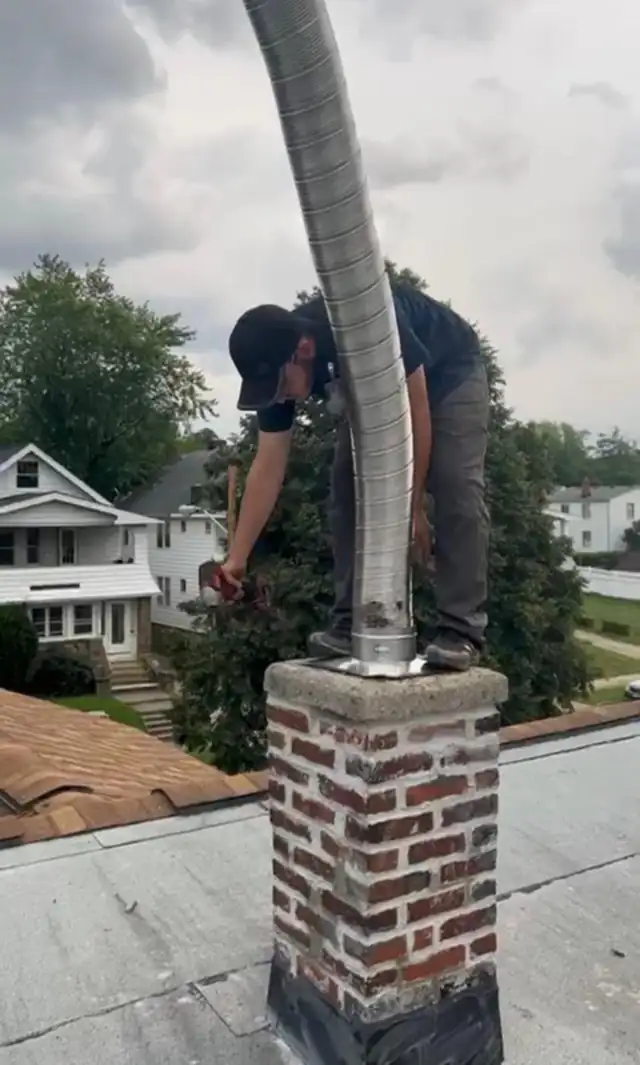
Feeding a new stainless liner down the flue
Meet the team
The people behind the work
Manny, Zack and Myke — meet the people behind Chimney Expert Solutions.
Our team and story →
Manny
Owner

Zack
Manager

Myke
Technician
FAQ
Chimney Relining in South Euclid: questions we hear
How do I know which era my chimney is from?
The roofline usually tells you before we get inside. A tall stack rising out of the middle of a steep roof is almost always the older build; a short stack near a gable end on a shallower roof is postwar. Inside, the pre-war fireboxes are narrower and deeper with a hand-laid look to the firebrick. If it is genuinely ambiguous, the flue tile itself dates it — the sizes and joint styles changed.
Our neighbor was told they needed a full rebuild. Should we assume the same?
No, and on these streets that is a specifically bad assumption. Houses four doors apart here can be twenty-five years apart in construction, with different brick, different mortar and different flues. Even two identical houses weather differently depending on which way the stack faces and whether a tree has been shading it for forty years. Yours gets its own scan and its own photographs.
Do you inspect the basement as well as the roof?
Yes, and on this housing it is where half the useful evidence is. The clean-out contents, the condition of the vent connector into the chimney, staining or efflorescence on the chimney breast and the state of the base itself all say something about what is happening sixty feet up. A rooftop-only look misses it.
The chimney is being rebuilt anyway. Do the liner at the same time?
Almost always yes. A rebuild is the one moment the flue is open and accessible, and doing both together avoids paying twice for access, staging and roof protection. If we are rebuilding the top of a stack and the camera shows a compromised flue below it, we will say so before the scope is agreed rather than after.
Why stainless instead of replacing the broken clay tiles?
Access. Clay tiles are stacked inside a sealed masonry shaft, so reaching a cracked one partway up means opening the chimney to get to it — which usually costs more than relining and leaves you with a repaired eighty-year-old flue. A stainless liner installs from the top, restores a continuous sealed passage in a day or two on most jobs, and the liner itself typically carries a manufacturer lifetime warranty.
Free estimate
Chimney Relining in South Euclid?
Tell us what you’re seeing and we’ll call or text back to schedule a look — with photos of what we find and an honest read on what’s urgent and what can wait. That evidence-first method is the way we work on every job.
Call and tell us what the chimney's doing — if we're up on a roof, we'll call you back. Other ways to reach us are on the contact page, and South Euclid is one of the communities we cover across Greater Cleveland.
Call216-647-1882