
Cuyahoga County, Ohio
Chimney Sweep & Cleaning in Westlake, OH
Full mechanical sweep of the flue, smoke chamber and firebox — creosote out, dust contained, and a look at the whole system while we're in it.
What chimney sweep involves in Westlake is set by the housing stock here: Later-era housing with a high share of factory-built fireplaces — rusting chase covers, cracked refractory panels and metal flues that still need annual sweeping, plus conventional masonry in the older pockets.
Westlake was farmland and township into the middle of the last century, and the bulk of its housing came later than the inner-ring suburbs: substantial building from the 1970s onward and strong 1990s and 2000s neighborhoods filling in around Dover Center, Columbia and Hilliard. That changes what chimney service means here in a way that catches a lot of contractors out.
Creosote is what wood smoke leaves behind on the inside of a flue, and it is the fuel in nearly every chimney fire. It leaves the fire as vapor, condenses on any flue wall cool enough to catch it, and hardens over a season into something closer to tar than soot. A real sweep takes the flue back to bare liner with rods and brushes sized to that specific flue, works the smoke chamber and smoke shelf where the deposits sit heaviest, and finishes in the firebox, with the room sealed off and a HEPA vacuum running the whole time.
What we find on Westlake chimneys that leads to chimney sweep
Metal flues still build creosote
There is a persistent belief that a factory-built fireplace does not need sweeping because there is no masonry. Wood smoke deposits creosote on a stainless flue exactly as it does on clay tile, and NFPA 211's annual inspection recommendation covers factory-built systems explicitly. What changes is technique: a wire brush that is fine in clay tile will damage a stainless flue, so it wants a poly brush sized to the pipe. If a sweep does not ask what kind of system you have before arriving, that is worth noticing.
Cracked refractory panels, and the wrong repair
The molded panels lining a factory-built firebox are a wear item with a service life, and they crack with thermal cycling. The correct fix is replacement with the panel specified for that make and model, because the panel's job is to hold a defined thickness of insulating material between the fire and the steel shell. Filling a cracked panel with furnace cement is something we find constantly and it is not a repair — it restores the appearance and none of the function.
Chase covers rusting and dumping water into framing
The flat metal pan closing the top of a framed chimney chase is the highest-consequence component on a Westlake chimney. Builder-grade galvanized covers rust through, and because most were installed flat rather than with a cross-break, they pond water rather than shed it. Once they perforate, water goes directly into the framed chase, where it rots structure and soaks insulation out of sight. The rust stain running down the siding below the chimney top is the early warning, and the fix is a custom stainless cover with a proper cross-break and drip edge.
What actually happens when we sweep your chimney
Before a brush touches the flue
Drop cloths go down over the hearth and the floor in front of it. The fireplace opening is sealed, and a HEPA vacuum runs at the firebox for the entire job so the flue is held under slight negative pressure. That is the whole trick to a clean sweep: air moves from the room into the chimney, never the other way. If soot ends up on your furniture, the setup was wrong, not the chimney.
The flue
Rods and brushes are run the full length of the liner, either down from the top or up from the firebox depending on roof access and what is on top of the stack. Brush size and shape matter more than most homeowners expect. A round brush swept through a rectangular clay tile leaves the four corners untouched, and the corners are exactly where deposits collect. We match the head to the liner: round for stainless, square or rectangular for clay tile, wire or poly depending on what the liner can take.
The smoke chamber and smoke shelf
This is the part that gets skipped, and it is the part that matters. The smoke chamber is the funnel-shaped space above the damper and below the first flue tile, usually built from corbelled brick with rough, stepped surfaces that catch everything. Behind it sits the smoke shelf, the ledge that collects whatever falls back down. Both get hand-brushed and vacuumed. A chimney with a clean flue and a loaded smoke chamber has not been swept, it has been rodded.
The firebox and damper
Firebox swept out, ash dump cleared if there is one, damper operated through its full travel and cleaned where soot has built on the plate and frame. A damper that will not seat is a heating bill and a draft problem, and it is easier to catch it here than in December.
The walkthrough at the end
Before we leave you get told what we saw, with photos of anything that needs attention: liner condition, firebox joints, smoke chamber, damper, and if we were on the roof, the crown, cap and flashing. Findings get ranked plainly. Urgent, plan for it, fine. No verdict without a picture behind it.
What happens if it does not get done
Two failure paths, and they look nothing alike. The first is fire. Creosote ignites at temperatures an ordinary hot fire reaches without trying, and a chimney fire is often not the dramatic roaring event people expect. Plenty of them are slow and nearly silent, and the only evidence is found later: puffed, honeycombed deposits, warped damper, cracked flue tiles, a cap discolored by heat. The tiles are the problem. Once thermal shock has cracked them, the flue no longer contains what it is supposed to contain, and the next fire has a path toward the framing that surrounds every masonry chimney.
The second is blockage, and it kills quietly. Nests, leaf litter, fallen tile shards and heavy deposits all reduce the usable flue area. Exhaust that cannot get out comes back in, and with any fuel-burning appliance that means carbon monoxide. This is why we look at furnace and water-heater flues with the same seriousness as fireplaces, and why working CO alarms on every level of the house, near the sleeping areas, are not optional in a home with any combustion appliance.
This page covers chimney sweep as it plays out in Westlake. The full chimney sweep & cleaning page walks the whole job — every stage, what changes the scope, and what we do about each of them. For everything else we handle in this suburb, see chimney services in Westlake.
What a sweep with us includes
- Drop cloths, sealed fireplace opening and HEPA dust control before a brush touches the flue
- Mechanical sweep of the full flue length, with brush size and shape matched to your liner
- Smoke chamber and smoke shelf hand-cleaned — the corners most sweeps skip
- Firebox and ash dump cleared, damper cleaned and operated through full travel
- A visual once-over of the whole system, with photos of anything that needs attention
- Straight advice at the end: what's urgent, what can wait, what's fine
Our work
Chimney Sweep & Cleaning, photographed on the job
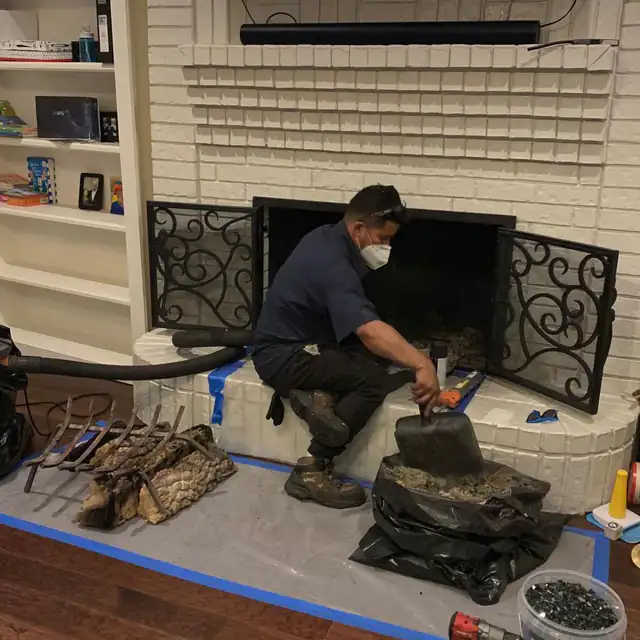
Drop cloths down and a vacuum on the hearth before anything is opened 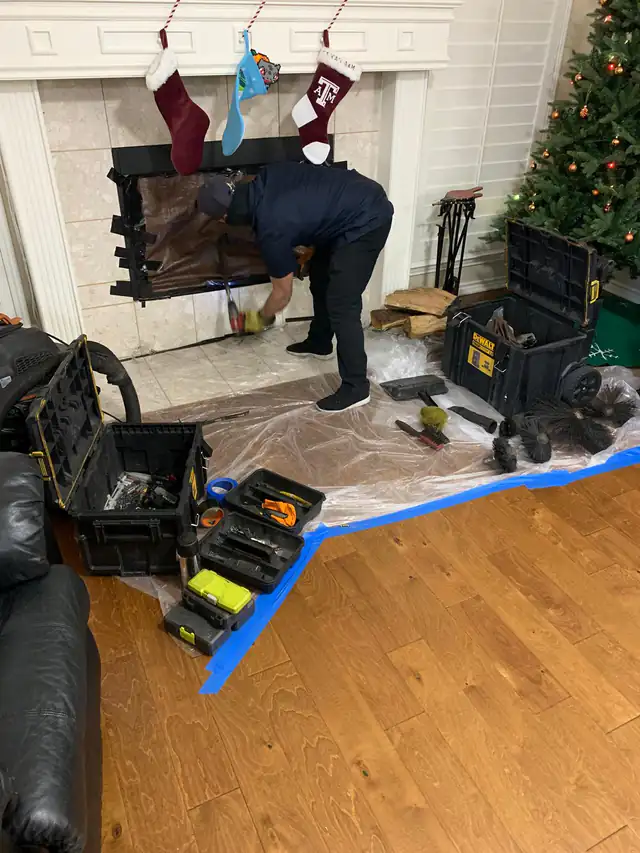
Working at the protected fireplace opening, with brushes and tools on covered floors 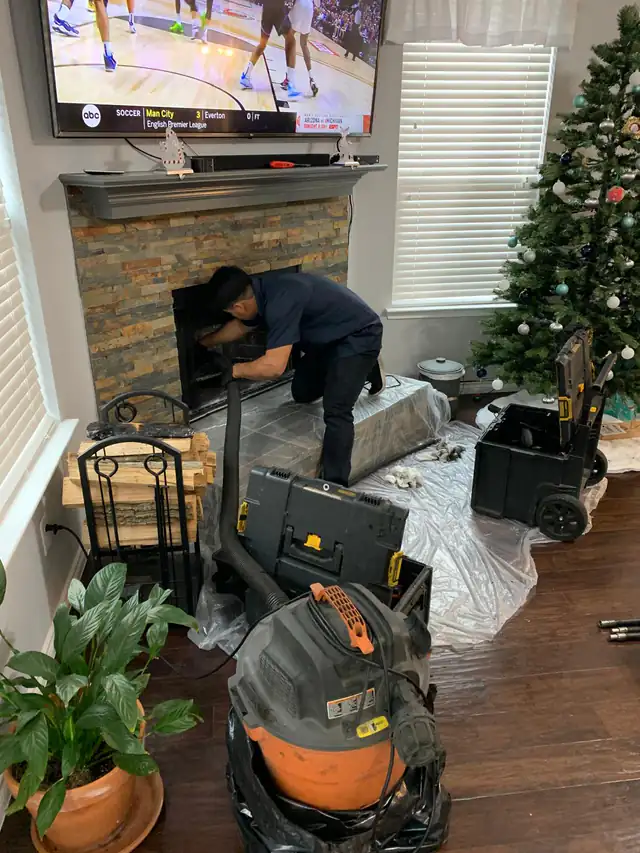
At the stone-front fireplace, with the hearth covered and a vacuum alongside 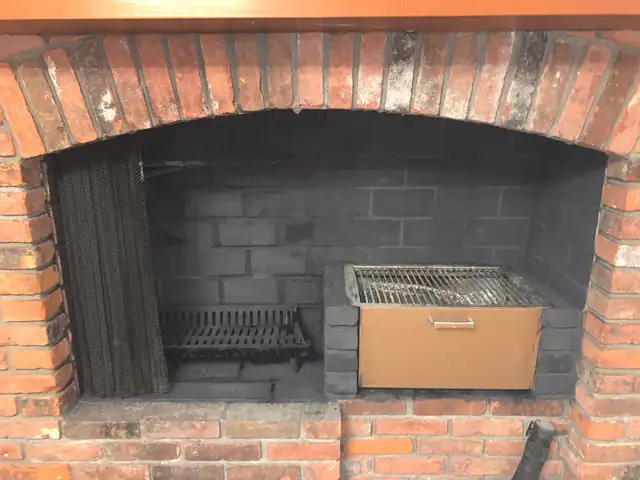
Firebox cleaned back to the brick, damper working 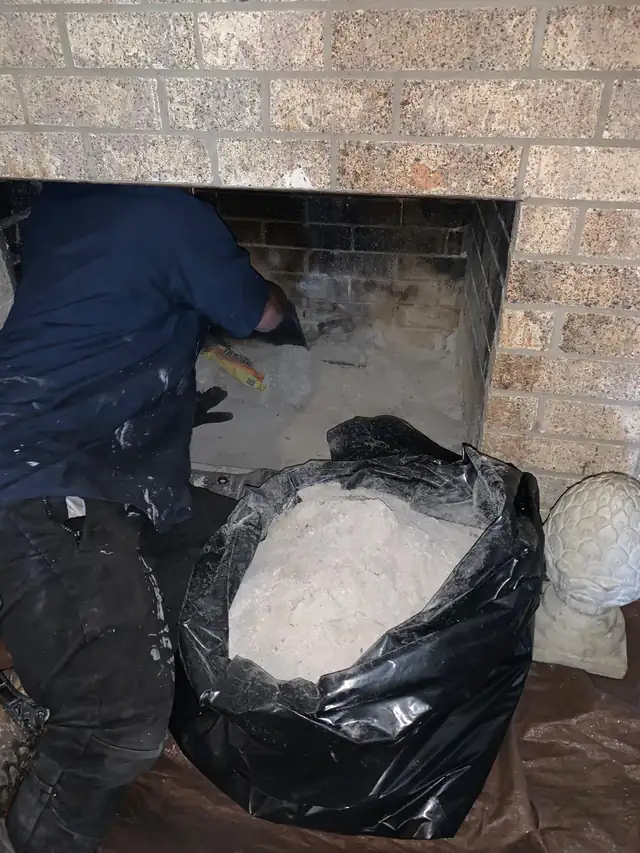
Clearing the firebox down to bare brick, floors covered
Meet the team
The people behind the work
Manny, Zack and Myke — meet the people behind Chimney Expert Solutions.
Our team and story →
Manny
Owner

Zack
Manager

Myke
Technician
FAQ
Chimney Sweep in Westlake: questions we hear
Do factory-built fireplaces really need annual service like masonry ones?
Yes. The flue is metal instead of clay, but wood smoke deposits creosote on it just the same, and the refractory panels, chase cover, cap and storm collar all have inspection points of their own. The NFPA 211 annual-inspection recommendation covers factory-built systems explicitly rather than treating them as exempt.
Our fireplace is from the 1980s and we can't find replacement panels. Now what?
That is a real situation and the honest answer is not always the one people want. A factory-built fireplace is a listed appliance that was tested as a complete assembly, so parts get replaced with the parts specified for that model rather than improvised. Where a model is genuinely obsolete, the choice is replacement of the unit or not burning in it. We will tell you that plainly rather than fabricating a workaround.
How do I know whether we have masonry or factory-built?
Look inside the firebox. Masonry is firebrick laid in courses with visible mortar joints and a masonry throat and damper above. Factory-built has smooth molded panels with seams, a metal surround, and usually a manufacturer's label somewhere on the frame, in the firebox, or behind the lower grille. If there is a label, photograph it before you call — it makes the whole conversation faster.
Do those creosote-sweeping logs work?
Partly, and not as a replacement. Creosote-modifying products can dry out and loosen stage-three glaze, which genuinely makes a subsequent sweep more effective. What they cannot do is remove anything. The deposit still has to be brushed loose and carried out of the flue by someone with rods and a vacuum.
What if you find damage while you're in there?
You get photos, a plain explanation of what it is and what it does if left alone, and a written scope. No scare tactics: most of what we find can be scheduled rather than panicked over. What we will not do is sweep a chimney that is not safe to use and say nothing about it.
Free estimate
Chimney Sweep in Westlake?
Tell us what you’re seeing and we’ll call or text back to schedule a look — with photos of what we find and an honest read on what’s urgent and what can wait. That evidence-first method is the way we work on every job.
Call and tell us what the chimney's doing — if we're up on a roof, we'll call you back. Other ways to reach us are on the contact page, and Westlake is one of the communities we cover across Greater Cleveland.
Call216-647-1882