
Cuyahoga County, Ohio
Chimney Sweep & Cleaning in North Olmsted, OH
Full mechanical sweep of the flue, smoke chamber and firebox — creosote out, dust contained, and a look at the whole system while we're in it.
What chimney sweep involves in North Olmsted is set by the housing stock here: 1950s–60s ranches, splits and Capes on shifting lake-plain clay, plus a wave of 70s and 80s family-room fireplaces — settling exterior stacks, short flues with draft problems, and masonry and factory-built systems on the same house.
North Olmsted filled in fast during the 1950s and 1960s, spreading north and south of Lorain Road across flat, heavy lake-plain clay, and the housing is mostly what that decade built: ranches, split-levels and Capes on generous lots, with later subdivisions added around Great Northern and out toward Columbia and Clague. It is a market with two distinct chimney questions, and most houses here have one or the other.
Creosote is what wood smoke leaves behind on the inside of a flue, and it is the fuel in nearly every chimney fire. It leaves the fire as vapor, condenses on any flue wall cool enough to catch it, and hardens over a season into something closer to tar than soot. A real sweep takes the flue back to bare liner with rods and brushes sized to that specific flue, works the smoke chamber and smoke shelf where the deposits sit heaviest, and finishes in the firebox, with the room sealed off and a HEPA vacuum running the whole time.
What we find on North Olmsted chimneys that leads to chimney sweep
Short ranch stacks and the height rule
A chimney is expected to stand at least three feet above the point where it comes through the roof, and at least two feet higher than anything within ten feet of it horizontally — the roof ridge, a dormer, an addition. Ranch chimneys frequently fail the second half of that, especially where a later addition or a matured tree changed what is around them. The result is wind rolling over the ridge and pressing down the flue, which shows up as a fireplace that smokes on windy days, backdrafts at startup, or smells. Extending the flue, sometimes only by a course or two plus the right cap, is often the whole fix.
Two different systems on one house
It is routine here to find a 1957 masonry heating chimney on the original part of the house and a 1979 factory-built fireplace in a framed chase on the back. They are different machines. The masonry stack wants a crown, tuckpointing, a clay-tile scan and a look at the vent connectors. The chase wants a stainless cover with a cross-break, a check of the storm collar, an inspection of the refractory panels and a poly brush rather than a wire one. Homeowners often do not know they have both, and a contractor who prices one and finds the other on the day is a contractor who is about to change the number.
Exterior stacks settling and pulling away from the house
The clay under this part of the county swells when it is wet and shrinks when it dries, and it does that on a different schedule at the shallow footing of an added-on chimney than under the original house foundation. Over decades the stack moves independently. The signs are specific and easy to see once you know them: a tapered gap between the chimney and the siding that is wider at the top than the bottom, flashing pulled open, stair-step cracking in the brick near the base, and doors or trim in the adjoining room going out of square. That is settlement, not weathering, and it is diagnosed with a level and a plumb line before anyone talks about tuckpointing — repointing a moving chimney just gives it new joints to crack.
What actually happens when we sweep your chimney
Before a brush touches the flue
Drop cloths go down over the hearth and the floor in front of it. The fireplace opening is sealed, and a HEPA vacuum runs at the firebox for the entire job so the flue is held under slight negative pressure. That is the whole trick to a clean sweep: air moves from the room into the chimney, never the other way. If soot ends up on your furniture, the setup was wrong, not the chimney.
The flue
Rods and brushes are run the full length of the liner, either down from the top or up from the firebox depending on roof access and what is on top of the stack. Brush size and shape matter more than most homeowners expect. A round brush swept through a rectangular clay tile leaves the four corners untouched, and the corners are exactly where deposits collect. We match the head to the liner: round for stainless, square or rectangular for clay tile, wire or poly depending on what the liner can take.
The smoke chamber and smoke shelf
This is the part that gets skipped, and it is the part that matters. The smoke chamber is the funnel-shaped space above the damper and below the first flue tile, usually built from corbelled brick with rough, stepped surfaces that catch everything. Behind it sits the smoke shelf, the ledge that collects whatever falls back down. Both get hand-brushed and vacuumed. A chimney with a clean flue and a loaded smoke chamber has not been swept, it has been rodded.
The firebox and damper
Firebox swept out, ash dump cleared if there is one, damper operated through its full travel and cleaned where soot has built on the plate and frame. A damper that will not seat is a heating bill and a draft problem, and it is easier to catch it here than in December.
The walkthrough at the end
Before we leave you get told what we saw, with photos of anything that needs attention: liner condition, firebox joints, smoke chamber, damper, and if we were on the roof, the crown, cap and flashing. Findings get ranked plainly. Urgent, plan for it, fine. No verdict without a picture behind it.
What drives the cost of a sweep
Sweeping is one of the more predictable jobs in the trade, and we would rather explain the variables than have you compare two numbers that were never quoting the same work.
- Number of flues. Older Cleveland and Heights homes routinely have two or three in one stack, and each is a separate job.
- Access. A walkable asphalt roof on a ranch is one thing. A steep slate roof on a three-story Tudor, where walking the slate would break it, means roof ladders and staging.
- Appliance type. An insert or stove with no direct liner connection usually has to be pulled out, swept, and re-seated with fresh gasket, which is real extra labor.
- Deposit stage. Stage one and two are inside the standard visit. Stage three glaze is rotary work, sometimes with a chemical pre-treatment and a return trip, and we will not quote it sight unseen.
- Condition. A flue with cracked or loose tiles cannot take aggressive brushing. Sometimes the right sequence is inspect first, stabilise, then clean.
- How long it has been. Ten years of accumulation is not ten times the work of one, but it is not the same visit either.
This page covers chimney sweep as it plays out in North Olmsted. The full chimney sweep & cleaning page walks the whole job — every stage, what changes the scope, and what we do about each of them. For everything else we handle in this suburb, see chimney services in North Olmsted.
What a sweep with us includes
- Drop cloths, sealed fireplace opening and HEPA dust control before a brush touches the flue
- Mechanical sweep of the full flue length, with brush size and shape matched to your liner
- Smoke chamber and smoke shelf hand-cleaned — the corners most sweeps skip
- Firebox and ash dump cleared, damper cleaned and operated through full travel
- A visual once-over of the whole system, with photos of anything that needs attention
- Straight advice at the end: what's urgent, what can wait, what's fine
Our work
Chimney Sweep & Cleaning, photographed on the job
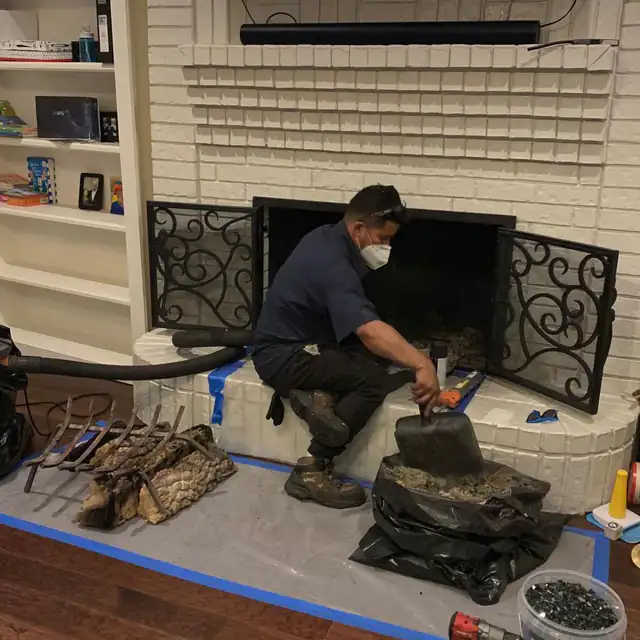
Drop cloths down and a vacuum on the hearth before anything is opened 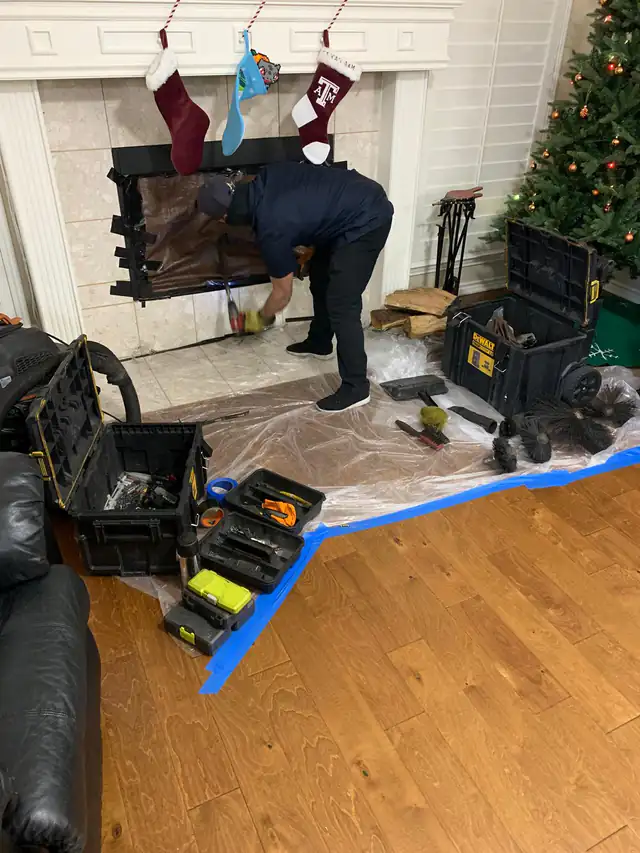
Working at the protected fireplace opening, with brushes and tools on covered floors 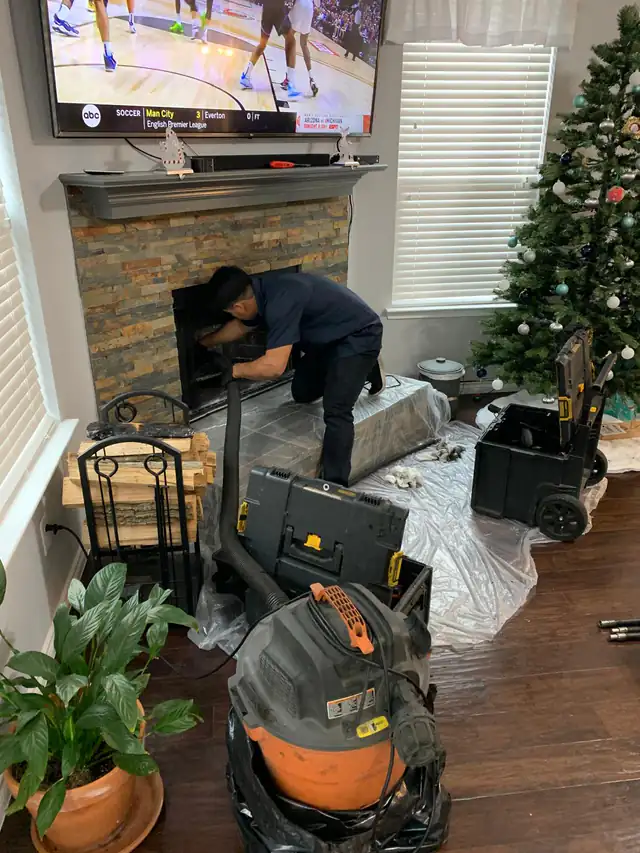
At the stone-front fireplace, with the hearth covered and a vacuum alongside 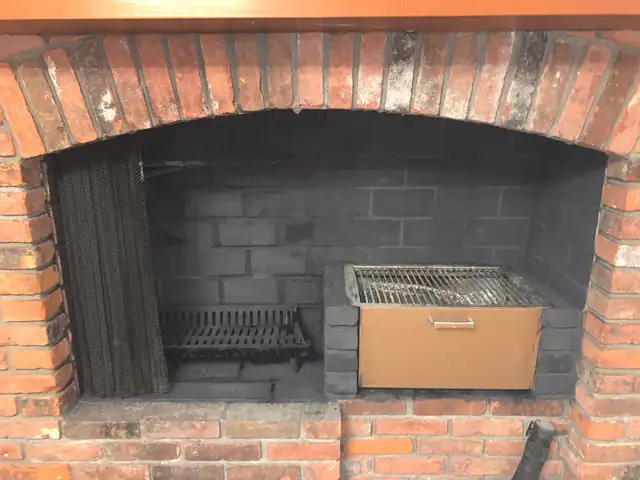
Firebox cleaned back to the brick, damper working 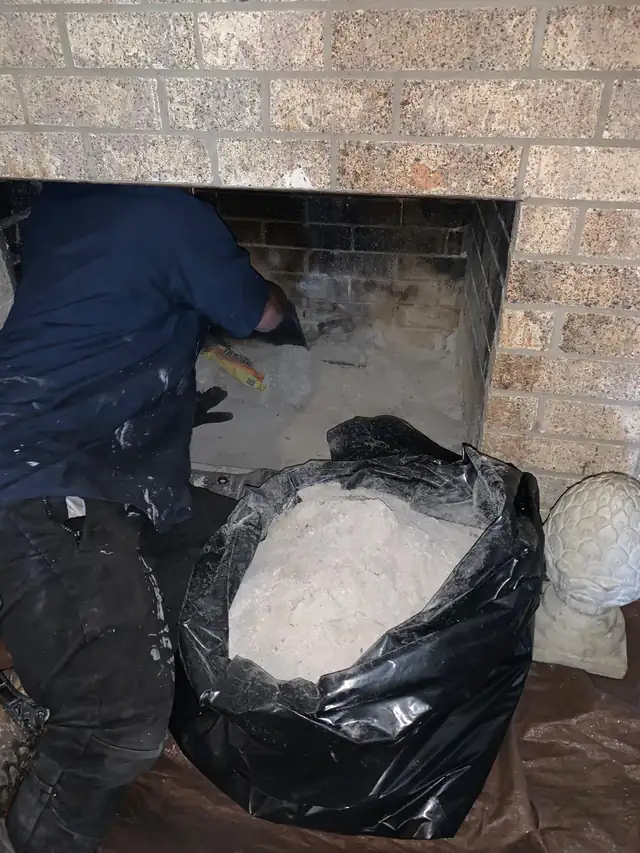
Clearing the firebox down to bare brick, floors covered
Meet the team
The people behind the work
Manny, Zack and Myke — meet the people behind Chimney Expert Solutions.
Our team and story →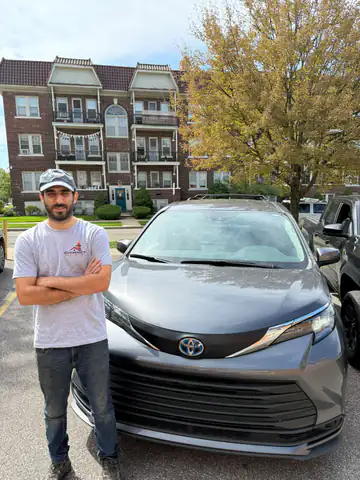
Manny
Owner
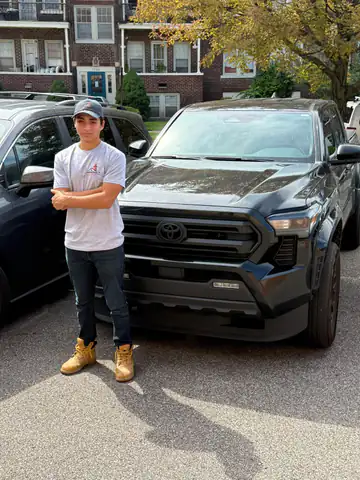
Zack
Manager
Myke
Technician
FAQ
Chimney Sweep in North Olmsted: questions we hear
Our fireplace smokes when it's windy but not otherwise. Why?
That pattern points at chimney height rather than the flue's condition. If the stack does not stand a clear two feet above everything within ten feet of it, wind coming over the ridge or a nearby addition presses down the flue and beats the draft. Adding height, and in some cases fitting a cap designed to handle wind, usually solves it. It is worth checking whether anything was built or grew nearby since the fireplace last worked properly.
There's a gap opening between our chimney and the house. Is that serious?
It depends on whether it is stable or moving, which is exactly what we assess. A tapered gap that is wider at the top usually means the stack is leaning away on a footing that is moving with the clay. Some of these have been stable for thirty years and need only the flashing and the joint made weathertight; others are progressing and need structural attention. Photographs and a plumb-line reading now give you a baseline to measure against.
What if you find damage while you're in there?
You get photos, a plain explanation of what it is and what it does if left alone, and a written scope. No scare tactics: most of what we find can be scheduled rather than panicked over. What we will not do is sweep a chimney that is not safe to use and say nothing about it.
Do you sweep from the roof or from inside the house?
Whichever puts less risk in your house. Roof access, cap design and the pitch and material of the roof all factor in — we will not walk a slate roof that will break underfoot. Both directions clean the same flue; the part that decides whether your living room stays clean is the sealed opening and the vacuum at the firebox, not which end the rods go in.
Free estimate
Chimney Sweep in North Olmsted?
Tell us what you’re seeing and we’ll call or text back to schedule a look — with photos of what we find and an honest read on what’s urgent and what can wait. That evidence-first method is the way we work on every job.
Call and tell us what the chimney's doing — if we're up on a roof, we'll call you back. Other ways to reach us are on the contact page, and North Olmsted is one of the communities we cover across Greater Cleveland.
Call216-647-1882