
Cuyahoga County, Ohio
Chimney Liner & Relining in North Olmsted, OH
Stainless steel relining for flues with cracked tiles, gaps, or no liner at all — sized to your appliance, insulated, done once.
What chimney relining involves in North Olmsted is set by the housing stock here: 1950s–60s ranches, splits and Capes on shifting lake-plain clay, plus a wave of 70s and 80s family-room fireplaces — settling exterior stacks, short flues with draft problems, and masonry and factory-built systems on the same house.
North Olmsted filled in fast during the 1950s and 1960s, spreading north and south of Lorain Road across flat, heavy lake-plain clay, and the housing is mostly what that decade built: ranches, split-levels and Capes on generous lots, with later subdivisions added around Great Northern and out toward Columbia and Clague. It is a market with two distinct chimney questions, and most houses here have one or the other.
The liner is the part of the chimney that does the actual work. Everything else is structure; the liner is what contains the heat and the combustion gases and delivers them out of the house without letting either reach the brickwork or the framing around it. Most Cleveland chimneys were built with clay tile liners, and clay has a hard life here. Thermal shock cracks it, settlement shifts it, and moisture eats the mortar joints between tiles until the sections stop behaving as one continuous passage. A cracked or gapped liner is invisible without a camera, and it is the failure that turns into house fires and carbon monoxide.
What we find on North Olmsted chimneys that leads to chimney relining
Two different systems on one house
It is routine here to find a 1957 masonry heating chimney on the original part of the house and a 1979 factory-built fireplace in a framed chase on the back. They are different machines. The masonry stack wants a crown, tuckpointing, a clay-tile scan and a look at the vent connectors. The chase wants a stainless cover with a cross-break, a check of the storm collar, an inspection of the refractory panels and a poly brush rather than a wire one. Homeowners often do not know they have both, and a contractor who prices one and finds the other on the day is a contractor who is about to change the number.
Exterior stacks settling and pulling away from the house
The clay under this part of the county swells when it is wet and shrinks when it dries, and it does that on a different schedule at the shallow footing of an added-on chimney than under the original house foundation. Over decades the stack moves independently. The signs are specific and easy to see once you know them: a tapered gap between the chimney and the siding that is wider at the top than the bottom, flashing pulled open, stair-step cracking in the brick near the base, and doors or trim in the adjoining room going out of square. That is settlement, not weathering, and it is diagnosed with a level and a plumb line before anyone talks about tuckpointing — repointing a moving chimney just gives it new joints to crack.
Short ranch stacks and the height rule
A chimney is expected to stand at least three feet above the point where it comes through the roof, and at least two feet higher than anything within ten feet of it horizontally — the roof ridge, a dormer, an addition. Ranch chimneys frequently fail the second half of that, especially where a later addition or a matured tree changed what is around them. The result is wind rolling over the ridge and pressing down the flue, which shows up as a fireplace that smokes on windy days, backdrafts at startup, or smells. Extending the flue, sometimes only by a course or two plus the right cap, is often the whole fix.
How we confirm a liner has actually failed
Camera first, always. Relining is a significant job and nobody should be selling one on a hunch or on what could be seen with a flashlight from the firebox. The scan is run the full length of the flue and it either shows you cracked tile, open joints, missing sections and gaps, or it shows you an intact flue. Both answers are useful and we say the second one out loud when it is the true one.
There is a specific version of this we want homeowners to be skeptical about: a photograph of a cracked flue that is not your flue. Footage from your chimney is identifiable, we walk you through it, and it should be part of every relining quote you receive from anyone.
What a relining job involves
Preparing the flue
The existing flue is swept and cleared. Where broken tile is obstructing the passage or protruding into it, it has to be removed or broken out so the liner can run straight. On some older chimneys with tight offsets, this is the part that takes the time, and it is the part a quote can get wrong if nobody looked first.
The liner and its insulation
A continuous stainless liner in the correct alloy for the fuel — 316Ti-grade stainless is the normal choice for wood and oil, and a listed alloy is used for high-efficiency condensing appliances, because condensate chemistry differs. It goes in insulated, either with a factory or field-applied wrap or a pour-around insulation mix. Insulation is not optional dressing: it is often required by the liner's own listing, it keeps the flue warm enough to draft properly, and it dramatically reduces condensation and creosote formation. An uninsulated liner rattling around inside an oversized masonry chase is a cheaper job and a worse chimney.
Termination at the top
A top plate seals the liner to the top of the chimney, a storm collar sheds water off the joint, and a cap sized to the new liner finishes it. Done properly, the top of the chimney is now sealed against rain for the first time in decades, which is a side benefit that quietly protects the masonry below.
The connection at the bottom
The liner is connected to the fireplace, stove or appliance with the correct listed components. Improvised adapters and unsupported connector pipe are common findings on older installations and they are exactly where the system leaks. On a fireplace, this usually means a connection at the smoke chamber; on an insert or stove, a direct connect to the appliance outlet.
Documentation
Photos of the completed run top to bottom, and the liner's product documentation handed over, so the manufacturer's warranty on the liner is something you actually hold rather than something you were told about.
This page covers chimney relining as it plays out in North Olmsted. The full chimney liner & relining page walks the whole job — every stage, what changes the scope, and what we do about each of them. For everything else we handle in this suburb, see chimney services in North Olmsted.
What a relining job includes
- Camera inspection first — you see why (or whether) the flue needs relining
- Continuous stainless steel liner in the correct alloy, sized to the fireplace or appliance it serves
- Insulation wrap or pour so the flue drafts correctly and meets the liner's listing
- Existing flue cleared, and broken tile removed where it obstructs the run
- New top plate, storm collar and cap terminating the system
- Correct listed connection at the appliance — no improvised adapters
- Photos of the completed run top to bottom, and the liner's product documentation
Our work
Chimney Liner & Relining, photographed on the job
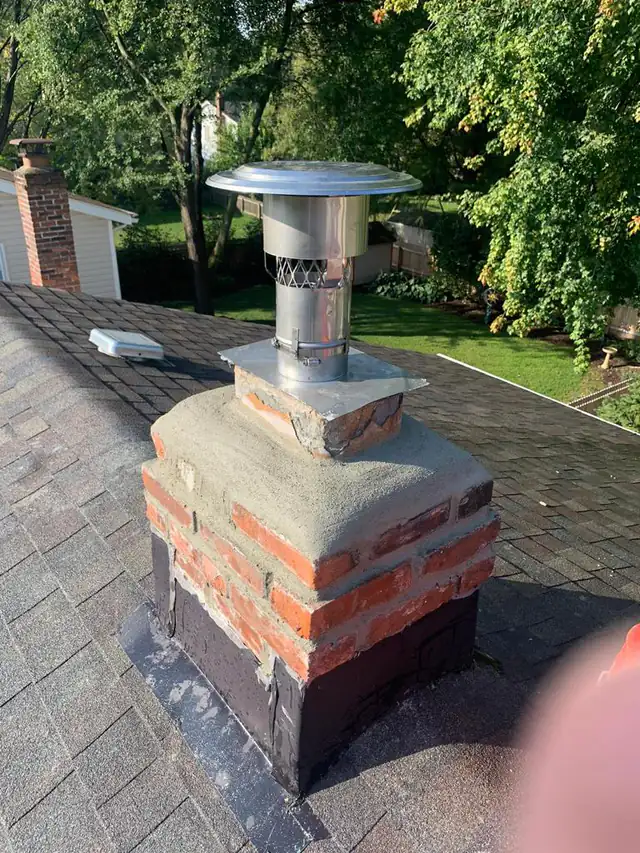
Stainless liner brought through a new crown, capped 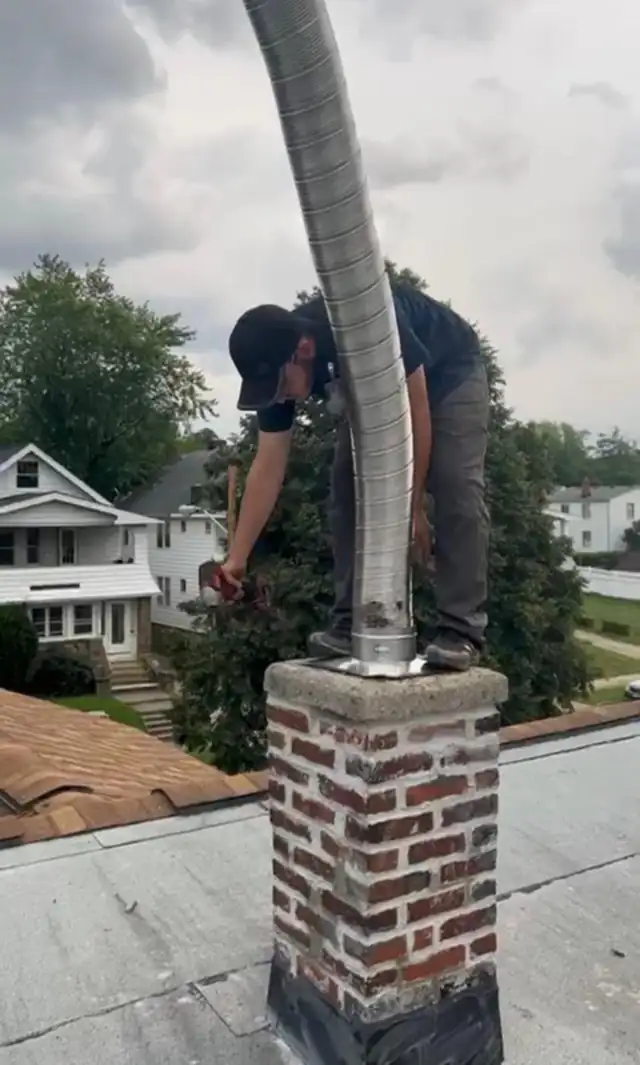
Feeding a new stainless liner down the flue
Meet the team
The people behind the work
Manny, Zack and Myke — meet the people behind Chimney Expert Solutions.
Our team and story →
Manny
Owner
Zack
Manager

Myke
Technician
FAQ
Chimney Relining in North Olmsted: questions we hear
There's a gap opening between our chimney and the house. Is that serious?
It depends on whether it is stable or moving, which is exactly what we assess. A tapered gap that is wider at the top usually means the stack is leaning away on a footing that is moving with the clay. Some of these have been stable for thirty years and need only the flashing and the joint made weathertight; others are progressing and need structural attention. Photographs and a plumb-line reading now give you a baseline to measure against.
Our fireplace smokes when it's windy but not otherwise. Why?
That pattern points at chimney height rather than the flue's condition. If the stack does not stand a clear two feet above everything within ten feet of it, wind coming over the ridge or a nearby addition presses down the flue and beats the draft. Adding height, and in some cases fitting a cap designed to handle wind, usually solves it. It is worth checking whether anything was built or grew nearby since the fireplace last worked properly.
The chimney is being rebuilt anyway. Do the liner at the same time?
Almost always yes. A rebuild is the one moment the flue is open and accessible, and doing both together avoids paying twice for access, staging and roof protection. If we are rebuilding the top of a stack and the camera shows a compromised flue below it, we will say so before the scope is agreed rather than after.
How long does a reline take and is my house disrupted?
Most single-flue relines are a one- or two-day job, and the majority of the work happens on the roof. Inside, the disruption is at the fireplace or the appliance for the connection. If the chimney vents your water heater, we plan the sequence so it is not left without a vent overnight.
Free estimate
Chimney Relining in North Olmsted?
Tell us what you’re seeing and we’ll call or text back to schedule a look — with photos of what we find and an honest read on what’s urgent and what can wait. That evidence-first method is the way we work on every job.
Call and tell us what the chimney's doing — if we're up on a roof, we'll call you back. Other ways to reach us are on the contact page, and North Olmsted is one of the communities we cover across Greater Cleveland.
Call216-647-1882