
Cuyahoga County, Ohio
Chimney Liner & Relining in Shaker Heights, OH
Stainless steel relining for flues with cracked tiles, gaps, or no liner at all — sized to your appliance, insulated, done once.
What chimney relining involves in Shaker Heights is set by the housing stock here: Planned-suburb 1920s architecture with prominent detailed chimneys — multi-fireplace houses, aging clay flues, slate roofs, and a neighborhood standard that makes matched masonry non-negotiable.
Shaker Heights was laid out by the Van Sweringen brothers as a planned garden suburb, built around rapid transit lines that still run down the middle of Shaker and Van Aken. The 1920s Tudors, Georgians and French-influenced houses that define Fernway, Lomond, Malvern, Ludlow, Onaway and the Boulevard neighborhoods were built with serious masonry: slate roofs, real brick and stone, and chimneys designed as part of the elevation rather than as a vent that had to go somewhere.
The liner is the part of the chimney that does the actual work. Everything else is structure; the liner is what contains the heat and the combustion gases and delivers them out of the house without letting either reach the brickwork or the framing around it. Most Cleveland chimneys were built with clay tile liners, and clay has a hard life here. Thermal shock cracks it, settlement shifts it, and moisture eats the mortar joints between tiles until the sections stop behaving as one continuous passage. A cracked or gapped liner is invisible without a camera, and it is the failure that turns into house fires and carbon monoxide.
What we find on Shaker Heights chimneys that leads to chimney relining
Century-old clay flues in multi-fireplace houses
A Shaker house with four fireplaces has four independent flue histories inside one or two stacks, and they were all built with clay tile in the 1920s. The joints between tile sections are the weak point, and a hundred years of heating cycles, condensation and freeze-thaw at the top of the stack washes them out. The result is a flue that is a series of separate tiles with gaps rather than a continuous passage. It is invisible without a camera and it is the single most common serious finding here.
Sizing: the part that decides whether it drafts
More relining jobs are ruined by wrong sizing than by bad installation. A flue that is too large runs cool, drafts weakly, and condenses moisture and creosote onto its own walls. A flue that is too small cannot move the volume of exhaust the appliance produces, and the surplus comes into the room. Neither problem announces itself as a sizing problem; both present as 'the fireplace smokes' or 'the chimney keeps getting dirty'.
For an open fireplace, the flue is sized against the area of the fireplace opening — the long-standing rule in NFPA 211 puts a round flue at no less than about a twelfth of the opening area, and a rectangular one at no less than about a tenth. For a stove, insert or appliance, the liner is sized to the manufacturer's specified outlet and the listed installation instructions, not to whatever is currently in the chimney. Getting this right is the difference between a fireplace that pulls crisply the moment it is lit and one the family stops using.
What happens if a failed flue keeps getting used
The two outcomes are the ones this whole trade exists to prevent. The first is a structure fire. A gap in the liner lets flue temperatures reach the masonry, and a masonry chimney is not a sealed object — it is built into a house with framing members close to it, sometimes closer than modern clearances allow, especially in houses built before those clearances existed. Heat over time chars wood, and charred wood ignites at a lower temperature than sound wood. This is the mechanism behind fires that start in a chimney the family had used without incident for years.
The second is carbon monoxide. A gapped or partially blocked flue lets exhaust find easier routes than the one out of the top. On a gas or oil appliance the exhaust is not visible and does not smell, and it comes back into a basement or a utility room. Every house with a fuel-burning appliance needs working CO alarms on every level regardless — but an alarm is a last defense, not a repair.
The reason to reline is that it removes both mechanisms permanently rather than managing them. The reason to camera-inspect first is that plenty of chimneys turn out not to need it.
This page covers chimney relining as it plays out in Shaker Heights. The full chimney liner & relining page walks the whole job — every stage, what changes the scope, and what we do about each of them. For everything else we handle in this suburb, see chimney services in Shaker Heights.
What a relining job includes
- Camera inspection first — you see why (or whether) the flue needs relining
- Continuous stainless steel liner in the correct alloy, sized to the fireplace or appliance it serves
- Insulation wrap or pour so the flue drafts correctly and meets the liner's listing
- Existing flue cleared, and broken tile removed where it obstructs the run
- New top plate, storm collar and cap terminating the system
- Correct listed connection at the appliance — no improvised adapters
- Photos of the completed run top to bottom, and the liner's product documentation
Our work
Chimney Liner & Relining, photographed on the job
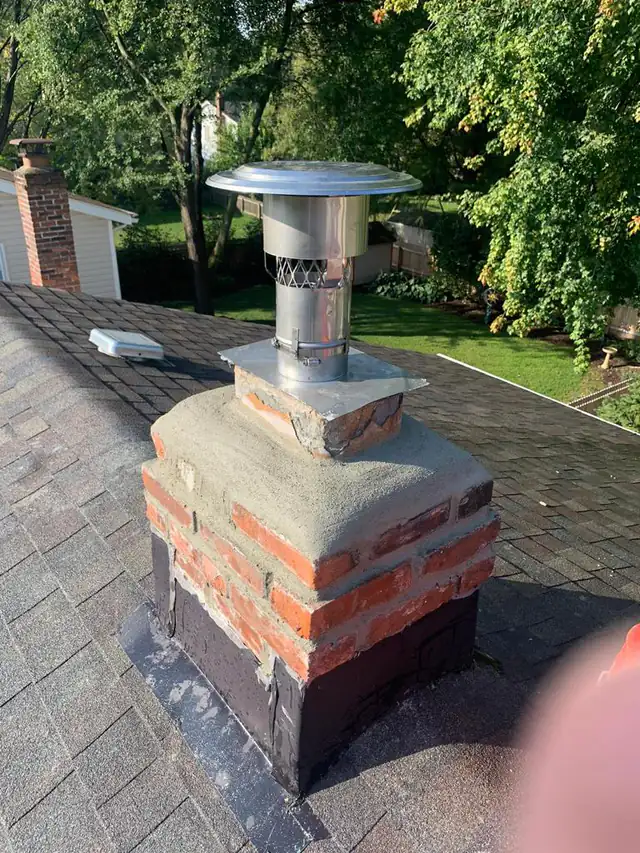
Stainless liner brought through a new crown, capped 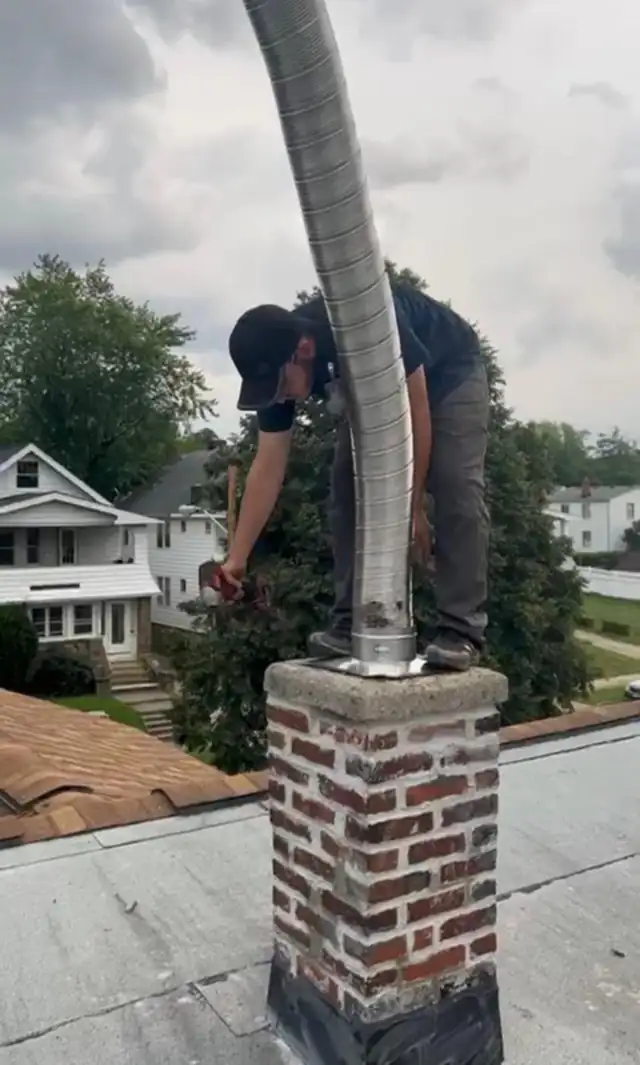
Feeding a new stainless liner down the flue
Meet the team
The people behind the work
Manny, Zack and Myke — meet the people behind Chimney Expert Solutions.
Our team and story →
Manny
Owner

Zack
Manager

Myke
Technician
FAQ
Chimney Relining in Shaker Heights: questions we hear
Is it worth relining a fireplace we only use a few times a year?
If the flue is damaged, yes — frequency does not change what a cracked liner does during the fires you do light, and the risk is per-fire rather than per-year. If the flue is sound, we will tell you that instead. Sorting out which of those two you have is exactly what an inspection is for, and it is a much smaller decision than the reline.
Can original chimney pots be kept?
Yes, and they should be where they are part of the design. Pots can be reset, and where one has cracked, salvage and reproduction options exist. What a pot does not do is keep rain out — it is an open flue that happens to be taller — so it still wants a cap, and there are caps made to sit with a pot without ruining the look.
Does a stainless liner need sweeping like clay?
Yes. Stainless is smoother and better insulated, so it usually builds less deposit and is easier to clean, but wood smoke still leaves creosote on it. What changes is the brush: a wire brush that is fine on clay tile can damage a stainless liner, so it needs a poly brush sized to the liner. Worth knowing if you ever hire a sweep who does not ask what your liner is.
Why stainless instead of replacing the broken clay tiles?
Access. Clay tiles are stacked inside a sealed masonry shaft, so reaching a cracked one partway up means opening the chimney to get to it — which usually costs more than relining and leaves you with a repaired eighty-year-old flue. A stainless liner installs from the top, restores a continuous sealed passage in a day or two on most jobs, and the liner itself typically carries a manufacturer lifetime warranty.
Free estimate
Chimney Relining in Shaker Heights?
Tell us what you’re seeing and we’ll call or text back to schedule a look — with photos of what we find and an honest read on what’s urgent and what can wait. That evidence-first method is the way we work on every job.
Call and tell us what the chimney's doing — if we're up on a roof, we'll call you back. Other ways to reach us are on the contact page, and Shaker Heights is one of the communities we cover across Greater Cleveland.
Call216-647-1882