
Lorain County, Ohio
Chimney Liner & Relining in Lorain, OH
Stainless steel relining for flues with cracked tiles, gaps, or no liner at all — sized to your appliance, insulated, done once.
What chimney relining involves in Lorain is set by the housing stock here: Dense mill and harbor-era housing with an unusual concentration of 1920s rebuilding — small stacks with hollow-tile backup, open lake exposure from the north, and flues that have outlived several generations of heating equipment.
Lorain is a mill and harbor city at the mouth of the Black River, and its housing tells that story block by block: dense, modest, closely spaced houses built for people who worked the steel plant and the shipyards, laid out in tight grids from the waterfront south, with more spacious later neighborhoods further out. These are small houses with small chimneys, and they were built to a budget by people who did not waste material.
The liner is the part of the chimney that does the actual work. Everything else is structure; the liner is what contains the heat and the combustion gases and delivers them out of the house without letting either reach the brickwork or the framing around it. Most Cleveland chimneys were built with clay tile liners, and clay has a hard life here. Thermal shock cracks it, settlement shifts it, and moisture eats the mortar joints between tiles until the sections stop behaving as one continuous passage. A cracked or gapped liner is invisible without a camera, and it is the failure that turns into house fires and carbon monoxide.
What we find on Lorain chimneys that leads to chimney relining
Small stacks, small flues, and a modern appliance
These houses were built with a single modest chimney sized around a coal-burning heating plant and, in some cases, a kitchen range. Every conversion since — coal to gas, gravity to forced air, standard furnace to high-efficiency — changed what the flue is being asked to do without changing the flue. What is left in a lot of Lorain basements is an appliance connected to a masonry flue that is either far too large for it, or in a couple of cases genuinely too small, with a connector arrangement improvised in whichever decade the last change happened. It wants sizing properly and lining to match, and the basement is where that assessment starts.
Hollow clay tile behind the brick face
Structural clay tile — hollow rectangular blocks — was a common, economical backup material in this era, used behind a single wythe of face brick in walls and in chimneys. It is not a bad material, but it fails differently from solid masonry. Water that gets past the brick collects in the hollow cells, freezes, and breaks the thin webs inside the tile where nobody can see it, so a chimney can be substantially hollowed out internally while the outside face still looks presentable. When a stack like this finally moves, it moves suddenly. Finding it changes the assessment, which is why we look at what is behind the face rather than just at it.
What the liner is actually for
A flue liner does three jobs at once, and losing any one of them matters. It keeps heat away from the wood framing that surrounds every masonry chimney — the code clearances that framing was built to assume an intact liner. It protects the masonry from the corrosive by-products of combustion, which will otherwise attack mortar and brick from the inside. And it provides a correctly sized, smooth passage so the appliance drafts the way it was designed to.
This is why 'the chimney is structurally fine' and 'the chimney is safe to use' are two different statements. A perfectly sound-looking stack with a broken flue is not a working chimney. It is a masonry column with a fire hazard running through the middle of it.
How clay tile liners fail
Thermal shock
Clay tile does not expand and contract quickly. A chimney fire, or in some cases just a very hot fire in a cold flue, puts a rapid temperature spike into the tile, and the tile cracks. The cracks are often vertical or spiral, and they do not close up when things cool down. This is the classic post-chimney-fire finding and the main reason the standard calls for an inspection after any suspected fire, no matter how minor it seemed at the time.
Failed mortar joints
Flue tiles are stacked in short sections with thin mortar joints between them. Those joints are the weakest part of the assembly, and in Northeast Ohio they take a beating from condensation and freeze-thaw at the top of the stack. Once the joints wash out, you have a series of separate tiles with gaps between them rather than a continuous flue, and gases can reach the masonry at every gap.
Condensation and acid attack
Any flue running cooler than the exhaust dew point condenses moisture on its walls, and that condensate is acidic. On a gas or oil appliance venting into an oversized masonry flue, the condensate dissolves the mortar joints and softens the tile over years. The tell is rust, dampness or white deposits at the base of the flue and around the clean-out.
Never lined in the first place
Ohio building practice did not universally require flue liners until well into the twentieth century, and a substantial share of pre-1940 Cleveland-area chimneys have bare brick flues with no tile at all. On those, combustion gases have been in direct contact with the masonry for their whole life, and the mortar joints between the flue bricks are frequently washed out. This is one of the most common findings on the older east and west side streets, and it is not something a homeowner can see.
This page covers chimney relining as it plays out in Lorain. The full chimney liner & relining page walks the whole job — every stage, what changes the scope, and what we do about each of them. For everything else we handle in this suburb, see chimney services in Lorain.
What a relining job includes
- Camera inspection first — you see why (or whether) the flue needs relining
- Continuous stainless steel liner in the correct alloy, sized to the fireplace or appliance it serves
- Insulation wrap or pour so the flue drafts correctly and meets the liner's listing
- Existing flue cleared, and broken tile removed where it obstructs the run
- New top plate, storm collar and cap terminating the system
- Correct listed connection at the appliance — no improvised adapters
- Photos of the completed run top to bottom, and the liner's product documentation
Our work
Chimney Liner & Relining, photographed on the job
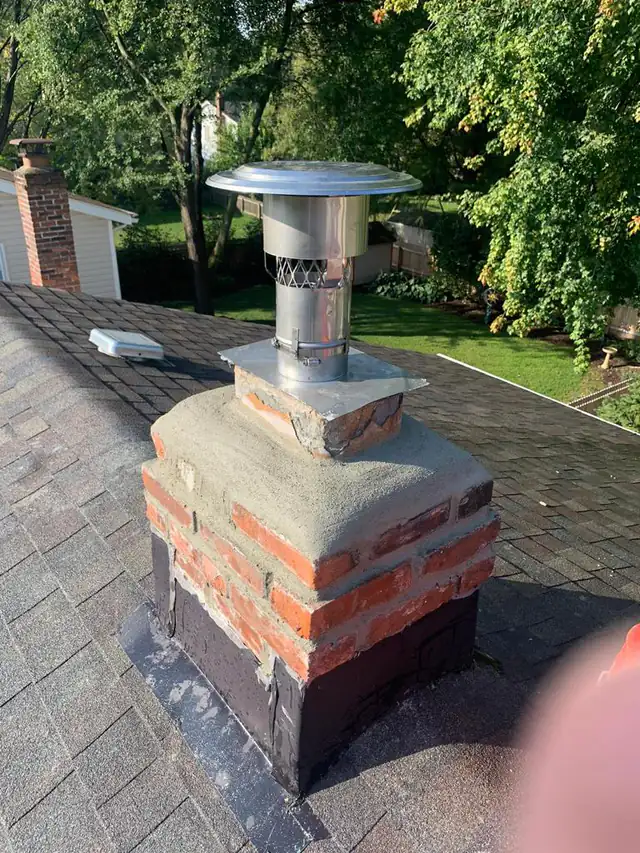
Stainless liner brought through a new crown, capped 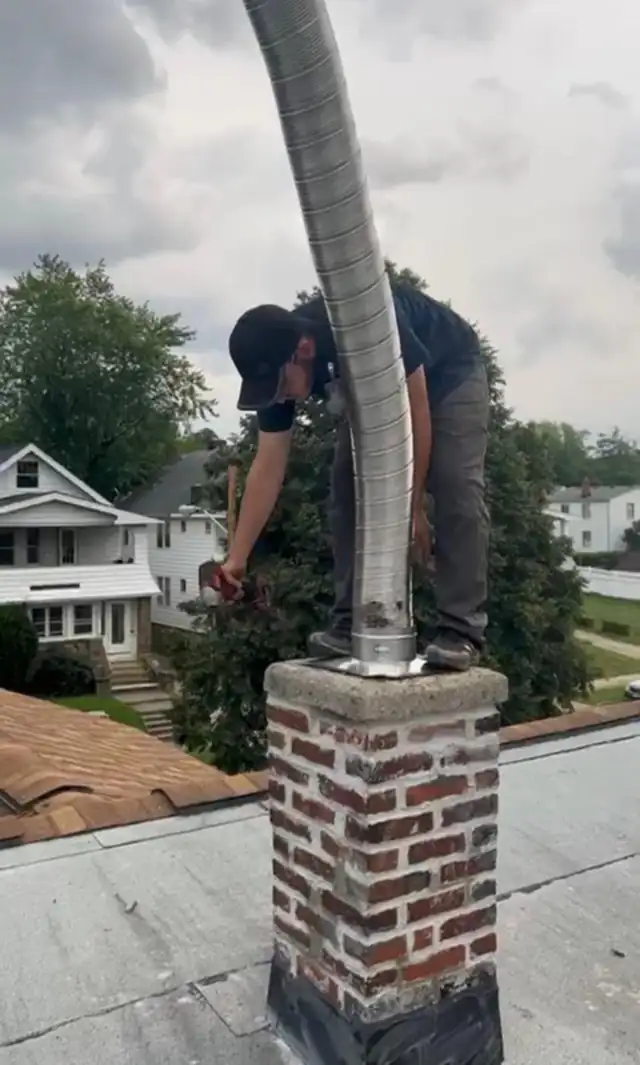
Feeding a new stainless liner down the flue
Meet the team
The people behind the work
Manny, Zack and Myke — meet the people behind Chimney Expert Solutions.
Our team and story →
Manny
Owner

Zack
Manager

Myke
Technician
FAQ
Chimney Relining in Lorain: questions we hear
Our furnace vents into the old chimney. Is that still appropriate?
It depends entirely on what the appliance is and what the flue measures. A modern furnace on a flue sized for a coal plant is far too large a passage — the exhaust cools, condenses and corrodes the tile from inside. The answer is usually a metal liner sized to the appliance, but the sizing has to come from the actual equipment and the actual flue, not from an assumption. We look at both.
How can a chimney look fine and still be unsound?
It happens most often where the stack is built with hollow clay tile behind a brick face. Water gets in, freezes in the hollow cells and breaks the internal webs, so the structure is being eaten from the inside while the visible face stays reasonably intact. It is one of the reasons a proper assessment includes the top, the interior of the flue and the base rather than a look from the driveway.
Why stainless instead of replacing the broken clay tiles?
Access. Clay tiles are stacked inside a sealed masonry shaft, so reaching a cracked one partway up means opening the chimney to get to it — which usually costs more than relining and leaves you with a repaired eighty-year-old flue. A stainless liner installs from the top, restores a continuous sealed passage in a day or two on most jobs, and the liner itself typically carries a manufacturer lifetime warranty.
Can one liner serve two appliances?
Sometimes, and it is governed by rules rather than preference — appliance types, fuels, input ratings and connection geometry all determine whether common venting is permitted. Plenty of existing shared arrangements in older Cleveland houses would not pass today. It is something we work out on site, and 'the old chimney did it this way' is not an answer.
Free estimate
Chimney Relining in Lorain?
Tell us what you’re seeing and we’ll call or text back to schedule a look — with photos of what we find and an honest read on what’s urgent and what can wait. That evidence-first method is the way we work on every job.
Call and tell us what the chimney's doing — if we're up on a roof, we'll call you back. Other ways to reach us are on the contact page, and Lorain is one of the communities we cover across Greater Cleveland.
Call216-647-1882