
Cuyahoga County, Ohio
Chimney Liner & Relining in Euclid, OH
Stainless steel relining for flues with cracked tiles, gaps, or no liner at all — sized to your appliance, insulated, done once.
What chimney relining involves in Euclid is set by the housing stock here: Snow-belt lake exposure on mixed-age stock — early-century streets with soft brick and unlined flues, postwar bungalows with failing crowns, and abandoned flues left open after heating conversions.
Euclid runs along Lake Erie on Cleveland's east side, and its housing comes in two distinct waves. There are early-century streets near the older core and the Lakeshore Boulevard corridor, and there are broad postwar neighborhoods of brick bungalows and Capes filling the numbered streets inland toward the East 200th Street area. Both are well built. Both take east-side lake weather straight on.
The liner is the part of the chimney that does the actual work. Everything else is structure; the liner is what contains the heat and the combustion gases and delivers them out of the house without letting either reach the brickwork or the framing around it. Most Cleveland chimneys were built with clay tile liners, and clay has a hard life here. Thermal shock cracks it, settlement shifts it, and moisture eats the mortar joints between tiles until the sections stop behaving as one continuous passage. A cracked or gapped liner is invisible without a camera, and it is the failure that turns into house fires and carbon monoxide.
What we find on Euclid chimneys that leads to chimney relining
Abandoned flues left open at the top
Euclid's postwar stock has been through several generations of heating equipment, and every conversion tends to leave a flue behind. An abandoned flue with no cap is a funnel pointed at the middle of the house: it collects rain and snow, delivers it into the stack, and lets frost do its work on the masonry above the roof with nothing venting through to dry it. Capping a dead flue and keeping a sound crown over it is a small job that prevents a genuinely expensive one.
What a relining job involves
Preparing the flue
The existing flue is swept and cleared. Where broken tile is obstructing the passage or protruding into it, it has to be removed or broken out so the liner can run straight. On some older chimneys with tight offsets, this is the part that takes the time, and it is the part a quote can get wrong if nobody looked first.
The liner and its insulation
A continuous stainless liner in the correct alloy for the fuel — 316Ti-grade stainless is the normal choice for wood and oil, and a listed alloy is used for high-efficiency condensing appliances, because condensate chemistry differs. It goes in insulated, either with a factory or field-applied wrap or a pour-around insulation mix. Insulation is not optional dressing: it is often required by the liner's own listing, it keeps the flue warm enough to draft properly, and it dramatically reduces condensation and creosote formation. An uninsulated liner rattling around inside an oversized masonry chase is a cheaper job and a worse chimney.
Termination at the top
A top plate seals the liner to the top of the chimney, a storm collar sheds water off the joint, and a cap sized to the new liner finishes it. Done properly, the top of the chimney is now sealed against rain for the first time in decades, which is a side benefit that quietly protects the masonry below.
The connection at the bottom
The liner is connected to the fireplace, stove or appliance with the correct listed components. Improvised adapters and unsupported connector pipe are common findings on older installations and they are exactly where the system leaks. On a fireplace, this usually means a connection at the smoke chamber; on an insert or stove, a direct connect to the appliance outlet.
Documentation
Photos of the completed run top to bottom, and the liner's product documentation handed over, so the manufacturer's warranty on the liner is something you actually hold rather than something you were told about.
What happens if a failed flue keeps getting used
The two outcomes are the ones this whole trade exists to prevent. The first is a structure fire. A gap in the liner lets flue temperatures reach the masonry, and a masonry chimney is not a sealed object — it is built into a house with framing members close to it, sometimes closer than modern clearances allow, especially in houses built before those clearances existed. Heat over time chars wood, and charred wood ignites at a lower temperature than sound wood. This is the mechanism behind fires that start in a chimney the family had used without incident for years.
The second is carbon monoxide. A gapped or partially blocked flue lets exhaust find easier routes than the one out of the top. On a gas or oil appliance the exhaust is not visible and does not smell, and it comes back into a basement or a utility room. Every house with a fuel-burning appliance needs working CO alarms on every level regardless — but an alarm is a last defense, not a repair.
The reason to reline is that it removes both mechanisms permanently rather than managing them. The reason to camera-inspect first is that plenty of chimneys turn out not to need it.
This page covers chimney relining as it plays out in Euclid. The full chimney liner & relining page walks the whole job — every stage, what changes the scope, and what we do about each of them. For everything else we handle in this suburb, see chimney services in Euclid.
What a relining job includes
- Camera inspection first — you see why (or whether) the flue needs relining
- Continuous stainless steel liner in the correct alloy, sized to the fireplace or appliance it serves
- Insulation wrap or pour so the flue drafts correctly and meets the liner's listing
- Existing flue cleared, and broken tile removed where it obstructs the run
- New top plate, storm collar and cap terminating the system
- Correct listed connection at the appliance — no improvised adapters
- Photos of the completed run top to bottom, and the liner's product documentation
Our work
Chimney Liner & Relining, photographed on the job
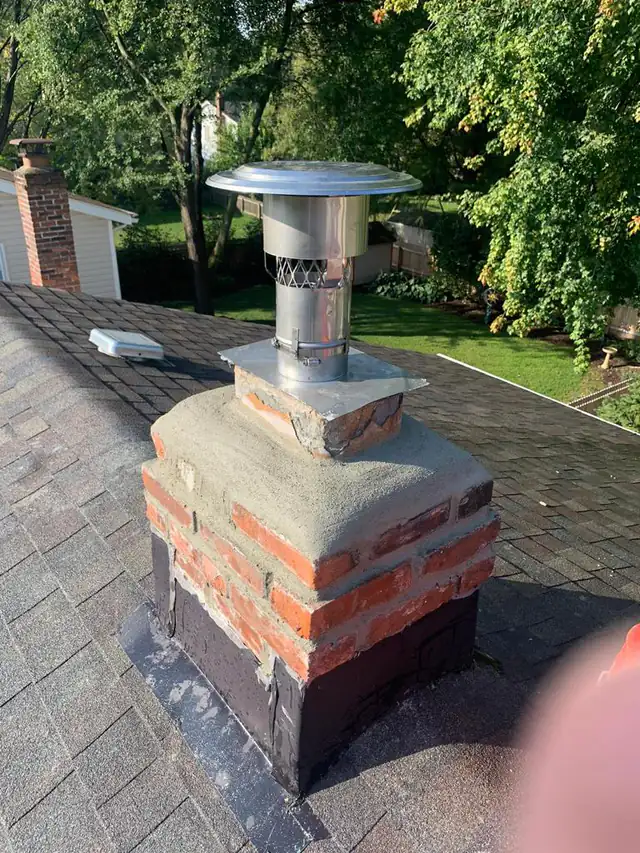
Stainless liner brought through a new crown, capped 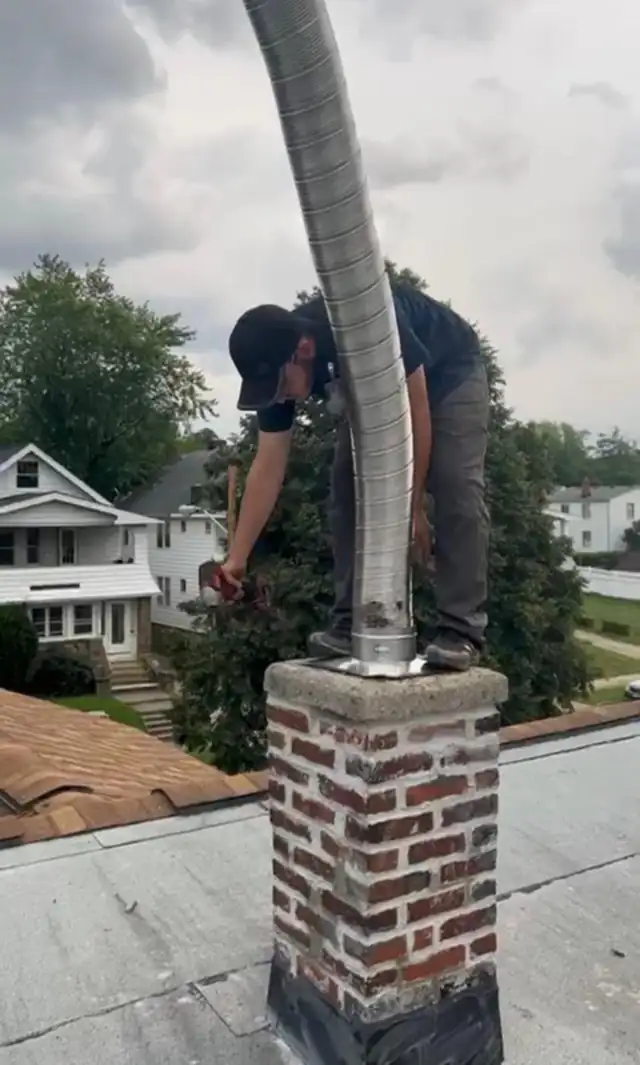
Feeding a new stainless liner down the flue
Meet the team
The people behind the work
Manny, Zack and Myke — meet the people behind Chimney Expert Solutions.
Our team and story →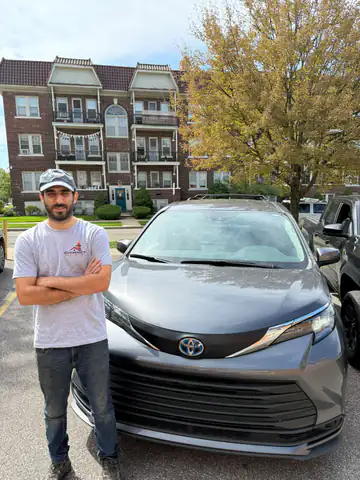
Manny
Owner
Zack
Manager
Myke
Technician
FAQ
Chimney Relining in Euclid: questions we hear
Our postwar chimney only served the old furnace. Can we ignore it?
Not entirely. If genuinely nothing vents into it anymore, it still needs a cap and a sound crown — an open abandoned flue funnels water into the middle of the house and frost-damages the stack above the roof. If the water heater still uses it, it needs considerably more than that, because a single small appliance on an oversized flue is the classic condensation and corrosion situation.
Does a stainless liner need sweeping like clay?
Yes. Stainless is smoother and better insulated, so it usually builds less deposit and is easier to clean, but wood smoke still leaves creosote on it. What changes is the brush: a wire brush that is fine on clay tile can damage a stainless liner, so it needs a poly brush sized to the liner. Worth knowing if you ever hire a sweep who does not ask what your liner is.
The chimney is being rebuilt anyway. Do the liner at the same time?
Almost always yes. A rebuild is the one moment the flue is open and accessible, and doing both together avoids paying twice for access, staging and roof protection. If we are rebuilding the top of a stack and the camera shows a compromised flue below it, we will say so before the scope is agreed rather than after.
Free estimate
Chimney Relining in Euclid?
Tell us what you’re seeing and we’ll call or text back to schedule a look — with photos of what we find and an honest read on what’s urgent and what can wait. That evidence-first method is the way we work on every job.
Call and tell us what the chimney's doing — if we're up on a roof, we'll call you back. Other ways to reach us are on the contact page, and Euclid is one of the communities we cover across Greater Cleveland.
Call216-647-1882