
Cuyahoga County, Ohio
Chimney Liner & Relining in Rocky River, OH
Stainless steel relining for flues with cracked tiles, gaps, or no liner at all — sized to your appliance, insulated, done once.
What chimney relining involves in Rocky River is set by the housing stock here: Lake exposure accelerating everything — older masonry taking wind-driven rain on its north and west faces, and newer chase-built fireplaces with rusting galvanized covers.
Rocky River sits between the lake and the river valley, and its housing runs in layers: an older core of 1920s–40s homes along Detroit Road and up toward Lake Road and Beachcliff, then solid postwar neighborhoods, then later contemporary building including condominium development near the river and the lakefront. Chimney work here spans the whole range, from pre-war masonry stacks to factory-built fireplaces in framed chases.
The liner is the part of the chimney that does the actual work. Everything else is structure; the liner is what contains the heat and the combustion gases and delivers them out of the house without letting either reach the brickwork or the framing around it. Most Cleveland chimneys were built with clay tile liners, and clay has a hard life here. Thermal shock cracks it, settlement shifts it, and moisture eats the mortar joints between tiles until the sections stop behaving as one continuous passage. A cracked or gapped liner is invisible without a camera, and it is the failure that turns into house fires and carbon monoxide.
What we find on Rocky River chimneys that leads to chimney relining
Chase-built fireplaces with galvanized covers
A lot of the newer housing here has a factory-built fireplace in a wood-framed chase, finished outside in siding or stone veneer and closed at the top with a flat metal chase cover instead of a masonry crown. Galvanized covers rust, pond water rather than shedding it, and then leak straight into the chase framing. The rust streak running down the siding below the chimney top is the giveaway. The durable fix is a custom stainless cover with a cross-break so water runs off.
How clay tile liners fail
Thermal shock
Clay tile does not expand and contract quickly. A chimney fire, or in some cases just a very hot fire in a cold flue, puts a rapid temperature spike into the tile, and the tile cracks. The cracks are often vertical or spiral, and they do not close up when things cool down. This is the classic post-chimney-fire finding and the main reason the standard calls for an inspection after any suspected fire, no matter how minor it seemed at the time.
Failed mortar joints
Flue tiles are stacked in short sections with thin mortar joints between them. Those joints are the weakest part of the assembly, and in Northeast Ohio they take a beating from condensation and freeze-thaw at the top of the stack. Once the joints wash out, you have a series of separate tiles with gaps between them rather than a continuous flue, and gases can reach the masonry at every gap.
Condensation and acid attack
Any flue running cooler than the exhaust dew point condenses moisture on its walls, and that condensate is acidic. On a gas or oil appliance venting into an oversized masonry flue, the condensate dissolves the mortar joints and softens the tile over years. The tell is rust, dampness or white deposits at the base of the flue and around the clean-out.
Never lined in the first place
Ohio building practice did not universally require flue liners until well into the twentieth century, and a substantial share of pre-1940 Cleveland-area chimneys have bare brick flues with no tile at all. On those, combustion gases have been in direct contact with the masonry for their whole life, and the mortar joints between the flue bricks are frequently washed out. This is one of the most common findings on the older east and west side streets, and it is not something a homeowner can see.
What a relining job involves
Preparing the flue
The existing flue is swept and cleared. Where broken tile is obstructing the passage or protruding into it, it has to be removed or broken out so the liner can run straight. On some older chimneys with tight offsets, this is the part that takes the time, and it is the part a quote can get wrong if nobody looked first.
The liner and its insulation
A continuous stainless liner in the correct alloy for the fuel — 316Ti-grade stainless is the normal choice for wood and oil, and a listed alloy is used for high-efficiency condensing appliances, because condensate chemistry differs. It goes in insulated, either with a factory or field-applied wrap or a pour-around insulation mix. Insulation is not optional dressing: it is often required by the liner's own listing, it keeps the flue warm enough to draft properly, and it dramatically reduces condensation and creosote formation. An uninsulated liner rattling around inside an oversized masonry chase is a cheaper job and a worse chimney.
Termination at the top
A top plate seals the liner to the top of the chimney, a storm collar sheds water off the joint, and a cap sized to the new liner finishes it. Done properly, the top of the chimney is now sealed against rain for the first time in decades, which is a side benefit that quietly protects the masonry below.
The connection at the bottom
The liner is connected to the fireplace, stove or appliance with the correct listed components. Improvised adapters and unsupported connector pipe are common findings on older installations and they are exactly where the system leaks. On a fireplace, this usually means a connection at the smoke chamber; on an insert or stove, a direct connect to the appliance outlet.
Documentation
Photos of the completed run top to bottom, and the liner's product documentation handed over, so the manufacturer's warranty on the liner is something you actually hold rather than something you were told about.
This page covers chimney relining as it plays out in Rocky River. The full chimney liner & relining page walks the whole job — every stage, what changes the scope, and what we do about each of them. For everything else we handle in this suburb, see chimney services in Rocky River.
What a relining job includes
- Camera inspection first — you see why (or whether) the flue needs relining
- Continuous stainless steel liner in the correct alloy, sized to the fireplace or appliance it serves
- Insulation wrap or pour so the flue drafts correctly and meets the liner's listing
- Existing flue cleared, and broken tile removed where it obstructs the run
- New top plate, storm collar and cap terminating the system
- Correct listed connection at the appliance — no improvised adapters
- Photos of the completed run top to bottom, and the liner's product documentation
Our work
Chimney Liner & Relining, photographed on the job
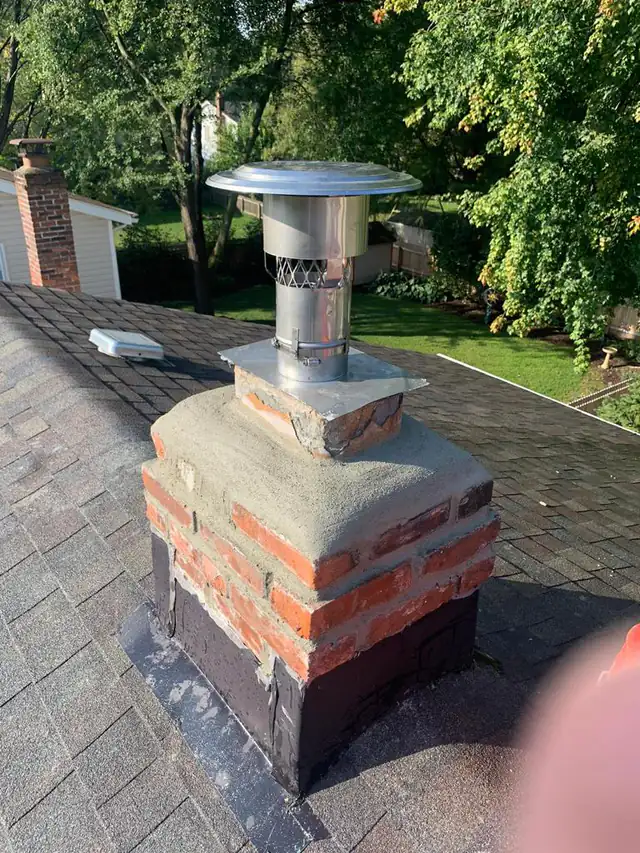
Stainless liner brought through a new crown, capped 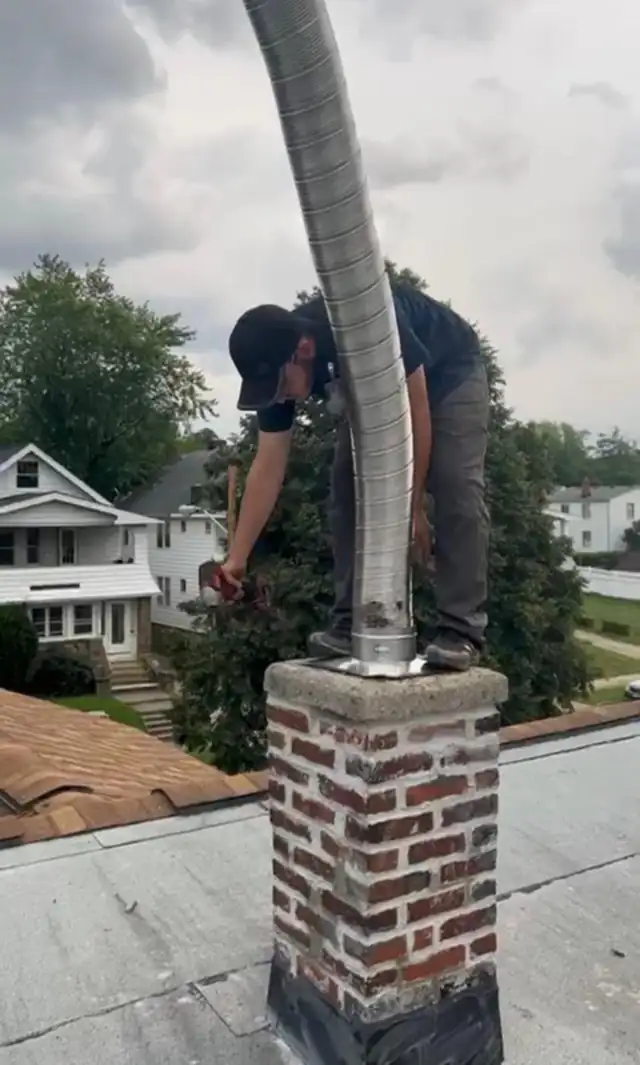
Feeding a new stainless liner down the flue
Meet the team
The people behind the work
Manny, Zack and Myke — meet the people behind Chimney Expert Solutions.
Our team and story →
Manny
Owner

Zack
Manager

Myke
Technician
FAQ
Chimney Relining in Rocky River: questions we hear
Our newer home has a metal box on top instead of a brick chimney. Is that yours to service?
Yes. That is a chase cover over a factory-built fireplace, and it is a chimney in every way that matters: the flue still builds creosote and needs sweeping, the cover rusts and pools water, and the refractory panels inside the firebox crack with age. Replacing a failing galvanized cover with stainless is one of the more common jobs on Rocky River's newer streets.
The chimney is on the lake-facing side of the house. Does it need more frequent work?
It usually needs the water-management components watched more closely, yes. The crown, cap, flashing and the pointing on the exposed face are the parts that wear faster. The flue itself does not care which way the house faces. It is a difference in inspection focus rather than an entirely different service.
Why stainless instead of replacing the broken clay tiles?
Access. Clay tiles are stacked inside a sealed masonry shaft, so reaching a cracked one partway up means opening the chimney to get to it — which usually costs more than relining and leaves you with a repaired eighty-year-old flue. A stainless liner installs from the top, restores a continuous sealed passage in a day or two on most jobs, and the liner itself typically carries a manufacturer lifetime warranty.
How long does a reline take and is my house disrupted?
Most single-flue relines are a one- or two-day job, and the majority of the work happens on the roof. Inside, the disruption is at the fireplace or the appliance for the connection. If the chimney vents your water heater, we plan the sequence so it is not left without a vent overnight.
Free estimate
Chimney Relining in Rocky River?
Tell us what you’re seeing and we’ll call or text back to schedule a look — with photos of what we find and an honest read on what’s urgent and what can wait. That evidence-first method is the way we work on every job.
Call and tell us what the chimney's doing — if we're up on a roof, we'll call you back. Other ways to reach us are on the contact page, and Rocky River is one of the communities we cover across Greater Cleveland.
Call216-647-1882