
Lorain County, Ohio
Chimney Liner & Relining in Avon Lake, OH
Stainless steel relining for flues with cracked tiles, gaps, or no liner at all — sized to your appliance, insulated, done once.
What chimney relining involves in Avon Lake is set by the housing stock here: Open lakefront exposure with no shelter from the north — steady wind that beats chimney draft, houses under pressure that pull air back down unused flues, and converted seasonal cottages carrying year-round heating loads.
Avon Lake runs along the shoreline west of the county line, with older housing on and around Lake Road — a lot of it originally built as summer places — and large stretches of newer subdivision south of it toward Walker Road and the highway. The chimney work here is shaped less by building era than by the fact that there is nothing between these houses and the open water.
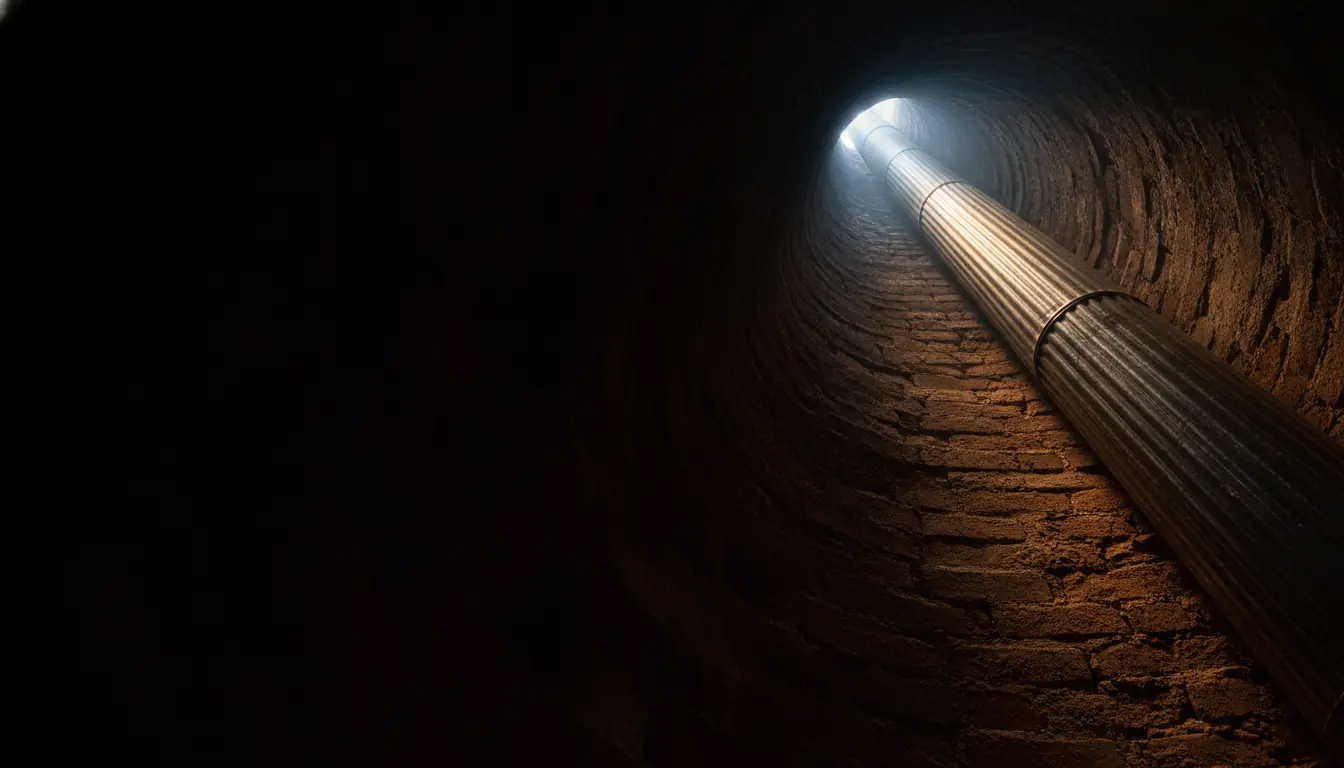
The liner is the part of the chimney that does the actual work. Everything else is structure; the liner is what contains the heat and the combustion gases and delivers them out of the house without letting either reach the brickwork or the framing around it. Most Cleveland chimneys were built with clay tile liners, and clay has a hard life here. Thermal shock cracks it, settlement shifts it, and moisture eats the mortar joints between tiles until the sections stop behaving as one continuous passage. A cracked or gapped liner is invisible without a camera, and it is the failure that turns into house fires and carbon monoxide.
What we find on Avon Lake chimneys that leads to chimney relining
Cottages that became houses
A good number of the older places near the shore began as seasonal cottages and were converted to year-round living over the decades, gaining insulation, a real heating system and often a fireplace along the way. The masonry frequently did not keep up with the conversion. We find chimneys built for occasional summer use now venting a heating appliance through every Ohio winter, foundations and footings that were adequate for a light seasonal structure carrying a full-height stack, and flue arrangements assembled in stages by different people. None of that is necessarily unsafe, but it does mean the chimney deserves to be assessed on what it is doing now rather than on what it was built to do.
Wind pushing the draft back down the flue
Steady onshore wind striking a roof creates a zone of downward pressure on the lee side and turbulence over the ridge, and if the chimney terminates inside that zone the wind wins. The symptom is unmistakable once you know it: the fireplace draws perfectly on calm days and backpuffs or refuses to start when it is blowing, always from roughly the same direction. There are two levers. One is height — getting the flue termination up out of the turbulent layer, which means at least two feet above anything within ten feet of it. The other is the cap: wind-directional and vacuum-style caps use the wind itself to pull the flue rather than fight it, and on an exposed lakefront they earn their place.
The fireplace we never use, and the smell
The most common Avon Lake call has nothing to do with fire. A house under negative pressure — from wind on the lee side, from bath and kitchen exhaust, from the stack effect of warm air rising in winter — pulls replacement air in wherever it can, and an open flue is a large, easy opening. Air comes down the chimney, passes over old deposits in the smoke chamber and the firebox, and delivers the smell into the room. Cleaning removes the source, but the airflow is the actual cause, and the durable fix is a top-sealing damper that closes the flue at the top rather than at the throat. It also stops you heating the outdoors through the winter.
How clay tile liners fail
Thermal shock
Clay tile does not expand and contract quickly. A chimney fire, or in some cases just a very hot fire in a cold flue, puts a rapid temperature spike into the tile, and the tile cracks. The cracks are often vertical or spiral, and they do not close up when things cool down. This is the classic post-chimney-fire finding and the main reason the standard calls for an inspection after any suspected fire, no matter how minor it seemed at the time.
Failed mortar joints
Flue tiles are stacked in short sections with thin mortar joints between them. Those joints are the weakest part of the assembly, and in Northeast Ohio they take a beating from condensation and freeze-thaw at the top of the stack. Once the joints wash out, you have a series of separate tiles with gaps between them rather than a continuous flue, and gases can reach the masonry at every gap.
Condensation and acid attack
Any flue running cooler than the exhaust dew point condenses moisture on its walls, and that condensate is acidic. On a gas or oil appliance venting into an oversized masonry flue, the condensate dissolves the mortar joints and softens the tile over years. The tell is rust, dampness or white deposits at the base of the flue and around the clean-out.
Never lined in the first place
Ohio building practice did not universally require flue liners until well into the twentieth century, and a substantial share of pre-1940 Cleveland-area chimneys have bare brick flues with no tile at all. On those, combustion gases have been in direct contact with the masonry for their whole life, and the mortar joints between the flue bricks are frequently washed out. This is one of the most common findings on the older east and west side streets, and it is not something a homeowner can see.
How we confirm a liner has actually failed
Camera first, always. Relining is a significant job and nobody should be selling one on a hunch or on what could be seen with a flashlight from the firebox. The scan is run the full length of the flue and it either shows you cracked tile, open joints, missing sections and gaps, or it shows you an intact flue. Both answers are useful and we say the second one out loud when it is the true one.
There is a specific version of this we want homeowners to be skeptical about: a photograph of a cracked flue that is not your flue. Footage from your chimney is identifiable, we walk you through it, and it should be part of every relining quote you receive from anyone.
This page covers chimney relining as it plays out in Avon Lake. The full chimney liner & relining page walks the whole job — every stage, what changes the scope, and what we do about each of them. For everything else we handle in this suburb, see chimney services in Avon Lake.
What a relining job includes
- Camera inspection first — you see why (or whether) the flue needs relining
- Continuous stainless steel liner in the correct alloy, sized to the fireplace or appliance it serves
- Insulation wrap or pour so the flue drafts correctly and meets the liner's listing
- Existing flue cleared, and broken tile removed where it obstructs the run
- New top plate, storm collar and cap terminating the system
- Correct listed connection at the appliance — no improvised adapters
- Photos of the completed run top to bottom, and the liner's product documentation
Our work
Chimney Liner & Relining, photographed on the job
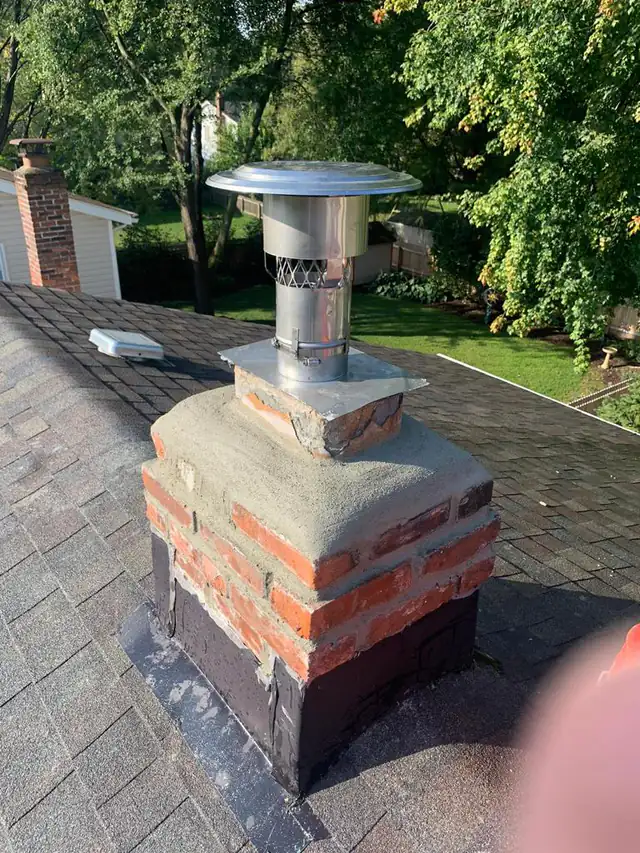
Stainless liner brought through a new crown, capped 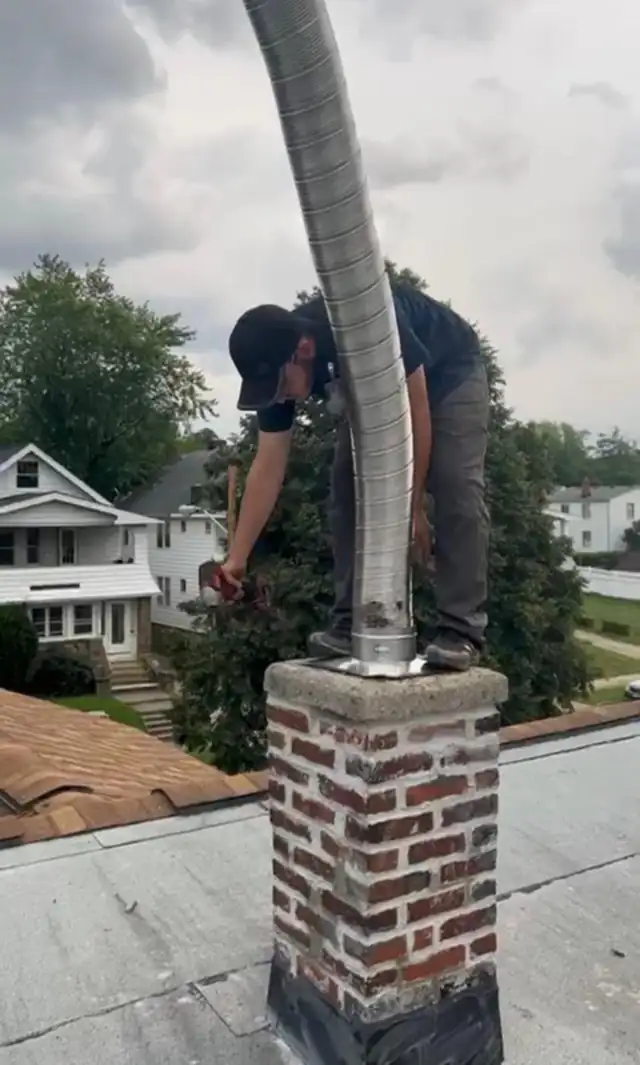
Feeding a new stainless liner down the flue
Meet the team
The people behind the work
Manny, Zack and Myke — meet the people behind Chimney Expert Solutions.
Our team and story →
Manny
Owner

Zack
Manager

Myke
Technician
FAQ
Chimney Relining in Avon Lake: questions we hear
Our fireplace only misbehaves when the wind is up. Is the chimney blocked?
Probably not, and a scan will settle it quickly. A fireplace that draws well on calm days and fails in wind from a particular direction is describing a pressure problem, not an obstruction. The usual causes are a flue that terminates too low relative to the ridge or a nearby structure, and a cap that fights the wind instead of using it. Both are fixable without touching the masonry below.
We smell the fireplace indoors even in summer. What is that?
Air coming down the flue rather than going up it, carrying odor off old deposits. It happens when the house is at lower pressure than the outside — which wind, exhaust fans and the stack effect all cause. Sweeping removes most of the smell source. A top-sealing damper, which seals the flue at the top rather than at the throat, is what stops the airflow itself.
Would a taller chimney really fix a wind problem?
Often, yes, because it gets the flue termination out of the turbulent air rolling over the roof. The rule of thumb is that a chimney should stand three feet above where it passes through the roof and two feet above anything within ten feet of it. Where height alone is not enough or is not practical, a wind-directional cap does the rest. We measure before recommending either.
How long does a reline take and is my house disrupted?
Most single-flue relines are a one- or two-day job, and the majority of the work happens on the roof. Inside, the disruption is at the fireplace or the appliance for the connection. If the chimney vents your water heater, we plan the sequence so it is not left without a vent overnight.
Does a stainless liner need sweeping like clay?
Yes. Stainless is smoother and better insulated, so it usually builds less deposit and is easier to clean, but wood smoke still leaves creosote on it. What changes is the brush: a wire brush that is fine on clay tile can damage a stainless liner, so it needs a poly brush sized to the liner. Worth knowing if you ever hire a sweep who does not ask what your liner is.
Free estimate
Chimney Relining in Avon Lake?
Tell us what you’re seeing and we’ll call or text back to schedule a look — with photos of what we find and an honest read on what’s urgent and what can wait. That evidence-first method is the way we work on every job.
Call and tell us what the chimney's doing — if we're up on a roof, we'll call you back. Other ways to reach us are on the contact page, and Avon Lake is one of the communities we cover across Greater Cleveland.
Call216-647-1882