
Portage County, Ohio
Chimney Liner & Relining in Kent, OH
Stainless steel relining for flues with cracked tiles, gaps, or no liner at all — sized to your appliance, insulated, done once.
What chimney relining involves in Kent is set by the housing stock here: A downtown and campus ring of older houses long since divided into units — decommissioned flues sealed at the bottom and open at the top, appliances added across decades, and shared flues serving separate households.
Kent is a river town with a nineteenth-century downtown and a university in the middle of it, and that combination has shaped its housing more than any building era has. A very large share of the older homes in the streets around campus and downtown are no longer single-family houses. They were divided into units — two, three, five, sometimes more — over the second half of the twentieth century, and most of them are still divided today.
The liner is the part of the chimney that does the actual work. Everything else is structure; the liner is what contains the heat and the combustion gases and delivers them out of the house without letting either reach the brickwork or the framing around it. Most Cleveland chimneys were built with clay tile liners, and clay has a hard life here. Thermal shock cracks it, settlement shifts it, and moisture eats the mortar joints between tiles until the sections stop behaving as one continuous passage. A cracked or gapped liner is invisible without a camera, and it is the failure that turns into house fires and carbon monoxide.
What we find on Kent chimneys that leads to chimney relining
Shared flues in a house with separate households
Where a divided house has appliances from more than one unit venting into a common flue, a fault in one unit becomes everybody's problem. A blocked or spilling appliance downstairs can put combustion products into a flue that another unit's appliance also connects to, and there is no reason the person affected would know where it originated. That is the specific argument for carbon monoxide alarms on every level of a divided building and near every sleeping area, regardless of what the appliances are — and for the flues and connectors being surveyed as a system rather than unit by unit.
Flues sealed at the bottom and open at the top
A decommissioned fireplace in a divided house is usually blocked at the firebox and left entirely alone above. That combination is worse than either extreme. Rain and snow enter at an uncapped top and cannot evaporate out at the bottom, so the interior of the flue stays wet through the winter and freezes repeatedly. Tile joints and brick take the damage from the inside where nobody will see it for twenty years. Doing it properly is not complicated — cap the top, keep the crown sound, and leave a controlled path for the flue to breathe — and it costs a fraction of the masonry it saves.
Nobody quite owns the chimney
In an owner-occupied house the chimney belongs to the person who lives under it. In a rental, the tenant sees the fireplace, the owner sees an invoice, the property manager sees a work order, and the thing itself falls between them for years at a time. The practical answer for an owner is documentation: a camera survey of every flue in the building, a written record of what serves what, and copies of the photographs. It settles what has been done, gives the next contractor a starting point, and answers the question a tenant or a buyer eventually asks.
What happens if a failed flue keeps getting used
The two outcomes are the ones this whole trade exists to prevent. The first is a structure fire. A gap in the liner lets flue temperatures reach the masonry, and a masonry chimney is not a sealed object — it is built into a house with framing members close to it, sometimes closer than modern clearances allow, especially in houses built before those clearances existed. Heat over time chars wood, and charred wood ignites at a lower temperature than sound wood. This is the mechanism behind fires that start in a chimney the family had used without incident for years.
The second is carbon monoxide. A gapped or partially blocked flue lets exhaust find easier routes than the one out of the top. On a gas or oil appliance the exhaust is not visible and does not smell, and it comes back into a basement or a utility room. Every house with a fuel-burning appliance needs working CO alarms on every level regardless — but an alarm is a last defense, not a repair.
The reason to reline is that it removes both mechanisms permanently rather than managing them. The reason to camera-inspect first is that plenty of chimneys turn out not to need it.
What the liner is actually for
A flue liner does three jobs at once, and losing any one of them matters. It keeps heat away from the wood framing that surrounds every masonry chimney — the code clearances that framing was built to assume an intact liner. It protects the masonry from the corrosive by-products of combustion, which will otherwise attack mortar and brick from the inside. And it provides a correctly sized, smooth passage so the appliance drafts the way it was designed to.
This is why 'the chimney is structurally fine' and 'the chimney is safe to use' are two different statements. A perfectly sound-looking stack with a broken flue is not a working chimney. It is a masonry column with a fire hazard running through the middle of it.
This page covers chimney relining as it plays out in Kent. The full chimney liner & relining page walks the whole job — every stage, what changes the scope, and what we do about each of them. For everything else we handle in this suburb, see chimney services in Kent.
What a relining job includes
- Camera inspection first — you see why (or whether) the flue needs relining
- Continuous stainless steel liner in the correct alloy, sized to the fireplace or appliance it serves
- Insulation wrap or pour so the flue drafts correctly and meets the liner's listing
- Existing flue cleared, and broken tile removed where it obstructs the run
- New top plate, storm collar and cap terminating the system
- Correct listed connection at the appliance — no improvised adapters
- Photos of the completed run top to bottom, and the liner's product documentation
Our work
Chimney Liner & Relining, photographed on the job
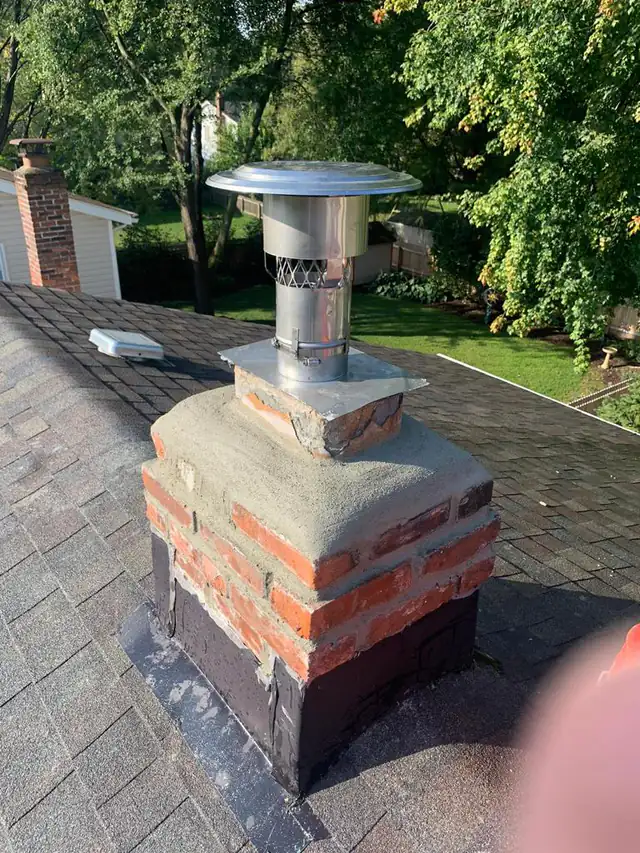
Stainless liner brought through a new crown, capped 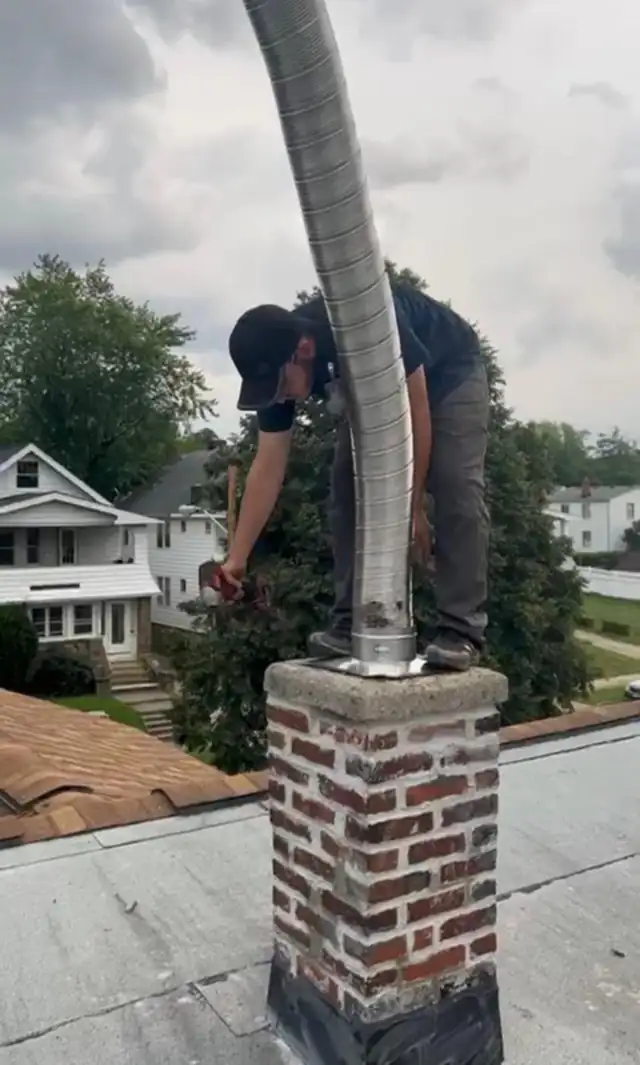
Feeding a new stainless liner down the flue
Meet the team
The people behind the work
Manny, Zack and Myke — meet the people behind Chimney Expert Solutions.
Our team and story →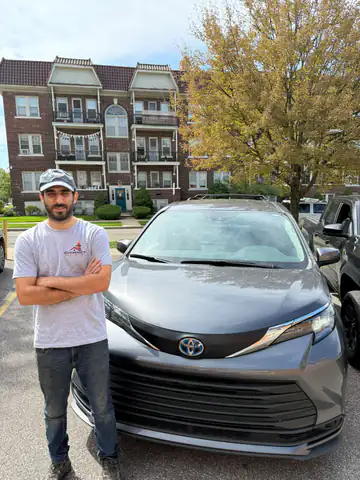
Manny
Owner

Zack
Manager

Myke
Technician
FAQ
Chimney Relining in Kent: questions we hear
Why does a shared flue matter for carbon monoxide?
Because a problem in one unit's appliance can reach another unit's air. If two apartments' appliances connect to the same flue and one spills, the products do not stay politely in the apartment they came from. That is the case for alarms on every level and near every sleeping area in a divided building, and for looking at the venting as one system rather than one apartment at a time.
The fireplace in our unit is boarded up. Is that safe?
It depends on what was done above it. Sealing the bottom while the top stays open is common and it quietly ruins the flue, because water goes in and cannot get out. It is also worth confirming nothing else vents into that flue. Both questions are answered from the roof and with a camera rather than from inside the room.
We own a rental here. What should we actually have done?
A survey of every flue in the building with a camera, a written record of which appliance connects to which flue, and photographs you keep. That gives you a baseline, tells you whether any decommissioned flue is quietly taking on water, and answers the question that comes up when a tenant reports a smell or a buyer's inspector asks. It is a single visit and it does not need repeating annually unless something changes.
Can one liner serve two appliances?
Sometimes, and it is governed by rules rather than preference — appliance types, fuels, input ratings and connection geometry all determine whether common venting is permitted. Plenty of existing shared arrangements in older Cleveland houses would not pass today. It is something we work out on site, and 'the old chimney did it this way' is not an answer.
Does a stainless liner need sweeping like clay?
Yes. Stainless is smoother and better insulated, so it usually builds less deposit and is easier to clean, but wood smoke still leaves creosote on it. What changes is the brush: a wire brush that is fine on clay tile can damage a stainless liner, so it needs a poly brush sized to the liner. Worth knowing if you ever hire a sweep who does not ask what your liner is.
Free estimate
Chimney Relining in Kent?
Tell us what you’re seeing and we’ll call or text back to schedule a look — with photos of what we find and an honest read on what’s urgent and what can wait. That evidence-first method is the way we work on every job.
Call and tell us what the chimney's doing — if we're up on a roof, we'll call you back. Other ways to reach us are on the contact page, and Kent is one of the communities we cover across Greater Cleveland.
Call216-647-1882