
Lorain County, Ohio
Chimney Sweep & Cleaning in Elyria, OH
Full mechanical sweep of the flue, smoke chamber and firebox — creosote out, dust contained, and a look at the whole system while we're in it.
What chimney sweep involves in Elyria is set by the housing stock here: A nineteenth-century county seat turned manufacturing town, built partly of the sandstone quarried in this county — stone that delaminates rather than crumbles, has usually been pointed too hard, and dries slowly in the river valleys.
Elyria grew up where the two branches of the Black River meet, and it has the building stock of a nineteenth-century county seat that then became a manufacturing town: substantial older houses around the square and Washington Avenue, worker housing near the industrial corridors, and postwar neighborhoods filling out from there. The distinctive material fact about the older half of it is stone.
Creosote is what wood smoke leaves behind on the inside of a flue, and it is the fuel in nearly every chimney fire. It leaves the fire as vapor, condenses on any flue wall cool enough to catch it, and hardens over a season into something closer to tar than soot. A real sweep takes the flue back to bare liner with rods and brushes sized to that specific flue, works the smoke chamber and smoke shelf where the deposits sit heaviest, and finishes in the firebox, with the room sealed off and a HEPA vacuum running the whole time.
What we find on Elyria chimneys that leads to chimney sweep
White bloom on the chimney breast in the basement
Efflorescence — the powdery white deposit that appears on interior masonry — is not a cosmetic problem, it is a message. It is salt that was dissolved in water inside the masonry and left behind when the water evaporated at the surface, which means water is moving through the chimney and coming out on your side of it. On a stack in the older housing here the source is almost always at the top: a cracked crown, a missing cap, an open abandoned flue, or joints that have washed out above the roofline. Wiping the wall and repainting it treats the symptom and hides the clock.
Sandstone pointed with mortar that is far too hard
The rule with any masonry is that the mortar must be the sacrificial element — softer than the units it joins, so that movement and salt damage go into a joint you can renew rather than into stone or brick you cannot. Sandstone is softer than most brick, so it needs a softer mortar still, and a great deal of the failed stonework in this city was pointed at some stage with a hard Portland-heavy mix because that is what was in the mixer. The result is joints that stand proud while the stone beside them erodes away. Getting the mix right, and cutting joints back to sound depth rather than skimming them, is most of the job.
The Northeast Ohio timing problem
Every chimney company in Greater Cleveland gets the same phone calls in the same two weeks of October, and nothing about that is good for homeowners. Booking a sweep between late spring and early fall gets you a real appointment slot instead of a queue position.
The bigger reason to go early is what happens if the sweep finds masonry work. Mortar needs sustained temperatures above roughly 40°F to cure properly, so the masonry season here runs about April through November. A failed crown discovered in late September may not get properly rebuilt until spring. Found in June, it is a scheduled repair rather than a winter of water going into the stack.
What makes a chimney build creosote faster
If you have been told you need sweeping more often than a neighbour with the same house, one of these is usually why. Fixing the cause is cheaper than sweeping around it.
- Wet wood. Freshly cut wood is roughly half water by weight; seasoned firewood should be near 20%. Wood that has not been split, stacked and covered for a year spends the first part of every fire boiling water instead of making heat, and cool smoke deposits fast.
- Smoldering fires. Damping a stove or insert right down overnight is the classic creosote factory — long, cool, oxygen-starved burns put the maximum amount of unburned gas up a cold flue.
- An oversized flue. Common in Cleveland after a wood fireplace is converted to gas, or a big open firebox is replaced with a small insert. Exhaust slows, cools, and condenses on the way out.
- An exterior chimney. A stack running up the outside of the house never holds heat the way an interior one does. On a January night in a lake-effect wind, that flue is a condenser.
- A short or poorly terminated chimney. Draft comes from height and temperature difference. A stack that barely clears the roofline never develops much of either.
- Soft woods and construction scrap. Pine and spruce leave more resin; painted, glued or treated wood leaves deposits you do not want in a flue at all.
This page covers chimney sweep as it plays out in Elyria. The full chimney sweep & cleaning page walks the whole job — every stage, what changes the scope, and what we do about each of them. For everything else we handle in this suburb, see chimney services in Elyria.
What a sweep with us includes
- Drop cloths, sealed fireplace opening and HEPA dust control before a brush touches the flue
- Mechanical sweep of the full flue length, with brush size and shape matched to your liner
- Smoke chamber and smoke shelf hand-cleaned — the corners most sweeps skip
- Firebox and ash dump cleared, damper cleaned and operated through full travel
- A visual once-over of the whole system, with photos of anything that needs attention
- Straight advice at the end: what's urgent, what can wait, what's fine
Our work
Chimney Sweep & Cleaning, photographed on the job
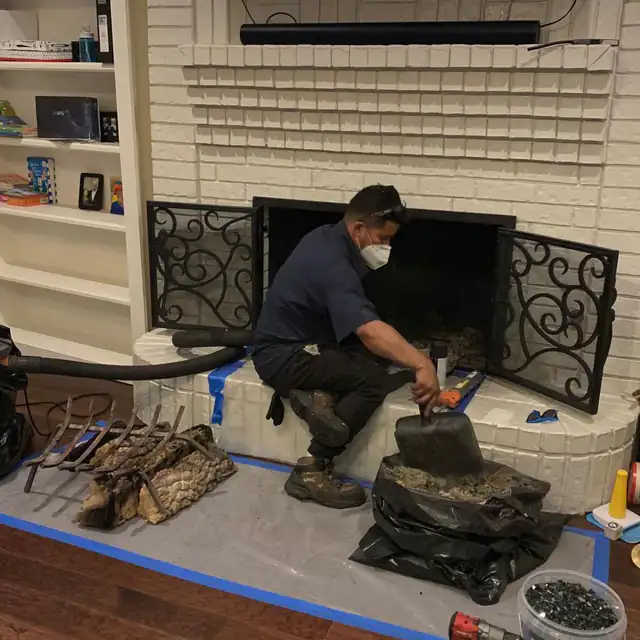
Drop cloths down and a vacuum on the hearth before anything is opened 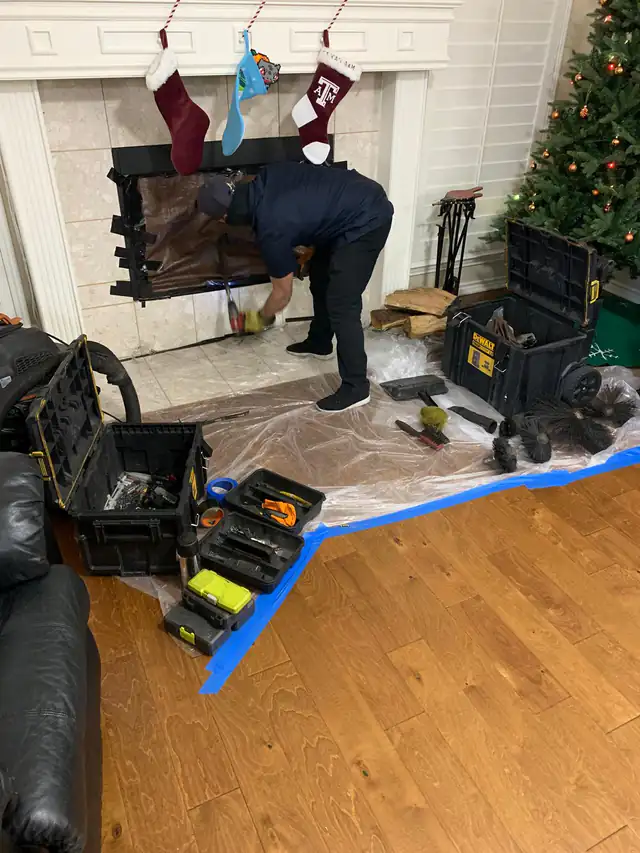
Working at the protected fireplace opening, with brushes and tools on covered floors 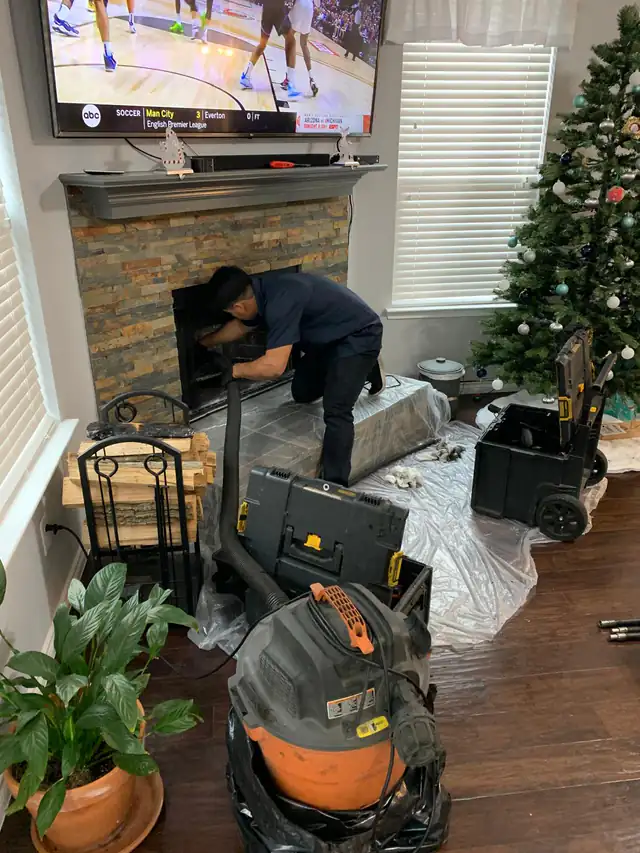
At the stone-front fireplace, with the hearth covered and a vacuum alongside 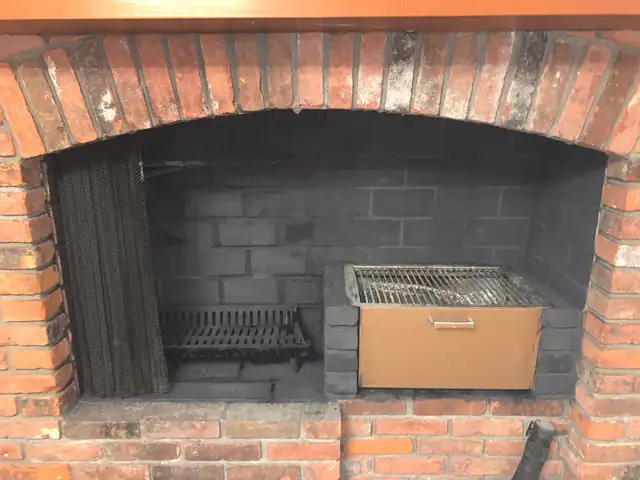
Firebox cleaned back to the brick, damper working 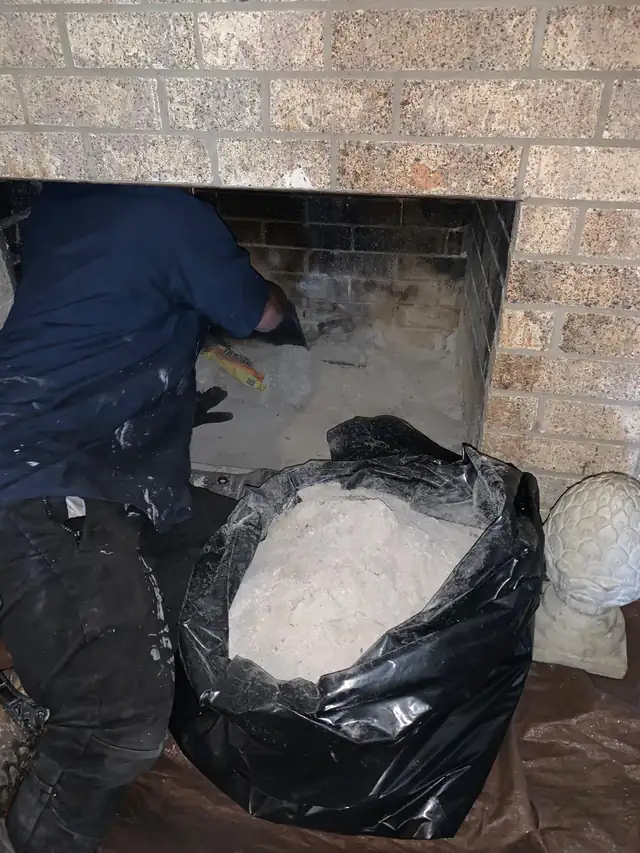
Clearing the firebox down to bare brick, floors covered
Meet the team
The people behind the work
Manny, Zack and Myke — meet the people behind Chimney Expert Solutions.
Our team and story →
Manny
Owner

Zack
Manager

Myke
Technician
FAQ
Chimney Sweep in Elyria: questions we hear
Our sandstone chimney base is peeling off in flat sheets. What causes that?
Sandstone splits along the layers it was formed in. Once water gets into those layers and freezes, it lifts them apart, and the stone sheds in plates rather than crumbling. It is often worse where a block was set with its bedding running vertically rather than horizontally. The repair depends on how much section has been lost, and filling the face with mortar generally makes it worse rather than better.
Why does mortar have to be softer than the stone?
Because something has to give, and you want it to be the part that can be replaced. Movement, freezing and salt all put stress into a wall. If the mortar is the softest element it absorbs that stress and erodes gradually, and renewing a joint is routine work. If the mortar is harder than the stone or brick, the stress goes into the units instead and they spall — and you cannot repoint a stone that has lost its face.
There's white powder on the chimney wall in our basement. Is that mold?
It is efflorescence — mineral salts left behind as water evaporates out of the masonry, not a biological growth. What matters is that it proves water is moving through the chimney. On this housing the entry point is nearly always at the top: a failed crown, a missing cap or open joints above the roof. Fixing the top stops the deposit; cleaning the wall alone just resets the clock.
How long does it take, and do I need to be home?
A single straightforward fireplace flue usually runs a couple of hours including setup, cleanup and the walkthrough. Multiple flues, an insert that has to be pulled, or heavy deposits take longer. Someone should be home to let us in and to hear the findings at the end — that conversation is half the value of the visit.
Do those creosote-sweeping logs work?
Partly, and not as a replacement. Creosote-modifying products can dry out and loosen stage-three glaze, which genuinely makes a subsequent sweep more effective. What they cannot do is remove anything. The deposit still has to be brushed loose and carried out of the flue by someone with rods and a vacuum.
Free estimate
Chimney Sweep in Elyria?
Tell us what you’re seeing and we’ll call or text back to schedule a look — with photos of what we find and an honest read on what’s urgent and what can wait. That evidence-first method is the way we work on every job.
Call and tell us what the chimney's doing — if we're up on a roof, we'll call you back. Other ways to reach us are on the contact page, and Elyria is one of the communities we cover across Greater Cleveland.
Call216-647-1882