
Cuyahoga County, Ohio
Chimney Liner & Relining in Lakewood, OH
Stainless steel relining for flues with cracked tiles, gaps, or no liner at all — sized to your appliance, insulated, done once.
What chimney relining involves in Lakewood is set by the housing stock here: Pre-1930 colonials, foursquares and doubles almost wall to wall — soft brick, original struck-mortar crowns, unlined flues, and stacks that have outlived several owners' memories of what they vent.
Lakewood is one of the most densely populated cities in Ohio, and almost all of it went up before 1930. Colonials, foursquares and the classic Lakewood doubles line the grid from Detroit and Madison up to Clifton and Lake, with the Birdtown streets in the southeast corner among the oldest of it. Nearly every one of those houses has original masonry chimneys that are now closing on a century of lake weather.
The liner is the part of the chimney that does the actual work. Everything else is structure; the liner is what contains the heat and the combustion gases and delivers them out of the house without letting either reach the brickwork or the framing around it. Most Cleveland chimneys were built with clay tile liners, and clay has a hard life here. Thermal shock cracks it, settlement shifts it, and moisture eats the mortar joints between tiles until the sections stop behaving as one continuous passage. A cracked or gapped liner is invisible without a camera, and it is the failure that turns into house fires and carbon monoxide.
What we find on Lakewood chimneys that leads to chimney relining
Sealed fireplaces people want back
Bringing a long-closed Lakewood fireplace back into use is one of the most common requests on these streets, and the answer is genuinely condition-dependent rather than a foregone conclusion. The sequence is camera inspection first, because the flue decides everything, then usually a sweep, a stainless liner if the tile has failed or was never there, damper work, and a cap. Sometimes the flue turns out to be sound and the job is small. Either way you see the footage before deciding anything.
Doubles: one stack, two units, several flues
The Lakewood double puts two households on one chimney, and after a century of furnace replacements, fireplace conversions and unit-by-unit renovations, it is normal to find flues nobody can account for. We routinely scan a double's stack and find one flue in fair shape, one cracked, and one abandoned and left open at the top, collecting rain into the middle of the house. Establishing what serves what is the first job, and it usually surprises the owner.
How clay tile liners fail
Thermal shock
Clay tile does not expand and contract quickly. A chimney fire, or in some cases just a very hot fire in a cold flue, puts a rapid temperature spike into the tile, and the tile cracks. The cracks are often vertical or spiral, and they do not close up when things cool down. This is the classic post-chimney-fire finding and the main reason the standard calls for an inspection after any suspected fire, no matter how minor it seemed at the time.
Failed mortar joints
Flue tiles are stacked in short sections with thin mortar joints between them. Those joints are the weakest part of the assembly, and in Northeast Ohio they take a beating from condensation and freeze-thaw at the top of the stack. Once the joints wash out, you have a series of separate tiles with gaps between them rather than a continuous flue, and gases can reach the masonry at every gap.
Condensation and acid attack
Any flue running cooler than the exhaust dew point condenses moisture on its walls, and that condensate is acidic. On a gas or oil appliance venting into an oversized masonry flue, the condensate dissolves the mortar joints and softens the tile over years. The tell is rust, dampness or white deposits at the base of the flue and around the clean-out.
Never lined in the first place
Ohio building practice did not universally require flue liners until well into the twentieth century, and a substantial share of pre-1940 Cleveland-area chimneys have bare brick flues with no tile at all. On those, combustion gases have been in direct contact with the masonry for their whole life, and the mortar joints between the flue bricks are frequently washed out. This is one of the most common findings on the older east and west side streets, and it is not something a homeowner can see.
Furnace and water heater flues: the Cleveland problem
This one affects tens of thousands of houses across Parma, Old Brooklyn, Euclid, Garfield Heights and every other postwar neighborhood, and almost nobody has been told about it. The sequence goes like this. The original furnace and the water heater both vented into the masonry chimney, and the flue was sized for the two of them together. The furnace gets replaced with a high-efficiency condensing unit, which vents through white PVC out a side wall. The water heater is left where it is.
Now a small appliance is venting into a flue sized for a large one. The exhaust volume is nowhere near enough to keep that flue warm, so it condenses on the way up. The condensate is acidic. It attacks the tile and the mortar joints, and over a decade it can take a flue apart from the inside while everything looks perfectly normal from the basement. The industry name for this is an orphaned water heater, and the standard fix is a correctly sized metal liner that matches the appliance rather than the chimney.
The signs are worth knowing: rust or scaling on the draft hood or the vent connector, dampness or white crusty deposits at the base of the chimney, tile fragments in the clean-out, or a chimney exterior that is staining on the outside near the top. If your furnace was upgraded in the last fifteen years and nobody looked at the chimney afterwards, that is the situation this section is describing.
This page covers chimney relining as it plays out in Lakewood. The full chimney liner & relining page walks the whole job — every stage, what changes the scope, and what we do about each of them. For everything else we handle in this suburb, see chimney services in Lakewood.
What a relining job includes
- Camera inspection first — you see why (or whether) the flue needs relining
- Continuous stainless steel liner in the correct alloy, sized to the fireplace or appliance it serves
- Insulation wrap or pour so the flue drafts correctly and meets the liner's listing
- Existing flue cleared, and broken tile removed where it obstructs the run
- New top plate, storm collar and cap terminating the system
- Correct listed connection at the appliance — no improvised adapters
- Photos of the completed run top to bottom, and the liner's product documentation
Our work
Chimney Liner & Relining, photographed on the job
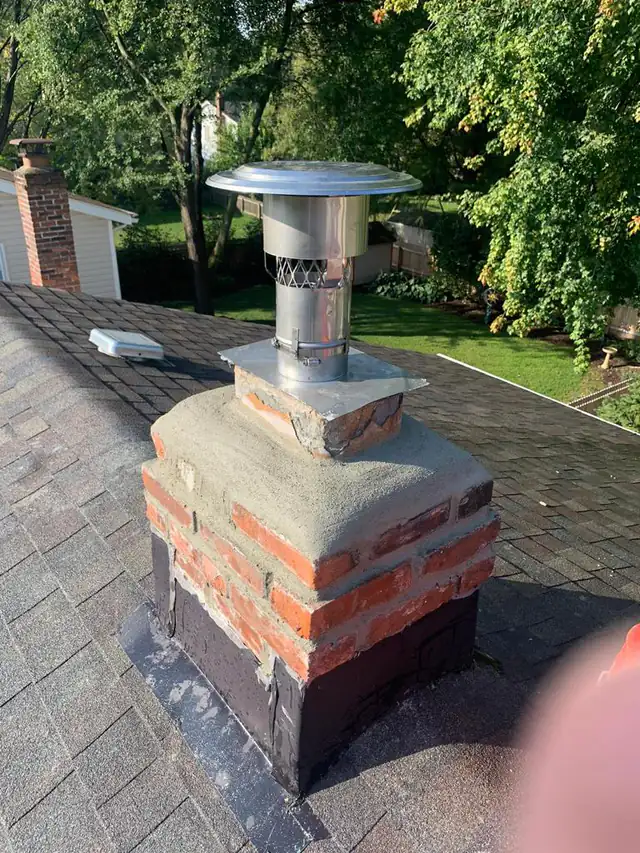
Stainless liner brought through a new crown, capped 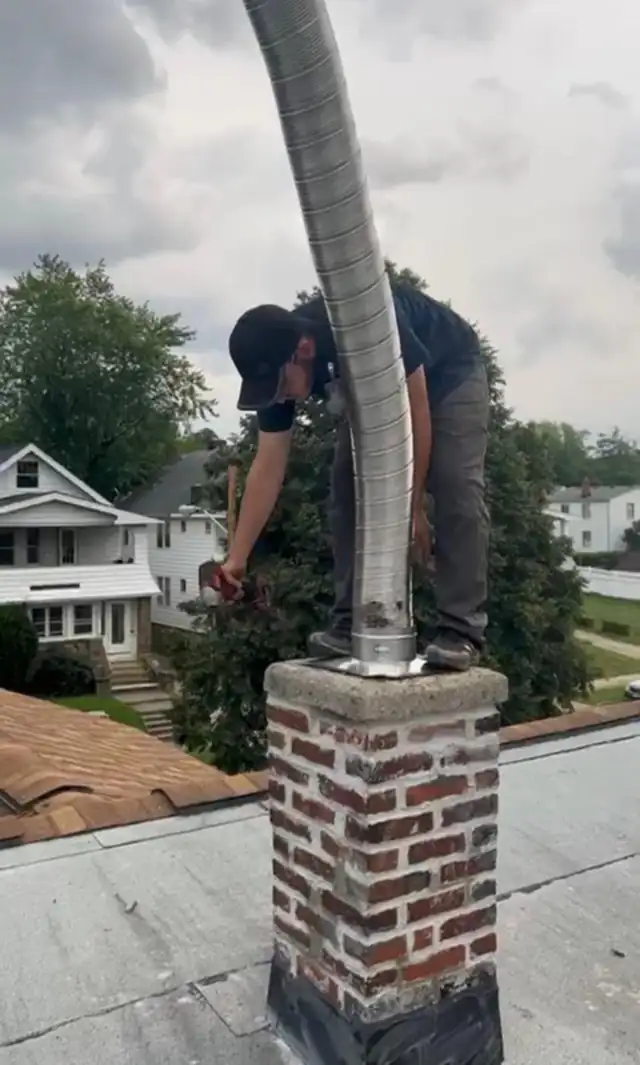
Feeding a new stainless liner down the flue
Meet the team
The people behind the work
Manny, Zack and Myke — meet the people behind Chimney Expert Solutions.
Our team and story →
Manny
Owner

Zack
Manager

Myke
Technician
FAQ
Chimney Relining in Lakewood: questions we hear
Our house is a double. Do we need to inspect every flue?
Each flue gets scanned on its own, because they age independently and they serve different things. The efficient part is that it is one visit and one set of access — a stack with three flues is three assessments, not three appointments, and caps can often be combined into one custom multi-flue cover.
How long does a reline take and is my house disrupted?
Most single-flue relines are a one- or two-day job, and the majority of the work happens on the roof. Inside, the disruption is at the fireplace or the appliance for the connection. If the chimney vents your water heater, we plan the sequence so it is not left without a vent overnight.
Does a stainless liner need sweeping like clay?
Yes. Stainless is smoother and better insulated, so it usually builds less deposit and is easier to clean, but wood smoke still leaves creosote on it. What changes is the brush: a wire brush that is fine on clay tile can damage a stainless liner, so it needs a poly brush sized to the liner. Worth knowing if you ever hire a sweep who does not ask what your liner is.
Free estimate
Chimney Relining in Lakewood?
Tell us what you’re seeing and we’ll call or text back to schedule a look — with photos of what we find and an honest read on what’s urgent and what can wait. That evidence-first method is the way we work on every job.
Call and tell us what the chimney's doing — if we're up on a roof, we'll call you back. Other ways to reach us are on the contact page, and Lakewood is one of the communities we cover across Greater Cleveland.
Call216-647-1882