
Summit County, Ohio
Chimney Sweep & Cleaning in Hudson, OH
Full mechanical sweep of the flue, smoke chamber and firebox — creosote out, dust contained, and a look at the whole system while we're in it.
What chimney sweep involves in Hudson is set by the housing stock here: Early Western Reserve houses of soft handmade brick and lime mortar with framing built into the stacks, alongside larger modern homes with multiple fireplaces — antique work that punishes modern materials and shortcuts.
Hudson kept its early architecture better than almost anywhere else in this part of Ohio. The houses around the Green and along the older streets are genuinely early — Federal and Greek Revival work from the 1820s through the 1850s, put up by New England settlers who built the way they had built at home — and the town has been deliberate about protecting how they look. Around that core is a great deal of newer and larger housing, much of it with several fireplaces.
Creosote is what wood smoke leaves behind on the inside of a flue, and it is the fuel in nearly every chimney fire. It leaves the fire as vapor, condenses on any flue wall cool enough to catch it, and hardens over a season into something closer to tar than soot. A real sweep takes the flue back to bare liner with rods and brushes sized to that specific flue, works the smoke chamber and smoke shelf where the deposits sit heaviest, and finishes in the firebox, with the room sealed off and a HEPA vacuum running the whole time.
What we find on Hudson chimneys that leads to chimney sweep
Floor joists and framing built into the stack
In houses of this age, it was standard to set the ends of floor joists, headers and mantel framing directly into pockets in the chimney masonry, because the chimney was the most solid thing in the building. That puts structural wood in permanent contact with a flue, sometimes with only a few inches of brick between it and the fire. Two centuries of slow heating dries that wood out and lowers the temperature at which it will ignite, a process that takes decades and gives no warning. It is one of the reasons a camera scan and an inspection of the framing around the chimney matter more on an antique house than anywhere else, and it usually shapes the entire approach to bringing a fireplace back into service.
Soft handmade brick and lime mortar, and what not to do to them
The brick in these walls was made from local clay and fired in small batches, so it varies from hard to genuinely soft within a single course, and it was laid in lime mortar that is far weaker than anything sold at a builder's merchant today. That combination has survived two centuries precisely because the mortar was the soft part. Repointing with a modern Portland-heavy mix reverses the relationship and destroys the brick faces within a few winters, and pressure washing or sandblasting takes off the fired surface that is the brick's only weather protection. The right work here is slow, matched, and done in small areas — and it is worth asking any contractor what mortar they intend to use before they start.
A twentieth-century top on a nineteenth-century chimney
Most of these stacks have been rebuilt above the roofline at some point, and a lot of those rebuilds used modern hard brick and modern mortar simply because that is what was available on the day. It creates a visible line where the two eras meet and an invisible problem at the same place: a hard, dense, rigid section sitting on soft, flexible, absorbent masonry, with moisture unable to move through the joint in the way the original wall was designed to handle. It is also, on a house in a district that cares about how things look, usually the thing an owner most wants corrected. Rebuilding the top in matched brick and appropriate mortar fixes both problems at once.
Wood stoves, inserts, and what changes with gas
Stoves and inserts run hotter and load their flues faster than open fireplaces, and they are usually connected to a stainless liner that requires a different brush than clay tile. Many older Cleveland installations have an insert simply slid into an existing masonry fireplace with no liner at all, venting into a flue several times too large for it. Those build deposits quickly in the smoke chamber and the bottom of the flue, and they are worth a camera look before another season.
Gas is a different conversation and we will not oversell it. A gas fireplace or a gas-fired appliance does not make creosote. What it does produce is scale, rust flake, and corrosion at the base of an oversized flue, and its flue is still an attractive place for a bird or a squirrel. The annual look stays the same standard; the brushing schedule honestly does not.
The Northeast Ohio timing problem
Every chimney company in Greater Cleveland gets the same phone calls in the same two weeks of October, and nothing about that is good for homeowners. Booking a sweep between late spring and early fall gets you a real appointment slot instead of a queue position.
The bigger reason to go early is what happens if the sweep finds masonry work. Mortar needs sustained temperatures above roughly 40°F to cure properly, so the masonry season here runs about April through November. A failed crown discovered in late September may not get properly rebuilt until spring. Found in June, it is a scheduled repair rather than a winter of water going into the stack.
This page covers chimney sweep as it plays out in Hudson. The full chimney sweep & cleaning page walks the whole job — every stage, what changes the scope, and what we do about each of them. For everything else we handle in this suburb, see chimney services in Hudson.
What a sweep with us includes
- Drop cloths, sealed fireplace opening and HEPA dust control before a brush touches the flue
- Mechanical sweep of the full flue length, with brush size and shape matched to your liner
- Smoke chamber and smoke shelf hand-cleaned — the corners most sweeps skip
- Firebox and ash dump cleared, damper cleaned and operated through full travel
- A visual once-over of the whole system, with photos of anything that needs attention
- Straight advice at the end: what's urgent, what can wait, what's fine
Our work
Chimney Sweep & Cleaning, photographed on the job
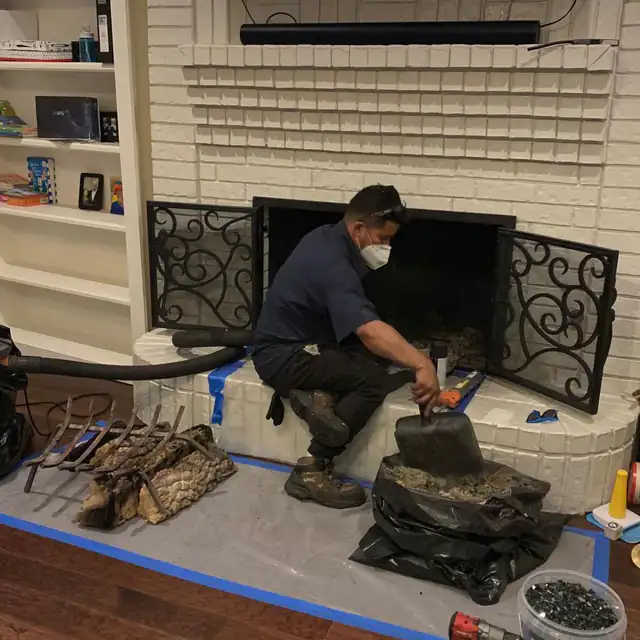
Drop cloths down and a vacuum on the hearth before anything is opened 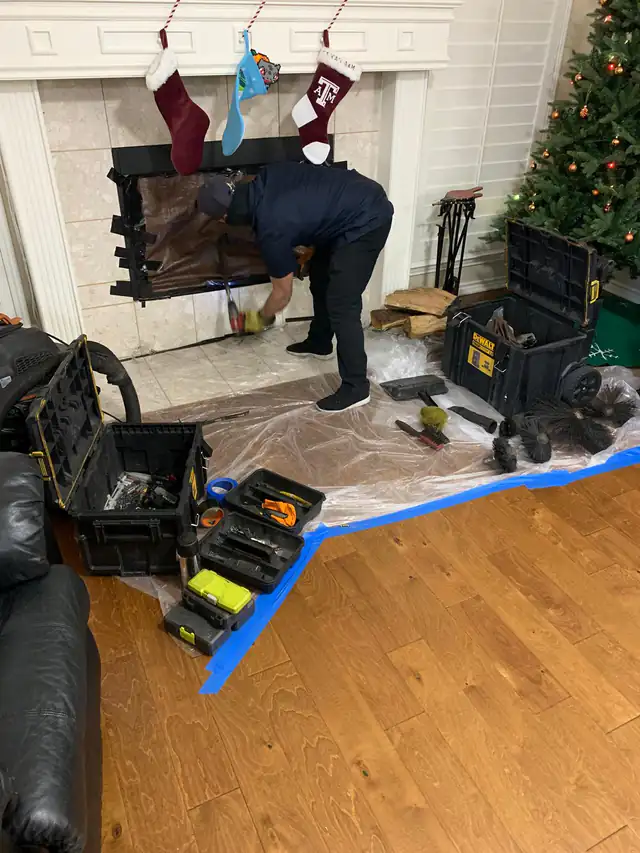
Working at the protected fireplace opening, with brushes and tools on covered floors 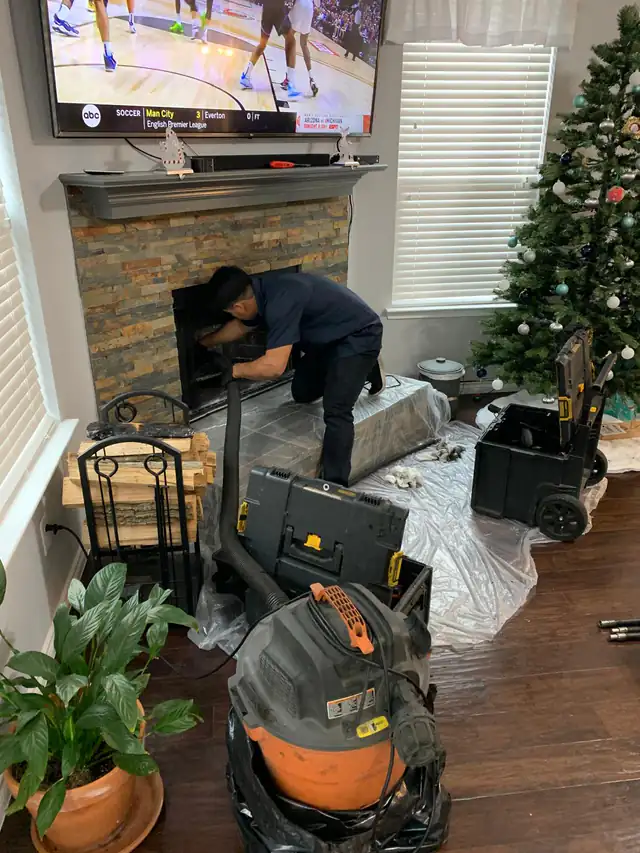
At the stone-front fireplace, with the hearth covered and a vacuum alongside 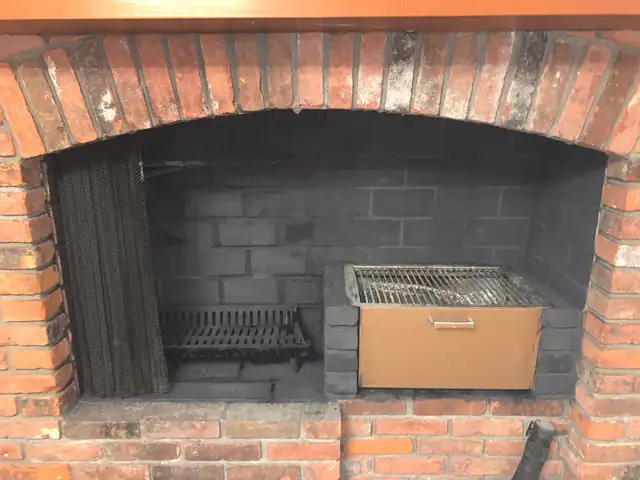
Firebox cleaned back to the brick, damper working 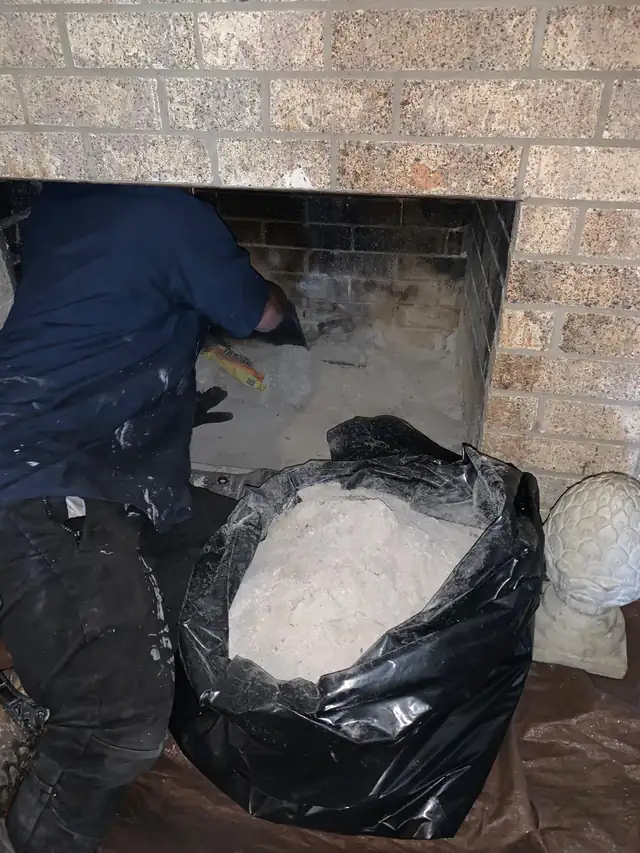
Clearing the firebox down to bare brick, floors covered
Meet the team
The people behind the work
Manny, Zack and Myke — meet the people behind Chimney Expert Solutions.
Our team and story →
Manny
Owner

Zack
Manager

Myke
Technician
FAQ
Chimney Sweep in Hudson: questions we hear
We want to use the original fireplace in our old house. What does that take?
A camera scan of the flue first, and an inspection of the framing around and inside the chimney, because framing set into the masonry is common in houses of this period and it changes the answer. From there it is usually some combination of a properly sized liner, firebox work and a cap. Sometimes the finding is that it can be brought back straightforwardly; sometimes it is that it should not be used as built. We will show you what the camera saw either way.
Why can't a modern mortar be used on an antique chimney?
Because it is stronger than the brick around it. In these walls the mortar was always meant to be the sacrificial part, absorbing movement and moisture and eroding slowly so it could be renewed. A hard modern mix forces that stress into soft handmade brick instead, and the brick faces spall off within a few winters. The repair then costs several times what it would have.
Should the chimney be cleaned before it's repointed?
Cleaned, yes — pressure washed or sandblasted, absolutely not. The fired outer surface of a handmade brick is the only weather-resistant part of it, and abrasive cleaning removes it permanently, which turns a durable wall into a sponge. Gentle methods only on this masonry, and it is worth confirming that with anyone you hire before they arrive with equipment.
What should I do before you arrive?
Do not burn for at least 24 hours, and 48 is better — a warm firebox is a miserable place to work and hot ash and drop cloths do not mix. Clear a path to the fireplace, take fragile things off the mantel, and keep pets in another room. If you have an insert or a stove, tell us the make and model when you book so the right brushes are on the truck.
Do those creosote-sweeping logs work?
Partly, and not as a replacement. Creosote-modifying products can dry out and loosen stage-three glaze, which genuinely makes a subsequent sweep more effective. What they cannot do is remove anything. The deposit still has to be brushed loose and carried out of the flue by someone with rods and a vacuum.
Free estimate
Chimney Sweep in Hudson?
Tell us what you’re seeing and we’ll call or text back to schedule a look — with photos of what we find and an honest read on what’s urgent and what can wait. That evidence-first method is the way we work on every job.
Call and tell us what the chimney's doing — if we're up on a roof, we'll call you back. Other ways to reach us are on the contact page, and Hudson is one of the communities we cover across Greater Cleveland.
Call216-647-1882