
Medina County, Ohio
Chimney Liner & Relining in Brunswick, OH
Stainless steel relining for flues with cracked tiles, gaps, or no liner at all — sized to your appliance, insulated, done once.
What chimney relining involves in Brunswick is set by the housing stock here: Split-levels, bi-levels and tract colonials from a fast 1960s–80s build-out — a high share of factory-built fireplaces on aging listed metal chimney systems, with long offset flue runs that are easy to sweep badly.
Brunswick was farmland that turned into a city inside about twenty years. The growth ran hard through the 1960s and 1970s along Pearl Road and Route 303 and kept going into the 1980s, and what it produced is a housing stock dominated by two forms: the split-level and bi-level house, and the tract colonial. Both were built quickly, to a plan, in quantity.
The liner is the part of the chimney that does the actual work. Everything else is structure; the liner is what contains the heat and the combustion gases and delivers them out of the house without letting either reach the brickwork or the framing around it. Most Cleveland chimneys were built with clay tile liners, and clay has a hard life here. Thermal shock cracks it, settlement shifts it, and moisture eats the mortar joints between tiles until the sections stop behaving as one continuous passage. A cracked or gapped liner is invisible without a camera, and it is the failure that turns into house fires and carbon monoxide.
What we find on Brunswick chimneys that leads to chimney relining
Metal chimney systems at the end of their service life
A factory-built chimney is a manufactured product with a design life, not a piece of masonry that lasts indefinitely with maintenance. After decades, the things that go are the joints between sections working loose, the inner liner discoloring or distorting from a hot fire nobody reported, corrosion where the storm collar has failed and let water track down the outside of the pipe, and support components rusting where they pass through framing. None of that is visible from the room below. It is visible from the top and from the attic, and it is the reason a system of this age warrants a proper look rather than a sweep and a wave.
Split-level layouts and flues that jog
In a split-level or bi-level, the fireplace usually sits on the lower level, so the flue has a long run and frequently has to move sideways on the way up to clear framing or another level's structure. Every offset in a flue is a place where deposits collect on the shallow side, where a brush wants to skip past instead of scrubbing, and where a camera has to be worked carefully to see around the bend. It is not a defect, but it does mean these chimneys are harder to clean properly and easier to clean badly, and a sweep who does not know the offset is there will miss the part that most needs attention.
Sizing: the part that decides whether it drafts
More relining jobs are ruined by wrong sizing than by bad installation. A flue that is too large runs cool, drafts weakly, and condenses moisture and creosote onto its own walls. A flue that is too small cannot move the volume of exhaust the appliance produces, and the surplus comes into the room. Neither problem announces itself as a sizing problem; both present as 'the fireplace smokes' or 'the chimney keeps getting dirty'.
For an open fireplace, the flue is sized against the area of the fireplace opening — the long-standing rule in NFPA 211 puts a round flue at no less than about a twelfth of the opening area, and a rectangular one at no less than about a tenth. For a stove, insert or appliance, the liner is sized to the manufacturer's specified outlet and the listed installation instructions, not to whatever is currently in the chimney. Getting this right is the difference between a fireplace that pulls crisply the moment it is lit and one the family stops using.
What a relining job involves
Preparing the flue
The existing flue is swept and cleared. Where broken tile is obstructing the passage or protruding into it, it has to be removed or broken out so the liner can run straight. On some older chimneys with tight offsets, this is the part that takes the time, and it is the part a quote can get wrong if nobody looked first.
The liner and its insulation
A continuous stainless liner in the correct alloy for the fuel — 316Ti-grade stainless is the normal choice for wood and oil, and a listed alloy is used for high-efficiency condensing appliances, because condensate chemistry differs. It goes in insulated, either with a factory or field-applied wrap or a pour-around insulation mix. Insulation is not optional dressing: it is often required by the liner's own listing, it keeps the flue warm enough to draft properly, and it dramatically reduces condensation and creosote formation. An uninsulated liner rattling around inside an oversized masonry chase is a cheaper job and a worse chimney.
Termination at the top
A top plate seals the liner to the top of the chimney, a storm collar sheds water off the joint, and a cap sized to the new liner finishes it. Done properly, the top of the chimney is now sealed against rain for the first time in decades, which is a side benefit that quietly protects the masonry below.
The connection at the bottom
The liner is connected to the fireplace, stove or appliance with the correct listed components. Improvised adapters and unsupported connector pipe are common findings on older installations and they are exactly where the system leaks. On a fireplace, this usually means a connection at the smoke chamber; on an insert or stove, a direct connect to the appliance outlet.
Documentation
Photos of the completed run top to bottom, and the liner's product documentation handed over, so the manufacturer's warranty on the liner is something you actually hold rather than something you were told about.
This page covers chimney relining as it plays out in Brunswick. The full chimney liner & relining page walks the whole job — every stage, what changes the scope, and what we do about each of them. For everything else we handle in this suburb, see chimney services in Brunswick.
What a relining job includes
- Camera inspection first — you see why (or whether) the flue needs relining
- Continuous stainless steel liner in the correct alloy, sized to the fireplace or appliance it serves
- Insulation wrap or pour so the flue drafts correctly and meets the liner's listing
- Existing flue cleared, and broken tile removed where it obstructs the run
- New top plate, storm collar and cap terminating the system
- Correct listed connection at the appliance — no improvised adapters
- Photos of the completed run top to bottom, and the liner's product documentation
Our work
Chimney Liner & Relining, photographed on the job
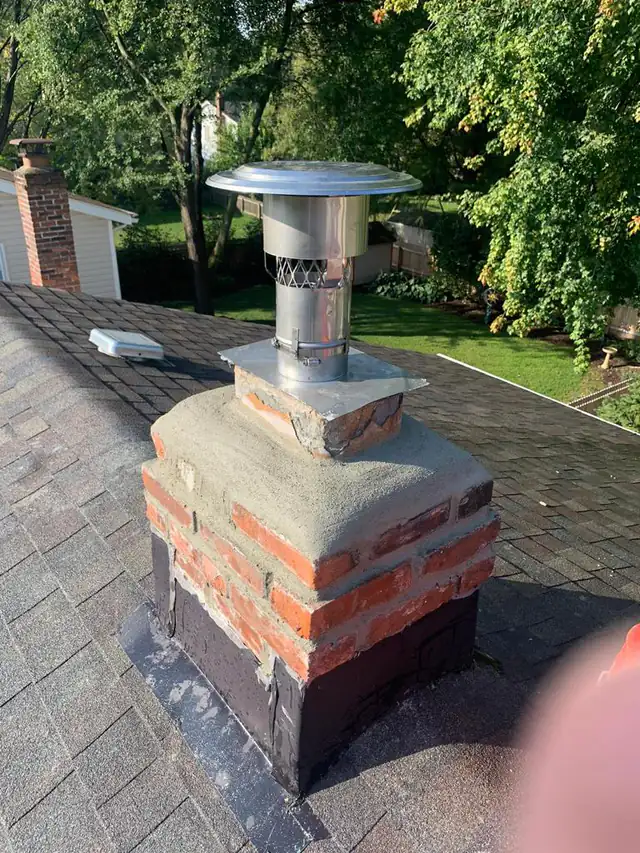
Stainless liner brought through a new crown, capped 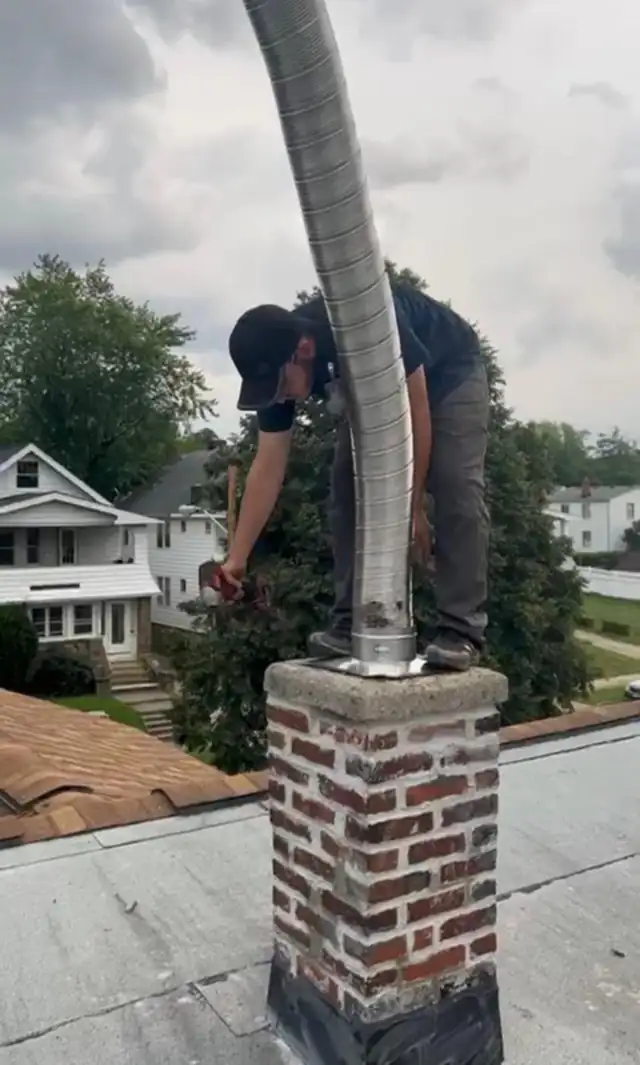
Feeding a new stainless liner down the flue
Meet the team
The people behind the work
Manny, Zack and Myke — meet the people behind Chimney Expert Solutions.
Our team and story →
Manny
Owner

Zack
Manager

Myke
Technician
FAQ
Chimney Relining in Brunswick: questions we hear
How long does a factory-built fireplace and chimney last?
It is a manufactured product with a service life rather than masonry that can be maintained indefinitely, and the ones going into houses here in the 1970s are now well into middle age. Some are in genuinely good condition; others have loosened joints, a distorted liner from a past overfire, or corrosion where water has tracked down the pipe. Condition rather than age decides it, and it takes an inspection from above to know which you have.
Our fireplace is on the lower level of a split. Does that make sweeping harder?
It usually means a longer flue run with one or more offsets in it, and offsets are where deposits build up and where a careless sweep skips. It is completely workable — it just needs the technique and the camera to follow the bend rather than assuming a straight shot. Knowing the layout before we arrive means bringing the right rods and heads.
Does a stainless liner need sweeping like clay?
Yes. Stainless is smoother and better insulated, so it usually builds less deposit and is easier to clean, but wood smoke still leaves creosote on it. What changes is the brush: a wire brush that is fine on clay tile can damage a stainless liner, so it needs a poly brush sized to the liner. Worth knowing if you ever hire a sweep who does not ask what your liner is.
Why stainless instead of replacing the broken clay tiles?
Access. Clay tiles are stacked inside a sealed masonry shaft, so reaching a cracked one partway up means opening the chimney to get to it — which usually costs more than relining and leaves you with a repaired eighty-year-old flue. A stainless liner installs from the top, restores a continuous sealed passage in a day or two on most jobs, and the liner itself typically carries a manufacturer lifetime warranty.
Free estimate
Chimney Relining in Brunswick?
Tell us what you’re seeing and we’ll call or text back to schedule a look — with photos of what we find and an honest read on what’s urgent and what can wait. That evidence-first method is the way we work on every job.
Call and tell us what the chimney's doing — if we're up on a roof, we'll call you back. Other ways to reach us are on the contact page, and Brunswick is one of the communities we cover across Greater Cleveland.
Call216-647-1882