
Cuyahoga County, Ohio
Chimney Liner & Relining in Bedford, OH
Stainless steel relining for flues with cracked tiles, gaps, or no liner at all — sized to your appliance, insulated, done once.
What chimney relining involves in Bedford is set by the housing stock here: Nineteenth-century Western Reserve houses around the old town center — narrow unlined stove flues, plastered-over thimbles hidden in walls, corbelled stacks with no footing, plus a postwar ring with conventional postwar chimneys.
Bedford is one of the older settlements in Cuyahoga County, and the housing around the square and the Broadway corridor shows it: Western Reserve frame houses, Greek Revival details, brick from the second half of the nineteenth century, with the Tinkers Creek valley and the Metroparks reservation cutting through below. Newer neighborhoods fill in around that core, but the old center is why chimney work here is genuinely different from the rest of the county.
The liner is the part of the chimney that does the actual work. Everything else is structure; the liner is what contains the heat and the combustion gases and delivers them out of the house without letting either reach the brickwork or the framing around it. Most Cleveland chimneys were built with clay tile liners, and clay has a hard life here. Thermal shock cracks it, settlement shifts it, and moisture eats the mortar joints between tiles until the sections stop behaving as one continuous passage. A cracked or gapped liner is invisible without a camera, and it is the failure that turns into house fires and carbon monoxide.
What we find on Bedford chimneys that leads to chimney relining
Chimneys taken down to the roof and abandoned in the attic
A very common history on these houses: at some re-roof decades ago, a redundant stack was demolished down to just below the roofline, decked over, and the rest of it left standing in the attic. Sometimes the flue was capped, often it was not. What is left is a masonry column sitting on old framing, collecting nothing, supported by nothing in particular, and occasionally still connected to something in the basement that people assume vents elsewhere. If your house has a chimney breast on a wall but no chimney on the roof, that is worth tracing before it is worth ignoring.
Plastered-over stove thimbles inside finished walls
An old stove connection that was blocked with a sheet-metal cover, a piece of tin, a rag or nothing at all and then plastered over is a hole into a live flue sitting behind your wallboard. If the chimney still vents anything, that is a path for combustion gases and for a chimney fire into the wall cavity. They are common in this housing and they do not show up in a visual inspection of the firebox or the roof — the way we find them is with a camera in the flue, looking sideways for the openings, and then matching them to floor levels. Closing one properly means a masonry or listed plug, not a cover plate.
Stacks corbelled out of the framing instead of standing on a footing
Upper-floor stove flues in this era were frequently started partway up the house, with the brick corbelled — stepped out course by course — from a wall or carried on a wood beam, rather than built from a footing in the ground. It works until the wood shrinks, the framing sags or someone removes a wall in a renovation. The tells are a chimney that stops at a ceiling in the basement or first floor instead of continuing down, a diagonal crack pattern in the plaster below it, or a stack visibly out of plumb. That is a structural assessment, not a mortar repair, and it is worth knowing before anyone starts a kitchen remodel.
What the liner is actually for
A flue liner does three jobs at once, and losing any one of them matters. It keeps heat away from the wood framing that surrounds every masonry chimney — the code clearances that framing was built to assume an intact liner. It protects the masonry from the corrosive by-products of combustion, which will otherwise attack mortar and brick from the inside. And it provides a correctly sized, smooth passage so the appliance drafts the way it was designed to.
This is why 'the chimney is structurally fine' and 'the chimney is safe to use' are two different statements. A perfectly sound-looking stack with a broken flue is not a working chimney. It is a masonry column with a fire hazard running through the middle of it.
How we confirm a liner has actually failed
Camera first, always. Relining is a significant job and nobody should be selling one on a hunch or on what could be seen with a flashlight from the firebox. The scan is run the full length of the flue and it either shows you cracked tile, open joints, missing sections and gaps, or it shows you an intact flue. Both answers are useful and we say the second one out loud when it is the true one.
There is a specific version of this we want homeowners to be skeptical about: a photograph of a cracked flue that is not your flue. Footage from your chimney is identifiable, we walk you through it, and it should be part of every relining quote you receive from anyone.
This page covers chimney relining as it plays out in Bedford. The full chimney liner & relining page walks the whole job — every stage, what changes the scope, and what we do about each of them. For everything else we handle in this suburb, see chimney services in Bedford.
What a relining job includes
- Camera inspection first — you see why (or whether) the flue needs relining
- Continuous stainless steel liner in the correct alloy, sized to the fireplace or appliance it serves
- Insulation wrap or pour so the flue drafts correctly and meets the liner's listing
- Existing flue cleared, and broken tile removed where it obstructs the run
- New top plate, storm collar and cap terminating the system
- Correct listed connection at the appliance — no improvised adapters
- Photos of the completed run top to bottom, and the liner's product documentation
Our work
Chimney Liner & Relining, photographed on the job
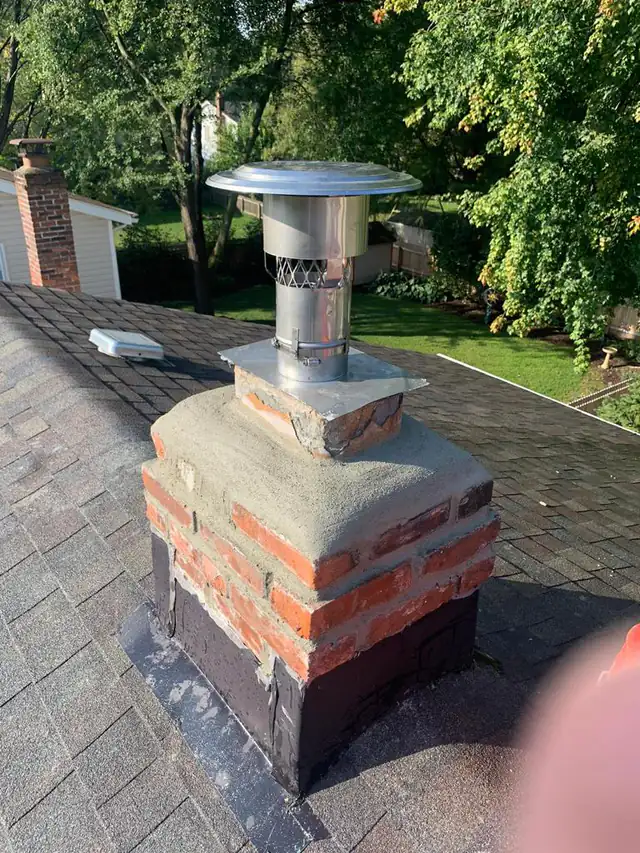
Stainless liner brought through a new crown, capped 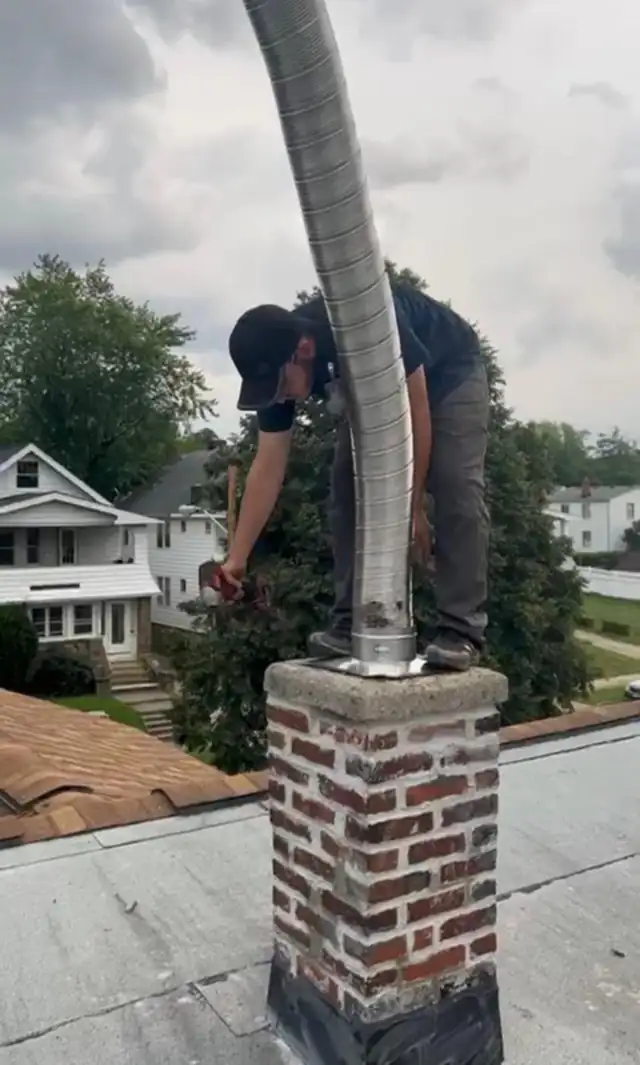
Feeding a new stainless liner down the flue
Meet the team
The people behind the work
Manny, Zack and Myke — meet the people behind Chimney Expert Solutions.
Our team and story →
Manny
Owner

Zack
Manager

Myke
Technician
FAQ
Chimney Relining in Bedford: questions we hear
Can a nineteenth-century flue be brought back into use?
Frequently, and a stainless liner is usually how. These flues were built narrow, unlined and for stoves, so they generally cannot serve a modern appliance as they stand. What decides it is what the camera shows: the flue's actual dimensions, its condition, how it is routed, and whether there are openings or framing issues to resolve first. We will tell you plainly if the honest answer is that it should stay decommissioned.
There's a round patch on the plaster near where a stove used to be. Does it matter?
It can, and it is worth a look. That is very likely an old stovepipe thimble — an opening into the flue that was covered over rather than sealed. If the chimney still vents an appliance, it is a route for combustion gases and heat into the wall cavity. Properly closing one is straightforward once we know where it is and what the flue behind it is doing.
Do you work on the newer parts of Bedford too?
Yes. The postwar neighborhoods here have conventional postwar chimneys — single stacks, thin original crowns, and flues that have outlived a heating conversion or two — and that work is straightforward. The old core is where the unusual findings are, but both get the same camera scan and the same photographs.
Can one liner serve two appliances?
Sometimes, and it is governed by rules rather than preference — appliance types, fuels, input ratings and connection geometry all determine whether common venting is permitted. Plenty of existing shared arrangements in older Cleveland houses would not pass today. It is something we work out on site, and 'the old chimney did it this way' is not an answer.
The chimney is being rebuilt anyway. Do the liner at the same time?
Almost always yes. A rebuild is the one moment the flue is open and accessible, and doing both together avoids paying twice for access, staging and roof protection. If we are rebuilding the top of a stack and the camera shows a compromised flue below it, we will say so before the scope is agreed rather than after.
Free estimate
Chimney Relining in Bedford?
Tell us what you’re seeing and we’ll call or text back to schedule a look — with photos of what we find and an honest read on what’s urgent and what can wait. That evidence-first method is the way we work on every job.
Call and tell us what the chimney's doing — if we're up on a roof, we'll call you back. Other ways to reach us are on the contact page, and Bedford is one of the communities we cover across Greater Cleveland.
Call216-647-1882